
A property with the strongest rent return isn’t automatically the better investment: capital growth and rental yield measure different outcomes. In the capital growth versus rental yield decision in Australia, growth is the increase in a property’s value over time, while gross rental yield is its annual rent divided by its value, multiplied by 100. One focuses on potential value gains; the other shows rental income relative to the property’s price.
It’s worth weighing both measures when you’re balancing long-term wealth goals with ongoing costs. Rental income can help offset expenses, but gross yield doesn’t account for them. Net yield gives a clearer picture of income after property costs.
This guide explains the difference between capital growth and rental yield, how to calculate gross and net yield, and what each may mean for your investment goals. You’ll also find a side-by-side comparison and a practical guide to weighing your time horizon, cash-flow needs and capacity to cover ongoing costs.
Key Takeaways
- Compare potential value growth with rental income, as each measures a different part of an investment’s performance.
- Estimate gross yield by dividing annual rent by the property’s value and multiplying by 100; use net yield to account for ongoing property expenses.
- Use weekly rent and purchase price to compare examples, then consider how costs and vacant periods may affect the income you keep.
- Match your approach to your priorities: rental cash flow can help with ongoing costs, while a growth focus may involve accepting lower yield.
- Before choosing, weigh your time horizon, capacity to contribute to expenses and the property’s location and demand.
What’s the difference between capital growth and rental yield?
Capital growth measures how a property’s value changes between purchase and sale. Rental yield measures annual rental income against the property’s value. It shows income relative to value, not the gain you might make when you sell.
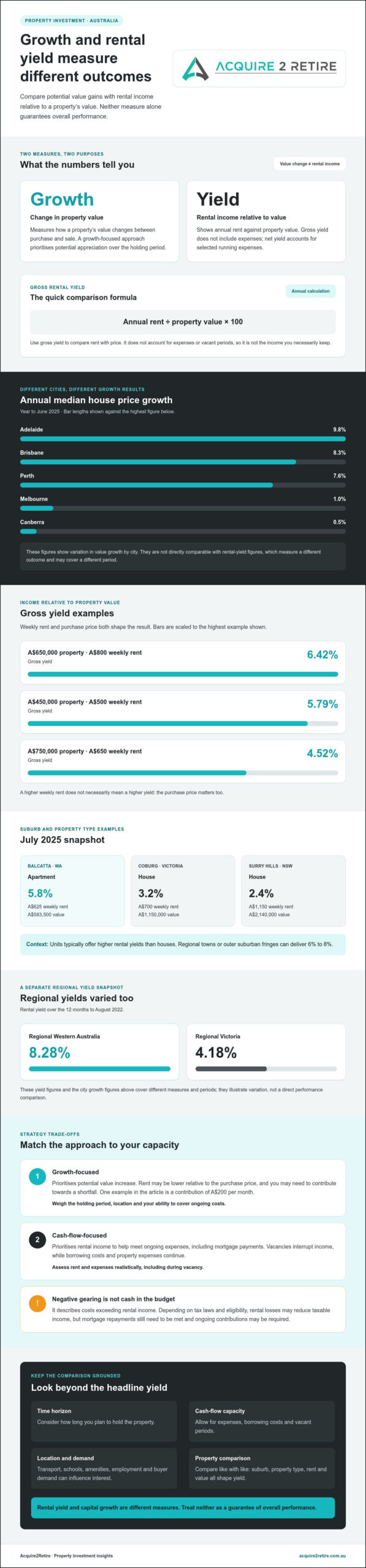
Australian results have varied by city and region. In the year to June 2025, median house prices recorded annual growth of 9.8% in Adelaide, 8.3% in Brisbane and 7.6% in Perth, compared with 1.0% in Melbourne and 0.5% in Canberra. Regional Western Australia recorded a rental yield of 8.28% over the 12 months to August 2022, while regional Victoria recorded 4.18%. These are different measures and periods, so they illustrate variation rather than a direct performance comparison.
A growth-focused strategy prioritises a property’s potential to appreciate over the holding period. An investor may accept lower rent relative to the purchase price and contribute money to cover a shortfall. For example, an investor pursuing capital growth might need to contribute A$200 per month to keep a property afloat. That contribution is a cash-flow commitment, even if the property’s value later rises.
A cash-flow-focused strategy prioritises rental income to help meet ongoing expenses, including mortgage payments. When rent exceeds relevant expenses, the property can generate positive cash flow and may be positively geared. But strong rent alone doesn’t guarantee surplus cash: vacancies interrupt income, while borrowing costs and property expenses continue. Higher borrowing costs can increase repayment pressure, so assess the cash flow using realistic rent and expense assumptions.
Negative gearing describes a situation where an investment’s costs exceed its rental income. Depending on tax laws and eligibility, an Australian investor may be able to use rental losses to reduce taxable income. This potential tax effect doesn’t put cash back into the property’s budget. Mortgage repayments still need to be met, and the investment may require ongoing contributions.
| Strategy | Main focus | Cash-flow implication | Key consideration |
|---|---|---|---|
| Growth-focused | Potential value increase | May require contributions | Holding period and location |
| Cash-flow-focused | Rental income | Rent helps cover expenses | Vacancy and borrowing costs |
Weigh your time horizon against your capacity to cover shortfalls. Don’t treat either yield or growth as a guarantee of overall performance.
Rental yield examples for different weekly rents and property prices
Weekly rent and purchase price both shape gross yield, while location and property type affect the comparison. The examples below show how rental income looks in relation to each property’s value.
Weekly rent and property price examples
A property priced at A$450,000 and renting for A$500 weekly has a gross yield of 5.79%. At A$750,000 with A$650 weekly rent, the yield is 4.52%. The higher rent doesn’t necessarily mean a stronger yield, because the purchase price also matters.
Compare that with a A$650,000 property renting for A$800 weekly, which produces a 6.42% gross yield. These examples use annual rent divided by property value, multiplied by 100. They help investors compare income against price, but don’t account for expenses or vacancy.
Suburb and property type examples
July 2025 examples show how suburb and property type can shift the result. A Balcatta, Western Australia apartment renting for A$625 weekly and valued at A$583,500 has a 5.8% gross yield. A Surry Hills, New South Wales house renting for A$1,150 weekly and valued at A$2,140,000 has a 2.4% yield.
A Coburg, Victoria house at A$1,150,000, renting for A$700 weekly, returns 3.2%. Units typically offer higher rental yields than houses, while regional towns or outer suburban fringes can deliver 6% to 8%. Compare like with like: suburb, property type, rent and value all influence the calculation.
How do property returns compare with shares and other investments in Australia? Property returns can combine rental income with changes in resale value. Shares may provide dividends and changes in market price. Compare each investment’s income, costs, liquidity and risk over the same holding period, rather than treating yield alone as total return.
What factors drive property capital growth versus rental yield in Australia? Infrastructure, local employment, population changes and buyer demand can influence property values. Rent, vacancy and purchase price shape yield. A new transport link may attract buyers and tenants, but its effect depends on the suburb and property.
Access to transport, schools and amenities can support buyer and tenant interest. Renovations, such as updating a kitchen or adding a bedroom, may improve a property’s appeal and rent, depending on local demand and the work involved. Weigh renovation costs against likely rent and resale value.
Serviceability depends on whether income can support loan repayments and other property expenses, including during vacancy. Liquidity also matters: selling property takes a different process from selling listed shares, so consider how quickly you may need access to funds. A careful property investment plan can help align these factors with your goals.
Gross and net rental yield calculations
Gross yield offers a quick way to compare rental income, while net yield accounts for selected running expenses. Calculate both annually, then consider finance and tax effects separately to understand cash flow and the return retained.
Gross rental yield calculation
Use this formula: annual rental income ÷ property value × 100 = gross rental yield percentage. For example, A$26,000 annual rent on a property valued at A$500,000 produces a gross yield of 5.2%. The calculation compares rent with value, but excludes costs, interest and vacancy, so it doesn’t show the income left after expenses.
For a consistent calculation, estimate rent over a full year and divide it by the property’s current value or purchase price. Either basis can be used, but comparisons work best when you use the same measure for each property. A vacant period reduces the rent actually received, even if the advertised weekly rent is unchanged.
Net rental yield after costs
Net yield subtracts relevant annual property expenses before dividing by value and multiplying by 100. These may include insurance, strata fees, repairs, legal fees, council rates and management costs. The resulting percentage gives a more useful view of property income after operating costs, although the expenses included can vary between calculations.
For a A$500,000 investment property earning A$26,000 annual rent, with A$6,340 in annual expenses, net yield is 3.93%. The gross figure is 5.2%, so the gap shows how costs reduce income before considering finance or tax.
Mortgage interest can also affect an investor’s cash position. A net yield calculation may include interest, but loan principal repayments and personal tax circumstances need separate consideration. Record which expenses your calculation includes so you don’t compare percentages based on different assumptions.
- Gross yield: annual rent ÷ property value × 100.
- Net yield: (annual rent − annual property expenses) ÷ property value × 100.
How do Australian property taxes and costs affect net rental yield and capital gains? Property expenses reduce the rental income available to the owner, while tax treatment affects the after-tax result. Buying and selling costs can also affect the gain retained. Eligible rental losses may reduce taxable income, subject to applicable tax laws.
Negative gearing occurs when investment expenses exceed rental income. An eligible investor may use the loss to reduce taxable income, but it doesn’t remove the shortfall: repayments and expenses still need to be funded. For a clearer comparison, calculate net yield first, then consider borrowing costs, cash flow and tax effects separately.
Choosing between growth and yield investment strategies
Match a strategy’s likely cash-flow demands and holding period to your financial priorities. Start by considering your investment horizon, capacity to cover ongoing expenses and tolerance for uncertainty.
Growth-focused investing
Growth-focused investors prioritise potential value increases over immediate rental income. A wealth-builder may plan to hold for 10-20+ years and accept a modest 2-3% yield in a high-demand suburb. The advantage is exposure to possible long-term equity gains; the drawback is that lower rent can leave a funding gap during ownership.
A growth-focused approach may suit investors who can meet expenses without relying on rent to cover every cost. Growth depends on location, infrastructure, demographic shifts and economic cycles, so consider these factors when assessing a property. A longer horizon allows more time for value changes, while a short horizon leaves less time to weather an unfavourable market cycle.
Yield-focused investing
Yield-focused investors prioritise rental income to support regular cash flow. A cash-flow strategy may target gross yields of 6% or higher, while a gross yield of 5-8% can offer a potential balance between income and growth. Stronger rent can help meet expenses, but vacancy or unexpected costs can reduce the income available.
A yield-focused strategy may suit investors who need rental income to contribute towards loan commitments or other expenses. Its advantage is a closer focus on cash flow; a trade-off is that high yields can occur in areas with weaker historical capital growth. Assess tenant demand and likely vacancy alongside the headline percentage.
Time horizon helps clarify the choice. An investor planning to build wealth over 10-20+ years may accept lower income while pursuing growth, whereas someone prioritising current cash flow may favour stronger yield. Neither profile removes market risk: property values and rent respond to different local conditions, and the same investment can perform differently across those measures.
Risk tolerance also includes your ability to manage a shortfall. Before buying, compare expected rent with mortgage commitments and property expenses, then consider how a vacancy would affect your budget. A property growing at an average annual rate of 6% could double in 12 years, but that example doesn’t describe every property or market.
Use this decision guide: set your intended holding period, estimate how much of the property’s expenses rent needs to cover, then decide whether a lower yield fits your capacity and goals. If regular income matters most, examine yield and vacancy exposure. If long-term value growth is the priority, assess the location’s growth drivers and whether you can sustain the holding costs.
Definitions of capital growth and rental yield
Capital growth is the increase in a property’s value over time, measured from its purchase value to a later valuation or sale price. If a property bought for A$1 million is later valued at A$1.1 million, its capital value has risen by A$100,000, or 10%. That figure describes the change in value, not the investor’s final profit after costs.
Rental yield measures rent relative to a property’s value, expressed as a percentage. For example, a A$1 million property earning A$30,000 in annual rent has a 3% yield. It describes the income relationship at a point in time, rather than how much the property’s value has changed since purchase.
Growth and yield can move in different directions. Rent may rise while a property’s value stays steady, lifting yield relative to value. If value rises faster than rent, yield based on the latest valuation falls, even if the owner’s equity has increased. Yield can be calculated using either the original purchase price or the latest valuation, so state which basis you use.
This distinction matters when comparing investment strategies. Yield based on the purchase price describes income relative to the original outlay. Yield based on today’s value shows how current rent compares with the asset’s present worth. For example, an owner considering whether to retain or sell can use current value to assess the income generated by the capital tied up in the property.
Capital growth is also relative to the period and starting value chosen. Compare like periods and use the same approach across properties; otherwise, one property’s annual change may be set against another’s total change. A rise from A$1 million to A$1.1 million represents 10% total growth, but it doesn’t by itself show the annual pace or account for income received.
Demand helps explain why Australian properties can combine growth and yield in different ways. Houses have greater potential for capital growth than units because of their land component, while units typically offer higher rental yields. A property in a high-demand capital-city suburb may therefore suit a different wealth objective from a unit chosen for rental income.
A gross yield around 4% or higher is described as solid in the Australian market, but that percentage alone can’t establish the best investment. Compare it with the property’s value prospects, rent, expenses and your holding period. A clear comparison separates income from value change, then considers both alongside the investor’s financial goals.
Treat growth and yield as complementary measures, not competing definitions of success. Calculate value changes over a stated period, assess rental income against a clearly stated valuation, and decide which result matters more to your strategy. This gives you a more grounded view of how each property may contribute to wealth.
Acquire2Retire: Planning & Strategy
Acquire2Retire can help you turn your growth or rental-yield priorities into a considered property investment plan. Its Planning & Strategy offering helps shape an approach around your financial goals, preferred time horizon and capacity to manage ongoing costs.
When you’re ready to act on that plan, Acquisition and Finance can support the purchase and finance aspects, while Tenancy can assist with tenancy coordination. This can be useful when you’re weighing a potential property’s income against its growth prospects and want those choices considered together, rather than as separate figures.
If you’d like to discuss a property investment approach suited to your goals, contact Acquire2Retire.
Turn your investment priorities into a considered plan
Choosing between capital growth and rental yield in Australia depends on what you need your property investment to do within your wider financial plans. Before taking the next step, clarify the role you want the property to play, how much cash-flow flexibility you need and what level of commitment feels manageable over time. Those priorities can help shape your decisions about a property and your investment approach.
Acquire2Retire can support this planning through its Planning & Strategy, Acquisition and Finance offerings, helping connect your investment goals with the decisions involved in purchasing property. A considered conversation can help you bring those priorities together and identify a practical direction for your next move.
Contact Acquire2Retire to discuss your strategy and take the next step with greater clarity.
Frequently Asked Questions
What is a good rental yield on an investment property in Australia?
A gross yield of 4% or higher is described as solid, while 5% to 8% is often considered a good range before taxes and other expenses. Treat these as comparison points, not a standalone buying rule. A yield that looks attractive may still leave limited net income after costs, and a lower-yield property may better fit an investor prioritising long-term value growth.
Which strategy suits which type of investor?
For investors comparing capital growth vs rental yield in Australia, the right strategy depends on their financial priorities and ability to manage shortfalls. A growth-focused approach may suit someone with a longer holding period who can manage lower rental income. A yield-focused approach may suit an investor who wants rent to contribute towards expenses. For example, anyone relying on rent to support repayments should pay close attention to vacancy exposure.
How much income can you expect?
Estimate gross annual rent by multiplying weekly rent by the number of rented weeks. Then account for vacancy and expenses to understand the income retained. The result depends on the property’s rent, how consistently it is occupied and costs such as insurance, repairs and strata fees. Loan interest and repayments also affect your cash position, but gross rent alone doesn’t capture them.
Does yield matter if I’m holding for 20+ years anyway?
Yes, because rental income affects how much you need to contribute while holding the property, even across 20+ years. A low yield can create ongoing cash-flow pressure, particularly during vacancy or when expenses rise. A long horizon may give value growth more time to contribute to your outcome, but it doesn’t remove the need to fund repayments and property costs along the way.
What is capital growth in Australian property investing?
Capital growth is the increase in a property’s value over a chosen period, measured against its starting value. For an investment decision, distinguish an estimated increase from a realised gain: the latter becomes clear when the property is sold and sale-related costs are accounted for. Comparing properties over the same period makes it easier to assess value changes alongside rental income.
What is rental yield and how is gross rental yield calculated in Australia?
Rental yield expresses rent as a percentage of a property’s value. To calculate gross yield, divide annual rental income by the property’s value and multiply by 100. For a more useful comparison, apply the same valuation basis to each property, such as purchase price or latest valuation. Gross yield excludes operating expenses, so it shouldn’t be treated as the amount of income kept.
Which Australian suburbs currently have the highest rental yields and strongest capital growth?
No single suburb can be identified as leading both measures from these examples, which cover different property types and dates. In July 2025, a Balcatta apartment example showed a 5.8% gross yield, while an Elizabeth house example showed 4.1%. City house-price growth in the year to June 2025 ranged from 0.5% in Canberra to 9.8% in Adelaide, illustrating how location and measure matter.
How do interest rates, vacancy rates and rents affect Australian property returns?
Higher interest costs can leave less rental income available, while vacancies mean fewer weeks of rent to cover ongoing expenses. Higher rent can lift gross yield if the property’s value stays unchanged, but it doesn’t automatically increase net income by the same amount. When comparing capital growth vs rental yield in Australia, weigh expected rent against borrowing costs and likely occupied periods to understand the cash-flow demands.