
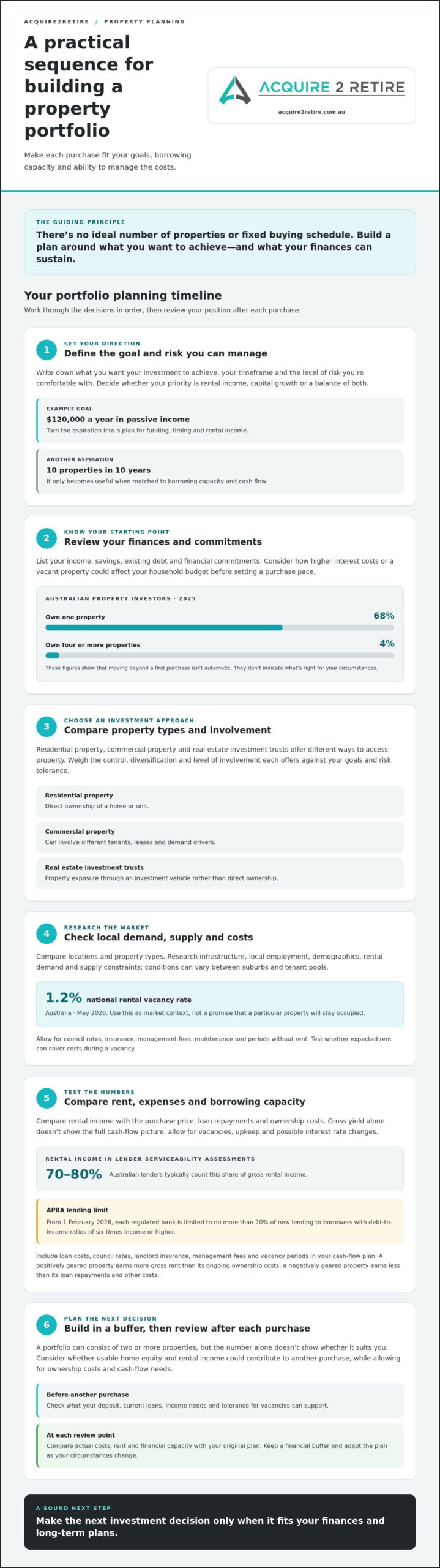
In Australia, 68 per cent of property investors own one property, while four per cent own four or more. To build a property portfolio, start with a clear investment goal and a realistic view of your borrowing capacity, then plan how equity and rental income could support future purchases. A portfolio can consist of two or more properties, but adding properties only makes sense when each step fits your finances and long-term plans.
It’s understandable to be drawn to goals such as earning passive income or building wealth through property, while feeling cautious about taking on more debt and responsibility. The right strategy isn’t a fixed number of properties or a one-size-fits-all buying schedule. It’s a sequence of decisions based on what you want your investments to achieve and what your finances can sustain.
This guide explains why investors build portfolios and how to set a practical direction, assess borrowing capacity, use home equity and rental income, and choose properties carefully. You’ll also learn how to bring these elements together in a plan that can adapt as your circumstances change.
Key Takeaways
- Set an investment goal that reflects the income, growth and level of risk you’re comfortable with, then use it to guide each purchase.
- Research local rental demand, vacancy rates and property supply alongside potential yields before choosing an investment.
- Understand how lenders assess your income, expenses, existing debt and rental income to see how much borrowing your finances can support.
- Consider whether usable home equity and rental income could contribute to another purchase, while allowing for ownership costs and cash-flow needs.
- Build a staged plan that suits your circumstances, keeps a financial buffer and can adapt as your goals and borrowing capacity change.
Assessing an investor’s current situation and goals
Australian investors can choose residential or commercial property, or real estate investment trusts, depending on their goals, risk tolerance and preferred level of involvement. Before buying, assess your finances, investment timeframe and capacity to manage ownership costs or periods without rent.
-
Set investment goals and risk tolerance
Write down what you want your investment to achieve, then set a timeframe and a level of risk you can manage. For example, $120,000 a year in passive income is a goal, but it needs a plan for funding, timing and rental income. Buying 10 properties in 10 years is another aspiration; it becomes useful only when matched to borrowing capacity and cash flow.
Review your income, savings, existing debt and financial commitments before setting a purchase pace. Consider how higher interest costs or a vacant property could affect your household budget. If you’re starting out, be cautious about high-risk developments, especially if an unexpected cost could disrupt your plans.
-
Consider locations, costs and vacancy periods
Compare Australian locations and property types rather than relying on one market’s recent performance. Research infrastructure, local employment, demographics, rental demand and supply constraints, as these factors can shape tenant demand and future prospects. Diversifying by location or property type may spread investment risk, but it won’t remove it.
Australia’s national rental vacancy rate was 1.2 per cent in May 2026. Treat this as market context, not a promise that a particular property will stay occupied. Include council rates, insurance, management fees, maintenance and periods without rent in your cash-flow plan. For each investment property, test whether expected rent can cover costs during a vacancy.
- Compare the investment structure with your priorities. Residential property gives you direct ownership of a home or unit, while commercial property can involve different tenants, leases and demand drivers. Real estate investment trusts provide property exposure through an investment vehicle rather than direct ownership. Weigh the control, diversification and involvement each option offers against your goals.
- Record your starting position before making a buying decision. In 2025, 68 per cent of Australian property investors owned one property, while four per cent owned four or more. These figures show that moving beyond a first purchase isn’t automatic. List your available deposit, current loans, income needs and tolerance for vacancies, then identify what would need to change before another purchase makes sense.
A property portfolio can consist of two or more properties, but the number alone doesn’t show whether it suits you. Set a review point after each purchase and compare actual costs, rent and financial capacity with your original plan. This gives your next investment decision a clear basis.
Why build a property portfolio?
A property portfolio can balance rental income and long-term capital growth, but every investment brings costs and risk. Assess local demand, cash flow and your borrowing position before deciding what to buy.
-
Assess rental demand and yields
Compare vacancy rates, rents and tenant demand in each market before selecting an investment property. Australia’s rental vacancy rate was 1.2 per cent in May 2026. Treat this as national context, then examine the specific suburb, property type and tenant pool, since conditions can differ within the same market.
Calculate rental yield against the purchase price, then allow for expenses and periods without a tenant. Don’t rely on gross yield alone: check local employment, available rental supply and likely property upkeep. These factors help show whether rent can support the investment after ownership costs.
-
Compare capital growth and rental yield
Decide whether capital growth, rental income or a balance of both best supports your plan. Capital growth is an increase in a property’s value over time; rental yield compares rent with the property’s value or price. A growth-focused property may require you to cover more costs from other income, while stronger rent can help meet ongoing expenses.
Test each option against your deposit, loan repayments and capacity to manage interest rate changes. Don’t treat past growth or a quoted yield as a forecast. Compare expected rent with council rates, insurance, maintenance, loan costs and vacancy periods to understand the cash-flow trade-offs.
-
Plan rental, expense and loan management
Map each property’s income and expenses, then consider how lenders assess your capacity to repay. Australian lenders typically count 70 to 80 per cent of gross rental income when assessing serviceability. From 1 February 2026, APRA limits each regulated bank to no more than 20 per cent of new lending to borrowers with debt-to-income ratios of six times income or higher.
Budget for council rates, landlord insurance, management fees and periods without rent. A positively geared property earns more gross rent than its ongoing ownership costs; a negatively geared property earns less than its loan repayments and other costs. Allow for vacancies and cost buffers instead of relying on full occupancy.
- Account for tax and landlord obligations. Land tax and capital gains tax may affect investment returns, while state and territory rules shape landlord responsibilities. Include tenancy, safety and record-keeping duties in your ownership plan, and consider how these obligations affect your costs and decisions.
Negative gearing describes rental income falling below loan repayments and other ownership costs. Losses from a negatively geared property can be offset against salary, reducing total taxable income. Changes to Australian negative gearing and capital gains tax settings took effect from 12 May 2026.
Consider how rent, expenses, tax treatment and loan commitments work together before buying. A coordinated property investment strategy can help organise these decisions around your portfolio goals.
Borrowing capacity and lender serviceability assessments
Risks include excessive debt, unexpected costs, vacancies and inadequate property research. Manage them by checking your finances, modelling cash flow and researching each property before borrowing or buying.
-
Assess borrowing capacity and financial position
List your income, living costs, existing debts, savings and loan commitments before assessing borrowing capacity. Include regular expenses and possible changes to household income, not just the deposit available for another purchase. This helps show how much room your finances have for repayments and ownership costs.
Consider how a property purchase could affect your finances if rent falls short or the property is vacant. Avoid borrowing to the edge of your budget just because a lender may approve the application. Research the location, tenant demand and property condition, and account for repairs rather than relying on expected capital growth.
Keep a separate emergency buffer for unexpected costs, and set a borrowing limit your household can sustain. A clear limit helps prevent each new purchase from reducing your ability to manage existing loans.
-
Model cash flow and serviceability
Build a cash-flow model for the proposed property, including loan repayments, expected rent, rates, insurance, maintenance and vacancy periods. Test how the figures change if rent is lower than expected or expenses rise. Australian lenders typically count 70 to 80 per cent of gross rental income when assessing serviceability, rather than treating all rent as available income.
APRA requires regulated lenders to assess borrowers at an interest rate three percentage points above the actual loan rate. This serviceability buffer has applied since late 2021. Model repayments at that higher assessment rate, then compare the result with your household budget and current commitments.
Review the numbers for your existing loans as well as the next purchase. This reveals whether your plan depends on optimistic rent, uninterrupted occupancy or future capital growth. If rents vary among houses in your target market, use property-specific estimates rather than assuming one figure applies across the portfolio.
-
Check borrowing power and obtain pre-approval
Ask a lending professional to assess your borrowing power using your income, expenses, debts, deposit and the proposed property’s rental income. Pre-approval can help establish a working price range before you make offers, but it doesn’t replace property research or a cash-flow assessment.
Check the assumptions behind the assessment, including how existing loans and rental income are treated. From 1 February 2026, APRA limits each regulated bank to no more than 20 per cent of new lending to borrowers with a debt-to-income ratio of six times income or higher. This applies to regulated banks’ new lending, not as a personal borrowing cap for every investor.
Before proceeding, compare the proposed loan with your repayment limit and emergency buffer. A finance plan should support the next purchase without leaving too little capacity for vacancies, repairs or changes in income. Revisit the assessment as your financial position changes.
Using home equity and rental income to fund purchases
Equity in your home may help fund a deposit on an investment property, while rental income can contribute to loan servicing. Treat both as parts of a borrowing plan, considering your existing loan, ongoing costs and cash flow together.
-
Discuss property value and equity with a lender
Ask a lender to assess your home’s value, current loan balance and potential usable equity. Most lenders will release up to 80 per cent of an Australian home’s value, less the outstanding loan balance, as usable equity. For example, the calculation considers the lender’s assessed value and debt still owing, not just the original purchase price.
Equity can increase as you repay the loan or as the property’s value rises, but the available amount depends on the lender’s assessment and your financial position. Consider how accessing it would change your total debt and repayments. A higher valuation doesn’t make the funds savings: using equity means borrowing against your home.
-
Use home equity to fund deposits
Work out how much equity could go towards a deposit, then compare the proposed loan with your budget. Australian homeowners commonly access equity by refinancing a loan, and the released amount can serve as a deposit for another property. Keep the new borrowing separate in your calculations so its repayments remain visible.
Before proceeding, include purchase costs, repayments on both properties and a buffer for vacancies or repairs. A deposit funded through equity can reduce the cash you need upfront, but it also increases debt secured against your existing home. Don’t treat the maximum available equity as a target to use.
- Model rental income against repayments. Estimate rent for the specific property and account for periods without a tenant. Australian lenders typically count 70 to 80 per cent of gross rental income when assessing serviceability, so a plan based on receiving every dollar may overstate your borrowing capacity.
Compare the rent counted by the lender with your expected loan repayments and ownership expenses. Council rates, insurance, maintenance and tenancy costs affect the cash left over. Rental income can support another purchase only if the figures work alongside your other commitments.
- Track equity and wealth-building progress. Review loan balances, repayments, property values and rental cash flow before planning another purchase. This shows whether equity has increased through debt reduction or a change in value, and whether accessing it would leave enough financial flexibility.
Use a staged approach: estimate the available equity, test repayments, include rental income conservatively, then decide whether the next purchase fits your plan. Revisit the figures as your loan balance and property circumstances change. This connects asset building with sustainable borrowing instead of relying on property value increases alone.
Creating a personalised portfolio-building strategy
Turn your goals and finances into a staged strategy, with a clear reason for each purchase. A workable plan sets the pace, investment criteria and review points before you choose another property.
- Set a sustainable acquisition pace. Estimate how quickly you could buy while maintaining enough cash flow for repayments and property costs. A realistic plan to assemble three investment properties may take 8 to 12 years from the first purchase. Use that as a planning example, not a target you must match: income, equity, lending capacity and market conditions shape your timeline.
- Match each property to a portfolio role. Decide whether the next purchase should prioritise rental yield, capital growth or a balance. Compare tenant demand, supply and economic drivers in the area with your existing holdings. If your borrowing capacity is limited, consider how different markets may perform across the property cycle rather than assuming every location will grow or generate income at the same time.
- Build in review and consolidation periods. Set a checkpoint after each purchase to compare actual rent, expenses, loan repayments and available equity with your plan. An illustrative strategy may allow five years for portfolio consolidation. During this period, experienced investors can review interest costs, reduce debt or prepare for the next purchase instead of buying automatically.
- Plan how the portfolio could support later goals. Write down how you might use rental income, asset sales or debt reduction over time. One illustrative retirement strategy is to hold 10 properties until they double in value, sell five to seven, repay all debt and live on rent from the remaining properties. This is an example, not a forecast; test the assumptions against your own time horizon and cash flow.
- Coordinate the moving parts before acting. Keep property selection, lending, cash flow, tax and legal advice aligned, and review how refinancing or using equity affects total debt. Model a negative cash-flow scenario, including vacancies and higher interest costs, before committing. A personalised property investment strategy can help connect these decisions to your goals and planned purchase pace.
Acquire2Retire: Planning & Strategy
Acquire2Retire helps Australian investors turn portfolio goals into a considered plan through its Planning & Strategy offering. If you’re weighing up your next purchase, its support can connect strategy with Acquisition and Finance, while Tenancy coordination and ongoing support help carry the plan forward.
This approach can help if you want to align borrowing capacity, property selection and investment goals before committing to another purchase. The focus is on shaping a strategy around your circumstances, rather than following a fixed property count or buying schedule.
For a conversation about planning your property portfolio, contact Acquire2Retire.
Choose your next step with care
A sound investment plan should leave room to adapt as your priorities, finances and experience change. Instead of treating the next purchase as an automatic milestone, use it to test whether your strategy still supports the life and income goals you’re working towards. Each decision then has a purpose, and progress doesn’t depend on accumulating properties for its own sake.
To build a property portfolio around your circumstances, Acquire2Retire can support you with Planning & Strategy, Acquisition and Finance. These offerings help connect the direction you want to take with the practical decisions involved in moving forward. Start by considering what you want your investments to achieve and what you’d like guidance with next.
Contact Acquire2Retire to discuss your plans and consider a next step that feels considered and achievable. A clear plan can help you move forward with greater confidence, one decision at a time.
Frequently Asked Questions
How do I know if a suburb is genuinely worth investing in?
Research a suburb more closely when tenant demand, local employment and infrastructure align with your investment plan. Compare recent rents for similar properties, inspect available listings and look for signs that supply is keeping pace with demand. For example, a new transport link may improve access, but its value to your decision depends on which tenants need it and whether suitable homes are already plentiful.
How long should I plan to hold a property?
Set a holding period that matches your reason for buying, then review it if your circumstances or the property’s performance changes. An investor focused on long-term growth may plan differently from someone relying on rental income for current commitments. Include potential repairs, loan costs and the effort involved in selling. A written exit plan can help you avoid holding a property simply because you haven’t decided what comes next.
Is it worth having multiple investment properties?
Owning multiple properties can suit investors able to manage the added debt, costs and decisions, but the number alone doesn’t make an investment sound. Consider how each property changes your overall exposure: two homes with similar tenants and local demand may behave alike, while different property types or locations may carry distinct risks. Before expanding, check that your household budget can handle one property needing repairs while another is vacant.
Should I focus on capital growth or rental yield?
Choose the balance that best supports your financial priorities and cash-flow capacity. A growth-focused property may require more income from elsewhere to meet costs, while stronger rental yield can help cover ongoing ownership expenses. Compare both with your expected loan commitments and plans for using the investment. For example, an investor needing regular rental income may weigh yield more heavily than someone with greater capacity to cover costs.
What is the value of having a coordinated advisory team?
A coordinated team can help keep property selection, lending, tax and cash-flow assumptions consistent. For example, a purchase may look affordable under one repayment estimate but strain your budget once ownership expenses and tax effects are considered together. Clear roles also help you identify which decisions need specialist input, so you can work through acquisition and finance questions as parts of one investment plan.
What are the steps to build a property portfolio in Australia?
To build a property portfolio, follow a sequence that connects each purchase to your broader plan:
- Set an investment objective and timeframe.
- Review your finances and borrowing position.
- Choose property criteria and research suitable markets.
- Assess the property, rental assumptions and ownership costs.
- Set a review point before deciding on another purchase.
Record the reasons behind each decision so later reviews can compare actual results with your original expectations.
How much deposit is needed to buy an investment property in Australia?
The deposit depends on the property price, lender assessment and your borrowing position. This is the combined savings example, not the deposit amount alone. Include buying costs in your cash plan and consider how the deposit affects your remaining funds after settlement.
What are the current Australian investment property loan rates and lending criteria?
Investment loan rates vary with the lender, loan structure and your circumstances. The rate offered can depend on factors such as the loan amount, property security, deposit, repayment type and financial position. Lenders assess income, living expenses, existing debts and rental income when considering an application. Compare total loan commitments and repayment assumptions, not just the advertised rate, when deciding whether a property fits your plans.