
Since 1993, median Australian house values have increased by 412%, while median unit values have increased by 316%. That history helps explain property’s appeal, but investors also consider rental income, long-term capital growth, or a combination of both. This first-time property investor guide sets out the main reasons people invest and the practical decisions that shape an investment.
It’s understandable to focus first on the purchase price, but the full picture also includes ongoing costs, the time involved in managing a tenancy and how the property fits your financial goals. A measured approach helps you weigh these factors before committing to a long-term investment.
This guide covers how location and property features can influence demand, what to weigh when choosing between self-management and a property manager, and how negative gearing works in Australia. It also explains how to assess costs and potential benefits together, so you can decide whether property investment suits your circumstances and priorities.
Key Takeaways
- Set your investment goal first, then assess whether rental income, long-term capital growth or a balance of both best fits your plans.
- Weigh the time and responsibilities of self-managing against the cost of appointing a property manager.
- Understand how rental income and ownership expenses affect negative gearing, and consider tax advice when assessing your position.
- Assess location, access to amenities and practical property features through the needs of both tenants and future buyers.
- Bring your goals, finances and acquisition choices together in a considered investment strategy before committing.
1. Why invest in property?
A first-time property investor guide should start with your goal: rental income, capital growth, or both. Rental income can help cover ownership costs, while capital growth refers to an increase in a property’s value over time. These outcomes differ, so decide which matters most before comparing suburbs or properties. Past growth alone doesn’t establish what a property will be worth when you sell.
For example, a property bought for A$300,000 and worth A$500,000 ten years later has gained A$200,000 in capital value. That example shows the difference between purchase price and later value, not a promised return. Your result also depends on purchase costs, ongoing expenses, rent and the eventual sale price. Set a holding period, such as ten, twenty or thirty years, that reflects your financial goals.
Australian investment mortgages may offer fixed or variable interest rates, plus features such as offset accounts, redraw and interest-only periods. Compare the rate, loan structure and terms with your cash flow and investment plan, as each can affect borrowing costs and repayments.
Rental yield helps compare rent with a property’s price, but it doesn’t show the whole investment outcome. A A$600,000 property rented for A$450 per week has a gross rental yield of 3.9%; after expenses, the example’s net yield is 3.1%. Compare both figures, then consider vacancy, repairs, insurance and interest costs.
To compare Australian suburbs and property types, review past sale prices, local rental yields and vacancy rates. Consider population growth, employment opportunities and planned infrastructure, then assess whether local rental demand matches the available housing. Check access to public transport, schools, healthcare, retail and childcare, as nearby amenities can influence tenant appeal.
Look beyond a single growth forecast. Compare the suburb’s prices, rental demand and vacancy trends with nearby areas, and consider how proposed developments may affect supply and access. A train station, bus stop or employment centre can strengthen a location’s appeal. The property type should also suit the tenants likely to seek housing there.
Stamp duty, land tax and landlord rules differ across Australian states and territories, so location affects both purchase costs and ongoing obligations. Rates, body corporate fees and insurance also vary by location and property type. Include these costs when comparing a house with an apartment.
Capital gains tax affects the tax outcome when an Australian investment property is sold, so factor potential gains into your planning. Keep records of the purchase, ownership costs and sale, and consider how the property’s use and your circumstances may affect the final tax calculation.
Use a consistent comparison before deciding: record each property’s price, expected rent, likely expenses, vacancy conditions and access to amenities. Then weigh rental yield against your capital-growth goal and available cash flow. This assessment helps explain why a property may suit one investor’s plans but not another’s.
2. Self-managing or appointing a property manager
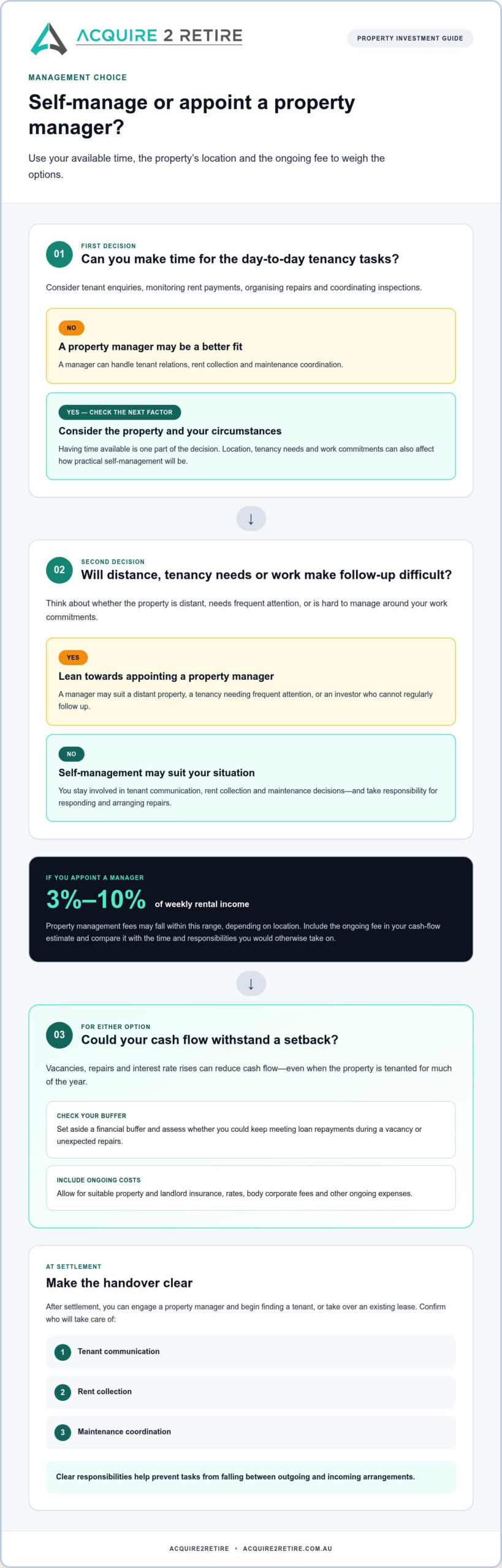
Managing a rental yourself keeps you involved in tenant communication, rent collection and maintenance decisions. It also means making time to respond to enquiries, organise repairs, monitor payments and coordinate inspections. Consider the property type and location, then compare these tasks with your available time and experience.
A property manager can handle day-to-day tenancy matters, including tenant relations, maintenance coordination and rent collection. Property management fees may range from 3% to 10% of weekly rental income, depending on location. Include that ongoing expense in your cash-flow estimate and weigh it against the time and responsibilities you’d otherwise take on.
Vacancies, repairs and interest rate rises can reduce cash flow, even when a property is tenanted for much of the year. Set aside a financial buffer, then assess whether you could continue meeting loan repayments during a vacancy or unexpected repairs.
Settlement is a practical time to organise tenancy arrangements. After settlement, you can engage a property manager and begin finding a tenant, or take over an existing lease. Confirm who will handle communication, rent collection and maintenance so responsibilities don’t fall between outgoing and incoming arrangements.
Insurance is another part of preparing for ownership. Include suitable property and landlord cover in your budget alongside rates, body corporate fees and other ongoing expenses. Consider cover that reflects the property type and the risks you need to manage, such as damage or a period without rental income.
Self-management may suit an investor who can make time for tenant enquiries and arrange repairs promptly. A manager may be a better fit if the property is distant, the tenancy needs frequent attention, or work commitments make regular follow-up difficult. Compare the likely workload with rental income rather than treating management as an automatic choice.
Choose a property and loan commitment you can afford to maintain, rather than relying solely on expected capital growth. Leverage can magnify the effect of rent shortfalls, repairs and interest costs on household cash flow. Research the property and borrowing structure, then consider how a negative cash-flow period would affect your other financial priorities.
Professional advice can help clarify how finance, tax and tenancy decisions interact with your plans. Keep records of rental income and expenses, and review your budget when loan costs or tenancy circumstances change. If you want a structured way to consider these choices, map out your property investment approach before committing.
3. Can you benefit from negative gearing?
Negative gearing occurs when an investment property’s eligible expenses exceed its rental income, creating a loss. In the supplied example, A$20,000 in annual rent against A$25,000 in ownership expenses creates a A$5,000 loss that the investor can claim as a tax deduction. The deduction may affect tax, but it doesn’t put the lost cash back into your account.
Compare that outcome with positive gearing: annual rental income of A$31,200 less property expenses of A$20,000 leaves A$11,200. A separate example shows A$15,600 in rent against A$20,000 in expenses, resulting in a A$4,400 loss. These examples show how rent and costs shape cash flow. Your result depends on the property’s income and expenses.
Negative gearing means accepting short-term costs while pursuing potential long-term returns, such as capital growth. It may suit an investor with enough income to support the shortfall and a plan for holding the property. It can be harder to sustain if rent falls, the property is vacant, repairs arise or interest expenses rise.
Before relying on a deduction, list the property’s rental income and ownership expenses, then separate cash flow from tax outcomes. Keep clear records of rent and costs, and discuss how the rules apply to your circumstances with a tax professional. A deduction doesn’t make a property loss-free, and it shouldn’t be your only reason to buy.
Consider how a shortfall could affect plans to build equity or save another deposit. If household income will need to cover expenses, account for that commitment before allocating funds elsewhere. Reinvesting positive cash flow is a separate choice: you might direct it towards savings, debt reduction or another investment goal, depending on your broader financial plan.
Tax rules and policy settings can change, so factor that uncertainty into a long-term strategy. The Federal Budget 2026/27 made recommendations to change the landscape around negative gearing in Australia. That statement describes recommendations, not a specific enacted change; assess your investment using the tax settings that apply to your situation.
To judge whether negative gearing may suit you, compare expected rent with ownership costs, assess your capacity to cover a shortfall and consider the property’s prospects beyond tax. Nearby amenities may support rental demand, while the purchase price, financing and likely expenses shape the return. A balanced decision weighs cash flow, potential capital growth and tax treatment together.
4. Choosing tenant- and buyer-friendly features
Choose a property by matching its features to the tenants and buyers likely to value them. In an Australian suburb, access to public transport, schools, healthcare, shops and childcare can support everyday convenience. A home close to a bus stop, local shops and a medical centre may appeal to tenants who want essential services nearby. These features can also broaden interest when you sell.
Start with the location, then compare the property type with local housing needs. A house with outdoor space may suit households seeking a yard, while an apartment near a business district may appeal to people who prioritise public transport. Neither type is automatically the better investment. Compare local prices, rental yields and vacancy rates, then consider which homes match demand in the area.
Walk the route to nearby amenities rather than relying only on a map. Check whether cafes, doctors, supermarkets, gyms and parks are reachable on foot or within a short drive. Look for public transport connections to the CBD and surrounding amenities, ideally with a train station or bus stop within walking distance. These practical checks help show how the suburb may work for tenants.
Inside the property, prioritise useful, durable features over costly upgrades chosen for personal taste. Consider storage, natural light, functional room layouts and easy-care outdoor areas. A practical kitchen and secure storage, for example, may matter more to prospective tenants than a highly customised finish. Compare repair or renovation costs with the rent and buyer appeal they could support.
Before purchasing, arrange building and pest reports when seriously considering a property. Review the findings for defects, pests and repairs that could affect your budget or future use. For an apartment, examine strata information and shared facilities, including maintenance records and upcoming work. Review the current lease and tenancy details to understand the existing arrangement and the property’s condition.
If considering a new development, research the developer’s track record and project style. Seek feedback from buyers and visit display centres to assess the layout, finishes and shared spaces. Compare what you see with the completed property’s specifications and the needs of likely tenants. For established homes, inspect the actual rooms, storage and outdoor areas rather than relying on listing photographs.
Your investment strategy should connect property features with rental income, capital growth and cash flow. A property needing extensive work may strain your funds, even if its location is attractive. Consider maintenance, insurance and property management alongside expected rent. If negative gearing is part of your plan, assess whether you can carry the shortfall without relying on future growth.
Before making an offer, compare each shortlisted property by location, transport, schools, condition, tenancy and likely ongoing costs. This gives you a consistent basis for weighing features against price and investment goals. A considered Planning & Strategy approach can bring those choices into a coherent plan.
5. Reasons to invest in property
Property can appeal to Australians seeking rental income, long-term capital growth, or a combination of both. About 2.2 million Australians have chosen to invest in property. That figure shows its place in household investment choices, but it doesn’t tell you whether a particular property suits your goals.
Long-term value growth is one reason investors consider real estate. Since 1993, median Australian house values have increased by 412%, while median unit values have increased by 316%. Those historical changes offer context for past performance, not a forecast for the next suburb or property you assess.
Rental income is another potential benefit. Rent can contribute towards property expenses, while a tenant’s payments may help support ownership over time. Compare likely rent with costs such as insurance, rates, repairs and loan interest. Looking at income and expenses together gives a clearer picture than rent alone.
Some investors seek to build wealth through a combination of rental income and capital growth. Others prioritise one outcome, such as rent that better supports ongoing costs. Write down your main objective before researching properties, then compare each option against it. This helps prevent an appealing feature from distracting you from your wider strategy.
Location research can reveal why one real estate opportunity differs from another. Compare local sale prices, rental demand and vacancy rates, then review population growth, employment and infrastructure plans. Public transport, schools, healthcare and retail can shape a suburb’s appeal to tenants and buyers. Consider how these factors work together, not in isolation.
Property can also provide a tangible asset, which some investors value as part of a broader wealth strategy. But the purchase price is only one part of the decision. Assess the property’s condition, ongoing expenses and likely rental demand, then consider how it fits your available funds and long-term plans.
Negative gearing may form part of an investor’s approach when property expenses exceed rental income. A tax deduction can affect the after-tax cost, but the cash shortfall still needs funding. Consider whether your income can support that commitment alongside repairs or vacancies, without relying on capital growth to meet regular expenses.
The clearest reason to invest is a fit between the property and your objectives. Research comparable suburbs, consider transport and amenities, and assess rental income alongside costs. Then decide whether the likely balance of income and growth matches your timeframe and financial capacity. Build a considered property investment strategy around those priorities.
Acquire2Retire: Planning & Strategy
Acquire2Retire helps Australian investors connect their property goals with practical decisions through Planning & Strategy, Acquisition and Finance. If you’re weighing rental income against capital growth, planning a purchase or assessing how a loan fits your wider finances, this support can bring those considerations into one investment plan. Tenancy coordination and ongoing portfolio support help you consider the next steps after acquisition, without losing sight of your long-term objectives.
A considered strategy can clarify what you’re looking for, how a property fits your financial position and which decisions need attention first. To discuss your property investment plans, contact Acquire2Retire.
Turn your investment goals into a considered next step
Property investment is a long-term commitment, so give yourself room to turn the ideas in this first time property investor guide into a plan that reflects your priorities. Before moving forward, clarify what you want the investment to do, what level of financial commitment feels manageable and which decisions need attention first. This gives you a steadier basis for choosing your next step.
Acquire2Retire can support that process through Planning & Strategy, Acquisition and Finance, helping you bring your investment goals and property decisions into alignment. If you’re ready to explore how those choices might fit your plans, contact Acquire2Retire to discuss your plans.
A measured start can make a complex decision feel more manageable. Take the next step when you’re ready, with your goals clearly in view.
Frequently Asked Questions
Why invest in property?
People invest in property to pursue rental income, potential capital growth, or both. The right motivation depends on your plans: an investor prioritising regular income may assess rent and running costs differently from someone focused on a longer holding period. For example, compare likely tenant demand with maintenance needs, then consider whether expected returns align with your financial goals and tolerance for risk.
Can you benefit from negative gearing?
Negative gearing may suit investors who can fund a rental shortfall while pursuing potential longer-term returns. A tax deduction can reduce taxable income, but it doesn’t reimburse the full loss or remove the need to meet expenses. Before relying on this approach, consider whether your cash flow can carry the shortfall alongside other commitments, and keep clear records of rental income and property expenses.
What can I afford?
Affordability depends on more than the purchase price. Start with your available deposit and account for purchase costs, loan repayments, insurance, rates, maintenance and periods without rent. Then compare the resulting cash-flow commitment with your income and existing debts. If a repair would leave you unable to meet regular repayments, for example, the property may stretch your budget even if the advertised price seems manageable.
What deposit and upfront costs do first-time property investors in Australia need?
A deposit of 20% is generally needed to avoid lenders’ mortgage insurance, while buyers with a smaller deposit may need to budget for that insurance. Upfront costs can include stamp duty, legal and bank costs, valuation and inspection expenses, insurance, and any immediate repairs. Stamp duty varies by state or territory and property details, so include location-specific costs when estimating the funds required before settlement.
How much can first-time investors borrow for an investment property in Australia?
Borrowing capacity depends on how a lender assesses your income, existing debts, household expenses, deposit and proposed loan. Expected rent may also affect the assessment, while the property valuation and loan structure can shape the amount available. Loan pre-approval can help clarify a working budget before you make offers, but base your decision on repayments and cash flow, not just the maximum amount a lender may consider.
What rental yield and cash flow should a first-time property investor calculate?
Calculate gross rental yield by comparing annual rent with the property’s purchase price, then estimate net yield after property expenses. To assess cash flow, compare expected rent with loan interest, rates, insurance, maintenance, management costs and possible vacancy periods. A property with an attractive gross yield may leave less cash available after recurring expenses. Comparing both measures helps show whether rent supports your ownership costs.
How do Australian investment property tax deductions and negative gearing work?
Negative gearing describes a situation where eligible investment property expenses exceed rental income, producing a loss that may be deductible against taxable income. The deduction doesn’t erase the loss, so assess the cash shortfall separately from the tax effect. Keep records of rent and expenses, and consider how your circumstances affect the tax treatment. This helps distinguish a potential tax benefit from the property’s underlying financial performance.
What steps are involved in buying an investment property in Australia, from research to settlement?
Start by setting your investment goals and budget, then research suburbs, comparable sales, rental demand and vacancy conditions. Review suitable properties, arrange building and pest inspections, and compare expected income with costs before making an offer. Once the purchase proceeds, follow the contract requirements and organise finance, insurance and tenancy arrangements ahead of settlement. A written checklist helps track deadlines, documents and decisions so you don’t overlook an important stage.