
A property strategy needs regular reviews, not just reactions to market headlines. A wealth strategy for property investors can include planned reviews and triggers for reassessment, helping keep your goals, cash flow and borrowing choices aligned as your circumstances change.
It’s understandable to focus on individual properties, but how they fit together and the loans behind them also affect portfolio resilience. A review helps you assess whether your investments still support your priorities, from rental income to long-term growth.
This article explains what to assess and when, how diversification can spread exposure, and why Australian property markets can behave differently. It also covers how loan structures and interest-rate changes can affect cash flow, and what to consider before adjusting your strategy.
Key Takeaways
- Set an annual review point, and revisit your strategy when your portfolio no longer matches your goals or risk tolerance.
- Assess location, growth potential and rental demand together before deciding whether a property fits your portfolio.
- Compare Australian markets on their local conditions; the Reserve Bank of Australia cut the cash rate to 4.10% in February 2025.
- Stress-test loan choices against changing interest rates, vacancies and larger property expenses to understand their effect on cash flow.
1. How often should I review my real estate investing strategy?
Set a regular review point, then reassess whenever your goals, finances or portfolio change. You can also define a rebalancing rule, such as reviewing sooner if an asset moves beyond a chosen allocation band. This keeps decisions connected to your investment plan, rather than short-term headlines.
Before buying, investigate the property’s history, condition and growth potential. Compare local rental yields and vacancy rates, and consider whether employment hubs, infrastructure and amenities nearby support tenant demand. Population growth may strengthen demand, while new supply can increase competition for tenants. Assess these factors together rather than in isolation.
Residential property can contribute to portfolio growth through rental income, potential equity growth and borrowing. A buy-and-hold approach focuses on selecting property for long-term growth and retaining it through market fluctuations. Leverage may help expand a portfolio, but it also adds repayments and expenses. Available equity does not automatically mean more debt suits your cash flow.
Property strategies differ in their time demands and risks. Buy-and-hold aims to retain property for long-term capital growth. Renovation seeks to improve condition or rental appeal, while development involves a more complex project. Rentvesting means renting where you live while owning an investment property elsewhere, separating lifestyle choices from property selection.
Rental income is generally assessable, while eligible investment expenses may be deductible. A negatively geared property’s net loss may reduce tax on other earnings, and capital gains tax may apply when an investment property is sold. The outcome depends on your income, eligible deductions and the circumstances of the sale.
To assess locations, compare rental yields and vacancy rates, review property histories and conditions, and examine infrastructure, employment and amenities. Consider population growth and property supply alongside rental demand. For a practical comparison, shortlist locations with similar property types, then assess each against your income and growth goals.
Plan an exit before purchasing by defining what might prompt a sale, such as changed goals or cash-flow pressure. Review equity alongside repayments, expenses and borrowing capacity before using it to expand. Keep the decision tied to your long-term goals, rather than treating rising equity as a reason to borrow.
2. Portfolio diversification and multi-property investing
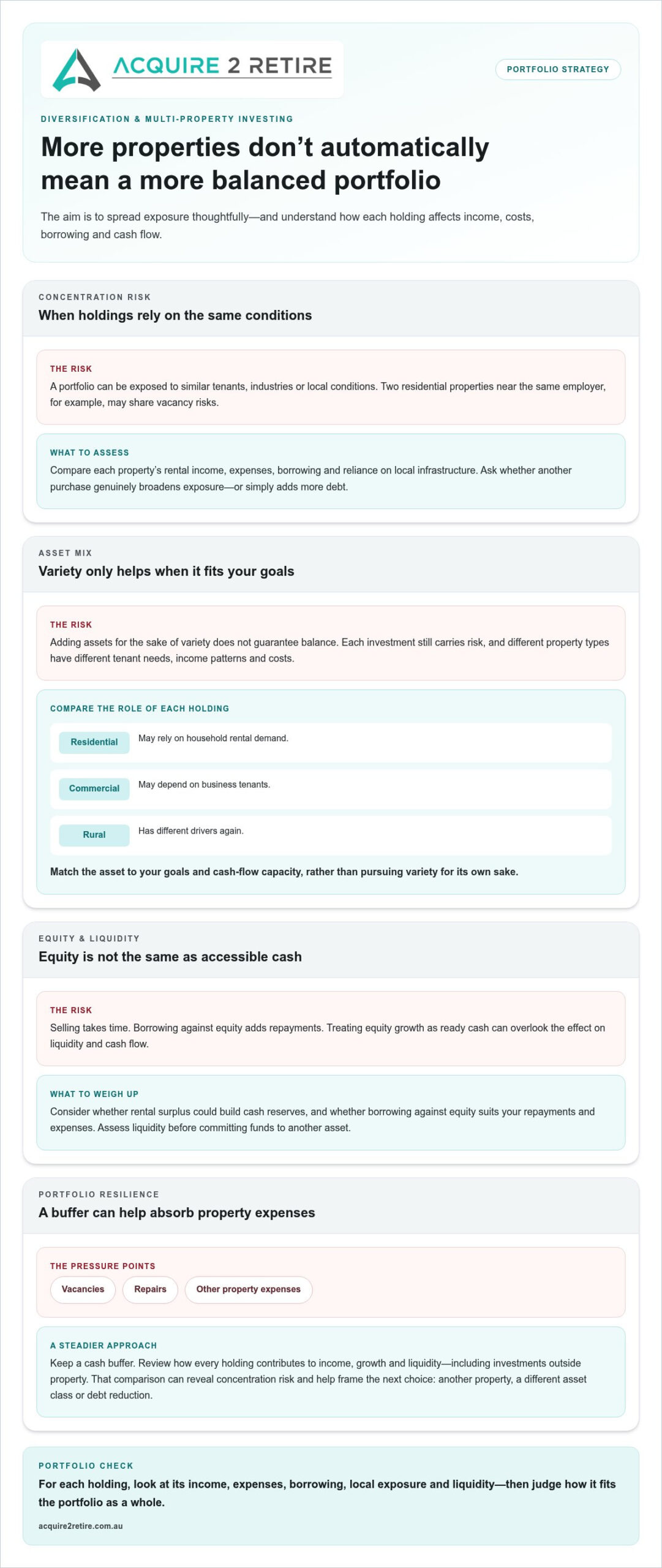
A property portfolio can concentrate risk when every asset depends on similar tenants, industries or local conditions. Diversification spreads exposure across investments that may respond differently to economic changes. For example, holding residential property alongside shares or bonds can reduce reliance on property alone. Each asset still carries risk, so consider its role, potential returns and effect on cash flow.
Holding multiple properties can spread exposure by location, tenant demand and property type, but more assets don’t automatically create balance. Two residential properties near the same employer may share vacancy risks. Compare each property’s rental income, expenses, borrowing and reliance on local infrastructure before adding another. This helps show whether a purchase genuinely broadens the portfolio or simply increases debt.
Australian investors can consider residential, commercial and rural property. These categories have different tenant needs, income patterns and costs. A residential property may rely on household rental demand, while a commercial asset may depend on business tenants. Rural property has different drivers again. Match the asset to your goals and cash-flow capacity, rather than pursuing variety for its own sake.
Diversified equity can support compounding when returns are retained or reinvested toward future investments. For instance, rental surplus may help build cash reserves, while equity growth can strengthen future borrowing options. But equity isn’t the same as accessible cash. Selling takes time, and borrowing against equity adds repayments, so assess liquidity before committing funds to another asset.
Keep a cash buffer for vacancies, repairs and other property expenses. Review how each holding contributes to income, growth and liquidity, including investments outside property. Comparing these roles can reveal concentration risk and help you decide whether the next step is another property, a different asset class or debt reduction.
If you’re weighing these trade-offs, structured property portfolio planning can help connect diversification choices with your wider investment goals.
3. Australian property market trends and regional differences
Australia’s property markets can move differently, so national averages need local context. The Reserve Bank of Australia cut the cash rate to 4.10% in February 2025. The Australian Bureau of Statistics reported a mean residential dwelling price of A$1,045,400 in the September quarter of 2025. Neither figure determines a particular property’s value, rental demand or investment suitability.
Compare suburbs using consistent evidence. Review median price changes over a 5–10-year period, rental yields, vacancy rates and days on market. Then consider population growth, employment, infrastructure and local property supply. Compare locations with similar property types and demand drivers, rather than assuming national conditions apply equally everywhere. This market research helps test whether an area suits your objectives.
To assess value, compare similar properties and recent sales, then account for condition, location and features. An off-market listing or a price below an estimate still needs careful analysis; access outside a public listing does not establish value. Consider whether local demand and expected rental income support the purchase. A discount alone does not show that an asset is sound or appropriately valued.
Australian property rules and taxes vary by state and territory, including purchase duties, land tax and tenancy requirements. Identify the local charges and landlord obligations that apply to each property. Holding costs can include duties, inspections, loan interest, insurance, maintenance and periods without rental income. Include these in cash-flow estimates alongside the purchase price to assess the full commitment.
Market volatility can test an investor’s time horizon. Some regional areas experienced strong growth during 2021–2022, but past movement doesn’t establish future performance. A long-term plan should account for changing interest rates, rental demand and supply, then assess whether the property still fits your broader portfolio. Review valuation assumptions and market evidence before changing course in response to a single price movement.
4. Investment property loan strategies
A loan strategy should support your objectives, not simply maximise borrowing. Compare repayments with expected rental income, household income, regular expenses and available cash reserves. This gives you a clearer view of each loan’s effect on cash flow and your capacity to hold the property as conditions change.
Next, test the numbers under pressure. Model the effect of a 1% rise in interest rates, a vacancy and significant capital expenditure, such as replacing a major fixture. Consider each scenario separately, then together. If the combined impact would strain your budget, adjust the purchase target or borrowing plan before committing.
Compare repayment structures by how they affect cash flow and the loan balance. Repaying principal reduces the balance over time, while interest-only repayments do not reduce principal during that period. Lower repayments may leave more cash for other expenses, but the debt remains. Weigh these trade-offs against your timeline for capital growth and income.
Loan flexibility also matters as your portfolio changes. Before taking on more debt, review borrowing limits, existing repayments and the impact of a vacancy at another property. Interest payments on investment property loans may be tax deductible in Australia. Keep loan purposes and investment records clear, and include tax treatment in your financial modelling.
Connect loan decisions to your broader wealth-building plan. If capital growth is the priority, assess whether repayments remain manageable when rental income fluctuates. If income is central, examine how loan costs affect your net cash flow. A mortgage broker or financial adviser can help assess borrowing capacity and compare options against your circumstances.
To align borrowing choices with your investment objectives, review your property finance strategy with tailored planning support.
Acquire2Retire: Planning & Strategy
Acquire2Retire can help turn your portfolio review into a considered plan, connecting your investment goals with property choices and finance decisions. Its Planning & Strategy offering can help you assess whether your current approach still aligns with your objectives, cash flow and appetite for risk.
If you’re preparing to buy, Acquisition and Finance can support the next steps, while Tenancy coordination can form part of the broader investment journey. This approach is useful when you’re weighing another purchase, reviewing existing holdings or deciding how property fits alongside other priorities. The focus is on making connected decisions rather than treating each property or loan in isolation.
To discuss your property investment strategy, contact Acquire2Retire.
Make your next decision with intention
Property investing is a long-term commitment, but your next move doesn’t need to be immediate. Take time to decide what you want your investments to make possible, then use that purpose to guide your choices. A wealth strategy for property investors is most useful when it connects financial decisions with the life you’re building, rather than treating each purchase as a separate goal.
Before making a change, write down the decision you’re facing and what would make it worthwhile. This can help distinguish a considered opportunity from a reaction to market noise. It also gives you a clearer starting point for conversations about your direction and priorities.
If you’re ready to explore your next step, talk with Acquire2Retire about your strategy. A thoughtful plan can help you move forward with greater clarity and confidence.
Frequently Asked Questions
How often should I review my real estate investing strategy?
Set a regular review, and revisit your plan sooner when a major change could affect your ability to invest or hold. A new job, reduced household income, planned retirement or substantial repair can change how well a property fits your portfolio. Compare actual rent and expenses with your budget, revisit your timeline, and record whether each property still serves its intended role.
Is property investing for me?
Property investing may suit you if you can commit capital for the long term and manage costs during vacancies or repairs. Consider how a deposit and loan repayments would affect everyday finances, emergency savings and other goals. If your budget relies on rent arriving on time, for example, a vacancy could create pressure and change whether investing is appropriate now.
When Should You Start Your Wealth Journey?
Start by clarifying your financial position and what you want wealth to support, rather than waiting for a particular age or market moment. Write down your income, expenses, assets, liabilities and existing investments, then set a time horizon. If buying property would leave too little flexibility for near-term commitments, preparation can be a useful first stage of your journey.
What is a wealth strategy for property investors in Australia?
A wealth strategy connects property decisions with your wider finances and long-term objectives. It can outline each asset’s role, how you’ll fund purchases, and how rental income and expenses fit your budget. In Australia, it should also account for your tax position, retirement plans and other investments, so property is not considered in isolation.
How should Australian property investors set investment goals and choose a strategy?
Choose a strategy by defining an outcome and timeline, then matching your approach to your resources and risk tolerance. An investor prioritising future income, for example, may assess a property differently from someone focused on long-term capital growth. Write down what success would look like, the costs you can carry and the circumstances that would prompt a change of plan.
How do Australian investment property loans, deposits, and borrowing capacity work?
A deposit is your upfront contribution towards a purchase, while a loan covers the remainder under agreed repayment terms. Lenders assess borrowing capacity using factors such as income, expenses, existing debts and financial commitments. Before pursuing a property, map repayments against your household budget and allow for vacancies and maintenance, so the loan remains manageable beyond the purchase.