
A gross rental yield of 5% or more is generally considered good in Australia, but the figure only tells part of the story. Knowing how to calculate rental yield in Australia means dividing annual rent by the property’s purchase cost and multiplying by 100; net yield then accounts for property expenses, giving you a clearer view of the return after costs.
It’s easy to focus on rent and purchase price, but costs such as rates, insurance, maintenance and vacancy can change an investment’s returns. This guide explains how to calculate gross and net rental yield in Australia, account for common expenses and judge yield in context. Use the calculations to compare properties and consider how rental income fits your broader investment goals.
Key Takeaways
- Calculate gross yield from annual rent and purchase cost, then compare it with net yield for a more complete view.
- Include costs such as rates, insurance, vacancy and maintenance when assessing rental income after expenses.
- Weigh rental return alongside capital growth potential, as yield alone doesn’t show the full investment picture.
- Judge whether a yield suits your goals by considering the property, its location and the risks behind its returns.
What’s the difference between gross and net rental yield?
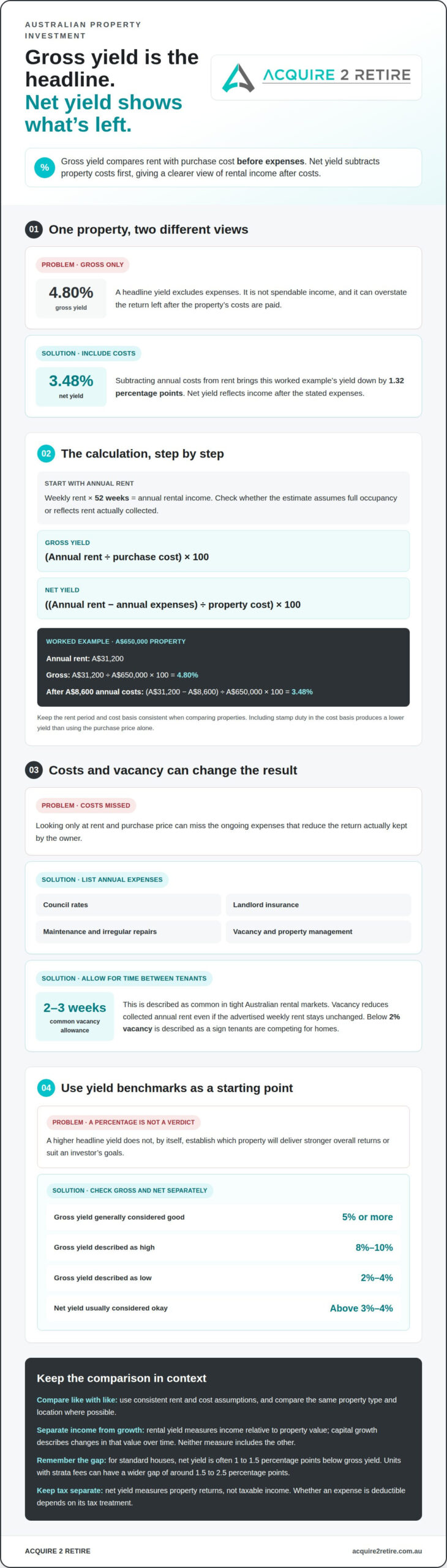
Gross yield compares a property’s annual rent with its purchase price before expenses. Net yield subtracts property expenses first, giving a clearer view of rental income after costs.
-
Calculate gross rental yield
Start with the weekly rent, then convert it into annual rental income using 52 weeks. To understand how to calculate rental yield in Australia, use the same property and rent assumptions throughout the calculation. Check whether the figure represents rent actually collected or assumes full occupancy, and don’t treat gross yield as spendable income because it excludes expenses.
-
Apply the gross yield formula
Divide annual rent by the property’s purchase cost, then multiply by 100 to express the result as a percentage. The formula is: gross rental yield = (annual rent ÷ purchase cost) × 100. Keep the rent period and cost basis consistent when comparing properties.
-
Compare gross and net yield
To calculate net yield, subtract annual property expenses from annual rent, divide the remainder by the property cost, then multiply by 100. This distinction matters when learning how to calculate rental yield in Australia: gross yield excludes costs, while net yield reflects them. For standard houses, net yield is often 1 to 1.5 percentage points lower than gross yield. Units with strata fees can have a wider gap, around 1.5 to 2.5 percentage points.
-
Review a worked gross yield example
Take a property costing A$650,000 with annual rent of A$31,200. Divide A$31,200 by A$650,000, then multiply by 100: the gross yield is 4.80%. If annual costs are A$8,600, subtract them from rent before calculating net yield. Compare houses, units or regional properties using consistent assumptions.
What expenses affect net rental yield?
To estimate net yield, subtract relevant annual property expenses from annual rent, then compare the result with the cost basis you choose. Keep upfront purchase costs separate from recurring expenses so you can see both the total acquisition cost and the property’s ongoing performance.
-
Identify property expenses
List expected annual costs, including council rates, landlord insurance, maintenance, vacancy and property management. Allow for irregular repairs too, even if they do not happen every year.
For example, A$500 weekly rent on a A$950,000 investment property gives A$26,000 annual rental income. With A$4,000 in annual expenses, net yield is 2.32% using the property value. Include actual costs rather than relying only on a gross yield comparison.
-
Consider rental income and deductible expenses
Record rent received and expenses separately for tax purposes. Net yield measures property returns; it does not calculate taxable income. Whether an expense is deductible depends on its tax treatment, so do not assume every cost in your yield calculation can be claimed.
Compare annual rent with a consistent cost basis. Including stamp duty in the denominator will produce a lower yield than using the purchase price alone.
-
Assess vacancy rates and rental demand
Allow for rent lost between tenancies rather than assuming every week is occupied. Two to three weeks a year is a common vacancy allowance in tight Australian rental markets; below 2% vacancy is described as a sign tenants are competing for homes. Local demand and suburbs matter because vacancy reduces collected annual rent, even when the advertised weekly rent stays unchanged.
Check your assumptions for missed costs, full occupancy and gross-yield-only comparisons. A gross yield of 5% or more is generally considered good, but expenses can materially reduce the return after costs.
Investing in property: what is rental yield?
Compare rental income with property value to assess income potential, then consider possible capital growth separately. These measures describe different aspects of an investment’s performance.
- Separate rental income from capital growth. Rental yield measures income relative to property value; capital growth describes how that value changes over time. A higher yield may support cash flow, while an investment focused on growth may depend more on increases in value. Neither measure includes the other, so compare both against your aims. Gross and net yield differ too: expenses reduce the income remaining after costs.
- Compare properties using the same location and type. Cotality’s September 2026 index reports gross yields of 3.0% for Sydney houses and 4.4% for Sydney units. In Darwin, it reports 6.0% for houses and 7.5% for units. These figures show why a city-wide average can hide differences between houses and units. Compare like with like, and remember that a weekly rent estimate alone doesn’t show annual income after vacancies or costs.
- Balance yield with location and investment priorities. Combined regional gross rental yield in Australia was 4.3%, compared with 3.6% across combined capital cities. That difference can help frame a comparison, but it doesn’t establish which property will deliver stronger overall returns. Consider local rental income alongside likely capital growth, property expenses and the effect of finance on your cash flow. A yield comparison is most useful when each property uses consistent assumptions and reflects the investor’s intended balance between income and growth.
What counts as a good Australian rental yield
Use a percentage as a starting point, not a verdict. In Australia, a gross yield of 5% or more is generally considered good, but costs, location and capital growth prospects shape the difference between a strong headline figure and a suitable investment.
- Set a benchmark, then identify whether it’s gross or net. A gross yield of 5% or more is generally considered good, while 8% to 10% is described as high and 2% to 4% as low. After expenses, a net yield above 3% to 4% is usually considered okay. Westpac recommends including insurance, strata fees, vacancy costs, repairs, legal fees, building inspection fees, maintenance and agent fees when estimating net rental yield.
- Compare the property with relevant Australian market figures. Cotality’s September 2026 index reports gross yields of 4.1% for Melbourne houses, 4.0% for Perth houses and 3.6% for Adelaide houses. Capital-city units averaged 4.7%, compared with 3.4% for houses. A yield above 4% is described as solid for a capital-city property, but compare the same property type and use net figures to assess income after expenses.
- Test the yield against your investment priorities. A high percentage may support rental income, while capital growth reflects changes in the property’s value. Neither alone captures the whole return. Consider whether rent can support cash flow alongside home loan repayments, and whether location and property costs fit your plan. Gearing can affect the investor’s position, but it doesn’t change the basic yield formula. For help weighing yield against growth and investment objectives, review your property investment strategy.
Acquire2Retire: Planning & Strategy
Acquire2Retire can help you turn rental-yield calculations into a broader property investment plan. Its Planning & Strategy offering helps connect expected rental income, expenses and capital growth aims with the decisions involved in building an Australian property portfolio.
Consider this support when you’re comparing properties and want to assess how an acquisition, finance approach and tenancy arrangements fit your investment objectives. Acquisition and Finance can support the purchase-planning process, while Tenancy helps coordinate that part of the investment journey. The aim is to consider the numbers alongside the wider portfolio strategy, rather than treating one yield percentage as the whole decision.
To discuss your property investment plans, contact Acquire2Retire.
Take your next investment decision forward
A yield calculation is most useful when it informs a decision, not when it stands alone as a percentage. Before proceeding, consider how the property fits your financial position, the role you want rental income to play, and the trade-offs you are comfortable making between income and long-term growth.
Understanding how to calculate rental yield in Australia gives you a practical starting point for those conversations. The next step is to connect your assumptions about rent, costs and finance with an investment approach that reflects your circumstances and priorities. A considered plan can help you compare opportunities with greater purpose, rather than relying on one headline measure.
If you’re ready to explore how a property investment could fit your plans, speak with Acquire2Retire about your next step. A thoughtful decision starts with the goals that matter to you.
Frequently Asked Questions
Do apartments or houses have higher rental yields?
Units can offer higher rental returns than detached houses, partly because their purchase prices may be lower while rents remain strong. This is not guaranteed for every property. Compare similar homes in the same market and account for strata costs, which can reduce an apartment’s net return. A higher gross yield alone does not show which option better suits your investment goals.
What is rental yield and how is it calculated in Australia?
Rental yield expresses a property’s annual rental income as a percentage of its value or purchase cost. To calculate it, convert the rent to an annual figure, divide by the chosen property value, then multiply by 100. The result helps compare income potential between properties, but it doesn’t show capital growth or the cash remaining after expenses unless you calculate net yield.
What is the formula for gross rental yield in Australia?
Use this formula: gross rental yield = (annual rent ÷ property purchase cost) × 100. For a weekly rent figure, first convert it to annual rent using 52 weeks. Gross yield leaves expenses out, so use the same purchase-cost basis when comparing properties. The resulting percentage is a quick income measure, not a complete assessment of investment performance.
How do you calculate net rental yield after expenses in Australia?
Subtract the property’s annual expenses from annual rent collected, divide the remainder by the property cost, then multiply by 100. This gives a percentage based on income after property costs. Keep your calculation period consistent: annual rent should be matched with annual expenses. If rent is lost during vacancy, account for the rent actually collected rather than assuming full occupancy.
Which property expenses should be included when calculating rental yield?
Include relevant costs of holding and operating the property, such as council rates, insurance, repairs and maintenance, vacancy allowances, agent fees and strata charges where applicable. Stamp duty is an upfront purchase cost, so include it when assessing yield against total acquisition cost. Separate recurring expenses from one-off costs, and do not assume every expense in the calculation is tax-deductible.
Should rental yield use weekly or annual rent and the property’s purchase price or current value?
Use annual rent for the calculation; convert weekly rent by multiplying it by 52. Choose the denominator to suit the comparison: purchase cost helps assess the return against what you paid, while current value shows income relative to the property’s value now. Apply the same basis when comparing investments, because switching between purchase price and current value can change the percentage materially.