
Selling an Australian investment property for more than its cost can add a capital gain to your taxable income for the relevant year, rather than triggering a separate capital gains tax bill. If you’ve owned it for more than 12 months, the 50% CGT discount may apply, subject to the relevant conditions. How much tax you ultimately pay depends on the gain included in your income and your tax position.
It’s understandable to focus on the sale price, but the amount you receive isn’t necessarily the amount used to calculate your gain. The property’s cost base, eligible costs, ownership share and any capital losses can all affect the result.
This guide explains capital gains tax on investment property in Australia, how to calculate a gain or loss, and how the rules may apply when you sell. It also covers the records and property circumstances that can affect the calculation, helping you focus on the details that matter.
Key Takeaways
- Separate the property’s sale proceeds from its capital gain by identifying the costs that may form part of its cost base.
- Understand how the main residence exemption and your property’s use can affect the taxable portion of a gain.
- Keep purchase, improvement, rental and sale records together to support your calculation and identify any capital loss.
- Consider how ownership, the sale contract date and your other income can shape the tax outcome before making property decisions.
What is a capital gain or capital loss?
A capital gain generally arises when an investment property sells for more than it cost. A capital loss may arise when the sale proceeds are lower, and losses can affect the gains considered for tax purposes.
The 50% CGT discount
For an eligible Australian resident, the 50% CGT discount can reduce the capital gain included in taxable income. The discount may apply to an investment property held for more than 12 months, subject to eligibility requirements.
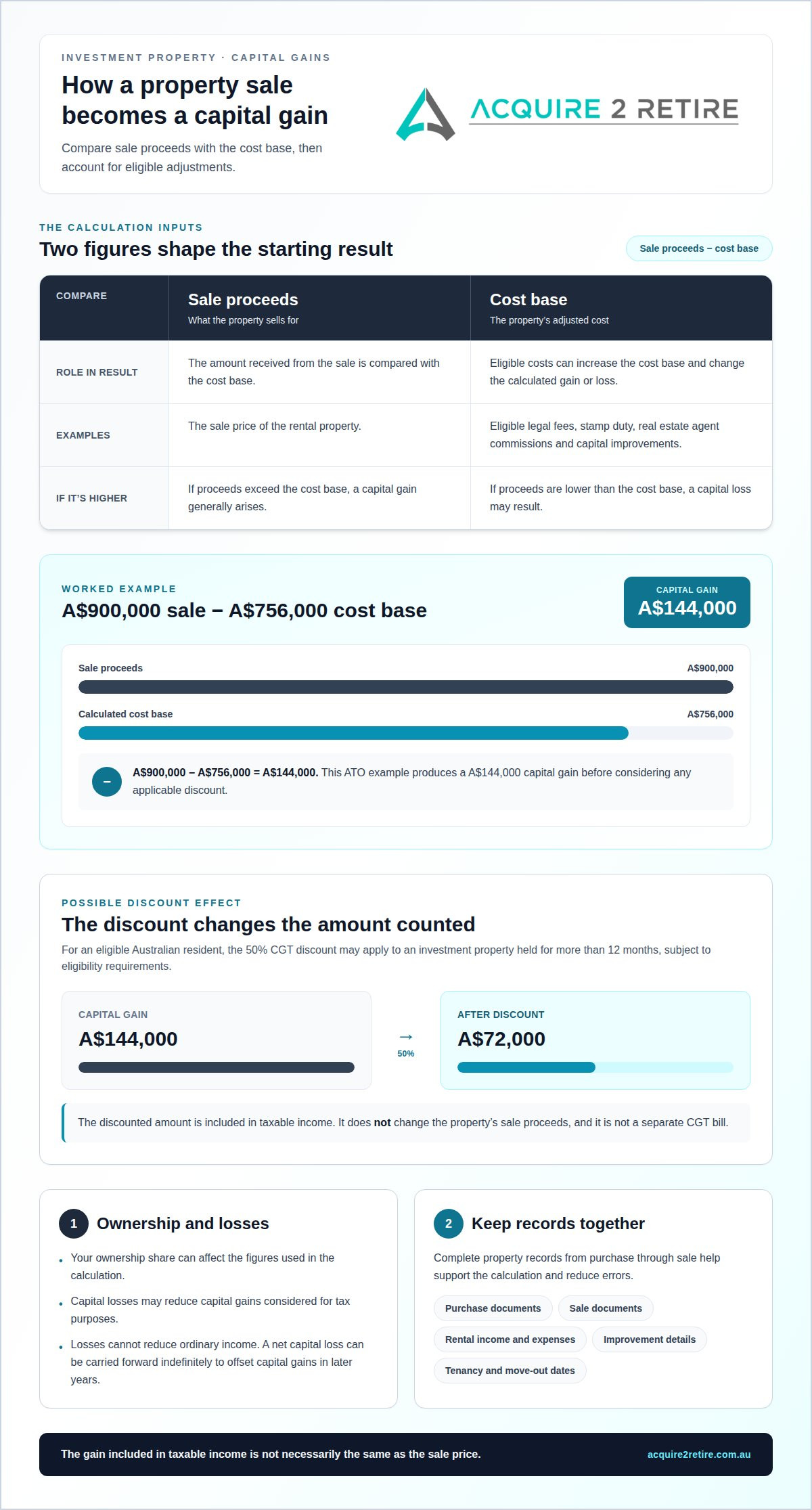
For example, an ATO example reduces a co-owned rental property’s A$144,000 capital gain to A$72,000 after the discount. Another example applies the discount to A$72,000, leaving A$36,000 in taxable capital gains. The discount changes the amount counted, not the property’s sale proceeds, so the distinction matters when estimating the gain’s effect on your return.
Discount and indexation methods
The discount method reduces an eligible capital gain, while indexation adjusts an asset’s original cost to reflect changes over time. Which method is available can depend on when the property was acquired, so the purchase date matters.
For Australian assets acquired between 20 September 1985 and 20 September 1999, taxpayers may choose between the discount and indexation methods. Investment properties purchased before 21 September 1999 may qualify for cost-base indexation. For properties held less than 12 months, the 50% discount described here doesn’t apply. Comparing the available method with the property’s records can show which calculation produces the relevant taxable gain.
Capital losses and the discount
A capital loss may reduce capital gains considered for tax purposes, but it can’t reduce ordinary income. If your losses exceed your gains, you can carry the net capital loss forward indefinitely to offset capital gains in later years.
For example, a loss from selling one asset can affect the gains calculated on another asset, including an investment property. Keep records of the loss with purchase and sale documents, as they help establish what remains to be considered. A loss doesn’t create a deduction against salary or other ordinary income. Understanding how losses interact with a discount helps clarify the amount that may be included in taxable income.
What is capital gains tax?
Australian capital gains tax generally applies to profits from selling investment assets purchased after 20 September 1985. A property’s use and ownership history can affect whether an exemption applies or some gain is taxable.
Main residence CGT exemption
The main residence exemption can exclude a qualifying home’s capital gain from CGT. It matters if a property has been both your residence and an investment, because how you used it during ownership can change the taxable outcome.
A home on two hectares or less may qualify if it meets the other main residence conditions. The exemption relates to the home and eligible land, rather than automatically covering every property you own. Buying a property as an investment doesn’t make it eligible simply because you later live there. The circumstances and ownership timeline matter.
Renting out a former home
If you move out and rent your former home, the six-year rule may allow you to continue treating it as your main residence, subject to its conditions. This can preserve an exemption while the property earns rental income.
For example, a former home rented for five years after you move out may qualify for a full exemption if you don’t nominate another property as your main residence during that time. If you rent it for seven years, the portion of the gain after the six-year mark may be assessable. If the home isn’t rented while you’re away, it may remain eligible for the exemption indefinitely.
Main residence tests and partial exemptions
The outcome depends on how you used the property and whether you nominated another home as your main residence. Under the six-year rule, you can’t treat a rented former home as your main residence while treating another owned home as your main residence during the same period.
Renting out part of your home can also mean a partial exemption. If 25% of its floor space was used to produce income while you lived there, 25% of the capital gain is assessable, including during a six-year absence. A main residence exemption can therefore cover only the eligible share or period, rather than the entire gain.
Other CGT exemptions cover specific assets, not just homes. Personal-use assets acquired for up to A$10,000 are exempt under the stated exemption, while collectables acquired for up to A$500 are also exempt. For an investment property, the main residence exemption remains the key consideration; the 12-month ownership period relates separately to eligibility for the CGT discount.
Calculating capital gains on investment property
For an Australian rental property, compare the sale proceeds with the cost base to calculate a capital gain or loss. Eligible costs and your ownership share can change the figures.
Calculating a property capital gain or loss
A capital gain is generally the difference between sale proceeds and the property’s cost base. If the proceeds are lower, a capital loss may result. In an ATO example, a rental property sold for A$900,000 had a calculated cost base of A$756,000, producing a A$144,000 gain.
A capital gain is included with your other income when calculating taxable income for your tax return. Keep purchase and sale documents, rental income and expense records, improvement details, and tenancy and move-out dates together. The ATO expects complete property records from purchase through sale. Organised records help support your calculation and reduce errors.
Costs included in the cost base
A property’s cost base can include eligible incidental costs of acquiring, holding and disposing of it. Examples include legal fees, stamp duty, real estate agent commissions and capital improvements. These amounts can increase the cost base and reduce the gain calculated against the sale proceeds.
Costs already claimed or claimable as tax deductions aren’t included in the CGT cost base. Capital works deductions can reduce the reduced cost base; an example reduces it by A$20,000. This distinction matters because rental expenses and capital costs can receive different tax treatment. Record improvement invoices and deduction details separately to calculate the appropriate figure.
Joint ownership and CGT calculations
Co-owners calculate their share of a property gain or loss according to their legal ownership interest. In an ATO example, equal joint tenants each included a A$36,000 capital gain in their tax return. A co-owner with a 10% interest included A$7,200, while a 90% owner included A$64,800.
Apply the ownership share to the relevant gain, then account for any applicable method and capital losses. The ATO’s A$144,000 example shows why establishing the property-level gain comes first. Each owner’s share is then reported in their own return, alongside their other income for taxation.
How capital gains tax applies to investment property
Australian CGT generally isn’t a separate tax. A capital gain may be included in your taxable income for the relevant year. The property’s purchase history, use and sale contract date help determine how the rules apply.
CGT rules for investment property
For an investment property, CGT applies when a relevant event, such as a sale, creates a capital gain. The event occurs when you enter the sale contract, not at settlement, so the contract date determines the relevant tax year.
Property bought after 20 September 1985 is generally subject to CGT on the entire property. For property acquired before that date, CGT generally applies only to certain capital improvements made afterwards. If the property was rented for more than six years after first producing income, its market value at that first income-producing use may form the cost base.
Inherited investment property
Selling an inherited investment property can have CGT consequences. The treatment depends on the property’s acquisition history, applicable cost base, ownership period and whether it qualified for a main residence exemption.
Start by establishing the relevant acquisition date and cost-base records, then identify the sale contract date and the property’s use. Those details help determine whether the pre-20 September 1985 rule, a residence exemption or the CGT discount may be relevant. The inheritance itself shouldn’t be treated as enough information to calculate the eventual gain.
The final taxable amount also depends on the cost base, eligible capital losses and the owner’s other income. For property held more than 12 months, the 50% CGT discount may apply to an eligible gain. A transfer to a relative or sale without an arm’s-length transaction uses market value as the sale value, even if no money changes hands.
Keep records of ownership, rental use, improvements and the eventual sale contract together. For a clearer view of how a property decision fits your broader plans, review your investment strategy.
Acquire2Retire: Planning & Strategy
Acquire2Retire helps investors connect property decisions with a broader Australian wealth strategy. Its Planning & Strategy support can help you consider how an investment property fits your objectives before you buy, hold or sell, while Acquisition and Finance support can inform the next property decision. Tenancy coordination and ongoing support can also help keep portfolio plans connected as circumstances change.
Turn to this support when you’re assessing a property purchase, reviewing your portfolio direction or weighing how a potential sale fits your investment plans. CGT calculations and tax-return reporting remain important parts of the decision, so keep the property’s ownership, use and cost records organised as you plan.
You’re welcome to contact Acquire2Retire or visit acquire2retire.com.au to discuss your property investment plans.
Plan your next property decision with clarity
Tax is one of several considerations when deciding whether an investment property supports your longer-term goals. Before making a move, consider how the property fits your portfolio, borrowing plans and approach to future investments. Weighing these factors together can help you understand the financial implications without letting one estimate drive the whole decision.
Understanding capital gains tax on an Australian investment property can inform that planning, while the broader strategy also considers what you want your assets to achieve. Acquire2Retire’s Planning & Strategy, Acquisition and Finance offerings support property-investment decisions. For capital gains tax on investment property in Australia, keep tax planning connected to your wider financial direction.
If you’re considering your next move, contact Acquire2Retire to discuss your property investment plans. A clear view of your goals is a steady place to begin.
Frequently Asked Questions
Can CGT rules change?
Yes, Australian CGT rules can change, so the rules applying when you sell matter. A proposed Australian CGT system would apply a 30% minimum tax rate to capital gains from July 2027, regardless of the taxpayer’s tax bracket. Treat that as a proposal, not a description of the current calculation. For a sale, distinguish the rules applying to the relevant tax year from future policy proposals.
How much do I have to pay for CGT?
There isn’t one fixed CGT amount for every investment property sale. The taxable capital gain is included with your other income, so the amount depends on your net gain and the tax rates that apply to your taxable income. A discount, capital losses, ownership share or exemption can change the amount included. The sale price alone doesn’t show your likely tax bill.
What happens if you partially used the property for income before moving out?
If part of your home produced income while you lived there, that use can reduce the main residence exemption. For example, if 25% of the floor space was used to produce income, 25% of the capital gain is assessable, including during a six-year absence period. Keep records of the area used and when income-producing use began, as these details help establish the relevant share.
What is the six-year rule?
The six-year rule may let you continue treating a former home as your main residence while it’s rented after you move out. It applies subject to conditions, including whether you nominate another home as your main residence during that time. If you rent the former home for more than six years, the period beyond the limit can affect the assessable gain. The rule relates to the main residence exemption; it doesn’t automatically exempt every rental property.
What are capital losses?
A capital loss occurs when an asset’s relevant sale proceeds are less than its cost base. It can reduce capital gains considered for tax, but it can’t be deducted from ordinary income such as salary. If losses exceed gains, you can carry the net capital loss forward indefinitely to offset capital gains in later years. Keep evidence of the original purchase and sale so you can calculate the loss.
How is capital gains tax calculated on an investment property in Australia?
Subtract the property’s cost base from its sale proceeds to calculate a capital gain, or compare a lower sale value with the cost base to identify a loss. Account for eligible capital losses and any applicable discount or exemption, then include the resulting net capital gain in your tax return. If you jointly own the property, each owner reports the portion matching their legal ownership interest. The sale contract date determines the relevant tax year.