
A larger property portfolio isn’t automatically a stronger one. A portfolio includes two or more properties, and a considered approach to how to accelerate property portfolio growth can combine usable home equity with careful borrowing, cash-flow buffers and regular reviews. The goal is to expand in a way that aligns with your financial objectives and ability to manage risk.
Looking beyond one property may make sense if you want to build rental income, grow equity or work towards a longer-term wealth goal. But every purchase adds commitments. The right balance between growth and rental yield depends on your strategy and the market.
This article explains why investors expand, how home equity may help fund another purchase, and what to weigh before taking on more debt. It also covers the role of diversification, financial buffers and regular reviews as your circumstances and market conditions change.
Key Takeaways
- Set a clear purpose for each property, such as building equity or supporting rental income, so new purchases fit your wider goals.
- Before using home equity, weigh usable equity against borrowing capacity, repayment impacts and the cash buffer you’ll retain.
- Plan for vacancies and ownership costs, and spread risk across locations or property types where that suits your strategy.
- Review your portfolio as your finances, goals and market conditions change, then adjust the balance between growth and rental yield.
1. Why scale beyond one property?
Owning more than one property can create different avenues for building wealth. One asset might focus on rental cash flow, while another targets capital growth or debt reduction. Give each purchase a clear purpose, then consider how it could support your financial plan over the next five to ten years.
Investment decisions depend on local conditions, because Australia’s property markets are not uniform. Investors can assess population movement, economic development and infrastructure when selecting a location. Property investment professionals can connect these factors with your goals, borrowing position and next purchase. Planning & Strategy can bring those decisions into one structured plan.
Purchase prices and returns vary between properties and markets. Compare the entry cost with expected rental income and ongoing ownership expenses rather than relying on headline yield alone. A positively geared property earns more gross rent than its ongoing costs, while a growth-focused investment may prioritise long-term value. Decide which outcome matters most, as one strategy may not deliver both.
Stamp duty and land tax differ across Australian states and territories. The amounts depend on factors such as location, purchase value, ownership and property use. Include these costs, as well as conveyancing, inspections, finance, insurance and vacancy allowances, when assessing a purchase. Together, they affect both the funds required upfront and the property’s cash flow.
Commercial property requires a separate assessment. Location, tenant quality and lease terms can all shape performance, so test income assumptions and risks before buying. A considered strategy helps you choose assets that work together, rather than adding properties simply to increase the portfolio’s size.
2. Using home equity towards an investment property deposit
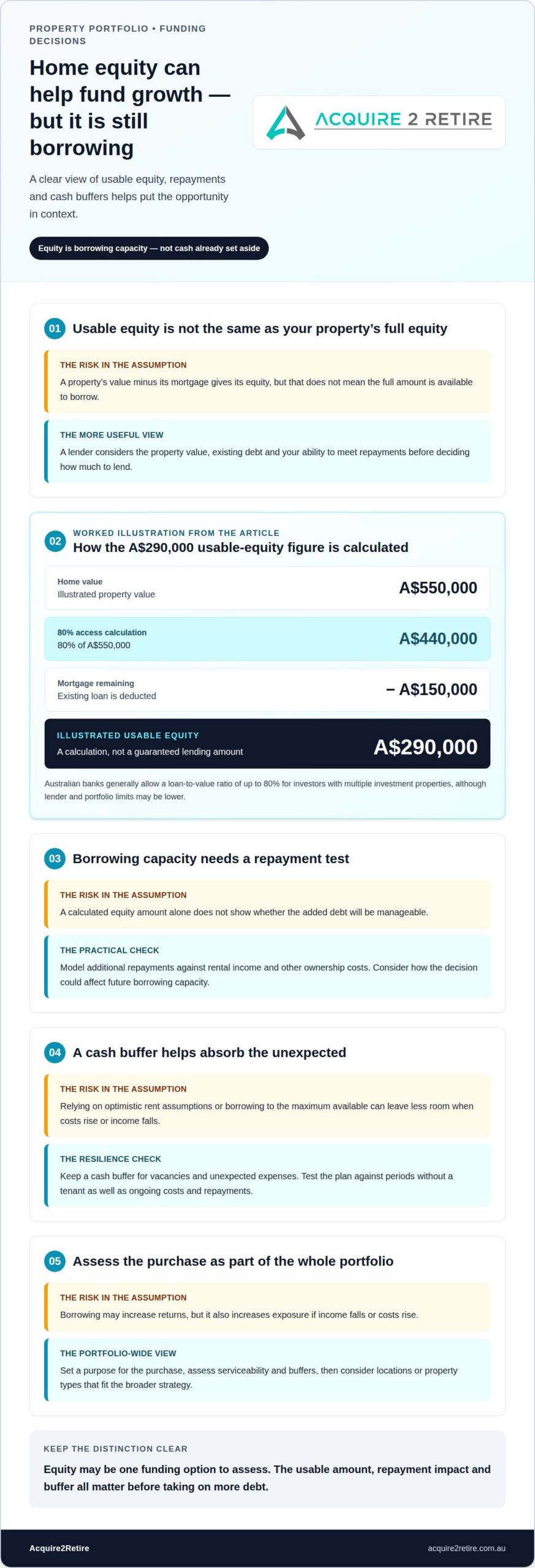
Equity is the difference between a property’s value and the debt secured against it. Australian homeowners may use some available equity towards another investment property, but equity is borrowing capacity, not cash already set aside. A lender assesses the property value, existing debt and ability to meet repayments before deciding how much to lend. For investors considering how to accelerate property portfolio growth, equity can be one funding option to assess.
For example, a home valued at A$550,000 with A$150,000 remaining on its mortgage has A$290,000 in usable equity under an 80% access calculation: 80% of A$550,000 is A$440,000, less the existing loan. This is an illustration, not a guaranteed amount. Australian banks generally allow a loan-to-value ratio of up to 80% for investors with multiple investment properties, although lender and portfolio limits may be lower.
Using equity responsibly means assessing your ability to service the debt, not just calculating the amount available. Model additional repayments against rental income and other ownership costs, then keep a cash buffer for vacancies and unexpected expenses. A measured plan reduces reliance on optimistic rent assumptions or borrowing to the maximum available. Consider finance and acquisition decisions together, including how each could affect future borrowing capacity.
Investors may need to consider how rental income compares with a property’s ongoing costs when assessing its cash flow. Losses may be offset against salary, reducing taxable income and tax payable. Tax on a capital gain may also affect net proceeds when the property is sold. Consider after-tax cash flow and potential sale proceeds when assessing the investment’s overall contribution.
To build a diversified portfolio while managing debt, set a purchase purpose, assess serviceability and buffers, then consider different locations or property types. Borrowing to fund acquisitions may increase returns, but also increases exposure if income falls or costs rise. A considered approach to how to accelerate property portfolio growth weighs these risks alongside the opportunity. A property finance and acquisition plan can help structure those decisions around your broader portfolio.
3. Managing market risk and maintaining a financial buffer
Start by defining your portfolio goals and the level of risk you can carry. A capital growth strategy may create different cash-flow pressures from an income-focused approach. Map expected rent, loan repayments and ownership costs for each asset, then consider how a vacancy could affect household finances. This makes risk tolerance part of the purchase decision, not an afterthought.
Spread exposure across locations, property types and investment strategies when they suit your plan. Holding assets in different Australian regions can reduce reliance on one local economy, while varied tenant demand may help balance income. Diversification doesn’t remove market risk, but it can limit the effect of a downturn in one area. Assess every opportunity against your existing portfolio.
Build a cash-flow buffer based on actual ownership costs. Include council rates, management fees, landlord home insurance, loan repayments and periods without a tenant. For example, model how the portfolio would perform if one property were vacant while rates and other expenses continued. A buffer can preserve flexibility and reduce pressure to sell in an unfavourable market.
Protecting assets is another part of risk management. Consider legal structures, tax-efficient strategies and risk management tools within your broader financial planning. Each choice can affect ownership, liabilities and cash flow, so assess how it fits the portfolio before making a change. Keep the purpose clear: protect capital while preserving capacity for future opportunities.
Reassess risk when lending rules, interest rates, economic conditions or tenant demand change. Compare actual rent and expenses with your assumptions, then decide whether each asset still supports the portfolio’s goals. If one property relies heavily on capital growth while another provides stronger income, check whether that balance remains suitable. Regular reviews help you make measured decisions and adjust exposure as circumstances shift.
4. Reviewing portfolio strategy regularly
Review your portfolio against its original goals, not its property count alone. Revisit the intended balance between wealth creation, rental income and debt reduction. Then compare each asset’s actual contribution with the role it was meant to play. This reveals whether your investment strategy still fits your financial position and priorities.
Personal circumstances and markets change. A property that suited your plans three years ago may need reassessment if interest rates, local performance or your goals have shifted. For example, a change in household income may affect how much you can comfortably borrow, even if rent remains steady. Treat a review as a decision point, not an automatic prompt to buy or sell.
Compare each property’s income and costs, including rent received, loan repayments, vacancy periods and ongoing ownership expenses. Check whether stronger-yielding assets help support properties selected for capital growth. If one asset consistently strains cash flow, consider how that affects the portfolio’s ability to fund another purchase. Measure success by how well the portfolio fits your goals, not by growth for its own sake.
Review diversification as well as performance. Look at exposure across locations, property types and economic drivers, then consider whether one region or tenant market has become too important to your overall income. Keep track of Australian market trends and relevant regulations, since both can influence future decisions. Record the reason for each adjustment to keep the portfolio’s direction clear.
A useful review ends with practical next steps: retain the current mix, strengthen income, reduce debt or reassess an asset’s role. Planning & Strategy can help connect those choices to your wider wealth goals. Arrange a portfolio strategy review to bring your goals, assets and next decisions into one considered plan.
Acquire2Retire
Acquire2Retire can help you turn portfolio goals into a considered plan when you’re weighing another purchase, reviewing finance or refining your investment strategy. Its Planning & Strategy, Acquisition and Finance offerings support decisions from portfolio direction through to property purchase, while Tenancy coordination and ongoing support help keep your investment plans connected over time.
If you’re unsure whether to use equity, how to balance growth with rental income, or whether your current assets still fit your goals, a structured discussion can help clarify the next step. Contact Acquire2Retire to discuss your property investment plans.
Make your next portfolio decision with purpose
Growth is most sustainable when every decision supports the life you want your assets to fund. Before moving towards another purchase, decide what you need the portfolio to do next: strengthen income, build long-term wealth or create more flexibility. That purpose can guide how to accelerate property portfolio growth without making expansion the only measure of progress.
A useful next step is to turn that intention into a clear acquisition and finance plan, with each decision considered in relation to your broader position. Acquire2Retire’s Planning & Strategy, Acquisition and Finance support can help bring those considerations together as you shape your next move.
Contact Acquire2Retire to discuss your property investment plans. A thoughtful plan can help you move forward with greater clarity and confidence.
Frequently Asked Questions
Why scale beyond one property?
Investors may expand to build wealth through different sources of income and growth, rather than relying on one asset. A second property can have a distinct role, such as supporting rental income while another investment targets capital appreciation. The decision should fit your financial goals and capacity to carry debt. For example, ask whether another purchase advances your five-to-ten-year plan or adds commitments without a clear purpose.
What strategies help accelerate property portfolio growth in Australia?
Set a defined investment strategy: identify each asset’s role, research local demand and infrastructure, and assess the financial impact before buying. Consider whether your portfolio needs stronger rental income, capital growth or a balance of both. Growth can also involve non-financial leverage, such as specialised knowledge, professional relationships and sound systems. Review the strategy as your finances and market conditions change, rather than pursuing acquisitions by default.
How much deposit and equity do Australian investors need to buy an investment property?
There is no single deposit amount for every Australian investor. It depends on the purchase price, lender’s assessment and available funds. Equity may contribute towards a deposit, but usable equity is not the same as cash savings. Allow for purchase costs and keep funds for ongoing expenses. For example, a lender’s valuation and your existing mortgage affect how much equity may be available to draw.
How can Australian property investors use equity recycling and refinancing to grow a portfolio?
Equity recycling generally means borrowing against available property equity and directing the funds towards another investment. Refinancing, by contrast, replaces or restructures existing loan arrangements. Before proceeding, model the proposed loan, its purpose, repayments and effect on cash flow. Releasing equity may fund part of an acquisition, for example, but the added debt also affects serviceability and future borrowing capacity.
What are Australian lender serviceability rules and borrowing capacity limits for property investors?
Australian lenders assess whether borrowers can manage repayments alongside their existing financial commitments; borrowing capacity is not determined by property equity alone. Banks generally allow a loan-to-value ratio of up to 80% for investors with multiple investment properties, though lender and portfolio limits may be lower. Income, debts, expenses, rental income and the proposed loan all contribute to the assessment.
How do capital growth and rental yield compare across Australian cities and regional markets?
Neither city nor regional markets deliver uniform results: local employment, population movement, infrastructure, supply and tenant demand all influence performance. Rental yield measures rent relative to a property’s value, while capital growth concerns changes in value over time. Compare locations against your investment horizon and cash-flow needs. A higher yield alone doesn’t show which property best suits your strategy or portfolio.