
Property and superannuation do not have to be an either-or choice. A retirement plan can use both, balancing property’s potential rental income and capital growth with super’s role in providing retirement savings. Learning how to plan retirement income from property starts with estimating what may remain after costs, considering how readily you can access your money, and deciding how property fits alongside super.
It’s understandable to weigh property’s tangible value against super’s flexibility when planning how to turn long-term assets into retirement income. The useful question isn’t simply which option might grow more. It’s how each could support the retirement you want, and which trade-offs you’re willing to accept.
This article explains how to estimate your retirement income needs, compare property with superannuation, and account for costs, cash flow and access to funds. It also offers a practical way to assess whether property belongs in your plan, either on its own or alongside super.
Key Takeaways
- Compare property’s potential rental income with mortgage interest, vacancies and ongoing costs to understand what it could contribute in retirement.
- Weigh property’s growth potential against its lower liquidity and the costs involved in buying, holding and selling.
- Estimate the income your retirement lifestyle may require, then consider how your assets could help meet that need.
- Explore how property and superannuation might work together, and where structured planning can help align property decisions with your wider retirement goals.
Should you use property to fund your retirement?
Property may provide rental income and potential capital growth, but mortgage interest, vacancy periods and other costs affect how much income remains. Compare the likely net cash flow with your retirement needs and the role of superannuation in your wider portfolio.
Property Costs and Vacancy Periods
An investment property has costs whether it’s tenanted or vacant. Mortgage interest, insurance, maintenance and land tax can reduce rental income. An interest-only loan also leaves the principal owing. Apartments may have additional costs, such as strata levies, that differ from those of houses.
Allow for periods without rent and expenses between tenancies. Unlike some other assets, property can require you to fund repairs and cover costs while it’s vacant. An outright-owned home also has ongoing household costs, so include these when estimating retirement living expenses.
Rental Yield and Cash Flow
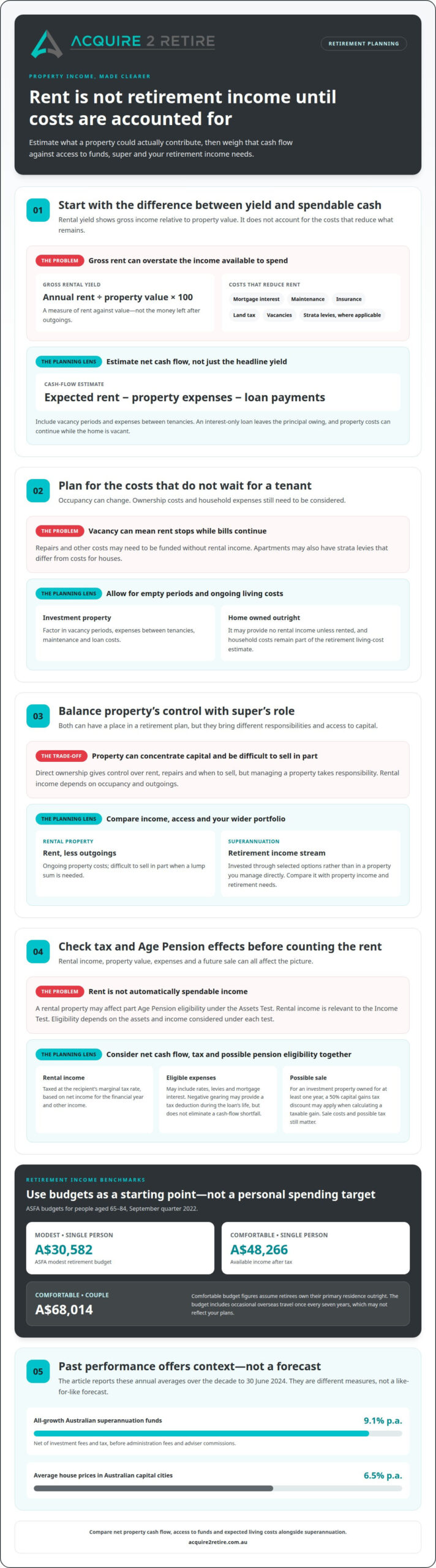
Rental yield compares rental income with a property’s value: divide annual rent by the property value, then multiply by 100. It indicates gross yield, not the money available to spend, because it leaves out interest, vacancies and other outgoings.
To estimate property cash flow, subtract property expenses and loan payments from expected rent. Include maintenance, insurance, land tax and vacancy periods. This helps show whether rent could make a meaningful contribution to retirement income or would be largely absorbed by costs.
Age Pension Assets and Income Tests
A rental property may affect eligibility for a part Age Pension under the Assets Test. Rental income is also relevant to the Income Test, so consider both the property’s assessed value and the income it produces as part of retirement planning.
Retirees must declare income, including rental income and superannuation income streams. The effect on eligibility depends on the assets and income considered under each test. Compare the property’s net cash flow with its possible effect on pension eligibility rather than treating all rent as spendable income.
| Option | Income potential | Costs and access |
|---|---|---|
| Rental property | Rent, less outgoings | Mortgage interest, vacancies and maintenance; difficult to sell in part |
| Home owned outright | No rental income unless rented | Household costs remain; supports a housing-cost estimate |
| Superannuation funds | Retirement income stream | Compare with property income and retirement needs |
Choose by comparing net property cash flow, access to funds and expected living costs; ASFA’s modest retirement budget for a single person aged 65-84 was A$30,582 in September quarter 2022.
Pros and cons of property investing for retirement
Property may provide rental income and capital growth, while superannuation offers a different investment structure. Before deciding how each could contribute to living costs, compare potential returns, control, tax treatment and access to capital.
Investor Control and Rental Income
Owning an investment property gives you direct control over decisions about rent, repairs and when to sell. It also brings responsibility: the property needs attention, and rental income depends on tenant occupancy and outgoings.
Superannuation is invested through selected options rather than in a property you manage directly. Property may feel more tangible, but it concentrates capital in one asset and is harder to sell in part when you need a lump sum.
Tax Deductions and Rental Income
Rental income is taxed at the recipient’s marginal tax rate, based on net income for the financial year and other income. Eligible expenses may include rates, levies and mortgage interest. Negative gearing may provide a tax deduction during the loan’s life, but it doesn’t eliminate the cash-flow shortfall.
For an investment property owned for at least one year, a 50% capital gains tax discount may apply when calculating a taxable gain. Selling can still create a substantial tax bill, so include the possible gain and sale costs in your retirement planning.
Performance figures offer context, not a like-for-like forecast. Over the decade to 30 June 2024, all-growth Australian superannuation funds returned an annual average of 9.1%; results were net of investment fees and tax, before administration fees and adviser commissions. Average house prices in Australian capital cities grew 6.5% per year over the same period.
Eligible homeowners may be able to contribute some proceeds from a home sale to super when downsizing, subject to eligibility conditions and contribution limits. Treat this as a possible part of your plan, not as an unrestricted lump sum.
For a considered view of property’s role in retirement, explore property investment planning.
Estimating retirement income needs
Start with the lifestyle you want, then estimate the yearly income needed to support it. ASFA’s September quarter 2022 budgets offer Australian benchmarks, but your circumstances determine how closely they fit.
Income for a Comfortable Lifestyle
For people aged 65-84, ASFA’s September quarter 2022 comfortable retirement budget was A$48,266 for a single person and A$68,014 for a couple. These figures represent available income after tax, and assume retirees own their primary residence outright.
Use the benchmark as a starting point, not a personal spending target. List expected costs for housing, food, health, transport and travel, then factor in the lifestyle you want. The ASFA comfortable budget includes occasional overseas travel once every seven years, which may not reflect your plans.
Property Income After Expenses and Tax
An investment property’s retirement income is the rent left after property outgoings, loan costs and tax, not the rent collected. The net amount depends on rent, vacancies, interest, maintenance and other expenses, as well as your other income for the financial year.
Rental income is taxed at the recipient’s marginal tax rate. To estimate what may be available for living costs, forecast rent and subtract recurring expenses, likely maintenance, mortgage payments and tax. A low yield or outstanding loan can reduce the income available, as can vacancies and other costs.
A rule of thumb suggests retirees may need around 70% of their working-life income, but this won’t capture every lifestyle or household. Compare that guide with your expected spending and the ASFA benchmarks, then identify any gap between income sources and living costs.
For a practical estimate, organise your figures into three groups:
- Essential spending: regular household and health costs.
- Flexible spending: leisure, travel and other lifestyle choices.
- Income sources: superannuation, rental income and other available funds.
Then test how the estimate changes if rent falls, the property is vacant or a repair increases outgoings. This shows whether projected property income could support your lifestyle without relying on uninterrupted rent.
Combining superannuation and property in a retirement plan
Australian retirement income can come from several assets rather than just one. A sound approach to how to plan retirement income from property considers how superannuation, cash and property can serve different purposes, from accessible spending money to potential rental income and capital growth.
Give each asset a role and timeline. Map which funds will cover regular expenses first, then consider whether property income or a later sale could support longer-term goals. This helps keep property decisions connected to your retirement cash flow.
Include the Age Pension in your projections. An investment property may affect eligibility under the Assets Test, and your plan should identify whether the Income Test or Assets Test has the greater effect. Compare scenarios with different property holdings or debt, then assess how each affects income, assets and access to funds.
Compare two timelines: one where you retain the property and receive rent, and another where selling it changes the capital available to you. Consider how each scenario could support spending at different retirement stages and whether you’ll need readily accessible funds for planned expenses.
To develop a property income plan with a financial adviser, set out your retirement income needs and map your super, property, debts and expected rent. As you consider how to plan retirement income from property, ask the adviser to compare keeping the asset with selling it, including cash flow, asset values and possible Age Pension effects.
- Model rental income after property outgoings and mortgage repayments.
- Compare keeping the investment property with selling and investing the proceeds.
- Review how each scenario affects accessible funds, income and pension eligibility.
Buying another property or investing further should support your income plan, rather than rely on rent alone. For help aligning borrowing with your wider strategy, explore property finance planning.
Acquire2Retire: Planning & Strategy
Acquire2Retire helps Australians assess how property could fit alongside superannuation and other retirement assets. Its Planning & Strategy work can bring your income goals, investment approach and property decisions into one considered plan, particularly if you’re weighing a purchase or reviewing an existing portfolio.
Where buying property forms part of that strategy, Acquisition and Finance support can help shape the purchase and funding approach. Tenancy coordination and ongoing support can also help keep the investment aligned with your objectives over time. This is property investment guidance, not a substitute for personalised tax or financial advice about your full retirement position.
If you’d like to discuss how property could fit your retirement strategy, contact Acquire2Retire.
Make your next retirement decision with clarity
Your retirement plan can evolve as your priorities, income needs and circumstances change. Treat property as a considered choice, not an automatic addition. Ask whether its role supports the life you want and works alongside your other resources.
A practical next step in working out how to plan retirement income from property is to bring your goals and property plans into the same conversation. This can help turn a broad idea into a clearer direction, whether you’re considering an investment, reviewing your approach or deciding what to do next. You don’t need every detail settled before starting.
Contact Acquire2Retire to discuss your options and explore a property strategy that reflects your retirement goals. A thoughtful plan can help you move forward with greater confidence, one decision at a time.
Frequently Asked Questions
What if my super still won’t be enough?
If projected super income falls short, revisit both expected spending and available income. Consider whether working longer, making eligible contributions or downsizing could help. You can also assess property income alongside other assets, while accounting for debts and costs. A revised projection can show which changes might narrow the gap.
What are typical Australian property management, maintenance, insurance and land tax costs?
There isn’t one typical total for costs across Australian investment properties. Expenses depend on the property, tenancy arrangements, maintenance needs, insurance cover and land tax circumstances. Build a property-specific budget from actual expenses, allowing for irregular repairs as well as routine outgoings. Keep these amounts separate from mortgage repayments to see how each affects retirement income.
Should I keep or sell my home or investment property to fund retirement in Australia?
Keep a property when its role in your housing or investment plan supports your retirement priorities; consider selling when releasing capital better meets those needs. Compare the proceeds after costs with the income and flexibility you would give up, including outstanding debt and potential tax consequences. If selling your home, consider where you would live and the housing costs that may follow.
How does a reverse mortgage or Home Equity Access Scheme provide retirement income in Australia?
Both approaches use home equity to access funds without relying on rental income, but the money is borrowed, not sale proceeds. The loan balance can grow and reduce the equity left in the home. A new Australian reverse mortgage has negative equity protection, meaning the borrower won’t owe the lender more than the home is worth. Consider how borrowing could affect future choices and inheritance.
What are the risks of relying on property for retirement income, including vacancies, interest rates and market downturns?
Property income can fall if a tenant leaves, rent is interrupted or costs rise. Higher interest can also squeeze cash flow on a loan, while a market downturn may reduce the asset’s value when you need to sell. Stress-test your plan for periods without rent and unexpected repairs, rather than relying on uninterrupted income growth.
How can I diversify property income with superannuation, shares or cash and manage liquidity?
Give each asset a different role: cash can cover near-term spending, while superannuation and shares can provide investment exposure beyond property. Keep enough accessible funds for planned expenses and unexpected property costs so you’re not forced to sell in an unfavourable market. Review the mix as retirement needs change, weighing income, access and concentration risk together.