
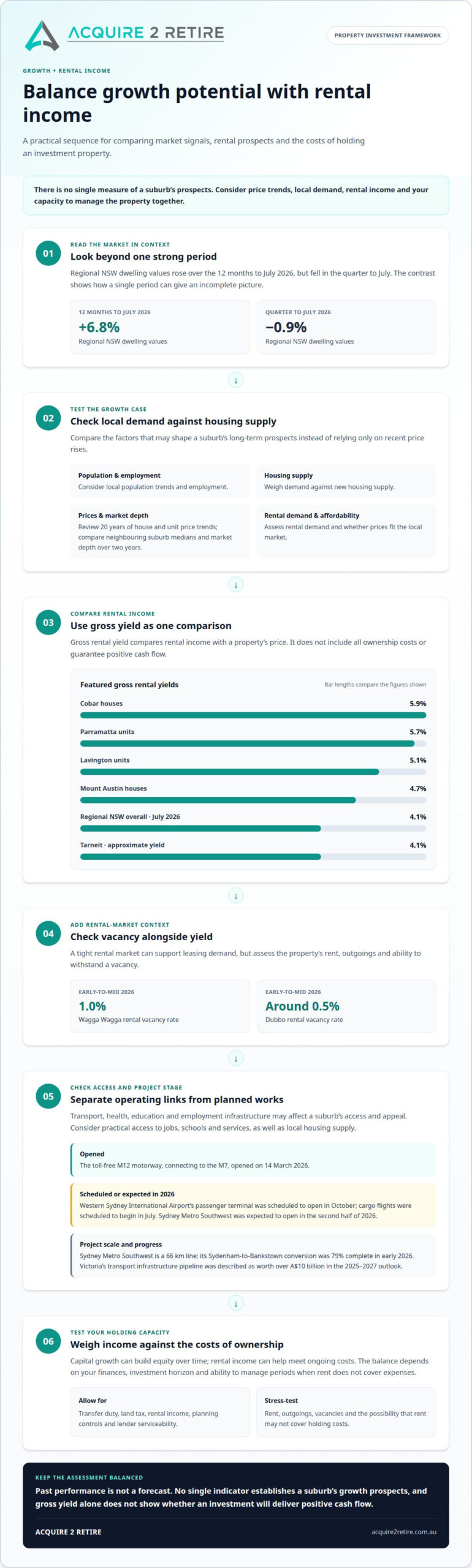
The strongest investment choice isn’t always the suburb with the biggest recent price rise. In Regional NSW, dwelling values rose 6.8% in the 12 months to July 2026, while the region’s gross rental yield was 4.1% in July 2026, so choosing future growth areas for property investment means weighing longer-term potential against the income a property may generate.
It’s understandable to want both steady rent and the prospect of capital growth, but they don’t always come together in the same location or property. A strong yield may support cash flow, while population trends, housing supply, local employment and infrastructure can help you assess a suburb’s growth prospects.
This guide explains how to balance growth and yield, what a buyers agent can contribute, and how to assess infrastructure and more affordable Western Sydney locations. You’ll also find a practical way to compare opportunities without relying on one recent result to make a long-term decision.
Key Takeaways
- Assess Melbourne suburbs through price trends, housing supply and local demand rather than relying on a single strong result.
- Balance potential capital growth with rental income and the cash-flow demands of holding an investment property.
- Consider how transport, employment and community infrastructure could affect a suburb’s appeal, while treating projects as one part of your assessment.
- Compare Western Sydney locations such as Mount Druitt for relative affordability, then weigh each property’s price against its rental prospects and investment goals.
1. How do buyers agents help investors identify growth areas?
An adviser can compare suburb profiles, property types and market signals before narrowing a shortlist. For future growth areas property investment, the key question is whether demand, supply and affordability support a property’s long-term prospects, not simply whether prices have risen recently.
In Melbourne, Tarneit, Pakenham East Precinct and Sunbury were identified as potential growth suburbs over the next 2-3 years. Their house prices rose approximately 2.3%, 6.9% and 6% respectively over 12 months. These differences show why suburb-level research matters. More than 100 Australian suburbs recorded average annual price growth of at least 10% in the latest PropTrack growth data cited, but that measure alone doesn’t establish future returns.
Recent rankings also vary by period and location. For quarterly price growth, Kimba in South Australia recorded 29.84%, Cooee in Tasmania 29.81%, and Bellamack in the Northern Territory 29.61%. For annual growth, Hopetoun in Western Australia recorded 49.74%, Mourilyan in Queensland 49.46%, and Orelia in Western Australia 49.65%. These are historical results, not suburb forecasts. Sydney also featured four locations in a growth-suburb list, while Liverpool houses recorded 14.3% one-year price growth.
Which property type leads? In one Regional NSW comparison, featured houses averaged 22.5% growth over 12 months, against 19.9% for units. That comparison doesn’t establish a national forecast for houses, units, industrial property or regional markets. Each responds to different demand and supply conditions.
State and city prospects differ, so compare local population, employment, housing supply, prices and rental demand rather than assuming one state leads. Tax, planning and lending considerations also vary by location and property. Account for transfer duty, land tax, rental income, planning controls and lender serviceability when assessing an investment.
To compare growth areas, examine 20 years of house and unit price trends, then compare neighbouring suburb medians and market depth over two years. A buyers agent can bring these signals together, assess the property and suburb, and weigh demand against new housing supply. No single indicator establishes a suburb’s growth prospects.
2. Balancing capital growth and cash flow
Capital growth can build equity over time, while rental income helps meet the ongoing costs of holding an investment. The right balance depends on your finances, investment horizon and capacity to manage periods when rent doesn’t cover expenses. A high-growth suburb may have a lower rental yield, while an established area with stronger rental returns may offer different growth prospects.
Use capital growth as one measure, not the whole investment case. Compare a suburb’s performance over several years with rental demand, population trends and available housing. Regional NSW dwelling values rose 6.8% in the 12 months to July 2026, but declined 0.9% in the quarter to July 2026. That contrast shows why a single period can give an incomplete picture of market conditions.
Gross rental yield offers a way to compare rental income with a property’s price, but it doesn’t show all ownership costs or guarantee positive cash flow. Regional NSW’s gross rental yield was 4.1% in July 2026. Among featured local examples, Cobar houses had a 5.9% gross yield, Mount Austin houses 4.7%, and Lavington units 5.1%. Tarneit’s approximate yield was 4.1%, compared with 5.7% for Parramatta units.
Vacancy rates add context to those figures. Wagga Wagga’s rental vacancy rate was 1.0% and Dubbo’s was around 0.5% in early-to-mid 2026. A tight rental market can support leasing demand, but investors still need to assess a property’s rent, outgoings and ability to withstand a vacancy.
Past performance is not a forecast. A careful portfolio assessment can weigh capital, rental income and holding capacity together; structured property investment planning can help organise those decisions.
3. Infrastructure projects and transport links
Transport, health, education and employment infrastructure can reshape a suburb’s access and appeal. Major Australian projects to assess include Western Sydney International Airport, Sydney Metro Southwest, the M12 motorway and Victoria’s transport infrastructure pipeline.
Project stage matters as much as the announcement. The toll-free M12 motorway connecting to the M7 opened on 14 March 2026. Western Sydney International Airport’s passenger terminal was scheduled to open in October 2026, while cargo flights were scheduled to begin in July 2026. Sydney Metro Southwest was expected to open in the second half of 2026; its Sydenham-to-Bankstown conversion was 79% complete in early 2026.
These timelines help distinguish operating links from construction and planned works. The Sydney Metro Southwest line is 66 km long. For nearby housing corridors, investors can consider how stations and road access connect families with jobs, schools and services, then assess whether local housing supply can respond to added demand.
Victoria’s transport infrastructure pipeline was described as worth over A$10 billion in the 2025-2027 outlook. That investment context may help identify suburbs positioned near improved connections, but a project’s value to a property depends on its location and practical access, not simply the project’s size.
Migration can add another demand signal. In the year to 31 March 2026, Queensland recorded net interstate migration of 14,718 people, while New South Wales recorded net interstate migration of -20,818 people. These state totals provide context, not a suburb-level forecast; population distribution and housing construction determine where demand is felt.
Compare a project’s announced, construction and operating stages, then map its access to established housing and employment areas. Interest costs also affect buyers’ capacity: the RBA raised Australia’s cash rate to 3.85% in February 2026. A transport upgrade may strengthen a suburb’s position, while borrowing conditions and competing housing supply still shape demand and returns.
4. Affordable Western Sydney investment areas
In Western Sydney, affordability is relative to Sydney’s broader market, not a promise of low entry costs. That comparison makes Mount Druitt a lower-priced house-market example, but price alone doesn’t establish value or growth potential.
Compare property types as well as suburbs. A unit and a house may involve different purchase prices, tenant demand and supply conditions. Assess comparable properties within each suburb before comparing one location with another.
Liverpool is another Western Sydney location to examine. Its houses recorded 14.3% one-year price growth, a past result that can help describe recent market performance, but doesn’t predict the next year. Sydney is expected to gain over 650,000 new residents by 2034, so population growth may support demand; where that demand settles depends on housing supply, employment and access to services.
Consider housing supply alongside population trends. City-wide figures provide context, not a suburb-level measure. Compare local rental demand with competing housing, then consider whether the property’s rent can support your cash-flow needs.
A practical shortlist can start with Mount Druitt, Parramatta, Marsden Park and Liverpool, comparing houses with houses and units with units. Weigh purchase affordability against rental prospects, access and supply, rather than selecting the lowest median or strongest past growth alone. For a considered Western Sydney purchase, plan your property investment strategy around your financial position and long-term goals.
Acquire2Retire
Acquire2Retire helps investors bring suburb research, growth potential and rental yield into a considered property investment plan. If you’re weighing affordable Western Sydney locations against other Australian markets, Planning & Strategy can help align the decision with your broader portfolio goals and financial position.
When you’re ready to move from research to action, Acquire2Retire can support property Acquisition, tailored Finance solutions and Tenancy coordination, alongside ongoing portfolio support. This joined-up approach helps connect the location decision with the practical steps involved in purchasing and preparing an investment.
If you’d like support weighing your property investment options, contact Acquire2Retire.
Make your next move with a clear investment thesis
Choosing future growth areas for property investment is not only about selecting a promising location. It also means setting a clear reason for buying, understanding what could change that view, and deciding how the property fits your wider financial plans. Before moving ahead, define the qualities that matter most to you, such as income stability, flexibility or the potential to build equity over time.
Keep your investment thesis practical. Identify the conditions that would make you reconsider a purchase, and decide how you’ll review the property’s performance as circumstances evolve. A deliberate framework helps keep short-term market noise from driving decisions that should serve your longer-term objectives.
When you’re ready to discuss your next step, contact Acquire2Retire today to explore an investment approach that reflects your goals. A thoughtful decision, made at your own pace, is a strong place to begin.
Frequently Asked Questions
Should I focus on capital growth or rental yield in Regional NSW?
Choose the balance that fits your finances and investment timeframe. Past growth is one data point, not a reason on its own to buy. Consider whether rental income, ownership costs and your ability to hold the property align with your goals.
Can a buyers agent tell me which suburb will grow the most?
No adviser can reliably identify in advance which suburb will grow the most. They can help assess a property’s location, comparable sales, buyer demand, housing supply and local employment, then explain how those factors fit your criteria. Treat any suburb ranking as a research starting point, not a forecast. Your budget, borrowing capacity and tolerance for risk also shape a suitable choice.
How do buyers agents help investors identify growth areas?
Property investment advisers can turn broad market research into a shortlist shaped around your goals. For instance, when considering a regional town, assess local employment drivers and whether new housing could compete with existing properties. At the property level, condition, layout and likely tenant appeal matter too. This helps distinguish an area with promising signals from a particular property that suits your plans.
Is it better to buy a house or a unit in Regional NSW?
Neither type is automatically better; compare local demand, purchase costs, maintenance needs and likely rent. A house may appeal to tenants seeking space, while a unit can suit a different household profile and price range. Regional NSW markets vary, so compare like with like in the same locality. Also consider the property’s condition and whether future spending could affect your cash flow.
When is the best time to buy near new infrastructure?
There isn’t one ideal purchase point for every infrastructure project. Consider how far work has progressed, whether the completed link will serve the specific property, and whether current prices already reflect expectations. Then test the investment against existing transport, employment and amenities, rather than relying only on a future project. A sound purchase should make sense for your plan even if construction timing changes.
Where are Australians moving to?
Migration patterns differ depending on whether you mean interstate or overseas arrivals. In the year to 31 March 2026, Queensland recorded net interstate migration of 14,718 people, while Western Australia recorded 10,314. Over the same period, net overseas migration was 84,573 in New South Wales, 81,732 in Victoria and 55,217 in Queensland. State totals don’t show where within each state people settle.