
Selling an investment property isn’t automatically the safer choice for retirement, and keeping it isn’t automatically better. The right property investment strategy for retirement depends on whether its expected income, costs and risks fit your long-term plans better than selling and using the proceeds elsewhere.
It’s understandable to weigh the appeal of a tangible asset against concerns about vacancies, repairs, debt and relying on rent. The decision also sits alongside your superannuation, savings, tax position and expected retirement income, so consider the whole picture rather than property in isolation.
This article explains when keeping or selling may make sense, what to weigh in each case, and how to compare both options with your broader retirement plans. You’ll have a clearer framework for deciding which path better supports the retirement you want.
Key Takeaways
- Start with the retirement income you want, then assess whether rent after costs can reliably help meet it.
- Compare the proceeds from selling with potential capital gains tax and acquisition costs before deciding what to do next.
- Consider your superannuation, savings and cash buffer alongside property, so your plan can support both regular income and unexpected expenses.
- Weigh the time needed for property investment to suit your plans against the flexibility you may gain by selling.
Should you use property to fund your retirement?
Property can contribute to retirement income, but rent alone may not meet your needs. Start by estimating the income your plans require, then compare property with your superannuation, savings and tolerance for costs.
Residential investment property
A residential investment property can provide rent and potential capital growth, while leaving you responsible for costs and periods without tenants. Financing may involve borrowing against income and assets; lenders assess serviceability, expenses, debts, loan term and repayment capacity. Older borrowers should understand how those criteria affect their borrowing options. Compare this hands-on asset with more diversified property investments before deciding.
Rental income, costs and vacancies
Rent is not the same as spendable retirement income. Repairs, maintenance, insurance, body corporate fees and land tax can reduce cash flow, while a property without tenants produces no rental income. An investment property may also affect the Age Pension assets and income tests, so include its potential effect when assessing your position. Build your plan around income after costs, not advertised rent alone.
Property yields and income targets
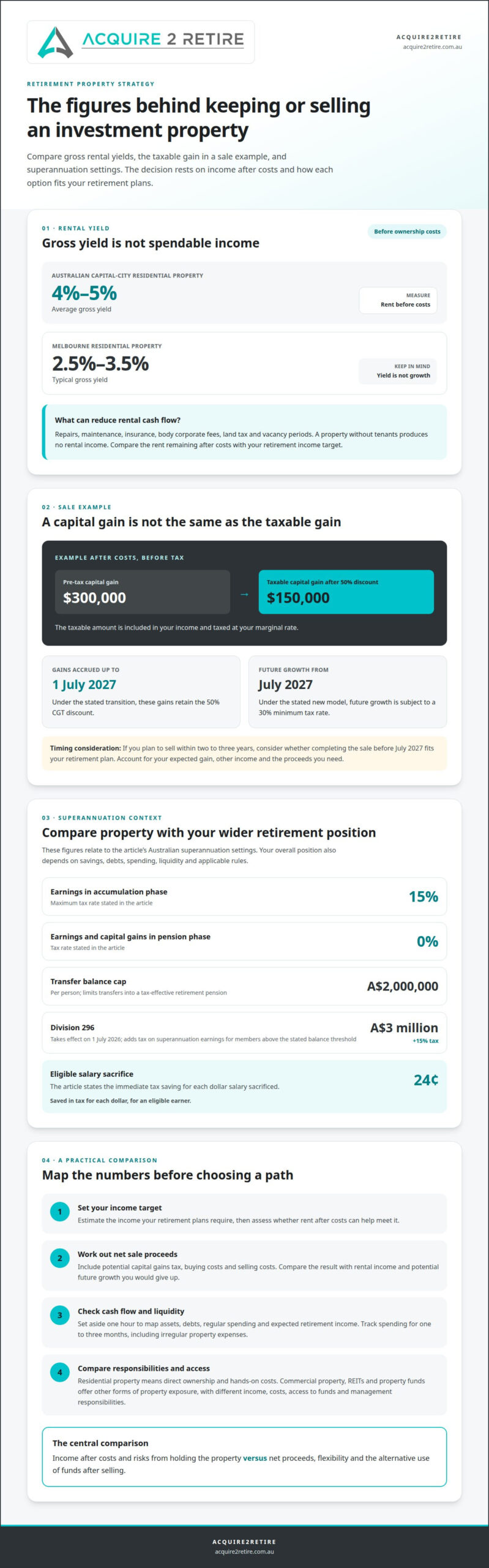
Australian capital-city residential property gross yields average 4% to 5%; Melbourne’s typical gross yield is 2.5% to 3.5%. These figures describe rental yield, not capital growth, which can vary between cities, regions and individual properties. Ownership costs can reduce rental income, so consider whether the remaining income would help meet your target. A yield comparison alone cannot establish which location will grow more.
Residential property offers direct ownership; commercial property, REITs and property funds provide other ways to gain property exposure. Their income, costs, access to funds and management responsibilities differ.
| Option | Income and costs | Ownership and access |
|---|---|---|
| Residential | Rent less property expenses | Direct ownership |
| Commercial | Income depends on the investment | Direct property exposure |
| REITs or property funds | Distributions depend on the investment | Units in a pooled investment |
Choose the option whose income after costs, risks and responsibilities fit your retirement target and financial situation.
Should I sell my investment property?
Selling can release capital for retirement, but the net proceeds depend on tax and selling costs. Compare those proceeds with the income and potential future growth you’d give up.
Capital gains tax timing
In Australia, a capital gains tax event can arise when you sell an investment property. Under the stated transition, gains accrued up to 1 July 2027 retain the 50% CGT discount; future growth from July 2027 is subject to a 30% minimum tax rate under the new model.
If you plan to sell within two to three years, consider whether completing the sale before July 2027 fits your retirement plan. The timing decision should account for your expected gain, other income and the proceeds you need.
Capital appreciation and selling
Capital appreciation is the increase in a property’s value, but it becomes available as cash only when you sell or borrow against the asset. For example, a $300,000 pre-tax capital gain after costs becomes a taxable capital gain of $150,000 after the 50% discount. The taxable amount is included in your income and taxed at your marginal rate.
Compare the after-tax sale proceeds with the rental income and potential growth you’d relinquish. This keeps past returns in perspective as you decide what supports your future plans.
Rental income and negative gearing tax
Australian rental income is assessed on its net amount per financial year, alongside the amount and type of your other income, and taxed at your marginal rate, up to 47%. Eligible property expenses may be deductible. A property bought before 7:30pm on 12 May 2026 retains full negative gearing against salary while held, under the stated transition.
Negative gearing describes a rental property where deductible expenses exceed rental income; a tax deduction doesn’t by itself make the investment profitable.
Buying also involves acquisition costs. Include buying costs and selling costs in your net-proceeds calculation, then compare the result with holding the property. Property acquisition planning can help frame that comparison as part of a broader investment decision.
Assessing current finances, superannuation and emergency savings
Set aside one hour to map your assets, debts, regular spending and expected retirement income. Then track spending for one to three months to understand your actual cash flow, including irregular property expenses. Separate money needed soon from investments intended to support a longer-term income stream, so liquidity remains part of the decision.
Compare rental income after costs with your superannuation and savings. Australian superannuation earnings are taxed at a maximum of 15% during accumulation, while earnings and capital gains in pension phase are taxed at 0%. The transfer balance cap is A$2,000,000 per person, limiting how much can be transferred into a tax-effective retirement pension.
Concessional contributions are taxed at 15% inside super. For an eligible earner, each dollar salary sacrificed saves 24 cents in tax immediately. Sale proceeds may be added to super through non-concessional contributions and the bring-forward rule, subject to applicable contribution rules. Compare this option with keeping funds available outside super, where they may provide greater liquidity for planned spending or unexpected needs.
Factor in balance-specific tax settings as well. Division 296 takes effect on 1 July 2026 and adds 15% tax on superannuation earnings for members with balances above A$3 million. Before Age Pension age, super in accumulation phase is not counted in the assets test for most people. Later, property and super can affect your Age Pension position under the applicable tests.
- Keep an emergency cash buffer for health, travel or unexpected expenses.
- Assess whether rental income and super together can support your planned spending.
- Consider how a sale changes super, accessible savings and your estate plans.
Treat that estimate as a prompt to assess your own income needs, not as a personalised projection.
Property investment as a long-term retirement strategy
A property portfolio can support retirement over a long horizon, but it needs to fit your lifestyle and wealth goals. Plan for a retirement lasting 20 or 30 years, and consider how mortgage repayments, rental income and other assets may change along the way. The aim is a sustainable balance, not simply owning more property.
Australian dwelling values increased by 382% over the 30 years from July 1992, an average compound annual growth rate of 5.4%. That historical growth illustrates property’s long-term potential, but it doesn’t predict the performance of a particular home, suburb or region. Your expected returns should account for location, costs, debt and the time you can remain invested.
Property buyers generally need an investment horizon of at least ten years to ride out market cycles, absorb acquisition costs and allow growth to compound. If retirement is closer, assess whether holding still suits your cash-flow needs and debt position. A diversified portfolio can reduce reliance on one asset or rental market while preserving access to funds for changing needs.
One example describes acquiring four investment properties in six years, while another models investing for 15-20 years before holding a debt-free portfolio worth A$2.5 million. These are illustrations, not a required pathway or assured outcome. The useful question is whether a staged plan leaves enough time to reduce the mortgage before retirement.
For an income-focused illustration, a debt-free portfolio worth A$2.5 million at a 4% net yield would generate A$100,000 per year. Actual results depend on costs and rental performance, so test different scenarios before relying on that income.
- Match the investment horizon to your retirement timeline.
- Test whether debt reduction supports your desired lifestyle.
- Consider how property fits alongside other diversified assets.
For a structured view of how property may fit your long-term plans, develop a property investment strategy.
Acquire2Retire: Planning & Strategy
Acquire2Retire can help bring your property decisions into a coordinated investment plan, particularly when you’re weighing whether to keep an asset, sell it or adjust your portfolio before retirement. Its Planning & Strategy work considers how property goals fit your broader wealth plans, while Acquisition and Finance support decisions about future investments and funding. Tenancy coordination can also be part of the plan.
This support is useful when you want to turn retirement income needs, property commitments and longer-term goals into a clear course of action. The focus is on making considered choices that reflect your position, rather than treating one property decision in isolation.
Contact Acquire2Retire to discuss your property investment plans.
Shape your next retirement decision
Your next step is to turn the decision into a plan you can revisit as your circumstances change. Clarify what you want your assets to support, which trade-offs feel acceptable, and what would prompt you to reconsider holding or selling. This gives you a practical reference point rather than leaving the choice to market movements or uncertainty alone.
A property investment strategy for retirement should connect property decisions with the life you want to fund, not treat them as a separate exercise. With a considered plan, you can approach the next stage with clearer priorities and a better sense of how each decision fits your longer-term direction.
If you’re ready to discuss how your property plans fit your retirement goals, contact Acquire2Retire. A thoughtful next step can help you move forward with greater confidence.
Frequently Asked Questions
What property investment strategies suit retirement in Australia?
A property investment strategy for retirement should match your income needs, time horizon and appetite for risk. Direct residential ownership may suit investors comfortable with property-specific costs and tenant changes; REITs or property funds offer exposure without owning a building directly. Some retirees prioritise lower debt and rental cash flow, while others may prefer selling and spreading the proceeds across different assets. Compare access to money and diversification, not just headline returns.
How much superannuation and property income is needed for retirement in Australia?
There’s no single balance or rental income amount that suits every Australian; estimate your own spending needs first. Set out regular living expenses and larger plans, then compare them with likely superannuation income, savings and property income after costs. For a property investment strategy for retirement, consider how long your savings may need to support you and whether Age Pension income could form part of the picture. Review your estimate as circumstances change.
What are the costs of buying and holding an Australian investment property, including stamp duty, rates and maintenance?
Budget for purchase costs and recurring expenses rather than treating rent as your net return. Stamp duty depends on the property’s location and transaction, while ongoing outgoings can include council rates, insurance, repairs and maintenance, body corporate fees and land tax. A property needing urgent work can also require cash before rent resumes. Build a reserve into your plan and assess costs against rental income after those outgoings.
What are the risks of property investment for retirement, including vacancies, interest rates and liquidity?
The main risks include interrupted rent, higher borrowing costs, unexpected repairs and difficulty accessing your capital quickly. A vacancy means no rental income during that period, while mortgage repayments and other ownership costs may continue. Test whether your budget can absorb a short vacancy, rising interest rates and a major repair without relying on immediate rent or a quick sale. Accessible savings can help cover unexpected expenses.
What steps should Australians take to build and manage a property investment plan for retirement?
Begin with your retirement income target, current assets, debts and available savings, then decide how property might contribute. Model the proposed investment’s rent after expenses, loan repayments, vacancy periods and maintenance needs. Compare keeping it with selling, including tax and the role of superannuation. Set review points for changes in your income, debt or retirement timing, and adjust your plan when those changes affect its fit with your goals.