
Your first property doesn’t have to be the home you live in. Asking yourself, “Is property investment right for me?” means weighing whether an investment property fits your finances, lifestyle and long-term goals better than buying a home to live in. There’s no single option that suits everyone, so start by comparing how each choice supports your plans.
It’s understandable to focus on the purchase price, but the decision also involves ownership structure, tax treatment and costs that continue after settlement. A home can be shaped around your needs, while an investment property may generate rental income, growth in value, or both, alongside its own financial responsibilities.
This article helps you compare buying a home with investing, understand individual, joint, trust, company and super fund ownership, and see how negative gearing eligibility can differ for established properties and new builds. It also covers ongoing costs, vacancies and loan repayments, so you can assess the trade-offs more clearly.
Key Takeaways
- Weigh the lifestyle and security of buying a home against the potential rental income and growth of an investment property.
- Understand how negative gearing eligibility can differ between established properties and new builds under announced changes.
- Compare individual, joint, trust, SMSF and company ownership based on how each structure affects your investment plans.
- Build a clearer picture of ongoing costs, vacancies and loan repayments before deciding what may suit your finances.
Should an adviser help you decide whether your first property should be a home or investment?
An adviser can compare buying a home with investing in light of your finances, lifestyle and long-term plans. If you’re weighing whether property investment is right for you, look beyond the purchase price: consider cash flow, potential rental income, capital growth, tax treatment and the responsibilities of ownership.
Rental yield measures rental income against a property’s value, while capital growth depends on its value rising over time. Neither makes a purchase suitable on its own. An adviser can assess likely rent against loan repayments and ongoing costs, then consider how vacancies, maintenance and insurance could affect cash flow. Direct property differs from shares, ETFs and superannuation: it concentrates investment in an asset that can be harder to sell, while diversified funds spread exposure. Outcomes depend on the asset and strategy.
The Australian Taxation Office says individuals can generally access a 50% capital gains tax discount for assets held for more than 12 months under current rules. Announced changes from 1 July 2027 replace that discount with indexation and a 30% minimum tax for individuals and companies; gains accrued before that date are expected to retain current treatment. A capital gain is generally the sale price less purchase price and purchase fees, with eligible costs affecting the cost base. Companies don’t receive the 50% discount; rental income is taxed at 25% for base rate entities and 30% for larger companies.
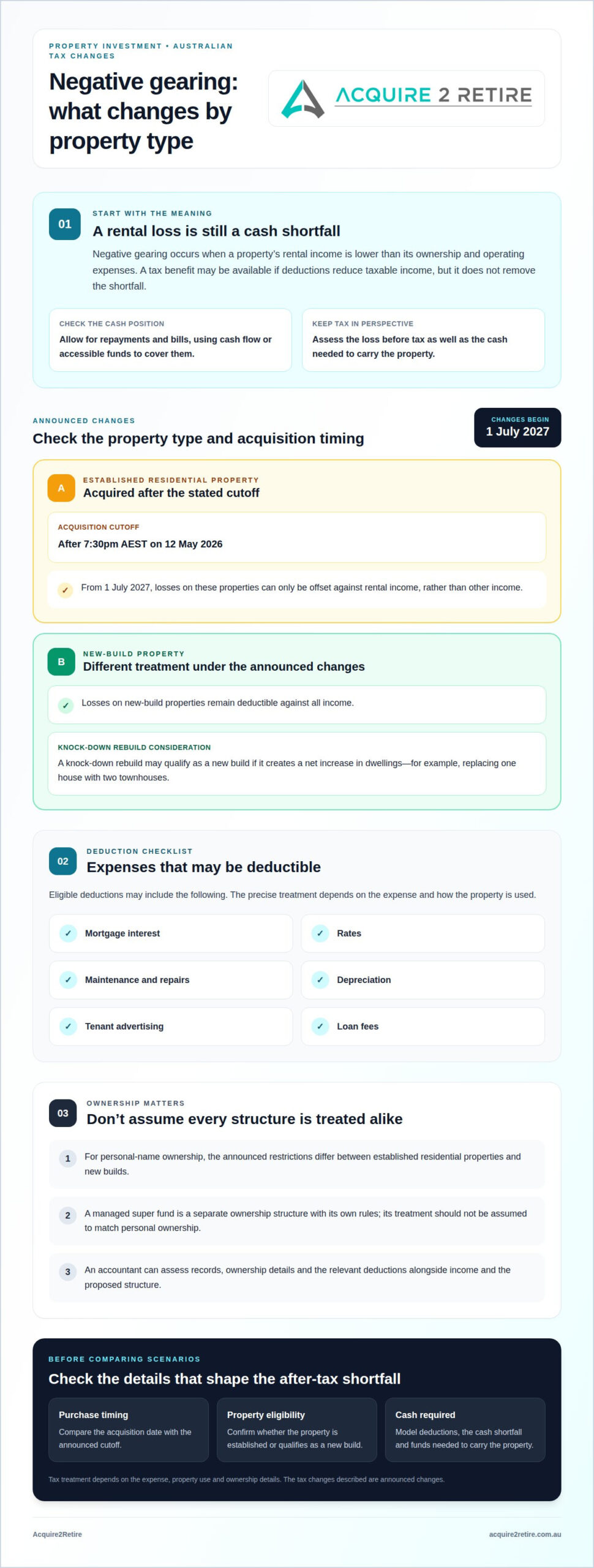
Negative gearing describes rental income falling short of property expenses. Under announced changes, losses on established residential properties acquired after 7:30pm AEST 12 May 2026 can only offset rental income from 1 July 2027. That tax treatment should sit alongside, not replace, a cash-flow assessment.
Landlord duties and tenancy laws differ across Australian states and territories, so local rules shape tenancy obligations. Tenancy coordination can help organise this part of an investment, but legal responsibilities still come with ownership. Pros include rental income and possible capital growth; cons include vacancies, expenses, concentrated risk and an asset that is less accessible than shares or ETFs.
| Option | Income | Capital potential | Key consideration |
|---|---|---|---|
| Home to live in | No rent from yourself | Potential value growth | Lifestyle and repayments |
| Investment property | Rent, less expenses | Potential value growth | Vacancies and ownership costs |
| Shares, ETFs or super | Depends on investment | Depends on investment | Different exposure and liquidity |
Choose by comparing after-cost cash flow, tax treatment, genuine lifestyle needs and the time you can devote to managing an investment.
Negative gearing eligibility for established properties and new builds
Negative gearing occurs when an investment property’s income is lower than its ownership and operating expenses. The resulting rental loss may provide a tax benefit if deductions can reduce taxable income, but that benefit doesn’t erase the shortfall. The property still needs enough cash flow, or accessible funds, to cover repayments and bills.
Eligible deductions may include mortgage interest, rates, maintenance, repairs, depreciation, tenant advertising and loan fees. The precise treatment depends on the expense and the property’s use. An accountant can assess your records and ownership details, while an investment assessment should also model the loss before tax and the cash needed to carry it.
The 2026-2027 Federal Budget announced changes for established residential properties acquired after 7:30pm AEST 12 May 2026. From 1 July 2027, losses on those properties can only be offset against rental income, rather than other income. This changes how a negative gearing benefit may be used, so the acquisition date and property type matter when comparing scenarios.
Under the announced changes, losses on new-build properties remain deductible against all income. A knock-down rebuild may qualify as a new build if it creates a net increase in dwellings, such as replacing one house with two townhouses. That distinction can affect tax treatment, but it doesn’t make an investment’s underlying cash flow positive.
For personal-name ownership, the announced restrictions differ depending on whether the residential property is established or newly built. A managed super fund is a separate ownership structure with its own rules, so its treatment shouldn’t be assumed to match personal ownership. An accountant can model the relevant deductions alongside your income and proposed structure.
Before committing, compare purchase timing, property eligibility, deductible expenses and the after-tax cash shortfall. For a structured view of these factors, consider property investment strategy support.
How an adviser can help you choose between individual, joint, trust, SMSF and company ownership
An adviser can compare ownership structures against your income, marginal rate, borrowing capacity and plans for the property. A sound comparison considers who owns the asset, how rental income and losses are treated, and the responsibilities that come with each structure. Tax modelling with an accountant can show how the choices affect potential savings and future flexibility.
Individual ownership puts the property in one person’s name, while joint ownership involves shared ownership and decisions. A trust or company adds a separate ownership structure, so control, tax treatment and administration need consideration alongside the property’s expected performance. An adviser can compare these options with your circumstances rather than choosing a structure based on tax outcomes alone.
SMSF property investment may suit an investor with a long-term retirement strategy and sufficient fund assets. Specialists commonly recommend a fund balance of A$200,000 to A$300,000 before considering direct property. Rental income within an Australian SMSF is taxed at 15%, and the fund’s investment strategy must support the purchase.
SMSF borrowing has specific constraints, including restrictions on renovations using borrowed funds. SMSF property arrangements can be subject to restrictions, so seek advice before proceeding. Buying commercial property and leasing it to your own business at market rates may suit some strategies; plans that rely on renovations, subdivisions or development may be unsuitable.
Division 296 took effect on 1 July 2026. It introduces an additional 15% tax on superannuation earnings attributable to balances above A$3 million; for members above A$10 million, the additional tax rises to a total of 25% on earnings above that threshold. This can affect the projected benefit of holding property in super.
SMSF assets and related-party dealings are subject to investment restrictions, with business real property an exception to in-house asset and related-party acquisition rules. An adviser can compare ownership alternatives, borrowing needs and retirement objectives, then coordinate tax modelling with an accountant before you select a structure.
Ongoing costs, vacancies and loan repayments
Model repayments, operating expenses and vacant periods together because each affects cash flow differently. Loan terms also vary by property and ownership structure.
Ongoing property costs
An investment property costs more to hold than its loan interest. Strata or body corporate fees, council and water rates, insurance, repairs and property management fees can all add to outgoings. These costs continue even when rental income is steady, unlike vacancy costs, which arise when rent stops. Include them in a strict cash-flow assessment rather than relying on rent alone.
Vacant-property periods
A vacancy interrupts rental income, but mortgage repayments and property expenses continue. A rentvestor may also need to keep paying rent for their own home during this period, leaving two housing costs to meet. Model a vacant period against available cash reserves and repayments rather than assuming tenants will always cover the investment’s costs. This pressure is separate from the property’s longer-term capital gains tax treatment.
Home loan repayments
Buying a home to live in generally gives borrowers lower interest rates than buying an investment property. At the time of writing, standard investment loan rates were roughly 5.5% to 6%. That difference can affect repayments and the monthly budget, although the loan amount and terms also matter. A lower rate is an advantage, but it doesn’t remove ownership costs or make a home affordable by itself.
SMSF property borrowing has different constraints. Residential SMSF loans were around 6.6% to 6.8% at the time of writing, with loan-to-value ratios often around 70% to 80%; commercial property may have lower ratios. These stricter terms can require more fund capital and affect retirement assets’ liquidity. Announced tax changes, including capital gains tax treatment, may influence after-tax outcomes, but a tax advantage linked to a marginal rate doesn’t cover repayments. Compare loan interest, operating costs and vacancy capacity before choosing between personal and SMSF borrowing.
For support modelling property cash flow and loan commitments, plan your investment finances.
Acquire2Retire
Acquire2Retire helps Australians assess whether property investment fits their finances, goals and preferred ownership structure. Its Planning & Strategy work can bring together the factors discussed here, including potential cash flow, tax considerations, borrowing and ongoing responsibilities, so the decision is grounded in a coherent investment approach.
If investing aligns with your plans, support can extend to Acquisition and Finance, with Tenancy coordination and ongoing support as your portfolio develops. This creates a connected pathway from shaping the strategy to progressing with a suitable property and considering its longer-term needs, without treating a tax benefit as the only measure of success.
If you’d like to discuss your property investment plans, contact Acquire2Retire.
Choose a path that fits your next chapter
The question “Is property investment right for me?” is best answered by looking beyond the property itself. Consider how investing would fit the life you want to lead, the flexibility you value and the responsibilities you’re comfortable carrying. Your preferred path can change as priorities shift, so treat the decision as a strategy to revisit, not a label you must keep forever.
A useful next step is to turn your priorities into a clear decision framework: what needs to remain affordable, what role property should play in your wider plans, and which trade-offs feel acceptable. This gives a future purchase a purpose and helps clarify whether to proceed now, wait or focus on buying a home instead. Your timeframe and capacity for change can help shape that choice.
If you’re ready to work through those choices with structured guidance, contact Acquire2Retire. A considered plan can help you move forward with greater clarity and confidence, at a pace that suits you.
Frequently Asked Questions
Are new builds now better for investors?
Not automatically. A new build may have different tax treatment, but that alone doesn’t make it the better investment. For example, compare the expected rent and purchase price of a new home with an established property that suits your investment plan. Also consider construction quality, tenant demand and ongoing costs, as well as whether the property meets your broader financial goals.
How much can you borrow?
Your borrowing capacity depends on your income, existing debts, regular expenses, deposit and proposed loan. Lenders also assess whether repayments remain manageable under their lending criteria. For example, an investor with substantial existing repayments may have less capacity than someone on the same income with fewer commitments. A Finance assessment can help establish a realistic purchase range before you focus on a particular property.
Negative Gearing Changes 2026: Should You Still Invest?
Potentially, but the decision should make sense beyond the tax outcome. Under announced changes, losses on established residential properties acquired after 7:30pm AEST 12 May 2026 can only be offset against rental income from 1 July 2027; new-build losses remain deductible against all income. Compare each property’s expected rent, costs and purchase timing, then consider whether the investment remains suitable without relying on a tax benefit.
Should I speak to my accountant or broker first?
Speak with an accountant and a mortgage broker early, because they address different parts of the decision. An accountant can explain how ownership structure and potential deductions affect your tax position. A mortgage broker can assess borrowing capacity and finance options. For example, if a proposed structure changes the lending approach, discussing the plan together can help align tax considerations and loan assumptions before you commit to a purchase.
So Should You Still Buy?
Buy only when the property and its financial demands fit your circumstances, not because a tax rule or market headline creates pressure. Consider whether you could meet repayments during a vacancy, cover ongoing expenses and hold the asset through changes in your plans. If those commitments would leave too little flexibility, delaying or reconsidering the purchase may be more appropriate than stretching your budget.
How much deposit and upfront costs are needed to buy an investment property in Australia?
There isn’t one deposit amount or upfront-cost total that applies to every Australian purchase. The deposit depends on the lender’s assessment, loan structure and property; upfront expenses can include state or territory stamp duty, conveyancing, inspections and loan-related costs. For example, buyers purchasing at different prices or in different jurisdictions can face different totals, so include these expenses in your borrowing plan.