
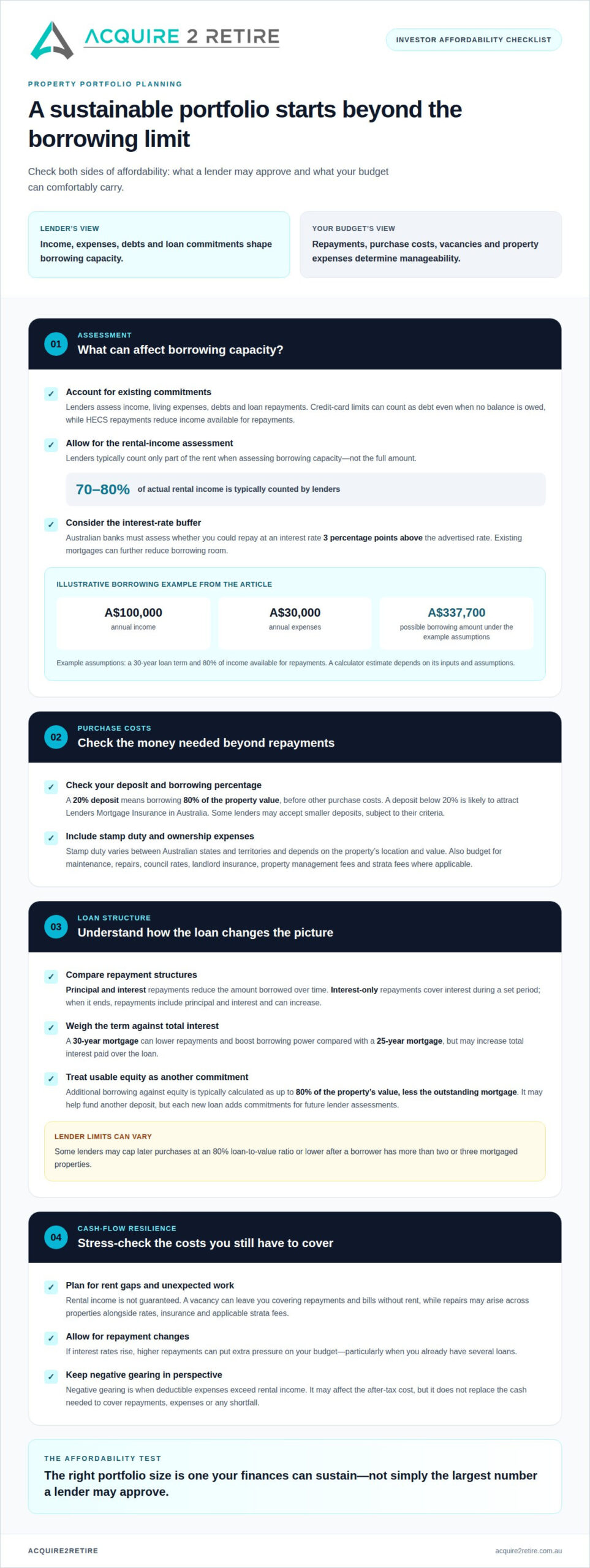
There’s no fixed maximum number of investment properties you can afford. How many investment properties can I afford depends on your income, existing debts, available deposit and how lenders assess each loan, as well as whether your budget can cover the costs beyond repayments.
It’s understandable to want a clear number, but borrowing capacity is only part of the picture. Rental income may support your finances, while vacancies, property expenses and changes in repayments affect how comfortably you can manage each investment. Negative gearing may also affect the after-tax cost, but it doesn’t remove the need to cover any shortfall from your own cash flow.
This article explains how income, investment loan structures, rental income and negative gearing can shape borrowing capacity, then considers the practical budget factors that determine whether another property is manageable. The right portfolio size is one your finances can sustain, not simply the largest number a lender may approve.
Key Takeaways
- Assess affordability through both lender borrowing capacity and the ongoing costs of owning an investment property.
- Understand how loan structure, usable equity and the way lenders assess rental income can shape future borrowing options.
- Factor in cash-flow shortfalls when considering negative gearing; a potential tax benefit doesn’t replace money needed for repayments and expenses.
- Build a budget that accounts for purchase costs, vacancies and maintenance before deciding whether another property fits your finances.
Can I Afford an Investment Property?
There’s no fixed number of properties you can afford. Lenders assess your income, expenses, debts and commitments, while your own budget must also cover the costs of ownership.
Ongoing property expenses
Ongoing property expenses are the costs of owning a rental beyond loan repayments, and they affect how much cash you need to keep available. Budget for maintenance, repairs, council rates, strata fees where applicable, landlord insurance and property management fees. Stamp duty also affects upfront affordability: rates differ between Australian states and territories, and the amount payable depends on the property’s location and value.
Estimating borrowing power
Borrowing power is an estimate of how much a lender may let you borrow after assessing income, expenses, debts and loan commitments. For example, an Australian borrower earning A$100,000 annually, with A$30,000 in annual expenses, may borrow A$337,700 under example assumptions of a 30-year loan term and 80% of income available for repayments. Credit-card limits can count as debt even when no balance is owed, while HECS repayments reduce income available for loan repayments. Existing commitments therefore matter alongside income.
Using a borrowing capacity calculator
An Australian borrowing capacity calculator estimates how a potential loan fits your finances. An adviser can use it alongside your income, living expenses, existing debts and loan commitments to estimate borrowing room, then consider how proposed rental income affects the assessment. The estimate helps frame how many properties may be affordable, but the answer also depends on purchase prices, deposits and ongoing costs. A calculator is only as useful as its inputs and assumptions.
Risks of multiple properties
Owning multiple properties means managing several sources of costs and cash-flow risk at once. Rental income isn’t guaranteed, so a vacancy can leave you covering repayments and bills without rent coming in. Repairs may also arise across properties, alongside rates, insurance and applicable strata fees. If interest rates rise, higher repayments can put further pressure on your budget, particularly when you already have several loans.
Investment loan structures and specialist lenders
Investment loan structures affect repayments, usable equity and how lenders assess borrowing capacity. The right arrangement depends on your cash flow, tax position and plans for future purchases.
Investment loan structures
Investors can use principal-and-interest or interest-only repayments, and may borrow against equity in an existing property. Additional borrowing against a property’s equity is typically calculated as up to 80% of its value, less the outstanding mortgage. That equity may help fund another deposit, but each new loan adds commitments that lenders include when assessing subsequent applications.
Repayment structures and interest rates
Principal-and-interest repayments reduce the amount borrowed over time, while interest-only repayments cover interest during a set period. When that period ends, repayments include principal and interest, which can increase the amount due. A 30-year mortgage can lower repayments and boost borrowing power compared with a 25-year mortgage, but may increase total interest paid over the loan.
Investor eligibility and rates
Investor loan eligibility depends on lender criteria, including income, expenses, existing debts and the proposed property’s rental income. Investor loans often have slightly higher interest rates and stricter eligibility criteria than an owner-occupied home loan. Lenders typically count 70-80% of actual rental income when assessing borrowing capacity, rather than treating the full rent as available for repayments.
Investment loan borrowing capacity
Borrowing capacity for another investment loan reflects both serviceability and the lender’s view of your portfolio. Some lenders may cap later purchases at an 80% loan-to-value ratio or lower after a borrower has more than two or three mortgaged properties. Most property expenses, including interest on a loan used to buy an investment property, may be claimed against rental income. This tax treatment can affect after-tax cash flow, but doesn’t replace funds needed for repayments.
For a considered view of loan structures and future purchases, investment finance planning can help bring these factors together.
Negative gearing in borrowing capacity calculations
Negative gearing occurs when an investment property’s deductible expenses exceed its rental income. It may affect the after-tax cost, but lenders still assess repayments, debts and cash flow when considering another investment loan.
Interest-rate buffers
An interest-rate buffer means lenders test whether repayments remain manageable at a higher assessment rate. Australian banks must assess whether a borrower can repay a home loan at an interest rate 3 percentage points above its advertised rate. This can reduce borrowing capacity compared with an estimate based on the advertised rate alone, particularly when existing mortgages already take up a share of income.
Deposit size and borrowing percentage
Your deposit determines how much of a property’s value the investment loan needs to cover. A deposit below 20% is likely to attract Lenders Mortgage Insurance in Australia, adding to the purchase costs. A 20% deposit means borrowing 80% of the property value, before other purchase costs. Some lenders may accept smaller deposits, but the loan amount and lender criteria still shape affordability.
How lenders calculate borrowing power
Lenders assess income, living expenses, existing debts, loan repayments and the proposed investment’s likely costs. They also test repayments using the higher assessment rate, rather than relying only on the advertised interest rate. For example, an investor earning A$100,000 a year may potentially buy a property worth about A$422,000 with a 20% deposit under the stated example assumptions. Approval depends on the full application and lender criteria.
Rental income and yield
Rental income can support borrowing capacity, while rental yield shows rent in relation to a property’s price. Lenders may recognise less than the full rent when estimating serviceability. In one example, three properties earning A$450 per week each contribute A$315 per week per property to the assessment for a fourth purchase. That discount reduces recognised rental income by A$405 per week across the portfolio, affecting the lender’s view of repayment capacity.
Budgeting for investment property affordability
A workable investment budget balances the purchase price with cash flow after settlement. In Australia, the number of properties your finances can support depends on deposits, buying costs, rental income and expenses that continue between tenancies.
Upfront costs include state or territory stamp duty and conveyancing, alongside the deposit and other purchase expenses. These amounts vary with the property and its location. For example, Queensland stamp duty on a A$600,000 investment property exceeds A$20,000.
Build your ongoing budget around actual costs, not rent alone. Loan repayments and other ownership expenses need to be included. Keep funds available for repairs and periods without tenants, rather than treating every rental dollar as spare income.
Vacancies can change the annual picture: a property renting for A$600 a week loses A$1,200 in rent during two vacant weeks, before reletting costs. Some investors keep a buffer of 1 or 2 months ahead of mortgage repayments. A calculator can model property projections for 1, 5, 10 and 30 years, helping show how cash flow changes over time. A 30-year commitment also calls for a budget that can absorb changing costs, not just the first year’s figures.
For an affordability assessment that brings purchase costs, rental assumptions and ongoing expenses together, discuss your investment property budget.
Acquire2Retire
Acquire2Retire helps investors connect their property goals with a considered view of affordability and portfolio strategy. Its Planning & Strategy, Finance, Acquisition and Tenancy offerings can support decisions from assessing a potential purchase through to coordinating tenancy.
Turn to Acquire2Retire when you want to weigh borrowing capacity alongside deposits, rental assumptions, ongoing costs and your longer-term plans. This broader assessment can help clarify whether another property fits your circumstances, rather than focusing on loan approval alone. The right portfolio size is shaped by what your finances can sustainably support.
Contact Acquire2Retire to discuss your investment property plans.
Set a sustainable pace for your portfolio
A sound answer to how many investment properties can I afford is not simply the largest number a lender might approve. It is the point at which your portfolio supports your broader financial plans without leaving too little room for everyday needs, unexpected costs or other priorities. Your circumstances shape that balance, and it may change as your income, commitments and investment goals evolve.
Before moving towards another purchase, consider what you want the portfolio to contribute over time and how each acquisition fits that direction. Acquire2Retire can bring Planning & Strategy, Acquisition and Finance together to help connect your investment goals with a considered purchasing approach. This can be useful when you are weighing a first property, planning another acquisition or reassessing your next move.
There is no need to rush a decision. A clear strategy can help you choose a pace that feels workable while keeping future options in view. Contact Acquire2Retire about your plans and take the next step with a steady, informed perspective.
Frequently Asked Questions
How does debt affect my borrowing power?
Debt reduces the income available to support another mortgage, so existing repayments and credit commitments can limit borrowing power. For example, a car loan payment remains part of your financial commitments even if you have substantial savings. Lenders consider the combined effect of debts and living costs, so paying down an existing balance may change the borrowing room available for a future investment loan.
How much can I borrow?
There’s no single answer to “how many investment properties can I afford”; the amount you can borrow depends on your income, household expenses, current debts, deposit and the lender’s assessment. A lender also considers the proposed property and expected rental income. Assess the likely loan alongside buying costs and cash reserves, rather than treating borrowing capacity as your available purchase budget.
Does having a guarantor increase borrowing power?
A guarantor may support a home loan application by offering additional security, but that doesn’t automatically increase what you can afford to repay. Lenders still assess the borrower’s income, expenses and existing commitments, and may consider the guarantor’s financial position and the security offered. The arrangement can affect the deposit or loan structure, so understand how it fits your circumstances before relying on it.
How accurate is a borrowing power calculator?
A calculator can help explore “how many investment properties can I afford”, but its result is a rough estimate based on the figures and assumptions entered, not a lender’s final assessment. If household spending, credit limits or loan repayments are entered inaccurately, the estimate can differ from an application outcome. Use it to explore possible scenarios, then treat the result as a planning guide, not financial advice.
How do Australian lenders calculate borrowing capacity for investment property?
Australian lenders assess whether your income can support proposed repayments alongside living expenses, existing loans and other financial commitments. They also consider the investment property’s rental income and test repayments at an assessment rate above the advertised rate. If you have several loans, the combined commitments matter: strong rent from one property doesn’t remove the repayment obligations attached to the others.
How much deposit is needed to buy an investment property in Australia?
Buyers may need a deposit of 10% to 20% or more of the purchase price, while some lenders may accept as little as 5%, subject to circumstances. A deposit below 20% is likely to attract Lenders Mortgage Insurance. The deposit is only one part of the upfront funds required, with stamp duty and other purchase costs also affecting the cash needed to complete a purchase.