
A property decision can shape your finances for years, so a clear strategy matters more than simply finding a property to buy. If you’re weighing the question, do I need a property investment advisor, the answer depends on your goals, experience and the time you can give to research and decision-making.
It’s understandable to want a steady, informed process when market conditions, finance and personal plans all influence an investment. Property investment advice itself isn’t licensed under an Australian Financial Services Licence in the same way as advice on financial products, so understanding an adviser’s role and credentials is an important part of choosing support. This article explains how an adviser can assess your goals, market conditions and investment strategy, what to expect from the process, and which credentials and boundaries to consider before proceeding.
Key Takeaways
- Clarify how your financial position, personal plans and risk tolerance shape a suitable property investment strategy.
- Assess local market conditions alongside the trade-offs between potential capital growth and rental income.
- Consider how interest rates, vacancy and maintenance could affect the investment’s cash flow before settling on a strategy.
- Understand the difference between property investment advice and licensed financial product advice when assessing an adviser’s credentials.
Communicating goals and receiving a Statement of Advice
An adviser’s value starts with understanding your circumstances, objectives and investment strategy. The recommendations and documents you receive depend on whether the engagement concerns property decisions or personal financial products.
Defining financial advice goals
Start by identifying the decision you need help with: planning a property portfolio, assessing a purchase or arranging finance. Explain how your income, existing commitments and future plans could affect your capacity to invest. This context helps an adviser shape recommendations around your objectives, risk tolerance and preferred level of support, whether you need help with a single decision or ongoing guidance.
Property and financial advice
A property investment adviser can develop an investment strategy, research suitable properties, support a purchase and provide guidance before and after acquisition. A buyer’s agent focuses on property selection and purchase, while a mortgage broker helps with lending options. A financial adviser considers your broader financial situation and may provide personal advice about financial products. Property investment advice is not licensed under an Australian Financial Services Licence (AFSL) in the same way as financial product advice.
For personal financial advice, an adviser should understand your circumstances before making recommendations. A Statement of Advice explains recommended strategies and products. It is different from a property strategy or purchase plan, so clarify which advice and documents the engagement covers.
Tax, ownership structures, self-managed super funds and licensed financial products involve separate advice questions. Property investment advisers should direct these matters to appropriately qualified professionals; legal and conveyancing questions require legal advice. Lending decisions depend on your financial position and the lender’s assessment, so distinguish finance guidance from a property recommendation.
When comparing a property investment adviser with a buyer’s agent, mortgage broker or financial adviser, consider which work you need: investment planning, property acquisition, lending or broader financial advice. Fees for property investment advice vary according to the scope, research and purchase involvement. Review what is included and how the adviser is paid before engaging them.
Australian property market conditions
Australia’s property market varies by location, property type and local demand. An adviser’s research can help relate those conditions to your investment objectives.
Professional market research and suburb selection
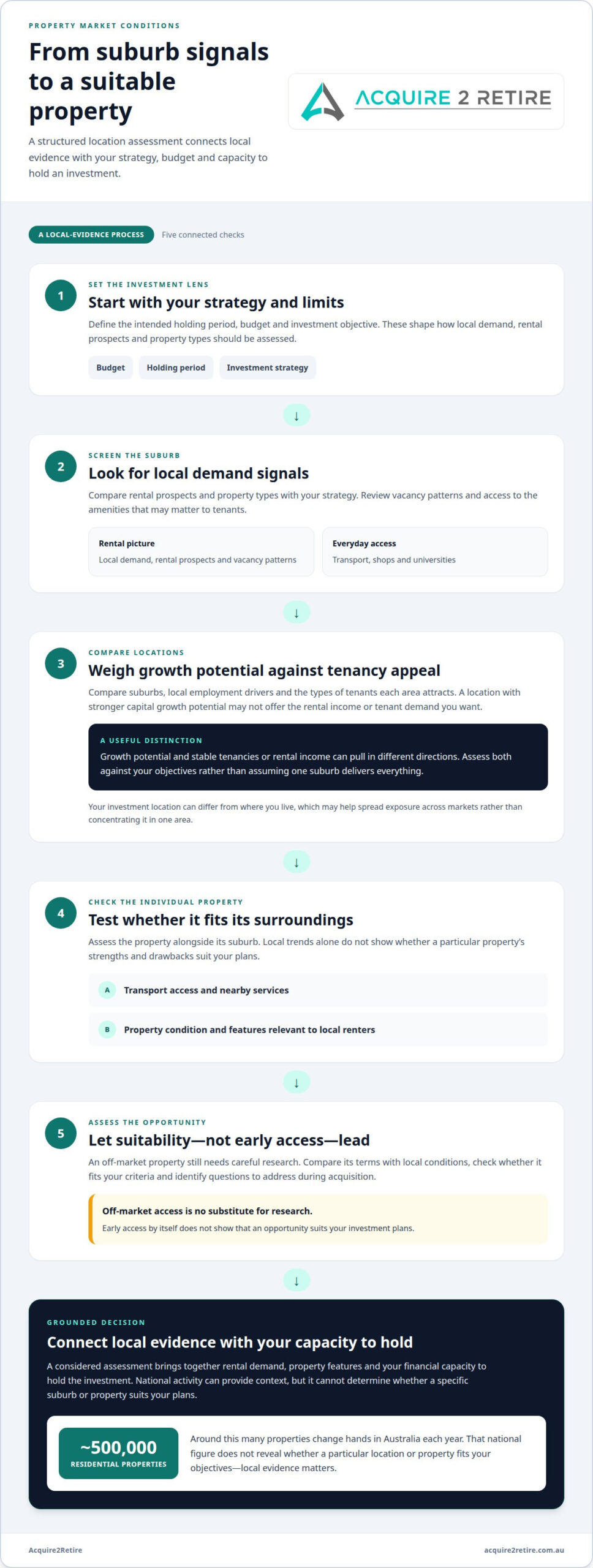
Choosing a suburb means comparing local demand, rental prospects and property types with your strategy. An adviser can examine vacancy patterns and access to transport, shops and universities, then weigh those factors against your budget and intended holding period. Proximity to a university, for example, may support tenant demand, but a suburb’s price alone does not show whether it suits your investment.
Professional location assessment
Location research weighs potential capital growth against the appeal of stable tenancies and rental income. An adviser can compare suburbs, local employment drivers and the types of tenants each area attracts. Your investment location can differ from where you live, which may help spread exposure across markets rather than concentrating it in one area.
Research should also consider how an individual property fits its surroundings. An adviser can assess transport access, nearby services, property condition and features relevant to local renters. These checks help distinguish a suburb-level trend from the strengths and drawbacks of a particular property.
Some properties are offered before broad public advertising, but off-market access is no substitute for research. An adviser can assess whether an opportunity fits your criteria, compare its terms with local conditions and identify questions to address during acquisition. The decision should be based on suitability, not simply on early access.
Around 500,000 residential properties change hands in Australia each year. That national activity doesn’t show whether a particular suburb or property suits your plans, so local evidence matters. A considered assessment connects market conditions with rental demand, property features and your capacity to hold the investment.
For a structured assessment of your investment location, explore property market research support.
Capital growth and rental income strategies
An adviser can shape a strategy around your priority: capital growth, rental income or a balance of both. That choice affects location, property features, borrowing and how much cash-flow variability you can manage. A growth-focused property may suit a longer investment horizon, while rental income may be more important if you need the property to contribute towards ongoing costs.
These objectives can pull in different directions. A location with stronger growth potential may not offer the rental income or tenant demand you want. An adviser can compare expected rent with purchase and holding costs, then assess whether the property’s anticipated returns from income and capital growth justify its borrowing costs. This makes the assumptions behind the decision easier to examine.
Consider rental yield alongside vacancy, maintenance and finance costs, rather than treating it as a complete measure of performance. A property near transport, shops or a university may appeal to tenants, while its condition and features can affect maintenance needs. An adviser can weigh these factors against local rental demand and the level of tenancy stability you want.
Cash-flow modelling can test whether a strategy remains manageable if conditions change. Macquarie recommends modelling adverse scenarios, including higher interest rates, extended vacancy and higher-than-expected maintenance costs. Its guidance also recommends testing whether an investment remains manageable if interest rates are one or two percentage points higher. These scenarios can show how much financial room your plan needs.
Some investors gear a property 50/50, aiming for basic rent to roughly match basic interest costs. That approach is one possible cash-flow strategy, not a measure of overall returns, because other costs and changes in property value still matter. An adviser can assess whether a growth-and-income balance fits your finances, investment horizon and capacity to cover periods when rent falls short. The strategy should make those trade-offs clear before you commit.
Checking an adviser’s qualifications and registration
Property investment advice and financial product advice have different registration requirements in Australia. Make sure the adviser’s experience and permissions match the work involved in your decision.
Qualifications and registration checks
There’s no mandatory government licence to work as a property investment adviser in Australia. By contrast, financial advisers need an Australian Financial Services Licence (AFSL) to advise on products such as shares, managed funds and superannuation. Search the financial advisers register by postcode when you’re considering personal financial advice, and check the adviser’s authorisation for the service you need. ASIC says an AFS licence is required to conduct a financial services business.
Ask what qualifications and experience support the adviser’s property research, acquisition recommendations and finance guidance. Registration for financial product advice does not, by itself, demonstrate property investment expertise. Keep the distinction clear, particularly if a recommendation involves both property and financial products.
Questions before hiring
Ask what the engagement includes, how recommendations are researched, how the adviser is paid and whether they receive benefits connected with a purchase. Request a clear explanation of the process, the evidence behind property recommendations and any matters that require separate tax, legal or financial advice. These answers help you understand the adviser’s position and potential conflicts.
Risks can arise if a property does not suit your finances, rental assumptions prove difficult to achieve, or a scheme’s promotion obscures how decisions are made. ASIC has raised concerns that some financial advice and superannuation lead-generation services may expose consumers to significant losses. Before buying through a scheme, clarify who makes investment decisions, what property is being acquired and how your money will be used.
Assess the adviser’s credentials against the exact service you need, rather than relying on a title alone. For guidance on the finance side of an investment decision, discuss property investment finance.
Acquire2Retire
Acquire2Retire can help you bring property decisions into a considered investment plan, from assessing your objectives and finance position to researching an acquisition and coordinating tenancy. This support may suit you if you’re weighing up whether professional advice could make your next step clearer, or want guidance that connects property selection with your broader investment strategy. The process can also include ongoing portfolio support as your circumstances and priorities change. Advice about tax, legal structures or licensed financial products remains a matter for the relevant professionals, so each part of your plan has a clear scope.
If you’d like to discuss your property investment goals and possible next steps, contact Acquire2Retire.
Make your next property decision with purpose
If you’re asking, “Do I need a property investment adviser?”, consider whether professional guidance would help you make a clearer decision. The next step is not automatically buying a property. You may need to refine your priorities, identify questions for a specialist or improve your plan before proceeding.
Before moving forward, decide what you want an adviser to help you work out and what would make the guidance useful. A clear discussion of your priorities can establish whether the proposed support fits the decision ahead, rather than simply adding another opinion to consider.
If you’re ready to explore how professional guidance could fit your plans, start a conversation about your property goals. A considered next step can help you move forward at a pace that feels right for your circumstances.
Frequently Asked Questions
Do I need a property investment advisor to buy an investment property in Australia?
No, hiring a property investment adviser is not a prerequisite to buying an investment property in Australia. Professional guidance may help if you want to connect property selection with your broader financial plans, or find research and purchase decisions difficult to coordinate. If you’re considering advice, define the decision you need help with and the work you expect the adviser to do.
What qualifications and licences should an Australian property investment advisor have?
There’s no mandatory government licence to work as a property investment adviser in Australia. Financial product advice is different: advisers providing it need appropriate authorisation under an Australian Financial Services Licence (AFSL), and you can search the financial advisers register. Ask what qualifications and experience relate specifically to property research and acquisition, and whether recommendations include financial products requiring separate authorisation.
How do I check an advisor’s track record, references, conflicts of interest, and complaints history?
Ask for examples of the adviser’s past work, references from clients with comparable objectives, and an explanation of how results were assessed. Discuss how the adviser is remunerated, whether commissions or other benefits may arise, and how conflicts are disclosed and managed. Ask what complaint-handling process applies and whether any relevant complaint history can be explained. Look for clear answers, documented terms and realistic discussion of risks.
What steps can I take to assess whether property investment advice is worthwhile for my goals and budget?
First, identify the decision you need help with, such as assessing a purchase or arranging finance. Then ask for the proposed scope, deliverables, fee structure and any acquisition-related costs. Consider whether the work addresses a genuine knowledge or time gap and whether its value is clear against your budget. Before deciding, review the assumptions behind recommendations, including rent, vacancy, borrowing and maintenance.
What Australian tax, lending, and legal rules should property investors consider before getting advice?
Tax, ownership structures, self-managed super funds and licensed financial products require separate advice from appropriately qualified professionals; legal and conveyancing questions require legal advice. Lending decisions depend on your financial position and the lender’s assessment, so distinguish finance guidance from a property recommendation.