
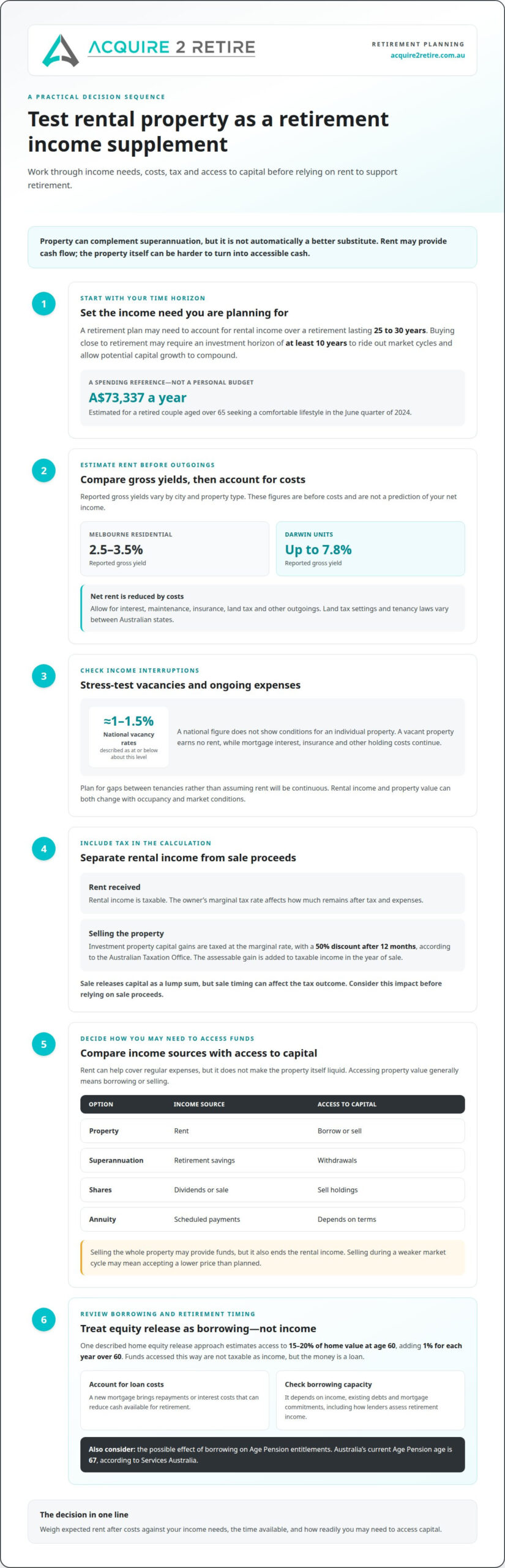
Property investment for retirement income in Australia can complement superannuation, but it is not automatically a better substitute. Rent may provide cash flow, while super offers another way to hold and access retirement savings. Buying close to retirement may require an investment horizon of at least ten years to ride out market cycles and allow potential capital growth to compound.
It is understandable to value property’s tangible nature and the prospect of rent, particularly when you want dependable retirement income. The trade-off is that property can be costly to maintain and harder to turn into accessible cash than a diversified super balance.
This comparison explores how rental income, access to equity, tax and liquidity can shape your decision, including the extra considerations involved in buying later in life. It offers a practical way to weigh property against super and assess whether one approach, or a combination, better suits your retirement plans.
Key Takeaways
- Compare property and super based on income needs, access to funds and the role each could play in your retirement plan.
- Allow for the costs and tax associated with property before treating rent as spendable retirement income.
- Remember that releasing property equity involves borrowing, while selling an investment property may be needed to access its value.
- Weigh the time available before retirement carefully, as buying property close to retirement may leave less room to manage market cycles.
Should you use property to fund your retirement?
Property may provide rent and potential capital growth, while superannuation, shares and annuities offer different ways to hold or draw on wealth. The choice depends on your income needs, access to capital and the costs of owning property.
Rental income and capital growth
Rent can support retirement spending, while a property’s capital growth may help preserve purchasing power over time. However, rental income depends on occupancy and is reduced by costs such as interest, maintenance and insurance. Gross yields vary by city and property type: Melbourne residential property is reported at 2.5-3.5%, while Darwin unit yields have been reported as high as 7.8%.
Sale gains and capital gains tax
Selling releases property capital as a lump sum, unlike rent, which arrives over time. Australian investment property capital gains are taxed at the marginal rate, with a 50% discount after 12 months, according to the Australian Taxation Office. The assessable gain is added to taxable income in the year of sale, so sale timing can affect the tax outcome. Consider the tax impact before relying on sale proceeds.
Property versus other retirement income options
Property differs from superannuation, shares and annuities in how income is generated and capital accessed. Rent may provide ongoing income, but accessing a property’s value generally requires borrowing or selling; super and shares can offer more flexible withdrawals, while an annuity can provide scheduled payments. Australia’s current Age Pension age is 67, according to Services Australia, making the timing of other income sources relevant.
| Option | Income source | Access to capital |
|---|---|---|
| Property | Rent | Borrow or sell |
| Superannuation | Retirement savings | Withdrawals |
| Shares | Dividends or sale | Sell holdings |
| Annuity | Scheduled payments | Depends on terms |
Balance your income needs against how readily you may need to access your capital.
State rules for property investment
Land tax settings and tenancy laws vary between Australian states, so a property’s location affects ownership costs and rental obligations. Land tax can reduce the net income left after rent, while tenancy rules shape arrangements with renters. Include the obligations that apply where the property is located, alongside interest and other outgoings, when assessing its role in retirement.
Property liquidity and borrowing against equity
Property can build wealth, but its value is not as readily accessible as cash or listed investments. For retirement planning, distinguish rental cash flow from money released by borrowing or selling.
Property liquidity and retirement cash flow
Rent may help cover regular expenses, but it does not make the property itself liquid. You generally cannot sell part of a home or investment property to release a smaller amount of capital. Selling the whole asset may provide funds, but it also ends the rental income and changes your retirement strategy.
Timing matters. If you need cash during a weaker market cycle, selling may mean accepting a lower price than planned. Holding property also ties up capital that could support near-term spending or be available for other investments. Include likely expenses and income needs in your cash-flow plan, rather than treating the property’s full value as accessible savings.
Borrowing against property equity
Borrowing against equity can release funds without selling, but the money is a loan, not income. Australians aged 60 who own their home may be able to access some equity; one described approach estimates 15-20% of home value at age 60, adding 1% for each year over 60. The funds accessed through home equity release aren’t taxable as income.
A new mortgage brings repayments or interest costs that can reduce the cash available for retirement. The deposit required depends on the purchase price and your available savings or equity. Borrowing capacity depends on income, existing debts and mortgage commitments, including how lenders assess retirement income. Account for these obligations alongside expected returns and the possible effect on Age Pension entitlements.
Mapping available equity, borrowing needs and future cash flow into a retirement property strategy can help clarify whether borrowing or selling better fits your plans.
Rental income as a supplement to superannuation
Rental income can supplement superannuation, but it varies with occupancy, expenses and market conditions. A plan for property investment for retirement income in Australia should consider whether rent can remain dependable throughout a retirement lasting 25 to 30 years.
Vacancies and rental income uncertainty
A rental property earns no rent while vacant, and changing demand can affect occupancy and rent received. Australian national vacancy rates have been described as at or below about 1-1.5%, but this broad figure doesn’t show conditions for an individual property.
Plan for the income a property could deliver after gaps between tenancies, rather than assuming rent will be continuous. A vacancy, for example, can interrupt cash flow while mortgage interest, insurance and other holding costs continue. Property values can also fluctuate, so do not treat rental income and capital growth as one predictable return.
Superannuation can provide another source of retirement funds alongside rent. A retired couple aged over 65 was estimated to need A$73,337 a year for a comfortable lifestyle in the June quarter of 2024. Use your household spending needs and other income to assess the role rent could play in your retirement plan, including if rental income falls temporarily.
Rental income, tax and property expenses
Rental income is taxable, and the owner’s marginal tax rate affects how much remains after tax. Investment property income has been stated to be taxed at the owner’s marginal rate, up to 47%. Eligible expenses, including interest on an investment loan, may reduce taxable income, but they also reduce cash available for retirement spending.
For property investment for retirement income in Australia, separate gross rent from net income by allowing for loan repayments, insurance, council costs, agent fees and maintenance. Gross residential yields in Australian capital cities have been stated to average about 4-5%, while net yields often fall below 3% after costs. Those figures illustrate why rent received isn’t the same as spendable income.
A positively geared property earns more rent than it has in outgoings, leaving a taxable surplus. A negatively geared property has higher outgoings than rental income. A tax deduction during the loan period does not replace cash flow, so consider whether your savings and superannuation can cover shortfalls as well as living costs.
Buying investment property close to retirement
Buying an investment property close to retirement leaves less time to recover from market setbacks. Consider whether your retirement plan can support the purchase, including its debt and holding costs, without relying on rapid capital growth.
Allow an investment horizon of at least ten years to ride out market cycles, absorb acquisition costs and give potential capital growth time to compound. If you expect to need the money within five years, property may be riskier: selling during a weaker market can limit your options. Compare your intended holding period with when you expect to draw on your savings.
Include the Age Pension in your calculations. An investment property may affect eligibility for a part pension because it is an assessable asset. Whether the Income Test or Assets Test has a greater effect depends on your circumstances. A purchase can therefore influence your retirement income and asset mix, not just your rental cash flow.
Before buying, model your budget in stages: include the deposit, loan repayments, property outgoings and periods without rent, then compare the remaining income with your planned lifestyle costs. Test whether your superannuation and other savings can meet those costs if rent falls short. Consider too whether the property could leave your estate less diversified or make funds harder to access when needed.
The clearest takeaway is that buying close to retirement suits a plan built around a long holding period, manageable borrowing and enough accessible funds for living costs. If your likely timeframe is shorter, or the purchase depends on selling at a particular price, the timing may not suit your retirement plan.
To assess the timing, borrowing and cash-flow assumptions together, develop a retirement property strategy before committing to a purchase.
Acquire2Retire
Acquire2Retire helps Australians assess whether property investment fits their retirement income plans, then shape a considered path from strategy to ownership. Its support can include planning, acquisition, finance and tenancy coordination, bringing the decisions into one structured process.
This can help when you are weighing a purchase against superannuation, deciding how much borrowing fits your retirement cash flow, or considering how property could contribute to a broader portfolio. The aim is to align your investment approach with your goals and circumstances, rather than assume property is right for every retirement plan.
For guidance on how property investment could fit your retirement plans, contact Acquire2Retire.
Shape a retirement plan that fits your next chapter
The next step is to turn your retirement priorities into a practical sequence of decisions. Start with the income you want for everyday life, then consider how much flexibility you need if your plans or circumstances change. Assess property investment for retirement income in Australia as part of that wider picture, not in isolation.
Consider what you want your assets to do, when you may need access to funds, and how comfortable you are with the responsibilities of owning an investment property. A clear plan connects those priorities with an approach to property, borrowing and timing, while keeping your broader retirement goals in view.
If you’re ready to explore your options, discuss your retirement property plans with Acquire2Retire. A considered next step can bring greater clarity to the choices ahead.
Frequently Asked Questions
What are the advantages?
Investment property may provide rent and exposure to potential capital growth in a physical asset. It may suit retirees seeking income beyond superannuation who are comfortable with the responsibilities of ownership. Property can also form part of a broader mix of assets rather than carry the retirement plan alone. Its value depends on whether the income, access to funds and holding costs fit your needs.
What are the disadvantages and risks?
Property concentrates capital in an asset that can be difficult to sell quickly or in part. Rental income can stop during vacancies, while loan interest, insurance and repairs may continue. Falling property values can also affect your options if you need to sell. Consider whether your other savings can cover living costs and unexpected expenses without relying on uninterrupted rent.
How much rental income can Australian investment property generate in retirement?
Gross residential property yields in Australian capital cities average about 4-5%, while net yields often fall below 3% after costs. These are broad measures, not a promise of income from a particular property. To estimate retirement cash flow, apply the expected yield to the property’s value, then allow for vacancies, loan interest, insurance, rates and maintenance before deciding how much rent could support your budget.
How is rental income taxed for Australian retirees, including negative gearing and capital gains tax?
Rental income is included in taxable income, and eligible expenses can affect the net amount. A negatively geared property has deductible outgoings greater than its rental income, but the tax treatment doesn’t remove the cash shortfall. On sale, the capital gain is generally calculated after accounting for the purchase price and incidental costs; if the property was owned for more than 12 months, the Australian Taxation Office says a 50% capital gains tax discount may apply.
How does investment property affect the Age Pension assets and income tests?
An investment property may affect Age Pension eligibility because it can be counted as an asset, while rent may also affect income-test calculations. The test with the greater effect depends on your circumstances and other assessable assets and income. Services Australia states that the Age Pension age is 67. Superannuation in accumulation phase is not counted in the assets test for most people before Age Pension age.
What are the costs of owning a rental property in Australia, including land tax, rates, insurance and maintenance?
Allow for land tax, council rates, insurance, maintenance, loan interest and costs during vacancies. The amounts depend on the property and, for land tax and tenancy obligations, its state or territory. For a practical estimate, separate predictable bills from irregular repairs, then allow for periods without rent. This helps clarify the cash reserve needed to keep the property operating alongside retirement spending.