
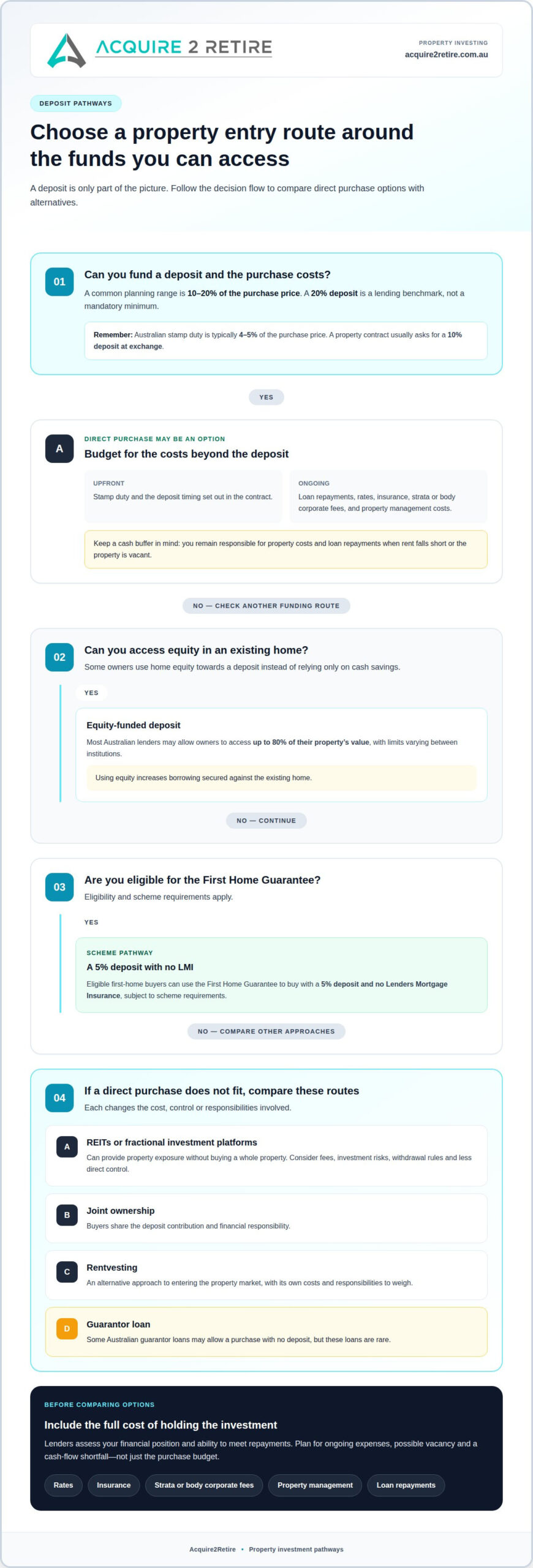
A cash deposit isn’t the only possible route: some Australian guarantor loans may allow a borrower to buy with no deposit, but these loans are rare. A more common planning range is 10-20 per cent of the purchase price, with purchase costs to consider as well. For anyone exploring how to start investing in property with little money in Australia, the right strategy matters as much as the amount saved.
It’s understandable to assume that investing in property starts with a large deposit and a home you can afford to live in. But rentvesting, joint ownership and other approaches can offer different ways to enter the market, each with its own costs, responsibilities and risks.
This guide explains the costs involved, compares capital growth with rental yield, and outlines what low-deposit strategies may make possible. It also covers how to choose an approach that fits your financial position, so you can weigh your next step with greater clarity.
Key Takeaways
- Budget for more than the deposit: ongoing expenses and periods without rental income affect what an investment property may cost to hold.
- Weigh rental income against potential capital growth, as each supports a different investment goal and can shape your property choice.
- Rentvesting and joint ownership may offer alternative ways into the market, but each comes with financial and shared responsibilities to consider.
- Compare direct ownership with other property investment strategies to find an approach that fits your available funds, goals and appetite for risk.
How much money do you need to invest in property?
A 10-20 per cent deposit is a planning range; 20 per cent is a lending benchmark, not mandatory. Property funds pool investors’ money under professional management, which can lower entry barriers, but fees, risks and withdrawal rules matter.
Purchase and ownership costs
Purchase and ownership costs are the upfront and ongoing expenses beyond the property’s price, and they shape the cash you need available. Australian stamp duty is typically 4-5% of the purchase price, and investment properties may attract a higher percentage than purchases for other purposes. A property contract usually asks for a 10% deposit at exchange, so confirm how that timing fits your savings and home loan arrangements.
Budget for rates, insurance, strata or body corporate fees, and property management costs as well as loan repayments. These expenses reduce the cash left from rent and affect whether an investment property is affordable for you.
Cash flow and financial buffers
Cash flow is the money left after rental income and property expenses are accounted for. A cash buffer can help cover costs when rent falls short or the property is vacant. As the owner, you remain responsible for loan repayments, maintenance, rates and insurance, even when there is no rental income.
Negative gearing occurs when property income is less than the expenses of holding the property. It describes a cash-flow shortfall, not a guarantee of an overall investment gain. Lenders assess your financial position and ability to meet repayments, so include ongoing costs in your borrowing plans, not just the purchase budget.
Renovation costs and investment alternatives
Renovations can add significant spending: costs, time frames, approvals and holding expenses all affect the project before rent or sale proceeds arrive. Overcapitalising means spending more on improvements than the added value justifies. Include renovation costs in your total funds calculation, rather than focusing on the deposit alone.
REITs and fractional investment platforms can provide property exposure without requiring you to buy a whole property. Pooled funds may offer income and the potential to benefit if property assets rise in value. The trade-off is less direct control, so weigh fees, investment risks and withdrawal rules before choosing this route.
Choosing between capital growth and rental yield
Australian property returns can come from rent, increases in value, or both. Which outcome you prioritise will shape the properties you consider and the income available to support ownership.
Rental income and property growth
Rental income is money received from a tenant, while capital growth is an increase in a property’s value. Both can contribute to returns from direct property investment, but neither tells the whole story alone. Rent may help cover regular expenses; growth may build equity over time. Consider how each outcome fits your goals and how long you expect to hold the property.
Rental yield and cash flow trade-offs
Rental yield compares rental income with a property’s value, while cash flow reflects income after expenses and repayments. Higher rent relative to the purchase price may support cash flow, but it does not establish the property’s potential for capital growth. Prioritising growth, in turn, may mean accepting less rental income. Compare both measures alongside ongoing costs, rather than treating yield as profit.
Rental demand and property features
Rental demand is the pool of prospective tenants for a property, and its features can influence who considers renting it. Layout, condition and location help shape its appeal, while the rent must suit the intended tenant market. These factors matter because extended vacancy can interrupt rental income. A considered tenancy assessment can help connect property selection with tenant needs.
Location-based investment comparisons
Rental yield, cash flow and capital growth vary between Australian cities, regional areas and individual properties; no location guarantees a particular mix. Compare likely rent, purchase value, costs and tenant demand for the specific property. Tax treatment also matters: negative gearing occurs when income is below holding expenses. From 1 July 2027, rental losses will generally be fully deductible only for eligible new residential dwellings. Existing residential investment properties held at 7:30pm (AEST) on 12 May 2026 are grandfathered under previous rules. The 2026 Federal Budget also announced changes to capital gains tax application.
Low-deposit strategies, including rentvesting and joint ownership
For anyone considering how to start investing in property with little money in Australia, rentvesting and joint ownership are two possible approaches. First-home buyer grants and stamp duty concessions depend on state-specific eligibility, so they aren’t automatically available for an investment purchase.
Deposit requirements and Lenders Mortgage Insurance
A deposit is the buyer’s contribution towards the purchase, and its size affects how much they need to borrow. In Australia, 20% is a lending benchmark, not a mandatory deposit; Lenders Mortgage Insurance may apply when the loan-to-value ratio exceeds 80%. Eligible first-home buyers can use the First Home Guarantee to buy with a 5% deposit and no LMI, subject to scheme requirements.
Savings and home equity deposits
A deposit can come from cash savings or equity in an existing home, but the source changes the financial commitments involved. Most Australian lenders may allow owners to access up to 80% of their property’s value as equity, with limits varying between institutions. Using equity increases borrowing secured against the existing home, while joint ownership means buyers share the contribution and financial responsibility.
First Home Guarantee eligibility
The First Home Guarantee supports eligible first-home buyers purchasing with a 5% deposit and no LMI; the scheme expanded significantly in October 2025. Government-backed incentives may require borrowers to live in the property as owner-occupiers for 12 months after purchase before renting it out. That condition can affect whether a scheme suits an investment plan from the outset.
Risks of low-deposit borrowing
Low-deposit borrowing means taking on a larger loan relative to the property’s value, which can leave less equity and increase repayment pressure. A guarantor loan may allow borrowing 100% of a property’s value, but these loans are rare. For a plan focused on how to start investing in property with little money in Australia, consider how repayments, vacancies and shared obligations could affect your available cash.
Choosing a strategy for property investors
A property investment consultant can assess your circumstances, savings, borrowing capacity and wealth goals, then research options and guide your acquisition. This can help you compare strategies with the funds you have and understand the responsibilities each approach involves.
How a property investment consultant researches an investment property
Research connects your budget and goals with property options that may suit your circumstances. A consultant considers your available funds, borrowing position, preferred investment approach and risk tolerance. Information about your savings, existing commitments and investment aims helps shape the assessment. Clear priorities make it easier to weigh a property’s potential income, costs and place in a longer-term wealth plan.
Buying an investment property on a limited budget with professional advice
Professional guidance can help you assess a property and its financing before making an application or purchase decision. A consultant can guide your search and acquisition around your budget, rather than treating your maximum borrowing capacity as a target. The process can also help clarify how direct ownership compares with pooled investments, where investors share exposure without buying a property outright.
Property funds pool investors’ money under professional management. Lower entry costs don’t remove investment risks, so fees, risks and withdrawal rules remain important considerations.
Other strategies also need careful assessment. Land banking involves buying undeveloped land in the hope of future value growth or development approval, and can carry high risks with fewer protections than other investments. Buying through an SMSF brings additional costs, risks and responsibilities, alongside strict legal and tax rules.
The right approach depends on how savings, borrowing and risk fit together. Explore property investment planning to consider a strategy aligned with your circumstances.
Acquire2Retire
Acquire2Retire helps investors bring their property goals, available funds and preferred approach into one considered plan. Its Planning & Strategy, Acquisition, Finance and Tenancy services can support you from assessing possible pathways through to purchasing and coordinating tenancy arrangements.
If you’re weighing rentvesting against direct ownership, considering joint investment, or unsure how borrowing fits your wider wealth plans, structured advice can help clarify the decisions and trade-offs. The aim is to align a property strategy with your circumstances, rather than assume there’s one suitable route for every investor.
When you’re ready to explore your options, contact Acquire2Retire to discuss your property investment goals.
Shape your next property investment decision
If you’re considering how to start investing in property with little money in Australia, make your next step a clear view of what you want your investment to achieve. Your circumstances, priorities and comfort with financial commitments can help shape a strategy that feels considered, rather than rushed. A useful discussion can turn broad possibilities into a path that reflects your goals and the resources available to you.
Acquire2Retire’s Planning & Strategy, Acquisition and Finance support can help bring those decisions together, from shaping an investment direction to considering a suitable purchase and its financing. The right starting point depends on your situation, so a conversation can focus on the questions that matter to you.
Discuss your property investment options with Acquire2Retire and take your next step with greater clarity and confidence.
Frequently Asked Questions
Can you really buy a house with no cash deposit?
Yes, a guarantor loan may let a borrower purchase without a cash deposit by using a family member’s property as security. These loans are rare, and buying without deposit savings doesn’t remove other upfront expenses, such as stamp duty. The guarantee also creates financial risk for the guarantor if the borrower can’t meet the loan obligations, so consider the arrangement carefully.
Do banks offer 100% home loans in Australia?
Some Australian guarantor loans may allow borrowing 100% of a property’s value, but these loans are rare. Banks generally finance up to 95% of a property’s value for home loans, so borrowing the full purchase price isn’t the usual route. A guarantor arrangement relies on additional security, and the borrower still needs to manage repayments and other purchase costs.
When is a no deposit home loan a bad idea?
A no-deposit loan can be a poor fit when repayments and other ownership costs would leave too little room in your budget. With little equity at the start, a fall in property value can also leave you owing close to, or more than, the property is worth. A guarantor’s security is at risk if repayments aren’t met, so weigh that exposure carefully.
Why invest in real estate?
Investors may choose real estate for rental income, potential increases in property value, or both. Direct ownership also gives you control over the asset, along with responsibility for its costs and tenancy. Consider how property fits alongside your other financial priorities, and whether you can manage the loan and ownership commitments through changes in income or rental conditions.
What is the minimum deposit needed to buy an investment property in Australia?
There’s no single mandatory deposit amount for every investment property loan. A 20% deposit is a lending benchmark, while investors are commonly advised to budget for 10-20 per cent, using cash savings or equity in an existing property. A smaller deposit means borrowing a larger share of the purchase price, and Lenders Mortgage Insurance may apply depending on the loan structure.
What are the upfront costs of buying an investment property in Australia, including stamp duty and conveyancing?
Budget for the deposit, stamp duty and conveyancing when planning an Australian investment purchase. Stamp duty is typically 4-5% of the purchase price, and investment purchases may attract a higher percentage than other purchases. Conveyancing covers the legal work involved in transferring ownership. Its cost depends on the transaction, so include it separately from the deposit when working out the cash required.