
The higher-return option isn’t automatically the better fit. In the long run, Australian shares have returned about 7-8% p.a. including dividends, while capital-city property in blue-chip suburbs has recorded about 5-6% p.a. in growth, so property vs shares in Australia in 2026 depends on more than headline returns. These figures measure different things, and neither tells the whole story about risk, costs or cash flow.
It’s reasonable to weigh property’s tangible asset and borrowing potential against shares’ accessibility and ability to spread an investment across companies and sectors. This guide compares how each can perform, where leverage changes the equation, and how holding both may help build a more balanced portfolio. You’ll also find a practical decision guide to help connect the trade-offs with your timeframe, borrowing capacity and investment goals.
Key Takeaways
- Compare total returns on a like-for-like basis, accounting for income, costs and the timeframe rather than relying on growth figures alone.
- Consider how readily you may need access to your money: listed shares are generally more liquid, while direct property involves a larger, less divisible asset.
- Before using borrowed money, weigh the potential to amplify gains against repayments and cash-flow pressure if conditions change.
- Think about how property and shares could complement each other, then shape the mix around your goals, existing assets and capacity for risk.
Do shares outperform property in Australia?
Long-run returns favour shares in some comparisons, but the result depends on the period, income and costs included. FY26 shows why it’s useful to compare like with like.
Property capital growth assumptions
Australian residential property has averaged annual returns of 6 to 8%, depending on the market and period measured. In blue-chip capital-city suburbs, long-run growth has been about 5-6% p.a.; regional property has recorded about 3-4% p.a. These are historical measures, not forecasts. Capital growth assumptions matter because a small change in a long-term estimate can alter an investment comparison.
Share market return forecasts
The ASX has historically delivered average annual returns of 8 to 10% over long periods. In FY26, Australian property delivered a total return, including rent, of 11%; the S&P/ASX 200 returned 7%, including dividends. Those past results don’t establish future forecasts. Shares also represent ownership in listed companies, so returns can include both capital growth and dividend income.
Property costs and tax settings
Direct property usually needs more upfront capital and carries purchase and holding costs; shares generally have lower entry costs and no stamp duty. Property costs can include stamp duty, land tax, council rates, interest and maintenance. Revenue NSW says first-home buyers in NSW pay no stamp duty on eligible purchases under A$800,000. In super, the 2026 changes described here don’t apply to superannuation; an SMSF residential property borrowing ban became law in June 2026.
Dividends and capital gains taxation
Rental income and dividends are income streams, while a sale can create a capital gain. The 2026-27 Federal Budget reforms replace the 50% capital gains tax discount with indexation, with a minimum 30% tax potentially applying to investment gains. From 1 July 2027, the new model applies to assets acquired after that date, including shares and ETFs. Proposed negative gearing changes restrict losses on established residential property.
| Option | Entry and costs | Return measure | Tax consideration |
|---|---|---|---|
| Property | Higher upfront costs; ongoing holding costs | Capital growth plus rent | Proposed established-property changes |
| Shares | Lower entry costs; more liquid | Capital growth plus dividends | Proposed CGT indexation model |
Compare potential returns after costs with your timeframe, cash-flow needs and tolerance for market changes.
Diversification across asset classes and sectors
Property and shares expose your portfolio to different markets and risks. Holding both may diversify your assets, while borrowing against property equity adds another layer of exposure.
Property equity and share diversification
Property equity is the difference between a property’s value and the debt secured against it. Borrowing against that equity to buy shares may broaden your holdings beyond residential property, adding exposure to listed companies and sectors. It also increases debt: interest and repayments remain obligations if share prices fall or rental income changes. This approach combines property exposure with share-market risk rather than replacing one with the other.
Liquidity and portfolio diversification
Listed shares are generally easier to sell than a direct property, making it easier to adjust that part of a portfolio. A diversified share portfolio may hold companies across sectors, reducing reliance on any one business or industry trend. A single investment property concentrates capital in one asset and location. Selling property involves a transaction process, while shares can usually be sold in smaller parcels.
Liquidity matters when plans or cash-flow needs change. Shares may offer more flexibility to release part of an investment, while selling a property means disposing of the whole asset. Rental income can help cover the costs of holding a property, but a vacancy interrupts that income without removing ongoing ownership costs.
Volatility and concentration risks
Share prices respond visibly to market conditions, company news and economic uncertainty. A portfolio concentrated in one company or sector may be more exposed to that company’s performance, dividend reductions or an industry downturn. Diversifying across sectors can limit the impact of a single trend, though it cannot prevent market-wide falls.
Property values are not visibly priced day to day, but direct ownership can concentrate risk in one location and dwelling. Local market weakness, vacancy, maintenance needs or rising interest costs can affect returns and cash flow. The risks differ: shares bring price swings and company-specific exposure; property brings concentration and ongoing ownership commitments.
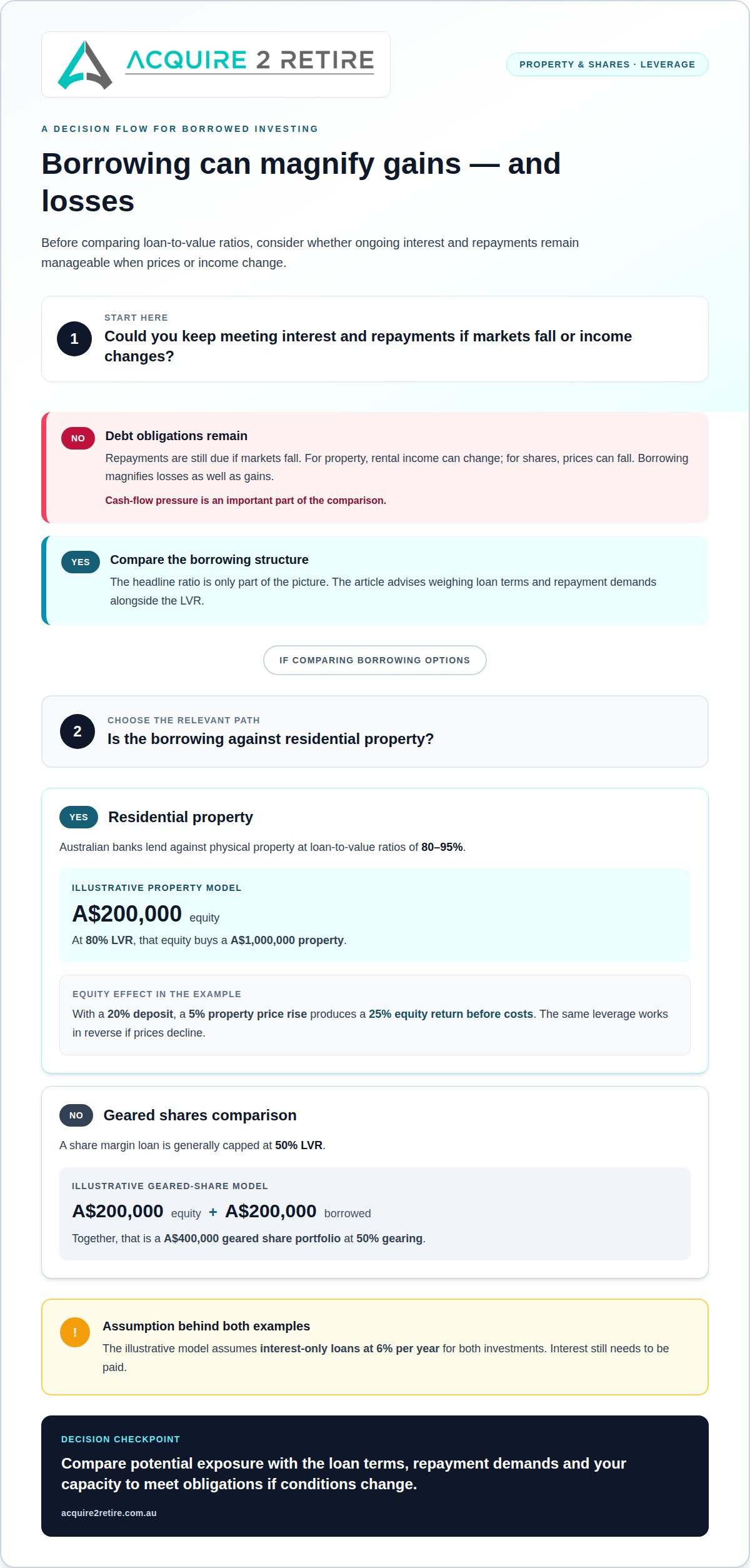
Leveraged residential property versus geared shares
Leverage means using borrowed money to increase the asset exposure supported by your own capital. It can magnify returns when values rise, but also magnifies losses, while repayments remain due if markets fall.
For residential property, loan-to-value ratio (LVR) measures borrowing against the property’s value. Australian banks lend against physical property at LVRs of 80 to 95%. By comparison, a share margin loan is generally capped at 50% LVR. These are different borrowing structures, so assess the loan terms and repayment demands alongside the headline ratio.
Consider the equity effect: with a 20% deposit, a 5% property price rise produces a 25% equity return before costs. The same leverage works in reverse if prices decline. In an illustrative model, A$200,000 of equity buys a A$1,000,000 property at 80% LVR. A geared share portfolio uses A$200,000 equity and borrows another A$200,000, or 50% gearing.
That model assumes interest-only loans at 6% per year for both investments. Interest still needs to be paid, and a property investor must meet mortgage repayments even if rent stops during vacancy. A share investor also faces interest costs, alongside market falls that can reduce portfolio value. Negative gearing may affect the after-tax cost of holding an investment, but it doesn’t remove the need for cash to cover debt.
In the model, the property grows at 6% per year over ten years and finishes A$159,564 ahead of geared shares. This is an illustrative outcome, not a universal result. It depends on its growth and financing assumptions, while actual returns also reflect costs and tax settings. Before borrowing, assess whether income can support repayments through weaker growth, higher interest costs or reduced rental income.
Building a portfolio with property and shares
Property and shares don’t have to be competing choices. They can play different roles in a portfolio: an investment property may combine rental income with capital growth, while shares provide exposure to listed companies and dividends. The key is how each holding fits your goals, cash flow and ability to manage risk.
Start by considering what role each asset would play. Property may suit an investor seeking a tangible residential holding and willing to manage financing, maintenance and tenancy considerations. Shares can offer broader sector exposure and easier access to invested capital. Combining them may diversify wealth across asset classes, but owning both does not automatically remove risk or prevent losses.
Next, consider your timeframe and cash-flow needs. The comparison in this article suggests shares tend to outperform property over investment horizons shorter than seven years, partly because of property purchase and selling costs. A longer wealth-building timeline gives capital growth and reinvested income more time to contribute, but outcomes still depend on each asset’s growth rate and costs.
A worked example illustrates the assumptions behind a combined decision: over 30 years, the property scenario assumes 5% annual growth, while the rent-and-invest approach assumes a 7% return in a balanced ETF portfolio. These are model inputs, not a forecast. The comparison also depends on rent, financing, holding costs and how consistently surplus cash is invested.
To structure your decision, map your existing assets and identify where your investments are most concentrated. Then assess whether new investments should add property exposure, share-market diversification or both. Keep borrowing and ongoing costs within your cash-flow plan, and review your mix as your income, timeframe or objectives change. This focuses on your whole portfolio instead of trying to predict which asset will outperform next.
For a tailored property strategy that considers how an investment property may fit alongside other assets, discuss your portfolio goals.
Acquire2Retire
Acquire2Retire helps Australian investors consider how property could fit within a broader wealth strategy, after weighing its trade-offs against shares. Its Planning & Strategy support can help shape a property investment approach around your goals, existing assets and capacity to manage borrowing and cash flow.
If you decide to pursue property, Acquisition and Finance support can guide those parts of the process, while Tenancy support helps coordinate tenancy matters. This can be a useful next step when your comparison points towards property and you want a considered plan for putting that decision into action. If shares remain the better fit for your current priorities, the comparison can still clarify what role property might play later.
For support with your property investment strategy, contact Acquire2Retire.
Make your next investment decision with purpose
The next step isn’t to find a permanent winner, but to decide what role each asset should play in your financial plan. The property-versus-shares question in Australia in 2026 is most useful when considered alongside your need for accessible funds, comfort with debt and priorities over time.
Before acting, write down what you want an investment to contribute, what cash flow you can comfortably support and which risks could disrupt your plans. Then consider how a new holding would affect the balance of your existing assets. This gives you a practical reference point to revisit as your circumstances and goals evolve.
If property is part of the path you’re considering, a tailored discussion can help connect your investment goals with a considered next step. Discuss your options with Acquire2Retire and move forward with greater clarity.
Frequently Asked Questions
Property vs Shares 2026: Where Should You Actually Put Your Money?
There isn’t one suitable choice for every Australian investor. The property vs shares Australia 2026 comparison is a framework for weighing your goals, not a universal instruction to buy one asset. If you need flexibility and broader exposure across listed companies, shares may suit your circumstances; if you’re comfortable with a concentrated asset and its ongoing responsibilities, property may fit. Start by separating near-term money from long-term investment capital.
What would change the result?
Different assumptions about growth, income, financing and costs can substantially change a comparison. For example, an investment property may look stronger when capital growth is higher, but weaker when vacancy or borrowing costs reduce cash flow. A share portfolio’s result varies with its mix of companies, dividends and fees. Compare outcomes over the same timeframe and after costs, then test how a less favourable scenario could affect your plans.
Buy a House or Invest?
Buying a home to live in and buying an investment asset serve different purposes. A home provides somewhere to live, while an investment is assessed for its contribution to income and long-term wealth. The main-residence capital gains tax exemption can also affect a home’s financial comparison. If you’re deciding between buying a home and investing elsewhere, consider housing needs, how you use your deposit, borrowing capacity and future flexibility.
How Do the 2026 Tax Changes Affect This Comparison?
The changes affect how some future gains and property losses are treated, so acquisition timing and asset type matter. The new capital gains model applies from 1 July 2027 to assets acquired after that date, including shares and ETFs. Tax treatment can vary by property type and individual circumstances, so check how it applies before relying on a tax benefit. Consider potential tax treatment alongside investment performance, rather than treating a tax benefit as a return by itself.
How Does the Leveraged Property Perform Over 10 Years?
In one illustrative model, the property’s net after-tax position is A$574,399 after ten years, compared with A$414,834 for geared shares. These results depend on that model’s assumptions, including financing, tax treatment, income and sale costs. They aren’t a forecast for every property or share portfolio. A useful next step is to examine whether repayments remain manageable if rent falls or growth is weaker.
How do I decide which investment is right for me?
For a property vs shares Australia 2026 decision, match the investment to your purpose, timeframe and capacity to handle changes in value and cash flow. Someone expecting to use their capital soon may prioritise access to funds; someone building long-term wealth may accept less liquidity for a different asset mix. Consider your existing holdings too, since adding to an already concentrated area may increase portfolio risk.