
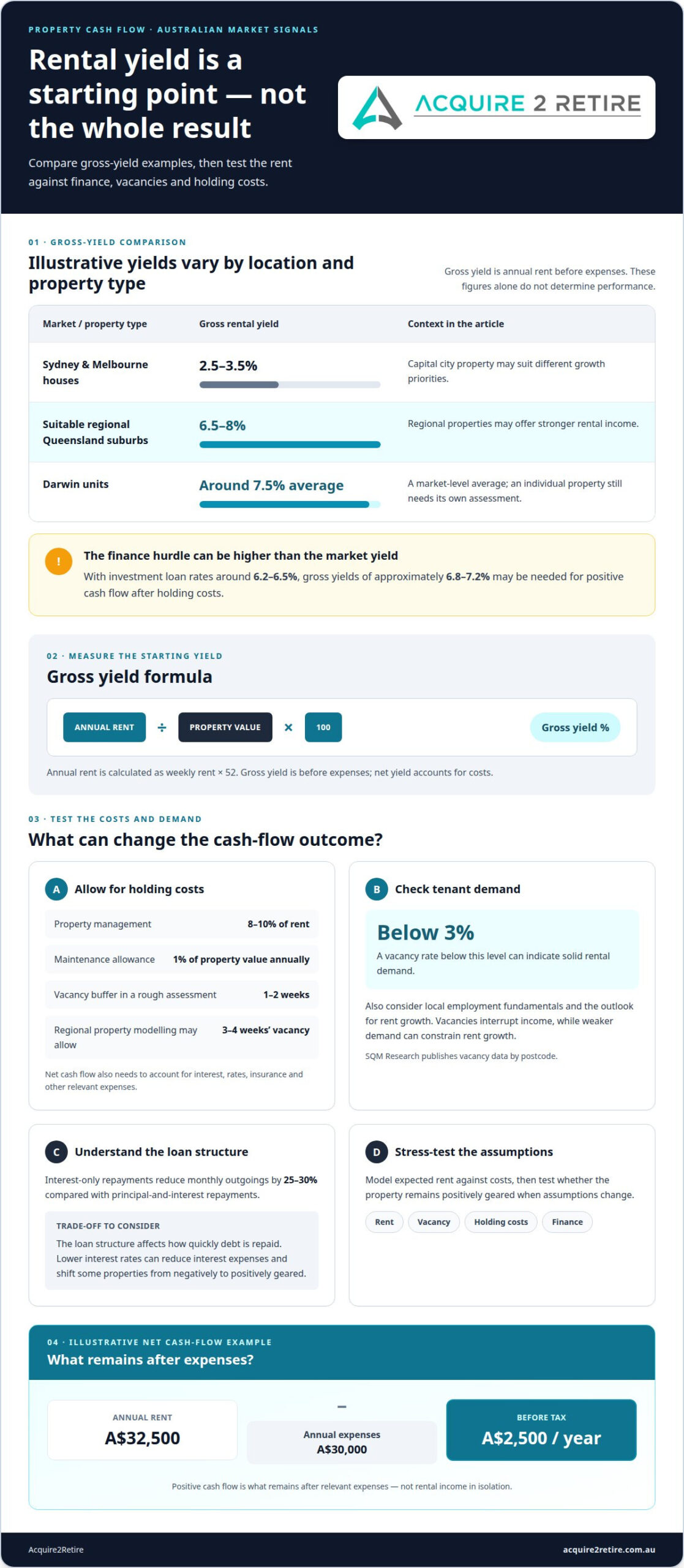
A property can bring in more rent than it costs to hold, but the difference depends on the full picture, not rent alone. A cash flow-positive property strategy in Australia aims for rental income to exceed expenses; in an illustrative example, A$32,500 in annual rent against A$30,000 in annual expenses leaves A$2,500 a year before tax.
It’s understandable to focus on whether rent can cover the mortgage, but other holding costs and periods without a tenant can change the result. Positive cash flow is what remains after relevant expenses, not rental income in isolation.
This article explains positive cash flow, how dual income and a secondary dwelling may contribute, and what to consider when assessing an illustrative property example. It also explains why additional rental income needs to be weighed against its costs, demand and fit with your broader investment goals.
Key Takeaways
- Assess rental yield alongside vacancy and holding costs to understand whether rent is likely to support the property’s cash flow.
- Explore how a secondary dwelling or other dual-income arrangement could add rent, while weighing the associated costs and tenant demand.
- Use the illustrative example to see how gross rent, expenses, tax assumptions and loan costs shape the final cash-flow result.
- Consider how interest rates and loan structure affect repayments, and how professional planning can bring property selection and finance into one strategy.
What is Positive Cash Flow Property?
A property is positively geared when its rental income exceeds its expenses, according to Australian Treasury. Assessing that outcome means weighing realistic rent against vacancies, holding costs and finance.
Rental yield and vacancy rates
Rental yield expresses annual rent as a percentage of a property’s value. An adviser compares gross yield, before expenses, with net yield, after costs, to judge whether the purchase may support cash flow. Gross yield uses weekly rent × 52, divided by property value, then multiplied by 100. Around 5% can signal potential, but investment loan rates of around 6.2-6.5% may require gross yields of approximately 6.8-7.2% for positive cash flow after holding costs. Suitable regional Queensland suburbs have recorded gross yields of 6.5-8%, while Darwin units average around 7.5%. Houses in Sydney and Melbourne typically yield 2.5-3.5%. Regional properties may offer stronger rental income, while capital city property may suit different growth priorities; neither yield nor location alone determines performance.
Calculating net cash flow and rental yield
Net cash flow is rental income after expenses, including interest, rates, insurance, maintenance, management and vacancy allowances. It matters because a strong gross rental yield can shrink once holding costs are included. For example, annual rent of A$32,500 less annual expenses of A$30,000 leaves A$2,500 per year before tax. The adviser models these costs against expected rent, then tests whether the property remains positively geared when assumptions change.
Expenses, interest rates and loan structures
Expenses and loan repayments determine how much rent remains available as cash flow. A rough net-income assessment may allow 8-10% of rent for property management, 1% of property value annually for maintenance, and a 1-2 week vacancy buffer. Interest-only repayments reduce monthly outgoings by 25-30% compared with principal-and-interest repayments, though the loan structure affects how quickly debt is repaid. Lower interest rates can reduce interest expenses and shift some properties from negatively to positively geared, according to the Reserve Bank of Australia.
Assessing and buying a property
An adviser assesses tenant demand by examining vacancy rates, local employment fundamentals and the outlook for rent growth. Vacancy rates below 3% can indicate solid rental demand, while SQM Research publishes vacancy data by postcode. This matters because vacancies interrupt income, and weaker demand can constrain rent growth. For regional property, cash-flow modelling can allow 3-4 weeks of vacancy. The adviser brings these demand indicators together with yields, expenses and finance assumptions before narrowing the acquisition options.
Illustrative positive cash flow investment example
An Australian investment property can appear cash-flow positive after tax while running at a pre-tax shortfall. The difference depends on assumptions about rent, expenses, finance and tax deductions.
Its projected after-tax cash flow is A$21 per week in year one, rising to A$83 per week in year ten. The same projection estimates A$465,495 in equity after ten years, a separate measure from spendable rental income.
Tax deductions for property costs
Tax deductions are eligible property-related costs and non-cash items accounted for in an investment’s tax calculation. They matter because the after-tax result can differ from cash flow before tax. In this example, depreciation and loan-cost deductions total A$7,496 in year one, while the on-paper loss is A$10,518. Those figures illustrate the model’s assumptions, not cash received as rent.
Deductions can affect the tax calculation, but they don’t remove the need to fund actual expenses. A sound cash flow assessment separates cash costs from non-cash deductions and doesn’t treat a projected tax benefit as guaranteed rental income.
Budgeting and investment planning
Budgeting maps an investment property’s expected income and outgoings against the investor’s wider finances. It matters because a property’s cashflow affects available capital for living costs, vacancies and future portfolio decisions. One illustrative A$100,000 income budget allocates A$25,000 to tax, A$35,000 to housing, A$9,500 to super and A$30,500 to living expenses.
Property investment risks include rent interruptions, changing interest costs and expenses that exceed the model. A secondary dwelling or other dual-income setup may broaden rental income, but its extra costs and tenant demand belong in the same assessment. Structured property investment planning can help bring those assumptions together before a purchase decision.
Benefits of positive cash flow property
Positive cashflow can give an investor more room in the household budget because rent contributes towards holding costs. For example, an illustrative property producing an extra A$50 per week could provide a buffer for expenses or future investment. A cash flow-positive property strategy in Australia can make this income contribution a priority, while still accounting for vacancies, interest rates and ongoing costs.
Rental income may reduce reliance on capital growth to support an investment’s overall performance. Even if property values grow slowly, rent can help meet expenses and support a steadier portfolio. However, rising interest rates can narrow the surplus, so assess the property against changing finance costs, not just its first-year projection.
A granny flat or another dual-income arrangement may create a second rental stream on one property, reducing reliance on a single tenancy. If one dwelling is vacant, income from the other may continue, although the combined result depends on tenant demand and the cost of maintaining each space. For a cash flow-positive property strategy in Australia, weigh additional rent against development, finance and ongoing expenses.
Positive cash flow can support wealth planning by helping you retain funds for loan repayments, property upkeep or later acquisitions. Consider the surplus alongside the property’s longer-term role: a high cash return may suit an income-focused plan, while another property may better match capital growth priorities. Comparing these outcomes helps prevent one positive cash flow figure from driving your entire investment strategy.
How do Australian mortgage interest rates and loan structures affect investment property cash flow?
Interest rates determine how much rental income goes towards loan interest, shaping the cash left after expenses. At investment loan rates of around 6.2-6.5%, a gross rental yield of approximately 6.8-7.2% or higher may be needed to achieve positive cash flow after holding costs. Lower rates reduce interest expenses and can shift some properties from negatively to positively geared, according to the Reserve Bank of Australia.
The effect depends on the loan balance as well as the rate. A higher loan-to-value ratio means a larger loan relative to the property’s value, which can increase interest costs and make positive cash flow harder to maintain.
Repayment structure also changes regular cash demands. Interest-only repayments on an investment loan reduce monthly outgoings by 25-30% compared with principal-and-interest repayments. That can leave more rental income available in the short term, while principal-and-interest repayments also reduce the loan balance over time. The appropriate comparison therefore considers both immediate cash flow and the investor’s debt-reduction priorities.
A useful stress test models repayments at 2 percentage points above the current rate. This shows how a rate rise could affect the property’s surplus, rather than relying only on today’s repayment estimate. An adviser can compare that result across loan structures and rental assumptions, then assess whether the property remains workable if interest costs increase or rent is interrupted.
Rate settings and loan terms can change the outcome, so finance assumptions belong in the property assessment from the outset. Explore investment finance planning to consider how loan structure and cash-flow projections fit your property strategy.
Acquire2Retire: Planning & Strategy
Acquire2Retire helps investors connect property selection, finance and tenancy considerations with a broader investment plan. Its Planning & Strategy offering can help clarify how a potential property, including one with a secondary dwelling, fits your cash-flow priorities and longer-term portfolio goals.
When you’re ready to move from projections to a purchase decision, Acquisition and Finance support can bring the property choice and loan considerations into the same process. Tenancy coordination can also help account for rental arrangements as part of the investment plan. This joined-up perspective is useful when you’re weighing expected rent against expenses, vacancy risk and the property’s role in your portfolio.
If you’d like support shaping your property investment approach, contact Acquire2Retire to discuss your goals.
Shape your next property decision with care
A cash flow-positive property strategy in Australia is most useful when it supports your broader financial direction, rather than becoming a goal in itself. Before moving ahead, consider what you want the investment to contribute to your portfolio and how much flexibility you want to retain for future decisions. This perspective can help keep the purchase aligned with your priorities as circumstances change.
Acquire2Retire offers Planning & Strategy, Acquisition and Finance to help connect investment goals with property selection and funding considerations. This support can be useful when you’re ready to turn an investment idea into a considered next step, with the key decisions viewed together rather than in isolation.
Contact Acquire2Retire to discuss your options and take the next step towards a property plan shaped around your goals.
Frequently Asked Questions
Where can investors find professional help sourcing positive cash flow properties?
Australian investors can work with Acquire2Retire for property investment planning and acquisition support. Its acquisition work includes market research, due diligence and identifying suitable investment properties, while Planning & Strategy connects property selection with the investor’s goals. This can help when you want professional support assessing opportunities and weighing their place in a broader investment approach.
Is positive or negative gearing better?
Neither is automatically better. The right fit depends on your income priorities, capacity to fund costs and broader investment goals. Positive gearing means rent exceeds expenses, leaving a surplus before tax. Negative gearing means expenses exceed rental income, so the investor funds the shortfall. An investor focused on regular income may favour a surplus, while another may accept a shortfall as part of a growth-oriented plan.
What is considered a good rental yield for positive cashflow in Australia in 2026?
A gross rental yield around 5% or more can be a positive signal, but it doesn’t by itself establish positive cash flow. Gross yield excludes property expenses, and financing costs also affect the final result. At investment loan rates around 6.2-6.5%, a gross yield of approximately 6.8-7.2% or higher may be needed to achieve positive cash flow after holding costs.
What does cash flow positive property mean in Australia?
It means rental income is greater than the property’s expenses over the period being assessed. The result may be calculated before or after tax, so the figures can differ. It describes rental performance, not capital growth or total investment return. For a dual-income property, include both rental streams and the costs associated with each dwelling in the assessment.
How does a property adviser calculate rental yield and cash flow after expenses in Australia?
An adviser annualises weekly rent using 52 weeks, then divides it by the property value to calculate gross yield as a percentage. To assess cash flow, the adviser accounts for expected rental income and relevant outgoings, including finance costs, maintenance and vacancy assumptions. For a dual-income property, each tenancy’s income and any additional costs should be incorporated into the overall projection.
Which Australian cities and suburbs have the highest rental yields in 2026?
Among the market examples, Darwin units average around 7.5% gross rental yield, while suitable suburbs in regional Queensland markets have recorded yields of 6.5-8%. These examples don’t establish a universal ranking of cities or suburbs. A property’s yield varies with its value and achievable rent, so investors should assess local rental demand and expenses alongside the headline percentage.