
The best suburbs for capital growth in Australia in 2026 aren’t necessarily those with the sharpest recent price rises. A stronger shortlist balances demand and growth potential with rental vacancy, new housing supply and cash flow. Melton recorded 8.3% annual median property value growth in the 12 months to July 2026, while Melbourne dwelling values were 4.7% lower over the year to 31 August 2026, showing why suburb-level conditions matter.
Gentrification can still support property demand as an area attracts new amenities, businesses and residents, but it’s only part of the picture. Strong recent growth may sit alongside a large pipeline of new homes or rental conditions that affect an investor’s holding costs.
Compare suburbs across Australia by looking at growth, vacancy, housing supply and rental cash flow together. This guide offers a practical way to weigh these factors and judge whether an area’s changes may support lasting demand, rather than relying on one headline figure or a recent price jump.
Key Takeaways
- Compare vacancy and planned housing supply alongside price growth to understand the risks that can affect rental demand.
- Use Melbourne’s suburb-level growth figures as a starting point, then weigh them against the broader market trend.
- Consider Brisbane’s forecast population growth as one demand signal, while assessing each suburb’s local housing conditions.
- Balance potential capital growth with rental yield and holding costs to judge whether an investment’s cash flow suits your plans.
1. Investment risks, including rental vacancy and new housing supply
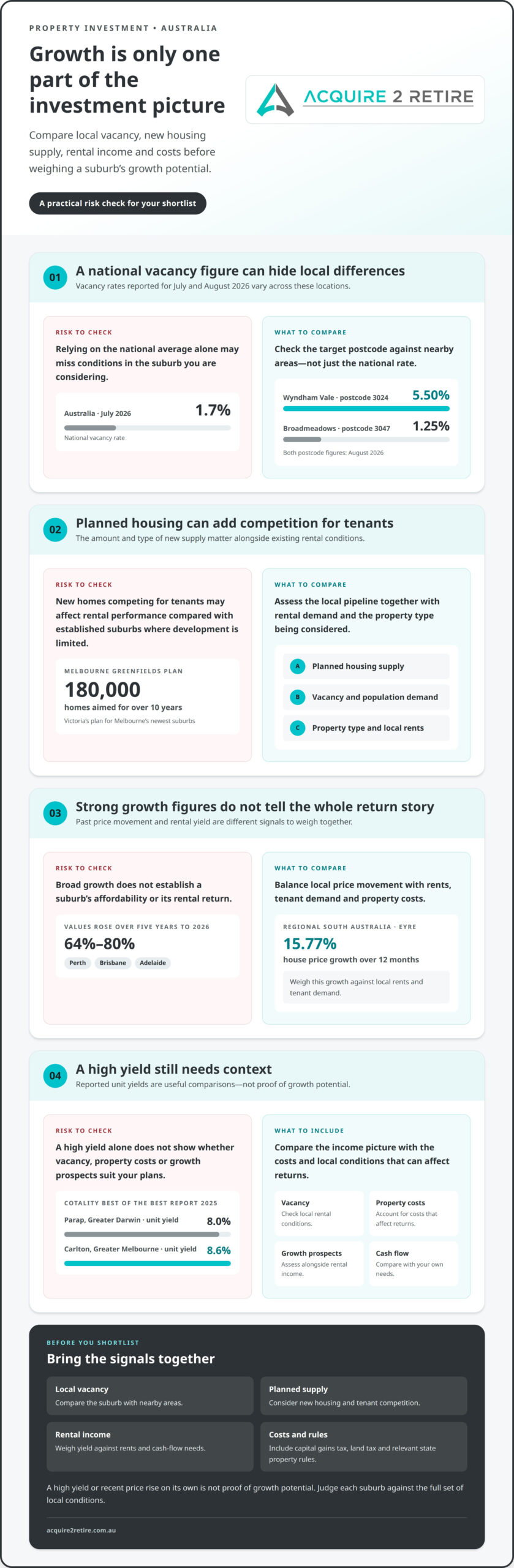
Australia’s national vacancy rate was 1.7% in July 2026, but local conditions vary. In August 2026, postcode 3024, covering Wyndham Vale, recorded 5.50% vacancy, compared with 1.25% in Broadmeadows postcode 3047. These figures show why investors should compare a target suburb with nearby areas, not rely on a national average.
New supply can also affect demand. Victoria’s 10-year plan for Melbourne’s greenfields aims to deliver 180,000 homes in the city’s newest suburbs. Where new housing competes for tenants, rental performance can differ from established suburbs with limited development. Assess planned supply alongside vacancy, population demand and the type of property being considered.
A property investment adviser can compare shortlisted suburbs by purchase affordability, rental yields and vacancy rates, then assess how each option fits your cash-flow needs. The comparison should also account for housing supply and local demand: a high yield alone is not proof of growth potential.
Perth, Brisbane and Adelaide property values rose between 64% and 80% over the five years to 2026. That broad result doesn’t make every suburb equally affordable or indicate its rental return. In regional South Australia, Eyre recorded 15.77% house price growth over 12 months; investors should weigh that growth against local rents and tenant demand.
Capital-city suburbs can also offer notable rental yields. Cotality’s Best of the Best Report 2025 recorded an 8.0% unit yield in Parap, Greater Darwin, and an 8.6% unit yield in Carlton, Greater Melbourne. Compare these returns with vacancy, property costs and growth prospects before choosing a target.
Include capital gains tax when estimating the potential after-tax result of a sale, and account for land tax and the relevant state’s property rules. These costs and requirements can affect returns, so weigh them alongside purchase affordability and rental income.
2. Melbourne suburbs ranked by annual median property value growth
Melton led the listed Melbourne suburbs, with annual median property value growth of 8.3% in the 12 months to July 2026. Sunshine West followed at 6.5%, while Botanic Ridge and Melton West each recorded 6.4%; Melton South reached 6.3%. These rankings compare annual growth, not future performance.
The broader cycle was weaker than those suburb figures suggest. Melbourne dwelling values fell 4.7% in the year to 31 August 2026 and sat 6.8% below their March 2022 peak. ANZ forecast a 9.2% fall in Melbourne housing prices in 2026, followed by a further 2.4% decline in 2027. The Reserve Bank of Australia held the cash rate at 4.35% in 2026, a financing factor investors may weigh when assessing affordability.
Price declines also vary by suburb and property type. Carisbrook’s median house price fell 20% over the 12 months to November 2025, reaching A$495,000; Zuccoli unit prices declined 9% over the same period. These examples show why a Melbourne-wide trend cannot describe every local market.
Infrastructure and planning can influence access, demand and future supply. The Metro Tunnel began running a full timetable on 1 February 2026, connecting Sunbury to Cranbourne and Pakenham through the CBD. Zoning decisions may also change where and how much housing can be built, affecting competition between existing homes and new supply.
New South Wales transaction patterns offer another comparison: houses made up 64.5% of sales tracked in Q4 2025, while strata-title properties accounted for 24.5% of purchases. For Melbourne, assess growth alongside median prices, interest costs, transport access and planning changes before judging a suburb’s position in the property cycle.
3. What are the best suburbs to invest in Australia for 2026?
There isn’t one suburb that suits every investor, so the best suburbs for capital growth in Australia in 2026 depend on budget, property type and investment goals. Sydney house prices were forecast to increase around 5%–6% annually by the end of 2026. In Queensland, Lowood house prices rose 23% to a A$681,000 median over the 12 months to November 2025. Surfers Paradise recorded 28.81% quarterly price growth, while Baringa on the Sunshine Coast grew 8.23% over 12 months to February 2026.
Brisbane’s population outlook is one broad signal of future housing demand. The Queensland Government forecast 500,000 additional people moving into the Brisbane City Council area by 2046, with its population reaching 1,721,000. Those projections don’t identify which suburb or property will perform best; local supply, rental demand and affordability still matter.
Other shortlisted suburbs show different growth and budget profiles. Wallacia in outer Sydney recorded annual house price growth above 20% to November 2025. Carlisle in Perth also exceeded 20% over that period, while Port Adelaide units rose 45%.
To assess the best suburbs for capital growth across Australia in 2026, an adviser compares price trends with vacancy, rents, housing supply and buyer demand. They can then compare similar properties by location, dwelling type and condition against the investor’s budget and cash-flow priorities, distinguishing a quarterly surge from evidence of broader demand.
Assess suburbs with lower supply, strong rental demand and planned infrastructure by weighing all these factors together. Transport access, employment and housing proposals may influence buyer interest, while substantial new supply can increase competition. A structured investment strategy connects the evidence with your objectives, helping narrow the shortlist before you assess individual properties.
4. Balancing capital growth and cash flow
Choosing suburbs for growth means considering rental income alongside the potential for value growth. In 2026, the article’s target gross dwelling yield is 4.0%, while yields between 4% and 6% are described as generally good. Gross yield compares annual rent with purchase price, but doesn’t account for expenses or finance costs.
Suburb examples show how that balance varies. Pakenham’s computed gross rental yield was 4.12%, based on median rent to 31 August 2026 and median price to 30 June 2026. Melton’s was 3.77% using the same periods. These figures help compare rental income with prices, but investors should also consider vacancy, property condition and expected outgoings.
Higher yields can come with different local conditions. Zuccoli recorded a 7.2% house rental yield and Millner a 7.3% unit yield over the 12 months to November 2025. Cotality’s Best of the Best Report 2025 recorded an 8.6% unit yield in Gray, Greater Darwin, and a 14.3% unit yield in Newman, regional Western Australia. A higher yield alone doesn’t establish stronger growth prospects.
Compare likely rent with ownership costs, then consider whether the resulting cash flow fits your budget. Employment, rental demand and housing supply matter alongside lifestyle appeal, particularly in Queensland and Victoria, where conditions vary. A lower-yield property may suit an investor prioritising growth, while stronger rental income may better support a tighter budget. The best suburbs for capital growth in Australia in 2026 will depend on how these trade-offs fit your goals and capacity to hold through market changes.
For a considered comparison of growth potential and rental cash flow, develop a property investment strategy around your objectives and budget.
Acquire2Retire
Acquire2Retire helps investors turn suburb research into a considered property investment plan. If you’re weighing growth potential against vacancy, new housing supply and rental cash flow, its Planning & Strategy support can help align those factors with your investment goals. From there, Acquisition, Finance and Tenancy support can assist across key stages of building a property portfolio, with ongoing support as your portfolio develops.
This may be a useful next step when you have a shortlist but need to assess how a property decision fits your broader strategy, budget and preferred level of risk. Contact Acquire2Retire to discuss your property investment goals.
Make your next property decision with clarity
Choosing among the best suburbs for capital growth in Australia in 2026 is only one part of a sound investment decision. The next step is to connect your suburb shortlist with the way you want your portfolio to serve you, including your preferred balance of growth, rental income and flexibility. That perspective can help keep a compelling market headline from outweighing the practical fit of a particular property.
Before committing, clarify your priorities: the role the investment should play, the cash flow you can comfortably manage, and how the purchase fits your broader plans. A clear strategy makes it easier to assess opportunities consistently instead of changing direction with every new market signal.
If you’re ready to discuss how your property goals could shape your next step, contact Acquire2Retire to explore your options. A considered decision starts with a clear understanding of what matters to you, and you can take that step at your own pace.
Frequently Asked Questions
Does gentrification still drive property prices in 2026?
Yes, gentrification can support property prices when new amenities, businesses and services attract residents and buyers. Its influence depends on whether an area’s appeal translates into sustained housing demand rather than short-lived attention. Improved local amenities may broaden buyer interest, for example, while abundant competing housing can limit the effect. Assess who is moving into the area and what is changing locally.
Time to buy?
Buy when a property suits your investment plan, budget and ability to manage its cash flow, not simply because prices have recently risen. Consider the purchase price, likely rent, ongoing costs and the area’s supply outlook together. If the numbers work only under optimistic assumptions, the investment may not suit your circumstances. A clear strategy helps keep the decision grounded in your priorities.
What are the best suburbs to invest in Australia for 2026?
There is no single suburb that suits every investor: budgets, property types and cash-flow needs differ. Leppington and Noosa are contrasting examples of markets investors may assess for longer-term growth, while high-yield areas such as Darwin suburbs may better suit a cash-flow focus. Treat these as starting points, then compare local demand, property supply and rental prospects with your investment objectives.
What is impacting price growth in Melbourne?
Melbourne prices respond to buyer affordability, borrowing conditions, housing supply, population demand, and access to transport and amenities. These influences vary between suburbs and property types, so a city-wide movement may not reflect the prospects of a particular home. Nearby new housing can create more competition, for instance, while improved transport access may increase buyer interest. Consider the factors together before choosing where to buy.
Which Australian cities and regions have the strongest population and employment growth?
Brisbane has a substantial population-growth outlook: the Queensland Government forecast an additional 500,000 people moving into the Brisbane City Council area by 2046. Victoria added about 109,000 residents in the year to March 2026. Employment growth also matters because local jobs can support housing demand, but population growth alone doesn’t show how employment is changing in a particular suburb.
What are the main risks of investing in high-growth Australian suburbs?
Recent growth can increase the risk of paying more than a property’s local rental demand and long-term appeal support. Other risks include high vacancy, substantial new housing supply and reliance on a single growth driver, such as a planned transport link. Consider whether expected rent can support ownership costs. A balanced assessment looks beyond past price increases to the property’s broader role in your portfolio.