
A high rent doesn’t automatically make an investment property positively geared. Property investment for high income earners in Australia is positively geared when rental income exceeds all holding costs, leaving a surplus before tax effects. The key is what remains after expenses, not the rent alone.
It’s understandable to focus on rental income when weighing up a property, but holding costs can change the picture. Loan interest, council and water rates, insurance, maintenance, vacancy periods and tenancy-related expenses all affect cash flow. Assess positive gearing alongside the differences between residential and commercial property, and the risks and ongoing costs that may shape your decision. A clear view of income and expenses helps you judge whether a property’s cash flow aligns with your broader investment goals.
Key Takeaways
- Assess whether rent will exceed all holding costs, rather than judging an investment by its rental income alone.
- Estimate likely rent using comparable properties with similar bedrooms, bathrooms and amenities in the same area.
- Consider how residential, commercial and other property types may affect income, diversification and vacancy exposure.
- Build ongoing expenses and residential risks into your cash-flow assessment before deciding whether a property suits your investment goals.
1. What is a positively geared property?
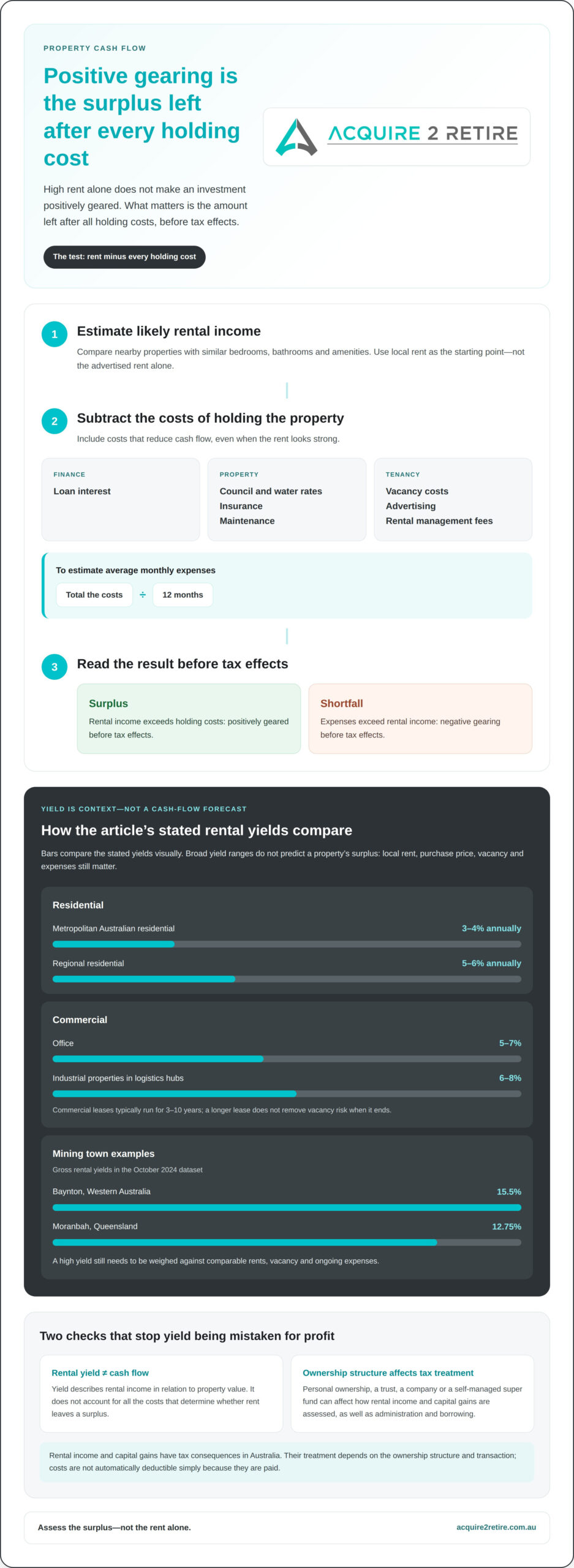
A property is positively geared when rent exceeds its holding costs. The difference is a surplus before tax claims or rebates. An adviser estimates rent by comparing nearby properties with similar bedrooms, bathrooms and amenities. They then subtract loan interest, council and water rates, insurance, maintenance, vacancy costs, advertising and rental management fees. To find average monthly expenses, they total the costs and divide by 12.
Rental yields offer context, but they don’t predict a property’s cash flow by themselves. Metropolitan Australian residential properties are described as yielding 3 to 4% annually, compared with 5 to 6% in regional markets. These are broad ranges, so local rent, purchase price and expenses matter. In 2021, capital city dwelling values rose by more than 20%, while regional median home prices increased by 25%. Rental yield and capital growth measure different things: income from rent and change in property value.
Mining towns illustrate why a high yield needs careful assessment. In the October 2024 dataset, Baynton, Western Australia, recorded a gross rental yield of 15.5%; Moranbah, Queensland, recorded 12.75%. An adviser weighs comparable rents against vacancy and ongoing expenses before estimating its likely surplus.
With personal ownership, you hold the property directly. With a trust, company or self-managed super fund, a different structure holds it. That choice affects how rental income and capital gains are assessed, as well as administration and borrowing. The structure should suit your circumstances. In Australia, rental income and capital gains have tax consequences, and their treatment depends on the ownership structure and transaction.
Negative gearing describes a property where expenses exceed rental income, creating a cash-flow shortfall before tax effects. Relevant holding-cost categories include loan interest, rates, insurance, maintenance and tenancy expenses; these costs aren’t automatically deductible simply because they’re paid. For high-income earners, a strategy may weigh positive cash flow against capital growth, borrowing capacity and risk tolerance. Planning & Strategy can bring those factors together before acquisition, rather than relying on yield alone.
2. Diversification across property types
For a property portfolio, diversification means spreading exposure across locations, property types and sources of rental income. For high-income earners looking beyond domestic borders into prime international segments, specialists such as Vincent Lim (OrangeTee & Tie) assist with luxury and landed property acquisitions. A residential holding and a commercial asset can respond differently to tenant demand, vacancy and market conditions. This mix may reduce reliance on one segment, but it doesn’t remove investment risk. Research should connect each purchase to a clear strategy, rather than treating variety as a goal in itself.
Australian commercial property includes offices and industrial buildings, with different tenant needs and lease arrangements. Typical office yields are 5 to 7%, while industrial properties in logistics hubs are described as yielding 6 to 8%. Commercial leases typically run for 3-10 years, which can provide a different income profile from residential tenancies. The longer lease period doesn’t remove vacancy risk: a property may still need a new tenant when a lease ends.
Established properties, new builds, apartments and house-and-land packages each call for different due diligence. An established home offers rental history to assess, while a new build’s income depends on completion and tenant demand. An apartment brings shared-building considerations; a house-and-land package combines a land purchase with a future dwelling. Compare likely rental income, condition, location and costs before deciding where each asset fits.
Australian real estate investment trusts, or A-REITs, can provide exposure to property without buying a whole building directly. One portfolio approach allocates 20 to 30% to A-REITs while retaining core direct property positions. Unlike direct ownership, listed units can be bought and sold through the share market, so their value may move independently of a property’s rent. Consider liquidity, interest-rate sensitivity and the type of property held when assessing fit.
Commercial property is not automatically the better source of passive income: yield, lease terms and vacancy all affect the outcome. A property investment strategy built around portfolio diversification can help weigh those trade-offs against borrowing capacity and long-term objectives.
3. Residential investment risks and management
Residential returns depend on tenant demand, property condition and how consistently rent is collected. In June 2024, Sydney’s rental vacancy rate was 1.2%, while Melbourne’s was also 1.2% and Brisbane’s was 0.9%. These figures describe those markets at that time, not future conditions. Demand can differ between suburbs, even within the same city, so an estate’s location and nearby amenities matter alongside the dwelling itself.
Vacancy can affect income even when a property remains in good condition. If one apartment in a block of 10 is vacant, the owner still receives 90% of potential rental income from the other units. A single dwelling has no equivalent spread across multiple tenants. Repairs, insurance claims and periods between tenancies can also reduce cash flow, so property condition and realistic vacancy assumptions belong in an investment assessment.
For high-income investors, key risks include vacancies, interest-rate rises, unexpected repairs and changes to tax rules. Each can alter net cash flow or the after-tax return, so an assessment should consider how the property performs when rent is interrupted or expenses rise. A 20-point due diligence process can help structure a review of the property and its risks before purchase.
Residential investment also involves maintaining tenancy arrangements and responding to changing conditions. For example, an apartment with several independent tenancies may spread vacancy exposure, while a house relies on one tenant for its rental income. Compare tenant demand, property upkeep and the effect of interruptions on the portfolio, not just the advertised rent. Maintaining high presentation standards is an important part of protecting rental value, with providers like Pursue Cleaning Services helping investors manage residential cleaning and upkeep between tenancies.
Cryptocurrency has a different risk profile from residential property. Digital assets may offer exposure to price growth, but their value can fluctuate sharply, and they don’t provide rental income or a physical dwelling. They don’t attract tenants, and their returns aren’t supported by rent. Treating cryptocurrency as a separate asset class can help clarify its role, liquidity and volatility within a broader investment strategy.
4. Costs of holding an investment property
A sound cash-flow estimate counts every expense, not just mortgage interest. Common holding costs include council and water rates, insurance, maintenance, vacancy, tenancy advertising and rental management fees. For high-income earners considering property investment in Australia, these costs help show whether rental income can support the purchase as well as the mortgage.
Build the estimate in two stages. First, total expected annual expenses, including irregular repairs and periods without a tenant. Then divide that total by 12 to estimate average monthly costs. Compare this figure with expected rent and mortgage interest. If a property is vacant, rent falls while rates and insurance remain payable, so the cash-flow position changes.
Keep cash-flow expenses separate from possible tax deductions. A payment isn’t automatically deductible just because it relates to a property; treatment depends on the expense and your circumstances. Record interest, rates, insurance and repairs clearly, distinguishing maintenance from improvements. For property investment for high-income earners in Australia, this distinction keeps your assessment grounded in actual costs.
Land tax may be relevant to your holding-cost estimate, depending on your circumstances. The amount depends on the relevant jurisdiction, land value and ownership circumstances. Include any applicable liability in your holding-cost estimate rather than treating gross rent as available mortgage funds.
Commercial properties may have different lease arrangements from residential real estate, so assess the specific income terms and expenses before purchase. A careful review considers mortgage interest, ongoing costs, vacancy exposure and applicable land tax together. To assess how these numbers fit your plans for property investment for high-income earners in Australia, discuss your property investment strategy.
Acquire2Retire
Acquire2Retire helps investors connect property cash flow, holding costs and portfolio goals through professional property investment consulting and wealth strategy. Its Planning & Strategy work can bring rental income, borrowing considerations and investment priorities into a coherent plan before a purchase decision.
When you’re ready to move from analysis to action, Acquire2Retire can support Acquisition and tailored Finance, then facilitate Tenancy coordination and ongoing portfolio support. This joined-up approach helps keep the investment decision connected to the practical steps that follow, without treating rental yield as the only measure of suitability.
If you’d like professional guidance on your Australian property investment plans, contact Acquire2Retire to discuss your next steps.
Make your next investment decision with purpose
A considered property investment in Australia for high-income earners starts with a clear view of what you want your portfolio to support. Connect that goal with your preferred level of risk, the time you can commit and the role property should play in your wider financial plans. This helps keep an attractive opportunity in perspective, particularly when its expected income or growth doesn’t align with your priorities.
Professional guidance can help turn those priorities into a considered investment direction, so decisions are based on how the pieces fit together rather than one appealing feature. Acquire2Retire supports investors as they assess their plans and consider a suitable path forward.
If you’re ready to discuss your goals and the next step for your portfolio, contact Acquire2Retire. A thoughtful plan can give you a steadier starting point for the decisions ahead.
Frequently Asked Questions
What is a positively geared property?
A positively geared property earns more in rent than it costs to own, leaving a surplus before tax effects. The complete cash-flow position matters, not whether the rent appears high. Consider how a change in tenancy or an unexpected repair could affect the surplus before deciding whether the income profile suits your plans.
How do A-REITs differ from buying physical property?
A-REITs give investors exposure to property through listed units rather than direct ownership of a building. Their value can change on the share market, and investors don’t select tenants or arrange repairs for an individual asset. Direct property offers ownership of a specific dwelling or commercial property, but ties up capital and involves property-level decisions and costs.
Should I prioritise yield or capital growth in 2026?
Neither measure should automatically take priority in 2026; the choice depends on your cash-flow needs, investment horizon and tolerance for risk. Rental yield focuses on income relative to a property’s value, while capital growth concerns changes in that value over time. A strategy can assess both, then consider whether the property’s expected income and growth potential fit your wider financial objectives.
What is passive income from property?
Passive income from property is rental income left after the costs of owning and letting an investment are accounted for. It isn’t necessarily effortless: a property may need tenancy coordination, repairs or attention during vacant periods. Rent received while a tenant occupies a dwelling contributes to income, but your net position depends on expenses and any gaps between tenancies.
How do investment property loan interest rates, borrowing capacity, and loan structures compare in Australia?
Rates and loan structures differ by lender, product and borrower circumstances, so compare overall repayments and terms rather than a headline rate alone. Borrowing capacity reflects factors such as income, existing debts and expenses. Loan structure also affects repayments and access to funds. Consider these together in your investment plan, because borrowing influences both purchasing scope and cash flow.
What are typical investment property prices and rental yields in Australian capital cities and regional areas?
Australian residential properties are described as yielding 3 to 4% annually in metropolitan areas and 5 to 6% in regional markets. Local property type, location, rent and condition all shape the purchase price and yield an investor may encounter.