
Changing buyer’s agents isn’t always the right first step when a search feels off. But switching from one buyer’s agent to another may make sense if the relationship remains misaligned after an honest conversation. Before ending it, review your agreement: the termination and commission clauses affect what you may owe and when.
It’s reasonable to expect clear communication, useful feedback and a search that reflects your priorities. Raise your concerns with your current agent and agree on what needs to change. If the same problems persist, you can move on with a clearer brief and a more considered choice of replacement.
This guide explains how to decide whether it’s time to switch, what to check in your existing agreement and how to assess a new buyer’s agent. It also covers how to carry your search forward and what to clarify about commission before signing a new agreement.
Key Takeaways
- Before ending an agreement, review its termination and commission clauses, including whether the former agent may still be entitled to commission.
- Raise concerns with your current agent and see whether a clear reset resolves ongoing misalignment before deciding to move on.
- Prepare an updated property brief and interview prospective agents about their approach, communication and experience with similar purchases.
- Use an agent’s transaction history as one part of your assessment, alongside how well their search strategy fits your goals.
Continuing agency and commission clauses
Before ending an agreement, identify its end date, notice requirements and any continuing commission rights. These terms can help you switch agents while avoiding unnecessary disputes.
-
Review the signed agreement
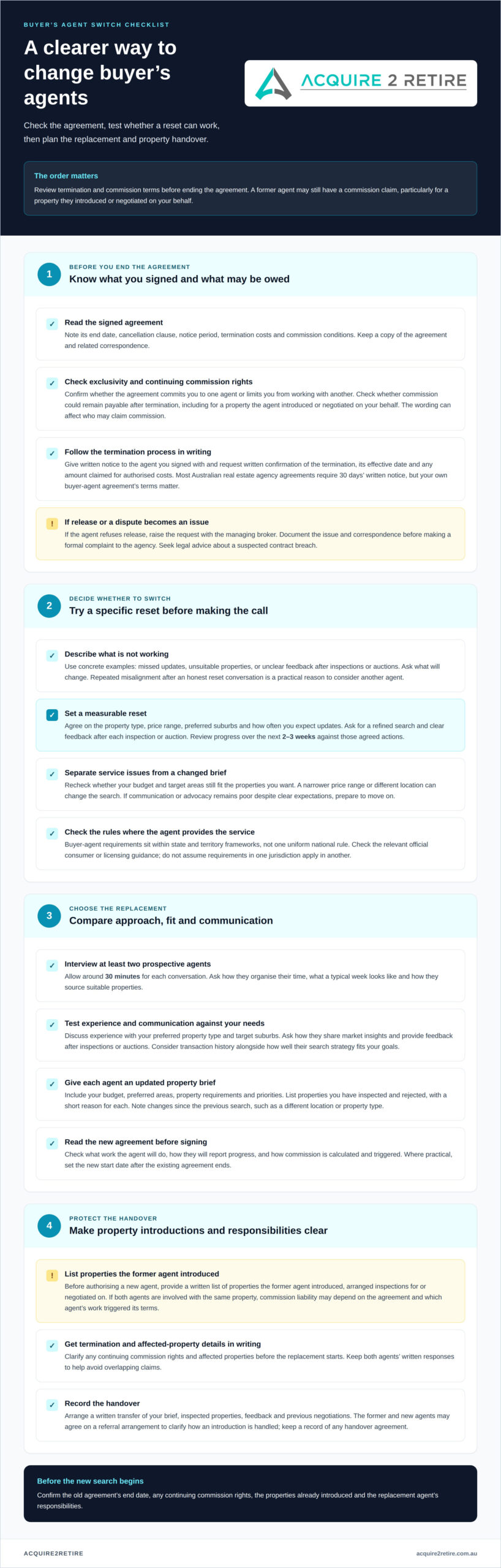
Read the signed contract and note its term, cancellation clause, notice period, termination costs and commission conditions. A buyer-agent agreement may require you to work exclusively with that agent or provide for commission if you purchase a property. Check whether commission could still be payable after termination, particularly for a property the agent introduced or negotiated on your behalf. Keep a copy of the agreement and related correspondence.
-
Check the agency arrangement
Check whether the agreement is exclusive or open, and don’t assume these terms work the same way for buyers and sellers. An exclusive seller agency gives one agent the right to sell during an agreed period; an open listing lets multiple agents seek a buyer. As a buyer, check whether your contract commits you to one agent or limits you from working with another. The wording can affect who may claim commission.
-
Give notice to terminate
Follow the contract’s termination process and give written notice to the agent you signed with. Most Australian real estate agency agreements require 30 days’ written notice, but your buyer-agent agreement’s own terms matter. Request written confirmation of termination, its effective date and any amount claimed for authorised costs. If the agent refuses release, raise the request with the managing broker. To complain or resolve a dispute, document the issue and correspondence, then make a formal complaint to the agency; seek legal advice about a suspected contract breach.
-
Resolve overlapping property introductions
Before authorising a new agent to act, give them a written list of properties the former agent introduced, arranged inspections for or negotiated on. If both agents are involved with the same property, commission liability may depend on the agreement and which agent’s work triggered its terms. To avoid overlapping claims, get written termination and clarify any affected properties and continuing commission rights before the replacement starts. Keep both agents’ written responses.
Is It Time to Switch Real Estate Agents?
Assess the service against your buying brief before deciding to switch agents. A specific conversation can show whether the problem is fixable or reflects a persistent mismatch.
-
Identify reasons for switching
Note specific examples of missed updates, unsuitable properties or unclear feedback after inspections or auctions. Raise them with your buyer’s agent and ask what will change. Slow progress alone may not justify switching if your brief, budget or target areas have shifted. But repeated misalignment after a reset conversation is a practical reason to consider another agent.
-
Check relevant state and territory rules
Buyer-agent requirements are governed through state and territory frameworks, rather than one uniform national rule. Check the relevant official consumer or licensing guidance for requirements that apply where the agent provides the service. Don’t assume an agreement or agent requirement in one jurisdiction automatically applies in another.
- Agree on a short, measurable reset before making a final decision. Set out the property type, price range, preferred suburbs and how often you expect updates. Ask the agent to refine the search and provide clear feedback after each inspection or auction. Review progress over the next 2-3 weeks against those agreed actions, rather than relying on a general promise to improve.
- Separate service problems from changes to your own brief. Recheck whether your budget and target areas still match the properties you want. A narrower price range or a different location can change the search. If the agent is sourcing suitable options, sharing market insight and adapting the approach, discuss a revised plan. If communication or advocacy remains poor despite clear expectations, prepare to move on.
Finding and interviewing a replacement agent
If switching from one buyer’s agent to another is your next step, prepare a clear brief before the new search begins. This gives prospective agents a practical picture of your priorities and previous decisions.
-
Research prospective agents
Interview at least two prospective agents and allow around 30 minutes for each conversation. Ask how they organise their time, what a typical week looks like and how they source suitable properties. Discuss their experience with your preferred property type and target suburbs. Ask how they share market insights and provide feedback after inspections or auctions, so you can compare their approach with your needs.
- Update your brief with your budget, preferred areas, property requirements and priorities. List properties you’ve inspected and rejected, with a short reason for each. This helps a replacement understand what you’ve already considered and how your preferences may have changed. Include any updates since your current agent began the search, such as a different location or property type.
-
Appoint the replacement agent
Choose an agent whose proposed strategy fits your brief, then read the new agreement before signing. Check what work they’ll do, how they’ll report progress, and how commission is calculated and triggered. Where practical, set the start date after your existing agreement ends. Make sure responsibilities are clear before the new search begins.
- Arrange a written handover covering your brief, inspected properties, feedback and previous negotiations. The former and new agents may agree on a referral arrangement between themselves to clarify how an introduction is handled. Keep a record of any handover agreement. A careful transfer makes switching from one buyer’s agent to another more organised and helps the replacement focus on your current priorities.
Assessing an agent’s experience and transaction volume
Use transaction history as one measure, then check whether the agent’s experience matches your buying brief. A high deal count alone won’t show how they’ll approach your search.
- Ask how many property transactions the prospective agent completed over the previous 12 months. Then ask which involved buyer representation, rather than listing or selling property for vendors. This distinction helps you understand whether their recent work reflects the buying support you need. Invite them to explain how those transactions relate to your target suburbs, budget and property type.
- Ask how the agent has sourced suitable properties and assessed market conditions for buyers. A useful answer describes the search process, the information considered and how they adapted when a property didn’t fit the brief. Look for practical detail, such as how they compare options or adjust the strategy when suitable listings are limited.
- Ask what the agent’s transaction volume means for the attention they can give your search. Find out how they manage competing commitments, keep buyers updated and provide feedback after inspections or auctions. Their answers should clarify how communication works in practice. For example, ask who will update you and how they’ll discuss a property that misses your key requirements.
- Compare the agent’s answers with your written brief, not just their headline figures. Consider whether their experience fits the property type and areas you’re targeting, and whether their approach addresses your priorities. Ask what they would do first, what they need from you and how they’ll refine the search as your preferences develop. Clear, relevant answers make their experience easier to assess.
For help aligning your purchase with a broader investment plan, discuss your property investment goals.
Acquire2Retire
Acquire2Retire helps Australian property investors connect their next purchase with a broader wealth strategy. If you’re changing agents because your property search no longer fits your investment goals, its Planning & Strategy and Acquisition support can help align your priorities with your next property decision. Finance and Tenancy support can also form part of a wider investment approach.
This is most relevant when you’re reassessing what to buy, where to invest or how a purchase fits your portfolio. Acquire2Retire focuses on investment planning and acquisition, rather than resolving disputes under an existing buyer’s agency agreement. For help considering your next property investment, contact Acquire2Retire.
Make your next property decision with purpose
Once the transition is settled, use the change as a chance to reconnect your search with the reason you’re buying. If switching from one buyer’s agent to another has left you uncertain about your investment priorities, clarify what the next purchase needs to contribute before choosing a new direction.
Consider how location, property type and finance fit your wider plans, then use those priorities to guide discussions with your replacement agent. A considered brief can keep the search focused on your investment goals, rather than simply continuing the same process with a different representative. If you’re still weighing up your direction, refine your goals before making the next commitment.
Acquire2Retire can help you think through your property investment direction and the next steps that fit your plans. Contact Acquire2Retire for help as you shape your next move with greater clarity and confidence.
Frequently Asked Questions
How Do You Terminate a Real Estate Contract?
If you mean your agreement with a real estate agent, follow its termination clause rather than assuming a phone call ends it. Give notice in writing, state the date you want the agreement to end and ask for written confirmation. Keep the agreement and correspondence together. If you mean a property purchase contract, that’s separate and may require prompt legal advice.
How do you tell your agent you want to switch?
Tell your agent calmly and clearly that you’re considering ending the relationship, then explain the specific issue, such as missed updates or a search that no longer reflects your brief. Ask whether a practical change could resolve it. If you decide to leave, send a separate written notice that follows your agreement, and keep the exchange factual and dated.
Should You Switch Buyer’s Agents Mid-Search?
Consider switching if repeated service problems continue after you’ve discussed them and agreed on changes. In competitive property markets, suitable homes can sell within days, sometimes through private negotiation before public listing cycles finish. That pace makes clear communication and a current brief especially useful. Before moving on, weigh whether the agent’s effort is misaligned or your budget, preferred suburbs or property criteria have changed.
Can you change buyer’s agents in Australia after signing an agreement?
Yes, you can seek to change agents after signing, but your agreement may set conditions for ending the relationship. For example, it may require written notice or address commission if you later buy a property the former agent introduced. Read those terms before appointing a replacement, and get the end date and any continuing obligations recorded in writing.
How do you terminate a buyer’s agent agreement in Australia?
Start by reading the agreement’s termination clause and following its process. Send written notice to the agent, identify the agreement and request written confirmation of when it ends. Keep records of property introductions and negotiations, as they may matter to later commission claims. If the agent won’t release you, raise the issue with the managing broker and document the response.
What notice period and termination fees apply to a buyer’s agent agreement?
The notice period and any termination fee depend on the signed agreement; there isn’t one universal buyer-agent fee. Most Australian real estate agency agreements require 30 days’ written notice, but don’t assume that period automatically applies to your buyer’s agreement. Check its notice clause and any authorised cost-recovery or continuing commission terms before giving notice, then ask for a written breakdown of amounts claimed.