
What if a sound property investment plan isn’t a prediction about what prices will do, but a framework for making decisions when conditions change? Property investment planning can feel difficult to start when you’re weighing up your goals, borrowing capacity and the ongoing costs of owning an investment property. It’s easier to assess each choice when you can see how it fits your wider finances.
It’s sensible to seek clarity before taking on debt. A property that looks promising on paper still needs to suit your cash flow, appetite for risk and the time you can commit to a long-term investment. The aim isn’t to find a guaranteed outcome, but to understand the trade-offs and make considered choices based on your circumstances.
This guide sets out a practical sequence for building your plan, from defining financial priorities and assessing capacity to researching properties and considering finance. It also explains how to review your assumptions over time, so you can respond thoughtfully as your finances, goals or market conditions change. A clear process can make property decisions feel more connected to the future you’re working towards, and less like a leap into the unknown.
Key Takeaways
- Use property investment planning to connect your financial position, priorities and tolerance for risk before weighing up property options.
- Assess your income, expenses, existing commitments and cash flow to understand which ongoing costs may fit your circumstances.
- Compare strategies focused on rental income, long-term growth or a balance of both by considering their trade-offs, rather than assuming one suits everyone.
- Turn your plan into practical criteria for research, finance discussions and acquisition due diligence, then revisit it when your circumstances or assumptions change.
- Understand how planning, acquisition, finance, initial tenancy coordination and ongoing support may connect your next steps, and where you may need separate services.
What property investment planning means for Australian investors
A first property decision can feel difficult when your goals are still taking shape and each option brings different trade-offs. It’s easy to focus on what’s available to buy before working out what you need an investment to do for your finances and future plans.
Property investment planning is the process of aligning your objectives, financial position, research and future decisions to guide property choices, while recognising that investment risk remains. Property investment can involve decisions about valuation, finance and potential income or growth. The global overview of property investment provides useful background before you apply those ideas to your own circumstances in Australia.
Planning isn’t the same as selecting a property, arranging a loan or managing a tenancy. Those may be steps or separate responsibilities within the wider investment journey. A plan gives you a reasoned basis for considering them, so a property’s features, financing and tenancy arrangements can be assessed against your priorities rather than treated as isolated decisions.
What does a property investment plan include?
A useful plan brings together your goals, financial position, investment approach, decision criteria and review points. Each element informs the others: your objectives help shape your approach, your finances help define what may be manageable, and your criteria help you assess whether a property suits that approach. Review points give you a reason to revisit the plan if your circumstances or assumptions change.
There’s no universal formula. The right balance depends on personal factors such as your existing commitments, cash flow, timeframe and appetite for risk. A plan should make those factors visible, not hide them behind a generic checklist or a property that looks appealing at first glance.
Why plan before researching properties?
Written priorities give you a consistent way to assess opportunities. For example, if preserving flexibility in your household cash flow is a priority, compare a property’s potential costs with that priority instead of judging it on location or expected growth alone. Your criteria can also show you what you still need to investigate before making a decision.
Market information can help, but it shouldn’t replace an honest assessment of your capacity and needs. A plan can guide your research and help you compare trade-offs; it can’t predict market movements, remove risk or guarantee results. Treat it as a flexible decision framework that supports deliberate choices as you move from broad objectives towards practical next steps.
How to build a property investment plan around your circumstances
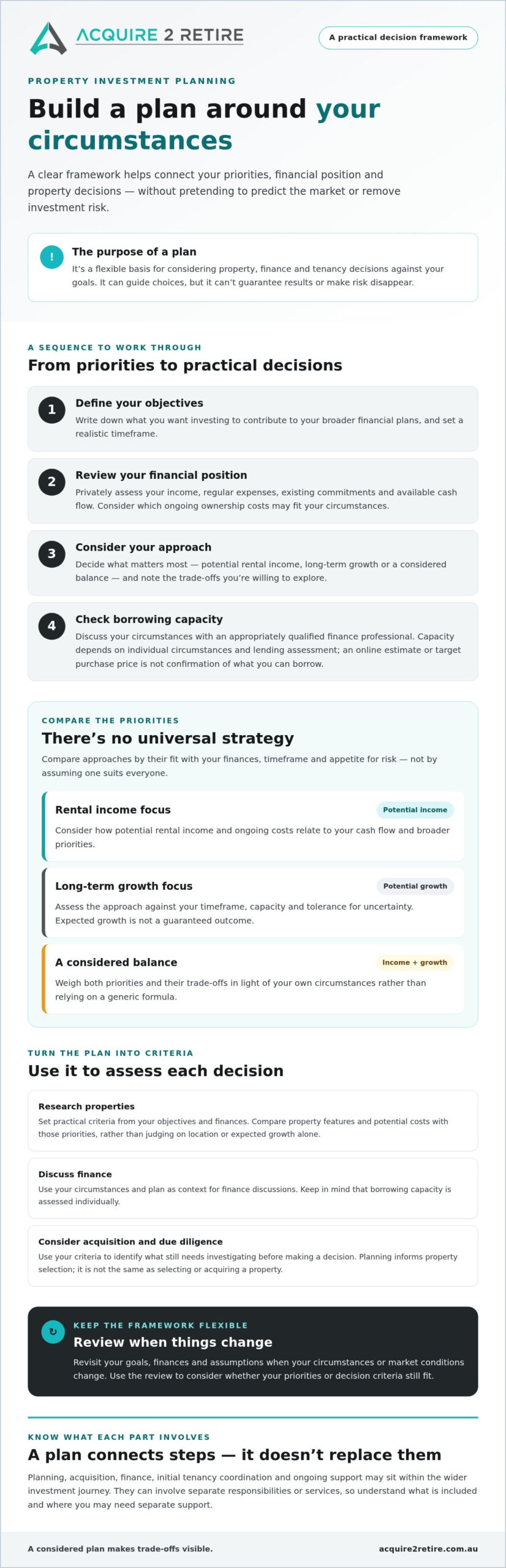
A practical plan starts with your own priorities, not a shortlist of properties. This sequence can help you organise the decisions while keeping sensitive financial details private.
Start with goals, timeframe and financial capacity
First, write down what you hope property investing will support and roughly when you’d like that to happen. Then distinguish long-term aspirations from present-day constraints, such as household cash flow, existing financial commitments and how much uncertainty you’re comfortable carrying. For further exercises to clarify your priorities, look for a dedicated guide to property investment goal setting.
- Step 1: Define your objectives. Describe what you want investing to contribute to your broader financial plans, and set a realistic timeframe.
- Step 2: Review your financial position. Privately assess income, regular expenses, existing commitments and available cash flow. A summary or personal budget is enough for your own planning; don’t include account numbers or other sensitive details in a general planning document.
- Step 3: Consider your approach. Decide what matters most, such as potential rental income, long-term growth or a considered balance, and note the trade-offs you’re willing to explore.
- Step 4: Check borrowing capacity. Discuss your circumstances with an appropriately qualified finance professional. Borrowing capacity depends on individual circumstances and lending assessment, so don’t treat an online estimate or target purchase price as confirmation of what you can borrow.
The Australian Government’s property investment guide offers a useful overview of ways to invest and factors to consider. Use general resources to inform your questions, then assess each option against your own position rather than assuming it will suit you.
Record assumptions and define decision boundaries
Next, document the assumptions behind your thinking, including expected income, expenses, borrowing arrangements and possible vacancy periods. These are estimates to review, not certainties. Set boundaries for the level of debt and ongoing commitments you’d be comfortable considering, and be clear about how much investment uncertainty you can tolerate.
- Step 5: Set decision criteria. Record the features an opportunity would need to meet, as well as the conditions that would make you pause or walk away.
- Step 6: Note assumptions and review dates. Keep the reasoning behind your estimates with the plan, and set a date to revisit them or review sooner if your circumstances change.
In short, clarify your goals, assess your capacity, choose an approach, confirm borrowing considerations, set boundaries, then record assumptions and review dates. This sequence can support more deliberate decisions, but it can’t guarantee a successful investment. Personal financial, tax and legal circumstances can be complex, so seek advice from suitably qualified professionals where needed. If support connecting planning with acquisition and finance discussions would help, explore property investment planning support from Acquire2Retire.
Compare property investment strategies without chasing a single outcome
There isn’t one property investment strategy that suits every Australian investor. Your documented priorities should guide the type of asset you research, the finance discussions you have and the period you expect to hold an investment. A strategy focused on income, for example, raises different questions from one centred on long-term growth. Neither should be treated as a promise of results.
Income focus, growth focus or a balanced approach?
An income focus gives greater weight to potential rental cash flow and how an investment’s ongoing costs may fit your budget. A growth focus places more emphasis on the potential for the asset to increase in value over a longer timeframe, while a balanced approach considers both priorities. Your need for accessible cash flow and the time you can remain invested may influence which trade-offs are worth exploring. A separate guide to cash flow planning can help you examine income and growth considerations in more depth.
| Strategic priority | Considerations and trade-offs | Questions to ask |
|---|---|---|
| Income | Consider potential rent alongside costs, vacancies and your need for cash flow. Income expectations aren’t guaranteed. | Could I manage ongoing commitments if rental income changes or there’s a vacancy? |
| Long-term growth | Consider whether your timeframe allows you to hold through changing conditions, while accounting for the costs and uncertainty of ownership. | Does this approach fit my timeframe and capacity to hold? |
| Balanced | Weigh income and growth objectives together, recognising that a compromise may not meet either priority fully. | Which priority takes precedence if the two pull in different directions? |
The table is a way to structure questions, not rank strategies. For broader context on Australian investor circumstances, the Reserve Bank of Australia’s analysis of housing investors provides data-informed background; it doesn’t determine which approach is right for you.
How diversification and risk tolerance inform the strategy
Diversification means considering how concentrated your investments are, rather than relying heavily on one asset or exposure. It may be relevant when shaping a plan, but it can’t prevent losses or remove property-specific risks. Debt, changes in your finances and the length of time you can hold an investment also affect how much uncertainty you may need to manage.
Property investment planning should connect your risk tolerance with practical choices about asset selection, finance and holding horizon. Someone who needs more flexibility may assess commitments differently from an investor with a longer timeframe, but neither position points automatically to a particular property. For a more detailed reflection on your comfort with investment risk, refer to the planned risk profile article, then use those considerations to revisit your documented decision criteria.
Turn your property investment plan into practical decisions and reviews
A plan becomes useful when it helps you decide what to investigate, what to ask and when to pause. Before progressing with a property opportunity, translate your priorities into criteria you can apply consistently. This won’t replace property-specific research or professional advice, but it can help you identify where the available information doesn’t yet support a decision.
Create a decision checklist before considering an acquisition
Use a short checklist to compare an opportunity with your documented plan. For each property you’re considering, ask:
- Does it fit my goals? Check whether its features and intended holding period align with the priorities you’ve recorded.
- Does it appear financially manageable? Revisit your cash flow assumptions and discuss borrowing questions with an appropriately qualified finance professional.
- What evidence supports my view? Separate information you’ve verified from assumptions that still need checking.
- Which risks have I documented? Consider how costs, vacancy, finance conditions or a change in your circumstances could affect your ability to proceed or hold.
- What remains unanswered? Write down questions about the property, its condition, likely commitments or relevant professional advice before deciding on next steps.
If key information is missing, treat that as a reason to investigate further, not to fill the gaps with optimism. Property-specific acquisition and due diligence guides can help you examine an individual opportunity in more detail. Your plan is a decision aid, not a substitute for appropriate inspections, independent checks or professional advice relevant to your circumstances.
Review the plan as your circumstances change
Choose a review cadence that suits your situation, then revisit the plan sooner if a meaningful change occurs. This could include a shift in income or expenses, new financial obligations, a change in your objectives or lending conditions that prompt you to reassess your assumptions. There’s no single review interval that suits every investor.
At each review, check whether your goals still reflect what matters to you, whether cash flow assumptions and debt commitments remain realistic, and whether your investment progress is consistent with the plan. Record what has changed and why. This creates a clear trail of reasoning rather than a series of disconnected decisions. A portfolio review article can offer further guidance on monitoring investments over time.
Sound property investment planning stays open to adjustment. If you’d value support connecting your strategy with acquisition research, finance discussions and ongoing portfolio advice, explore property investment planning support from Acquire2Retire.
How Australian property investment advice can support your next steps
Some investors find it helpful to have support connecting their financial objectives with property research, acquisition decisions and finance discussions. This can be useful when you’ve developed a plan but want help translating it into practical next steps, or when you’re unsure which questions to resolve before proceeding.
Acquire2Retire provides property investment planning and strategy, acquisition support, finance support, initial tenancy coordination and ongoing portfolio advice. These services can connect the planning process with decisions about a property and considerations that follow an acquisition. Clarify the scope of support from the outset, so you understand which parts of your investment journey it covers and which require other professionals.
What to expect from an advisory conversation
A useful initial discussion can begin with your objectives, current circumstances, concerns and the support you’re seeking. You might explain your intended timeframe, the priorities in your plan and your questions about research, acquisition or finance. You don’t need to arrive with every decision settled; identifying what remains uncertain can help clarify which support may be relevant.
Before engaging any adviser, ask about the proposed scope, fees, service boundaries and qualifications relevant to the advice being discussed. You can also ask how recommendations relate to your stated objectives and what further checks may be needed. A discussion doesn’t guarantee finance approval, a particular property selection or investment performance. Those outcomes depend on circumstances and factors beyond any planning conversation.
Choose support that matches the decisions ahead
Investment strategy and acquisition support are distinct from legal, tax and day-to-day property management services. Acquire2Retire does not provide legal or conveyancing services, or ongoing property management. Its tenancy offering is initial coordination, rather than ongoing management after a tenant moves in.
Depending on your needs, you may need to speak with separate appropriately qualified professionals about tax or legal matters, and make other arrangements for ongoing property management. Being clear about these boundaries helps you build a complete support structure without assuming one adviser covers every responsibility.
If you’re considering your next steps, you can discuss whether Acquire2Retire’s planning, acquisition, finance, tenancy coordination or ongoing support may fit your situation. Take the time you need to understand the scope and decide whether it aligns with the decisions ahead.
Take your next property decision with greater clarity
A considered property investment plan starts with your goals and financial capacity, then uses clear criteria to guide research, finance discussions and acquisition decisions. It should also make room for review, because your circumstances and assumptions may change over time. No plan can remove investment risk, but a flexible framework can help you weigh trade-offs with greater care.
If you’d value support connecting those steps, Acquire2Retire can assist with planning, acquisition, finance and ongoing portfolio support. Its services also include initial tenancy coordination, but not ongoing property management or legal conveyancing, so you can understand the boundaries and arrange separate support where needed.
Explore property investment planning support to discuss whether advisory assistance fits your situation. Take a considered next step with a clearer understanding of the decisions ahead.
Frequently Asked Questions
How do I create a property investment plan in Australia?
Start by clarifying what you want property investing to support and your timeframe, then assess your financial capacity and existing commitments. Choose a strategic priority, such as rental income, long-term growth or a balance, and set criteria for researching opportunities. Record your assumptions about costs, borrowing and vacancy, along with questions for relevant professionals and a date to review the plan. This process guides decisions, but can’t guarantee an outcome.
What should a property investment plan include?
A property investment plan should connect your objectives, financial position, preferred investment approach and criteria for assessing opportunities. It should also record assumptions about income, expenses, borrowing and vacancy, as well as risks you’re considering and questions that need further investigation. Add review points so you can revisit the plan if your circumstances or assumptions change. Tax, finance and legal matters may require advice from appropriately qualified professionals.
Is property investment planning suitable for a first-time investor?
Yes, property investment planning can help a first-time investor organise decisions before researching or pursuing a property. Setting out your goals, timeframe, financial commitments and tolerance for uncertainty can make it easier to identify what you need to learn and what questions to ask. You don’t need to have every answer at the start. A plan can develop gradually and adjust as you gain information, without promising that an investment will succeed.
How do I decide between rental income and long-term growth?
Compare each priority with your cash flow needs, timeframe and capacity to manage ongoing commitments. An income-focused approach gives more attention to potential rent and costs, while a growth-focused approach places greater emphasis on a longer holding horizon and possible changes in value. A balanced approach considers both, though it may involve trade-offs. Assess each option against your circumstances, and don’t assume either approach will deliver a particular result.
Can a property investment plan guarantee a return?
No, a property investment plan can’t guarantee a return or remove investment risk. It’s a framework for connecting your objectives and financial position with research, decision criteria and future reviews. Property outcomes can be affected by factors outside your control, and assumptions may not match what happens. Use a plan to consider risks and guide decisions, not as a promise of performance. Seek professional advice where your circumstances call for it.
How often should I review my property investment plan?
Set a review schedule that suits your circumstances, then revisit your plan sooner if something important changes. This might include a shift in your income, expenses, objectives, debt commitments or lending conditions. At each review, check whether your assumptions remain realistic and whether your investment decisions still align with your priorities. There’s no single review interval for every investor; the key is to review deliberately and update the plan when needed.
Do I need a property investment adviser to create a plan?
No, you can draft a plan yourself by documenting your goals, financial position, approach and review points. An adviser may be useful if you want support connecting strategy, acquisition research, finance discussions and ongoing portfolio advice. Acquire2Retire provides planning and strategy, acquisition, finance, initial tenancy coordination and ongoing support. It doesn’t provide ongoing property management or legal conveyancing, so you may need separate professionals for those services.