
What if the best first move in property investing isn’t choosing a property, but deciding what you need your finances and strategy to achieve? A property investment roadmap can turn broad ambitions into manageable decisions. It helps you see what to address now, what can wait and when to review your direction.
It’s understandable to feel uncertain about where to begin. Borrowing capacity, cash flow, risk tolerance and longer-term goals all affect the choices ahead. A strategy that looks suitable on paper may not fit your circumstances, and it can be difficult to consider an acquisition separately from finance and portfolio planning.
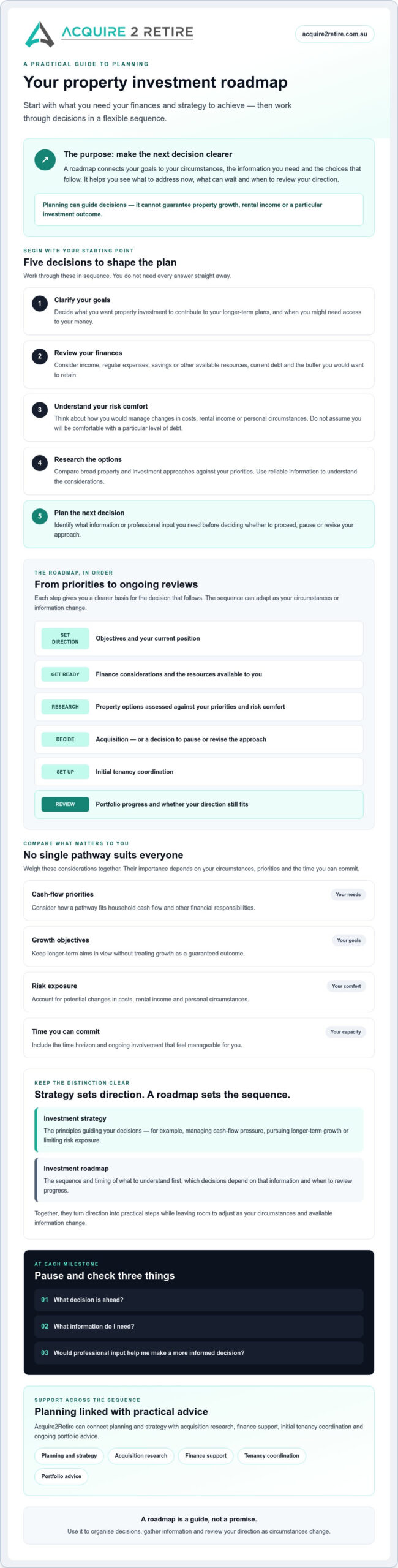
This guide sets out a staged plan around your priorities, with clear decision points and regular reviews. You’ll work through objectives and your current position, then consider finance, property research and acquisition, followed by tenancy setup and portfolio reviews. You’ll also see when strategy, finance or acquisition advice may help you make a more informed decision. The aim isn’t to predict outcomes, but to create a practical sequence that can adapt as your circumstances change.
Key Takeaways
- A property investment roadmap organises decisions into a flexible sequence. It can guide your planning, but it can’t guarantee investment outcomes.
- Use your time horizon, available resources, cash-flow needs and existing commitments to shape a plan that reflects your starting point.
- Compare investment pathways by weighing cash-flow priorities, growth objectives, risk exposure and the time you can commit.
- Set milestones that identify the decision ahead, the information you need and when professional input may be useful.
- Acquire2Retire can connect planning and strategy with acquisition research, finance support, initial tenancy coordination and ongoing portfolio advice.
What a property investment roadmap should clarify before you begin
Not sure where to start, or wary of rushing into a purchase before you understand how it fits your finances? A property investment roadmap gives you a considered way to organise the decisions ahead, without treating a purchase as the first or inevitable step.
A property investment roadmap is a flexible sequence of goals, decisions, actions and review points that helps you decide what to do next, and when to reconsider. It’s more than a property wish list. A list might describe the asset you hope to own, while a roadmap connects that ambition to your circumstances, the information you need and the choices that follow.
Planning can help you compare options and prepare for decisions, but it can’t guarantee property growth, rental income or any particular investment outcome. Property values, costs and rental conditions can change, as can your priorities. For a broad introduction to the concepts and risks involved, see Real estate investing. Use your roadmap to ask better questions, not to assume certainty.
How a roadmap differs from a property investment strategy
A strategy sets the principles that guide your investment decisions. It may reflect whether your priority is to manage cash-flow pressure, pursue longer-term growth or limit the level of risk you’re comfortable taking. A roadmap sets out the sequence and timing: what you need to understand first, which decisions depend on that information and when you’ll review progress.
The two work together. Your strategy provides direction; your roadmap turns that direction into practical steps. Both should reflect your circumstances and new information, rather than locking you into choices made before you’ve assessed your position.
Who benefits from a staged investment plan?
A staged plan can help first-time investors work out what needs attention before considering an acquisition. It can also help existing investors assess whether their portfolio still aligns with their financial priorities, risk tolerance and longer-term plans.
For either group, property decisions sit alongside other commitments. Household cash flow, savings goals and existing financial responsibilities can affect what feels manageable and when. Copying another investor’s approach may not suit you, even if their circumstances seem similar. Start with your own priorities, then shape the next steps around them. A useful roadmap leaves room to pause, gather advice and adjust course as your situation or available information changes.
Build your Australian property investment roadmap around your starting point
Before comparing properties, take stock of your starting position. Record your time horizon, available resources, cash-flow needs and existing commitments. These details help turn broad goals into practical criteria and make it easier to spot when a proposed step could put too much pressure on your finances.
Work through the decisions in sequence. You don’t need every answer straight away, but each step should give you a clearer basis for the next.
- 1. Clarify your goals. Decide what you want property investment to contribute to your longer-term plans and when you might need access to your money.
- 2. Review your finances. Consider your income, regular expenses, savings or other available resources, current debt and the buffer you’d want to retain.
- 3. Understand your risk comfort. Consider how you’d manage changes in costs, rental income or personal circumstances. Don’t assume you’ll be comfortable with a particular level of debt.
- 4. Research options. Compare broad property and investment approaches against your priorities. The Australian Government’s property investment advice is one source of information to help you understand the considerations.
- 5. Plan the next decision. Identify what information or professional input you need before deciding whether to proceed, pause or revise your approach.
Turn personal goals into practical planning criteria
Make long-term aims specific enough to guide later choices. For example, distinguish a need to preserve household cash flow from a preference to invest within a particular timeframe. Record financial non-negotiables separately from preferences about property type or investment pace. This helps prevent an appealing option from overriding what your budget can support. Use your criteria to assess each step, and revisit them if your circumstances change.
Review finances, risk tolerance and borrowing position
Review your income, expenses, existing debt and the funds you’d want to keep available for unexpected needs. A lender’s assessment of borrowing capacity is not the same as your personal comfort with taking on debt. Assess lending capacity and borrowing structures against your circumstances, and don’t treat an indicative figure as a decision to borrow.
Before committing, confirm relevant tax, lending and legal matters with suitably qualified professionals, such as a tax adviser, lending professional and solicitor or conveyancer. Their advice can help clarify issues that affect your decisions, but it doesn’t remove investment risk.
If you’d like support connecting your goals with finance and acquisition decisions, you can discuss your property investment circumstances with Acquire2Retire.
Compare roadmap pathways without assuming one property strategy suits everyone
Your property investment roadmap doesn’t need to lock you into one pathway. It should help you compare the trade-offs between options and adjust your plan as your finances, priorities or available information change. Rental yield and capital growth are different measures: yield relates rental income to a property’s value, while capital growth refers to a change in value over time. Neither is guaranteed, and neither alone shows whether an investment suits your needs.
Use a consistent set of questions to compare broad approaches, rather than trying to pick a predicted market winner. The Moneysmart’s guide to property investment is one useful Australian reference for understanding key considerations.
| Decision factor | Questions to consider |
|---|---|
| Cash-flow needs | How much ongoing contribution could your household manage after allowing for expenses and possible vacancy periods? |
| Growth objectives | Are you prepared to focus on longer-term potential value changes without relying on them to meet near-term costs? |
| Risk exposure | How would you respond if expenses rose, rent changed or borrowing conditions shifted? |
| Time horizon | How long can you hold an investment before you may need access to the funds? |
Balance income needs, growth aims and resilience
Investors may place different weight on rental income and possible longer-term value changes. If household cash flow is a priority, consider whether income could cover expected costs and how you’d manage expenses during a vacancy. If your focus is longer-term growth, consider whether your finances could withstand periods when income or property values don’t meet expectations. There’s no universal balance. Borrowing conditions and personal commitments also matter.
Use research and due diligence to test assumptions
Broad market research can help you understand wider patterns and identify questions to investigate. It doesn’t replace assessment of a specific property. Before treating an option as suitable, consider checking:
- Comparable sales evidence to understand how similar properties have been priced.
- Property condition and any maintenance issues that could affect costs or suitability.
- Relevant demand indicators, such as rental availability and employment or population trends.
- Whether expected costs and income fit your cash-flow plan and time horizon.
These checks can challenge assumptions before they become commitments. Keep your shortlist provisional until market research, property-specific due diligence and a finance assessment support the next decision.
Turn the roadmap into milestones, decisions and regular reviews
A useful roadmap turns broad intentions into checkpoints. At each milestone, note the decision you need to make, the information required and the professional input that may help. This makes it easier to see what’s ready to progress and what needs more attention before you commit.
Review your roadmap whenever your circumstances or the information behind a decision changes. A shift in household goals, cash-flow pressure or lending circumstances may affect whether the next step still makes sense.
- Preparation: Decide whether you’re ready to begin researching. Bring together your goals, financial position, commitments and risk considerations. A strategy adviser or finance professional may help clarify what to address first.
- Research: Decide which options warrant closer assessment. Gather market information and compare it with your criteria. Acquisition advice may help with market research and identifying assets for further due diligence.
- Acquisition: Decide whether a specific property fits your plan and is suitable to pursue. Recheck affordability, finance assumptions and due diligence before committing. Seek lending input on finance, and refer legal, tax and conveyancing questions to suitably qualified specialists.
- Tenancy setup: Plan initial tenant selection and leasing arrangements after acquisition. Confirm what coordination is needed and who will handle ongoing day-to-day property management, which is separate from initial tenancy setup.
- Portfolio review: Decide whether to maintain, adjust or reconsider your approach. Review relevant portfolio information, cash-flow needs and equity position, seeking strategic or finance advice where it can inform the next decision.
Set decision gates before making an acquisition
Before moving from research to property selection, be clear about your affordability limits, the due diligence still required and how the proposed finance fits your wider plan. A decision gate can be as simple as pausing until key information has been checked and relevant advice received. Confirm legal, tax and conveyancing matters with qualified specialists, rather than treating them as part of an investment adviser’s role.
Plan for tenancy setup and ongoing portfolio monitoring
Tenancy setup is a distinct post-acquisition milestone, not a substitute for ongoing property management. Plan how initial tenant selection and leasing arrangements will be handled, then decide how you’ll monitor the investment over time. Set review points that suit your circumstances, and bring them forward if your goals, cash flow or lending conditions change.
If you’d like help connecting strategy, acquisition and finance decisions across these milestones, discuss your investment roadmap with Acquire2Retire.
When property investment advice can help put your roadmap into action
A property investment roadmap can be easier to act on when its decisions connect: your goals shape the strategy, the strategy informs finance and acquisition choices, and the purchase becomes part of a plan for ongoing portfolio review. Advice may help if you’re unsure what to decide first, need to test how borrowing fits your wider finances or want support assessing potential properties against your priorities.
Acquire2Retire provides planning and strategy, acquisition support, finance support, initial tenancy coordination and ongoing portfolio advice. Its services help investors consider decisions in light of their financial objectives, risk profiles, cash-flow needs and longer-term targets, without promising investment returns.
What an integrated advisory process may cover
Planning can help define your objectives and the criteria you’ll use to assess options. Acquisition support may include market research, due diligence, asset identification and negotiation. Finance support helps align lending arrangements with broader portfolio plans. Any lending assessment and approval remain subject to the relevant lender and your circumstances.
After a purchase, initial tenancy coordination can support tenant selection and leasing arrangements. This is not ongoing property management. Acquire2Retire also offers ongoing portfolio advice, including portfolio monitoring and equity reviews, to help you consider whether your plan still fits as circumstances change. Legal and conveyancing services aren’t provided, so arrange advice from appropriately qualified specialists for those matters.
Prepare for a useful first conversation
You don’t need to have every decision settled before asking for guidance. A few notes can help make the discussion more focused:
- Your investment goals, preferred time horizon and cash-flow priorities.
- Questions about your financial position, borrowing plans or risk comfort.
- Details of any existing properties or investments that may affect your next steps.
- What you’d like help with and what you expect to manage independently.
It’s reasonable to ask what the service includes, how fees are explained, who is responsible for each task and whether you’ll need input from external finance, tax or legal professionals. Clear boundaries help you understand how advice fits into your plan and where another specialist may be needed.
If you’d like to explore how planning, finance and acquisition decisions might fit your circumstances, speak with Acquire2Retire about a sensible next step. Start with your questions and current priorities, then decide whether the support offered is right for you.
Take the next step with a plan that fits
A practical property investment roadmap gives you a sequence for making decisions, not a promise of a particular return. Start with your financial priorities and risk comfort, compare options against your cash-flow needs and time horizon, then set milestones that help you pause and review when circumstances change.
The right pathway is personal. Your plan should connect goals with finance and acquisition decisions, while leaving room to reassess rather than committing you to a fixed course. Tailored planning can account for your financial objectives, risk profile, cash-flow requirements and longer-term targets. Support can also connect planning with acquisition research, finance and initial tenancy coordination.
If you’d value guidance in working out a sensible next step, discuss your property investment plans with Acquire2Retire. A considered conversation can help you clarify what matters most and where to focus next. You can move forward at a pace that suits your circumstances.
Frequently Asked Questions
What is a property investment roadmap?
A property investment roadmap is a flexible sequence of goals, decisions, actions and review points that helps you plan your next steps. Unlike a wish list of properties, it connects your financial priorities with the information and decisions needed along the way. It can cover preparation, research, finance, acquisition, tenancy setup and portfolio reviews, while allowing you to adjust direction as your circumstances or available information change.
How do I create a property investment roadmap in Australia?
Start by clarifying your goals, time horizon, cash-flow needs, available resources and existing commitments. Review your finances and risk comfort, then research options that fit your situation before deciding on next steps. Assess borrowing capacity and lending structures with an appropriate finance professional, and confirm tax and legal matters with suitably qualified specialists. A property investment roadmap should set decision points, not rush you towards a purchase.
What should I include in a property investment plan?
Include your financial objectives, time horizon, cash-flow requirements, existing commitments and the level of risk you’re comfortable taking. Note how you’ll research options, assess finance and affordability, and decide whether a specific property warrants further due diligence. Your plan can also set milestones for acquisition, initial tenancy arrangements and portfolio reviews, including what information or professional input you’ll need at each stage. Keep it flexible enough to reflect changing circumstances.
How often should I review my property investment roadmap?
Choose review points that suit your circumstances rather than relying on a universal schedule. Revisit your roadmap when a planned milestone approaches, and sooner if your goals, household cash flow, existing commitments or lending circumstances change. A review can help you check whether your assumptions still hold, whether you need more information and whether the next action remains suitable. Recording decisions and reasons can make later reviews clearer and more useful.
Can a property investment roadmap guarantee a return?
No. A roadmap can organise research and decisions, but it can’t guarantee capital growth, rental income or any investment return. Property outcomes can be affected by market conditions, costs, vacancies, finance and changes in your personal circumstances. Use planning to test assumptions, consider risks and decide what you can manage, rather than treating projected outcomes as certain. Seek appropriate professional advice for financial, lending, tax or legal questions relevant to your situation.
Should I speak to a property investment adviser before buying?
Speaking with an adviser before buying may help if you want to connect your financial goals with strategy, finance and acquisition decisions. Acquire2Retire offers tailored planning, acquisition research and finance support, alongside initial tenancy coordination and ongoing portfolio advice. Ask what the service covers, how fees and responsibilities are explained, and which matters require external specialists. Legal and conveyancing services, and day-to-day property management, are not provided by Acquire2Retire.
What is the difference between a property investment strategy and a roadmap?
A strategy sets the principles that guide your investment decisions, such as your priorities for cash flow, growth objectives and risk tolerance. A roadmap lays out the sequence and timing of decisions, actions and reviews that put those principles into practice. For example, a strategy may establish what matters most, while the roadmap identifies what to assess before researching properties, arranging finance or considering an acquisition. Both should reflect your circumstances and adapt as they change.