
What if building wealth through property started with deciding what you want an investment to achieve, rather than searching for a property first? Property investment goals setting turns a broad ambition into a practical direction, helping you compare decisions with your priorities instead of relying on guesswork.
It’s understandable to feel unsure where to begin. A long-term aim can be difficult to translate into steps when you’re also weighing cash flow, risk and other financial commitments. Your plan may also need to change as your circumstances do.
This article shows how to define the outcomes that matter, choose measurable milestones and keep expectations grounded. You’ll learn how to review your goals and connect them with property strategy, research, acquisition and finance decisions. A clear framework can guide your choices while leaving room to adapt when life or your priorities change.
Key Takeaways
- Start with the personal outcome you want from property, then use it to guide decisions rather than treating it as a promised result.
- Use property investment goals setting and the SMART framework to make objectives specific, measurable and reviewable.
- Test each goal against income stability, cash flow needs, borrowing position and your comfort with uncertainty.
- Break long-term aims into staged decisions. Record a baseline, next action, measure and review date.
- A tailored property roadmap can connect your objectives with risk, research, acquisition and finance support.
Property investment goals setting: start with the outcome you want
Success through property means different things to different investors. You might want to build wealth over the long term, create an income stream, have more flexibility in your working life or support future financial security. Effective property investment goals setting starts by naming the outcome that matters to you, before comparing locations, property types or borrowing options.
A goal gives your decisions a point of reference; it doesn’t promise a particular result. For example, wanting more choice about when you work is a lifestyle outcome. A portfolio milestone or a measure of net cash flow after relevant costs can help you track progress towards it. These measures help you compare options, but they can’t remove uncertainty or guarantee performance.
An investment goal is a guide for making decisions, not a guarantee of financial performance. This distinction lets you plan carefully while recognising that property markets, costs and personal circumstances can change.
What could a property investment goal be?
One investor might focus on building a portfolio over time, while another may prioritise income to complement other earnings. Someone else may want more flexibility to reduce work commitments in future or improve their financial security later in life. These aims can overlap, but they may call for different measures and involve different trade-offs.
You don’t need to choose a goal that sounds impressive or adopt someone else’s definition of success. For a broad overview of the concepts and approaches involved, see Real estate investing. Start with your intended outcome, not the assumption that one strategy suits everyone.
Start with your own timeframe and priorities
Consider when you may need access to investment income or capital, and how that timing fits with your life. Work plans, family commitments, existing finances and other responsibilities can all affect how much uncertainty you’re comfortable managing. A goal that suits a long investment horizon may not fit if you expect to need funds sooner.
Before looking at a particular property, write down what you want property to help you do, when that outcome may matter and what you need to protect along the way. You might value greater future flexibility but still need to preserve cash flow for current commitments. This exercise clarifies priorities; it doesn’t require choosing an asset or assuming a result. Use those priorities to choose relevant measures and milestones.
Use SMART goals to make property investment objectives measurable
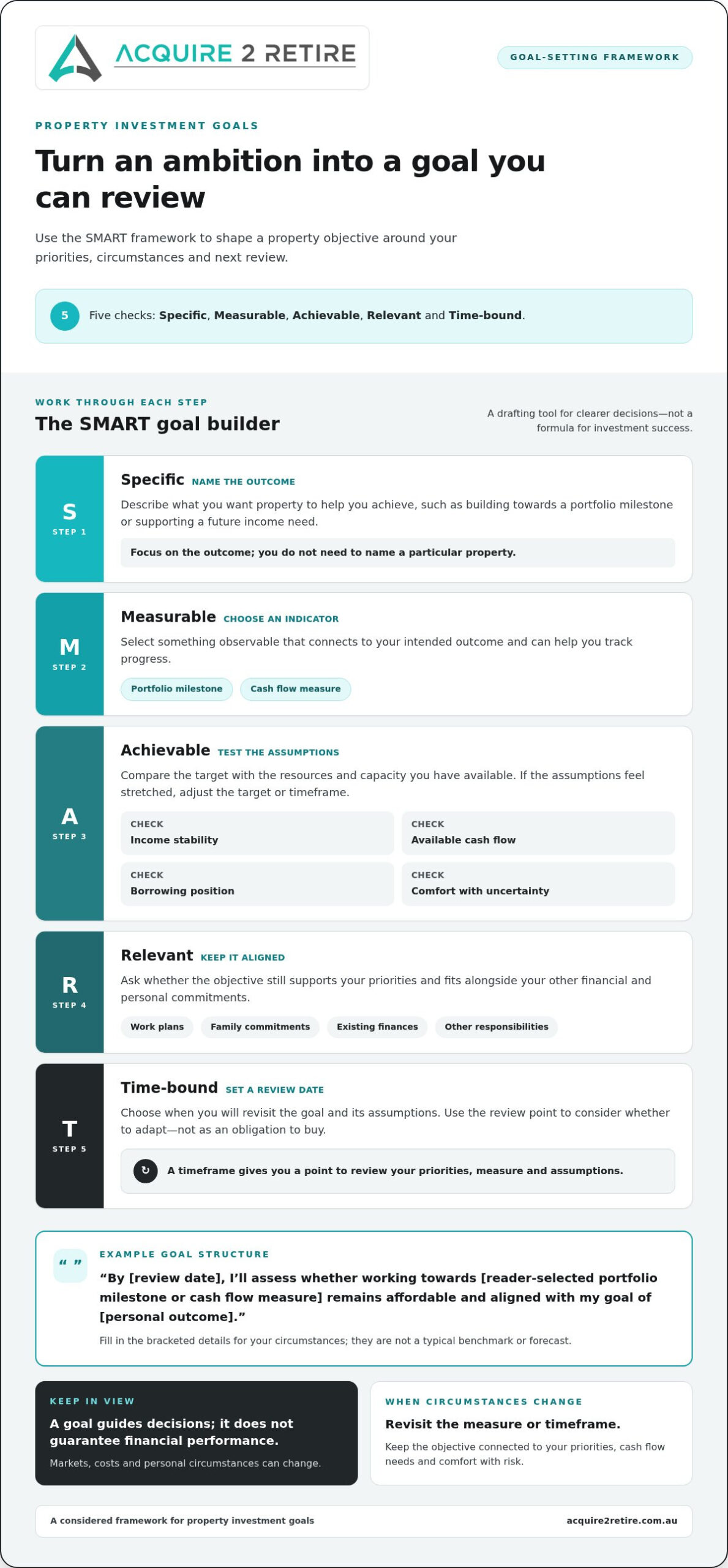
Once you know what you want property to help you achieve, the SMART framework can turn that ambition into an objective you can assess. SMART stands for Specific, Measurable, Achievable, Relevant and Time-bound. Use it as a drafting tool, not a formula for success: a carefully worded goal can guide decisions, but it can’t guarantee what an investment will deliver.
For practical property investment goals setting, work through these steps:
- 1. Specify the outcome. Describe what you want to achieve, such as building towards a portfolio milestone or supporting a future income need. You don’t need to name a particular property.
- 2. Choose a measure. Select an observable indicator linked to your outcome, such as a portfolio milestone or a cash flow measure that reflects your circumstances.
- 3. Test achievability. Compare the target with your income stability, available cash flow, borrowing position and capacity to manage uncertainty. If the assumptions feel stretched, adjust the target or timeframe.
- 4. Check relevance. Ask whether the objective still supports your priorities and fits alongside your other financial and personal commitments.
- 5. Set a review date. Choose when you’ll revisit the goal and its assumptions. A review date gives you an opportunity to adapt, not an obligation to buy.
How to apply each SMART criterion to a property goal
Specificity should clarify which decisions the goal will guide, not predetermine the asset. Choose measures you can track and that relate to your intended outcome. To test achievability, examine the resources and assumptions behind the target, then consider what could change. A timeframe gives you a point for review, while relevance keeps the objective tied to your priorities rather than an arbitrary benchmark.
A simple example: turn an ambition into a goal
“I want to build wealth” expresses an ambition, but it doesn’t explain how you’ll recognise progress. A more useful draft might be: “By [review date], I’ll assess whether working towards [reader-selected portfolio milestone or cash flow measure] remains affordable and aligned with my goal of [personal outcome].” The bracketed details are for you to fill in, not a typical Australian benchmark or forecast.
Shape the final wording around what you can reasonably sustain, including your cash flow needs and comfort with risk. If your situation or assumptions change, revise the measure or timeframe instead of treating the original target as fixed. A tailored property investment strategy can connect personal objectives with risk, cash flow and practical next steps, keeping the goal useful as your decisions develop.
Explore property investment planning to bring your priorities into a considered roadmap.
Check whether your property investment goals fit your circumstances
A goal can be clear and measurable but still be a poor fit if it puts too much pressure on your finances or conflicts with your priorities. Effective property investment goals setting considers your current capacity, likely commitments and comfort with uncertainty. Property outcomes also depend on changing market conditions, so your plan should be grounded without being fixed in place.
Start by checking your goal against four parts of your financial position:
- Income stability: Consider how secure your current income feels and what might happen if it changes.
- Cash flow needs: Identify the money required for regular commitments, savings and unexpected expenses.
- Borrowing position: Consider your existing debts and obligations alongside your broader financial circumstances.
- Capacity for uncertainty: Ask how much financial pressure you could manage if costs rose, income paused or plans took longer than expected.
Test the goal against cash flow and financial capacity
Look beyond the initial purchase decision. Consider ongoing holding costs, existing commitments and possible changes to household income or expenses. Allow for the possibility of interruptions to rental income, too. Rather than relying on assumed yields or market forecasts, test whether your budget could remain manageable if your assumptions don’t eventuate. If a goal depends on every part of the plan going perfectly, consider a more cautious timeframe or a different measure.
There are trade-offs. An income priority may lead you to assess options differently from someone focused on longer-term growth. Flexibility may matter more if you expect your circumstances to change. No priority is automatically best: the right balance depends on what you need the investment to support and what level of commitment feels sustainable.
Align your target with your risk comfort
Your comfort with risk can influence how you approach timeframe, borrowing and investment decisions. Think about what level of uncertainty would feel manageable in practice, not just in an optimistic scenario. Would a change in income or a delay in reaching your target cause significant strain? If so, revisit the assumptions and allow more flexibility. A guide to assessing your property investment risk profile can help you reflect on these questions.
For a broader view of how personal objectives, risk and cash flow can shape a plan, explore an Australian property investment planning framework. Use it to organise your thinking, then review your goal as your finances, responsibilities or market conditions change. A useful plan can adapt without losing sight of what you want it to support.
Turn property investment goals into milestones and review points
A long-term property objective can feel distant until you identify the decisions and preparation steps between today and that outcome. Milestones make progress easier to see, but they shouldn’t become deadlines to buy. A purchase makes sense only if it still fits your finances, priorities and assessment of the investment at the time.
As part of property investment goals setting, keep a simple record with four fields: your current baseline, the next action you can take, the measure you’ll use to track it and a date to review your progress. For example, you could record your current cash flow position, the information you need to gather, the measure you’ll use to assess it and when you’ll review the result. This gives you a practical reference point without assuming every milestone leads directly to an acquisition.
Build milestones that support the larger objective
Separate preparation from investment decisions. Preparation milestones might include reviewing your household budget, clarifying your borrowing position, identifying the cash flow you need to preserve and documenting what you want an investment to achieve. These are steps you can influence. An acquisition depends on whether an opportunity aligns with your criteria and circumstances, so it shouldn’t be treated as an automatic next step.
For each milestone, note what completion looks like. “Document my investment selection criteria” is within your control. “Buy by a particular date” may not be, especially if your financial position or the available opportunities change. This distinction helps you maintain momentum without creating pressure to proceed when the fit isn’t right.
Review your goals without reacting to every market headline
Set a review date in your calendar and use it to compare your current circumstances with your original objective and assumptions. You might bring the review forward after a major life change, a shift in income or expenses, a change in borrowing circumstances, or a new priority that affects how you want your finances to work.
A headline or short-term market movement doesn’t automatically mean your goal needs to change. Record what has changed, whether it affects your original reasoning and why an adjustment may be appropriate. You might continue with the goal, refine its measure or timeframe, or pause while you reassess. Each can be a considered response. Progress isn’t measured by buying as quickly as possible.
Thoughtful reviews keep milestones connected to the outcome you want while allowing your plan to respond to life as it unfolds. Build a property investment roadmap to connect your objectives with practical next steps and ongoing strategic review.
How property investment advice can support clearer goals
A documented goal gives property planning a practical starting point. Acquire2Retire can connect your objectives with your risk profile, cash flow needs and longer-term targets, then shape these considerations into a tailored property roadmap. This keeps decisions anchored to what you want an investment to support, rather than letting the property search define your goal.
From investment objectives to a considered property strategy
Your objectives can shape the next steps in sequence. Strategy helps clarify the role an investment is intended to play. Market research and asset identification can then be assessed against relevant criteria, while acquisition and finance support can help align decisions with your circumstances. Criteria might reflect your cash flow priorities, capacity for uncertainty and intended timeframe, rather than a property type chosen in isolation.
Due diligence is part of making an informed decision. Reviewing an asset and its relevant details can help you assess how well it fits your objectives, but it can’t remove uncertainty or guarantee a particular performance. Property investment goals setting creates a sound basis for decisions; it doesn’t promise a result. A considered plan helps you weigh information against your priorities and pause if an opportunity doesn’t fit.
Keep your plan connected to changing circumstances
Goals can shift as work, family responsibilities, finances or priorities change. Ongoing portfolio support, including portfolio monitoring, equity reviews and strategic advice, gives you opportunities to revisit whether your investment decisions remain aligned with your broader plan. A review might lead you to continue as planned, adjust a milestone or reconsider which outcome matters most. It doesn’t have to mean making a new purchase or reacting to every market change.
If an investment proceeds, initial tenancy setup coordination can support that stage of the plan. It is separate from day-to-day property management and can sit alongside ongoing strategic support as you review your portfolio and objectives over time.
A clear plan should offer direction while leaving room to adapt. Explore Acquire2Retire’s property investment planning to connect your priorities with considered property strategy, research, acquisition and finance support.
Give your property goals a clear next step
Property investment goals setting is most useful when it starts with the outcome you want, then turns it into measures and milestones that fit your finances, priorities and comfort with uncertainty. SMART goals give an ambition structure, while regular reviews help you decide whether to continue, refine or pause as circumstances change.
Your goals don’t need to predict exactly how an investment will perform. They should help you make considered decisions and keep your choices connected to what matters in your life. A tailored property investment roadmap can bring together your financial objectives, risk profile and cash flow requirements with planning, acquisition, finance support and ongoing portfolio strategy.
Ready to turn broad ambitions into a considered plan? Explore Acquire2Retire’s property investment planning and start with the priorities that matter to you.
Frequently Asked Questions
How do you set goals for property investment?
Start by defining what you want property to support, such as future income, long-term wealth building or greater flexibility. Choose a relevant measure, check it against your cash flow, borrowing position and comfort with uncertainty, then set a date to review it. Property investment goals setting works best when a goal guides decisions without assuming a particular return or requiring you to buy by a fixed deadline.
What are examples of property investment goals?
Examples include building towards a portfolio milestone, creating an income stream to support a future need or working towards more choice about when you work. Make an objective measurable by choosing a personal portfolio or cash flow measure and a review date. Treat targets as specific to your situation, not as standard Australian benchmarks or predictions of investment performance.
Are SMART goals useful for property investment?
Yes. SMART goals can turn a broad ambition into an objective that is Specific, Measurable, Achievable, Relevant and Time-bound. You might define a personal outcome, choose a measure to track progress and schedule a date to reassess whether the goal remains realistic. SMART is a planning tool, not a guarantee of financial performance, capital growth or rental income.
How often should I review my property investment goals?
Set a regular review date that suits your circumstances, and bring it forward if something significant changes. A shift in income, expenses, family commitments, borrowing position or priorities may affect whether the original goal still fits. At each review, compare your current position with your objective and assumptions. You may decide to continue, adjust a milestone or pause while you reassess.
Should my property investment goal focus on rental income or capital growth?
Neither objective is automatically right for every investor. Rental income may matter more if you’re focused on cash flow, while longer-term growth may suit a different timeframe and set of priorities. Consider how each aim fits your financial commitments, risk comfort and need for flexibility. You can balance objectives too, provided the trade-offs are clear and the plan remains affordable for you.
Can I change my property investment goals later?
Yes. Goals can be refined, paused or replaced as your circumstances and priorities evolve. A change in work, family responsibilities, income or financial commitments may alter what you need an investment plan to do. Record what has changed and why you’re adjusting the goal, then review its measures and timeframe. Revising a plan thoughtfully is a sensible response, not a failure to stay on track.
Do property investment goals guarantee financial freedom?
No. Clear goals can give your decisions structure, but they can’t guarantee financial freedom or a particular investment outcome. Property performance is uncertain and can be affected by market conditions, costs and changes in your personal circumstances. Use goals to guide research, assess decisions and review progress, while keeping expectations grounded. A considered plan can help you make informed choices, but results are never assured.