
What should an investment property acquisition service actually do beyond finding a property? If you’re weighing a major purchase, you need to understand how it fits your financial goals, what evidence supports it and who is responsible at each stage.
Useful support connects strategy with property research and purchase execution. Before you commit, understand the service scope, fees, incentives and decision points. A clear process can make it easier to compare properties, assess due diligence and negotiate, but it can’t promise growth or returns.
This guide explains the typical stages of an Australian property acquisition, from planning and property selection through finance support, negotiation and initial tenancy coordination. You’ll also learn how to compare services and consider whether the support suits your cash flow needs, risk profile and longer-term portfolio plans.
Key Takeaways
- An investment property acquisition service can range from property sourcing to broader advice that links strategy, research and purchase support.
- Use your objectives, risk tolerance and cash flow needs to guide property selection, rather than treating the search as a standalone task.
- Compare services by their written deliverables, decision points and responsibilities, including what happens after a purchase.
- Weigh structured research and time support against fees, remembering that professional guidance can’t assure investment performance.
- Acquire2Retire brings planning, market research, due diligence, negotiation and finance support together around your investment strategy.
What an investment property acquisition service should include
An investment property acquisition service helps an investor move from a purchase strategy to selecting and acquiring a property. The scope can range from identifying suitable properties to broader advice that connects the purchase with your objectives, risk tolerance, cash flow requirements and longer-term plans.
A concise definition: “Property acquisition advice links an investor’s purchase strategy with property research and support through the buying process. It’s more than a listing service, and it isn’t ongoing property management.”
Three terms can describe different levels of support. Property sourcing focuses on identifying potential properties. Buyer advocacy commonly involves representing a purchaser in the search, evaluation or negotiation. The buyer’s agent entry outlines this buyer-side role. Broader acquisition advisory may also connect the search to investment planning, due diligence and purchase coordination. These labels don’t guarantee identical tasks, so compare the agreed scope rather than relying on the job title.
How acquisition advisory differs from a narrow buyer’s-agent engagement
A focused brief might involve finding properties that match set criteria, assessing a property you’ve already found, or negotiating a purchase. Broader advisory can start earlier by defining what the next acquisition is intended to achieve, then linking the research and assessment to that goal. The distinction isn’t simply the job title: responsibilities and deliverables depend on the engagement. A written scope should identify the research, due diligence and coordination involved, as well as the decisions that remain yours.
When an acquisition service may suit your investment position
Structured support may be useful if you’re time-poor, buying an investment property for the first time, or considering a strategic next purchase within an existing portfolio. It can also help if you’re unsure how to compare property evidence or translate investment goals into practical selection criteria. The service supports your decision-making; it doesn’t replace your decisions.
Write an investment brief before assessing individual properties. Include your objectives, risk comfort, cash flow needs, finance parameters and how a purchase could fit your longer-term plans. Use these points to assess each option consistently. For example, compare whether a property meets your stated criteria and fits your cash flow requirements, rather than letting an appealing feature distract from the overall fit. For a wider framework, explore this guide to Australian property investment planning strategy.
Acquire2Retire connects tailored planning with market research, due diligence, negotiation and finance support, so acquisition forms part of an investment strategy rather than a standalone property search.
How an investment property acquisition service moves from strategy to settlement
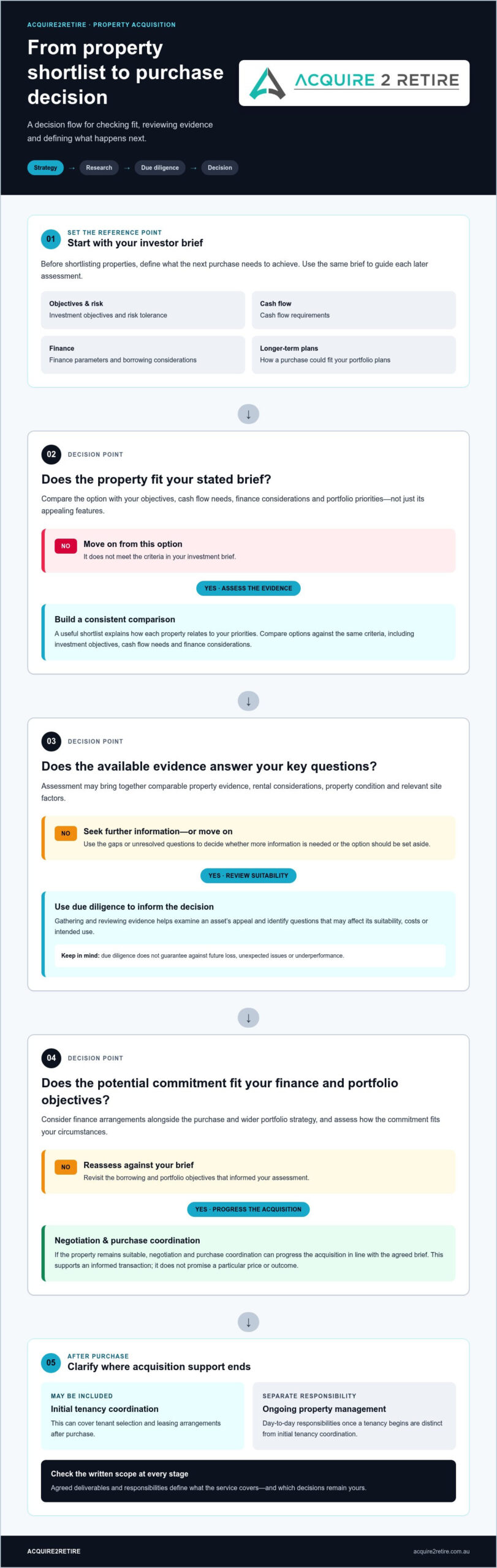
A well-structured acquisition journey begins before any property is shortlisted. The investor’s brief sets out objectives, risk tolerance, cash flow requirements and longer-term targets, giving each later decision a clear reference point. Finance considerations belong early in the process too, so potential purchases can be assessed against borrowing and portfolio objectives.
In brief: “An acquisition moves from investor brief and strategy through research, assessment and due diligence to negotiation, purchase coordination and initial tenancy setup. The service scope defines the responsibilities at each stage.”
Research, shortlist and property due diligence
Once the brief is established, market research and asset identification can narrow the field to properties that warrant closer assessment. A useful shortlist explains how each option relates to your priorities, rather than simply presenting available listings. You can then compare options against the same criteria, such as their fit with your investment objectives, cash flow needs and finance considerations.
Assessment may bring together comparable property evidence, rental considerations, property condition and relevant site factors. These inputs help you examine an asset’s appeal and identify questions that may affect its suitability, costs or intended use. Due diligence means gathering and reviewing evidence before a decision. It doesn’t guarantee against future loss, unexpected issues or underperformance. Use the findings to decide whether to proceed, seek further information or move on.
Negotiation, finance coordination and initial tenancy
If a property remains suitable, negotiation and purchase coordination help progress the acquisition in line with the agreed brief. The aim is to support an informed transaction, not promise a particular price or outcome. Finance arrangements can be considered alongside the purchase and wider portfolio strategy, helping you assess how a potential commitment fits your circumstances.
Initial tenancy coordination can cover tenant selection and leasing arrangements after purchase. This differs from ongoing property management, which involves day-to-day responsibilities once a tenancy begins. Defining that boundary early makes clear where acquisition support ends and ongoing operational tasks begin.
The value of a connected process lies in how each stage informs the next: strategy shapes research, research guides assessment, and due diligence supports a purchase decision. Explore Acquire2Retire’s property acquisition support as part of a considered investment approach.
How to compare investment property acquisition services
Service descriptions can sound similar while covering different responsibilities. To compare an investment property acquisition service, look beyond broad claims such as “full support”. Check the written deliverables, decision points, communication process and who is accountable for each task.
Comparison principle: Compare documented scope and incentives before comparing headline service claims.
| Scope area | What to look for in the written service scope |
|---|---|
| Strategy | How your objectives, risk tolerance, cash flow needs and portfolio position shape the investment brief and property criteria. |
| Research | What market research and asset identification are provided, and how shortlisted properties are linked to your brief. |
| Due diligence | Which evidence and property considerations are assessed, how findings are reported, and where further specialist input may be needed. |
| Negotiation | Whether negotiation and purchase coordination are included, and which decisions or approvals remain yours. |
| Post-purchase support | Whether support includes finance coordination, initial tenant selection or leasing arrangements, and what ongoing strategic advice involves. |
A useful comparison also explains how updates are shared and when you’ll need to make a decision. Defined milestones help you understand how a property moves from research to assessment and purchase. Clear boundaries also prevent assumptions about tasks outside the agreed engagement.
Questions that reveal the actual service scope
Check whether the written scope explains the research, property assessment and acquisition tasks involved. It should also state how finance support and initial tenancy arrangements are handled. Legal conveyancing and ongoing property management are separate functions, not part of acquisition support. Distinguish these responsibilities so you know what the engagement covers.
How to assess advice, incentives and accountability
Understand the fee arrangement before you commit, including what the fee covers and whether commissions, other remuneration or relevant commercial relationships are disclosed. Consider whether recommendations connect to your stated goals and risk profile, and whether the supporting evidence is presented clearly. A sound process can support informed decisions, but it can’t assure growth or returns. Look for transparent reasoning, not certainty about future performance.
Acquire2Retire connects planning, research, due diligence, negotiation and finance support around your investment strategy, with a defined scope guiding how the acquisition is approached.
Is an investment property acquisition service worth the commitment?
An investment property acquisition service has a cost, and no adviser can assure a successful purchase, future growth or a particular return. Its value depends on whether the support addresses a real need, the scope is clear and the work fits your investment strategy. The question isn’t whether professional advice is “worth it” in general, but whether the work is worthwhile for your circumstances.
Structured research and a clear process may help you use your time effectively, compare options against consistent criteria and identify questions that could otherwise be overlooked. Weigh these benefits against the fee, the work you’re prepared to do yourself and the fact that key decisions remain yours. If you have strong research skills and only need help with one stage, a narrower engagement may fit better than broader acquisition support.
What professional support can improve, and what it cannot promise
Research, assessment and due diligence can bring relevant evidence together before you decide to proceed, seek more information or walk away. A considered process may reduce avoidable oversights, but it can’t remove investment risk. Property markets can change, tenant outcomes are uncertain, and actual returns may differ from expectations. Treat clear analysis as decision support, not a prediction or guarantee.
Signs the service is aligned with your goals
Look for a process that starts with your objectives, cash flow needs and risk tolerance, then explains how these shape asset selection. Recommendations should have transparent reasoning and connect to available evidence. The written scope should set out responsibilities, decision points and communication. Measured advice makes room for questions and acknowledges uncertainty rather than relying on confident promises.
The fit may be weaker if the proposed work doesn’t address your main challenge or if you’re comfortable managing the research and coordination yourself. Before committing, identify what you need most: a strategic framework, help assessing properties, negotiation support, or guidance across several stages. The fee is easier to assess when you can relate it to clearly described work and the time or expertise you want to contribute.
For support that connects planning with property research, due diligence, negotiation and finance considerations, explore Acquire2Retire’s investment property acquisition support.
How Acquire2Retire supports an investment property acquisition
Acquire2Retire treats acquisition as part of a broader investment strategy, bringing planning, research, due diligence, negotiation and finance support into a connected process. The work is tailored to your objectives and circumstances, so the search starts with the role a potential purchase is intended to play, rather than with listings alone.
A coordinated process shaped around your investment objectives
Your objectives, risk profile, cash flow needs and long-term targets help shape your investment roadmap. These considerations guide research and asset identification, helping identify which opportunities warrant closer assessment and how they relate to your portfolio plans.
During property assessment, due diligence brings relevant evidence into the decision. Negotiation support helps progress the purchase in line with the agreed strategy. Neither step can guarantee a particular price, growth or investment result. Finance support includes structuring and arranging lending solutions in relation to the proposed purchase and broader portfolio objectives, keeping funding considerations connected to the investment plan.
Acquire2Retire also coordinates initial tenancy arrangements, including tenant selection and leasing. Ongoing portfolio support can include monitoring, equity reviews and strategic advice to help you review your approach over time. This is strategic support, not day-to-day property management.
Practical next steps before beginning an acquisition
A little preparation can make an initial discussion more useful. Bring together:
- Your objectives: what you want a potential acquisition to contribute to your investment plans.
- Your constraints: cash flow needs, risk comfort and relevant finance considerations.
- Your timeframe and questions: when you’re considering acting and what you want to understand before making decisions.
- Your preferred scope: whether you need planning and research, purchase support, or guidance across several stages.
Be clear about service boundaries too. Acquisition and initial tenancy coordination are distinct from day-to-day property management, while legal and conveyancing services are separate from investment planning and purchase support. Understanding these distinctions helps set realistic expectations and clarifies responsibilities.
If you’re considering an acquisition and would like to discuss how support could align with your investment objectives, discuss your investment property acquisition goals with Acquire2Retire.
Take your next investment step with clarity
A well-chosen investment property acquisition service connects the purchase with your broader financial direction, rather than focusing on property sourcing alone. Before engaging support, understand the scope, responsibilities, fee arrangements and incentives, then consider whether the process suits your goals and the time you can contribute.
Acquire2Retire’s tailored strategy considers your investment objectives, risk profile, cash flow requirements and long-term targets. Research and due diligence inform property assessment, while negotiation and finance support connect the acquisition with your wider portfolio plans. Initial tenancy coordination and ongoing portfolio advice support the transition and longer-term strategy, but are distinct from day-to-day property management. No process can promise a particular investment outcome, so clear evidence and considered decisions remain central.
If you’re ready to explore how acquisition support could fit your plans, discuss your investment property acquisition goals with Acquire2Retire. Start with your objectives and the stage where you want support, then take the next step with a clearer view of how the service fits your plans.
Frequently Asked Questions
What does an investment property acquisition service include?
An investment property acquisition service can connect your investment strategy with property research and purchase support. It may include clarifying your objectives, identifying suitable assets, assessing property evidence, undertaking due diligence and supporting negotiation. Acquire2Retire also provides finance support and initial tenant selection or leasing coordination. Review the documented responsibilities and decision points so you understand what happens at each stage.
Is an investment property acquisition service worth it?
It may be worthwhile if structured research, purchase support or help coordinating the process addresses a need you can’t easily manage yourself. Consider the service’s fees alongside the time and expertise it contributes, and whether the scope fits your investment goals. You’ll still make important decisions, and professional guidance can’t guarantee returns or remove investment risk. If you’re confident handling research independently, a narrower engagement may suit you better.
How does an investment property acquisition service differ from a buyer’s agent?
The scope varies between engagements, so the title alone doesn’t tell you exactly what’s included. A buyer’s agent may focus on searching for properties, assessing options or negotiating a purchase. Broader acquisition advisory can begin with investment strategy and connect the brief to research, due diligence, finance support and purchase coordination. Some services cover several stages, while others are more focused. Compare the documented tasks and responsibilities rather than assuming every adviser provides the same support.
How much does an investment property acquisition service cost?
There isn’t one set fee, because the cost depends on the agreed engagement and work involved. The arrangement may include advisory fees and brokerage commissions. Before proceeding, review what the fee covers, when it applies and whether commissions or commercial relationships are disclosed. A clear written scope helps you compare the proposed support with your needs without relying on headline claims alone.
Can an acquisition adviser help with investment property finance?
Yes. Acquire2Retire structures and arranges suitable lending solutions in line with the proposed purchase and your broader portfolio objectives. This helps you consider borrowing requirements as part of the investment strategy, rather than treating finance as a separate afterthought. Finance support can’t guarantee loan approval, specific terms or a particular outcome. Your borrowing position and the lender’s assessment remain important to the decision.
Does an investment property acquisition service manage tenants after purchase?
Acquire2Retire coordinates initial tenant selection and leasing arrangements to prepare a property for a tenancy. This differs from ongoing property management, which covers day-to-day responsibilities after a tenant moves in. Understand where initial coordination ends and ongoing management begins so you know who is responsible for tenancy matters over time.
What should I prepare before engaging an investment property acquisition service?
Prepare an outline of your investment goals, cash flow needs, risk tolerance and borrowing position. It’s also useful to note your preferred timeframe, current portfolio considerations and questions about research, due diligence, negotiation or post-purchase support. You don’t need every decision settled. A clear starting point helps shape a strategy and identify what support could be useful for your circumstances.