
What if the biggest risk in buying an investment property isn’t choosing the wrong suburb, but making sound decisions in the wrong order? The investment property buying process Australia investors face can be difficult to sequence: your goals, borrowing capacity, property research and contract checks all need to line up. A clear plan connects each decision and makes it easier to spot gaps before they become costly.
This 2026 guide takes you through the process, from setting your investment strategy and preparing a budget to arranging finance, comparing properties and completing due diligence. You’ll see where contract review, settlement costs and tenancy preparation fit, and why requirements can differ between states and territories. Use the stages to identify what to prepare before moving ahead, when independent financial and legal advice matters, and how to plan for the property’s first tenancy.
Key Takeaways
- Set clear investment goals, a realistic holding period and cash flow requirements before narrowing your property search.
- Understand how your budget and borrowing capacity shape the investment property buying process Australia, and include finance decisions in your broader investment plan.
- Compare each property against your strategy by weighing market research, condition checks and likely costs together.
- Before committing, understand the contract, finance conditions and settlement steps. Requirements can vary by state or territory and sale method.
- Plan for practical repairs, condition records and initial tenancy arrangements so the property is ready for its first occupants.
What is the investment property buying process in Australia?
Buying an investment property brings financial, property and legal decisions together. Your goals influence how much you can comfortably borrow, while your finance plan helps define the properties worth researching. Contract requirements, duties and tenancy rules also differ across Australian states and territories. The broad sequence is similar, but you need to check the requirements that apply to the property’s location and sale method.
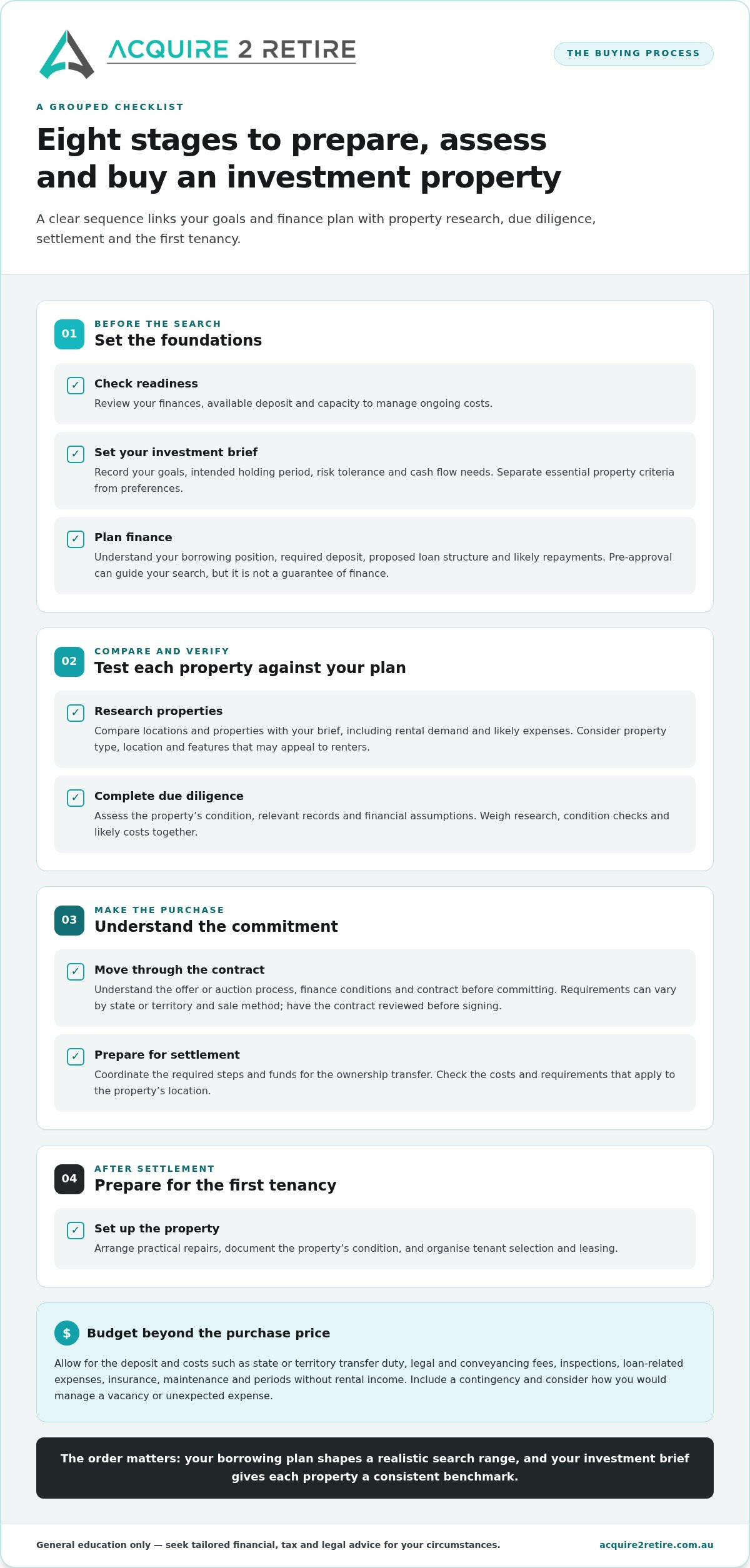
The investment property buying process is a sequence of connected decisions, from defining your investment brief to preparing the property for its first tenancy. A practical overview is:
- Check readiness: Review your finances, available deposit and capacity to manage ongoing costs.
- Set your investment brief: Define your goals, time horizon, risk tolerance and cash flow needs.
- Plan finance: Understand your borrowing position and how a loan could fit your broader financial plans.
- Research properties: Compare locations and properties against your brief, including rental demand and likely expenses.
- Complete due diligence: Assess the property’s condition, relevant records and financial assumptions.
- Move through the contract: Understand the offer or auction process and have the contract reviewed before committing.
- Prepare for settlement: Coordinate the required steps and funds for the ownership transfer.
- Set up the first tenancy: Arrange practical repairs, document the property’s condition and organise tenant selection and leasing.
The order matters. A borrowing plan based on your circumstances helps set a realistic search range, while a clear investment brief gives your research a consistent benchmark. This is general education, not tailored financial, tax or legal advice. For broader context on the Australian market and the role of investment properties, see Home ownership in Australia.
What are the main stages of buying an investment property?
Each stage informs the next. Readiness and strategy establish what you’re trying to achieve. Finance helps define what may be feasible, while research and due diligence test whether a property fits your plan. Contract and settlement turn a considered choice into a purchase, and tenancy preparation gets the property ready for its first occupants. Bringing strategy, finance and acquisition research together helps keep these decisions aligned.
How is an investment purchase different from buying a home to live in?
A home purchase may prioritise personal preferences such as layout or proximity to family. An investment purchase usually weighs those preferences against rental demand, ongoing costs, potential vacancy and how the property could fit a longer-term portfolio. Neither approach is inherently better; they serve different goals. For more detail on property research, assessment and negotiation, explore our investment property acquisition service guide.
Set your investment brief and finance plan before searching
Before comparing suburbs or inspecting properties, decide what the investment needs to achieve and what level of financial commitment is workable. Your brief gives research a clear filter, while a finance plan connects your objectives with a realistic purchase range. In the investment property buying process Australia, these early decisions can influence the property type you consider and the funds you keep available after settlement.
What should an investment property brief include?
Record your investment rationale, intended holding period, risk tolerance and cash flow needs. Then identify the property characteristics that support those aims, such as property type, location or features likely to appeal to renters. Separate essential criteria from preferences. A particular finish may be appealing, but it should not outweigh evidence about demand, costs or fit with your longer-term portfolio.
Set budget parameters that account for more than the purchase price. Include the deposit and costs such as state or territory transfer duty, legal and conveyancing fees, inspections, loan-related expenses, insurance, maintenance and periods without rental income. Allow for a contingency as well. Consider how you would manage a vacancy or an unexpected expense, rather than basing the plan on an ideal cash flow scenario.
For a deeper framework for connecting goals with investment decisions, read our Australian property investment planning strategy.
How do finance and pre-approval fit into the process?
Pre-approval can provide an initial indication of borrowing capacity and help guide your search, but it isn’t a guarantee of finance. Lender criteria, your financial circumstances and the property being assessed all matter. The final decision may depend on further checks. Treat pre-approval as a planning guide, not permission to commit beyond your means.
Before making an offer, understand the deposit you’ll need, the proposed loan structure, likely repayments and how the lender assesses your ability to service the debt. Consider the effect repayments could have on your wider cash flow if rent is interrupted or expenses rise. You may need to revisit finance assumptions once a specific property and contract are under consideration, so allow time to review them before committing.
Lending, tax and legal considerations depend on individual circumstances, so seek tailored professional advice before making decisions. A coordinated plan can keep your goals, finance structure and property search aligned. Explore property investment planning and support as you shape your next steps.
Research and assess properties before you make an offer
A property can look appealing and still be a poor match for your investment brief. A popular suburb alone doesn’t show whether a particular property will attract tenants, suit your budget or fit your longer-term plans. In the investment property buying process Australia investors should compare different kinds of evidence, then record why each property merits further consideration or should be ruled out.
Which evidence should investors compare when assessing properties?
Look beyond a single feature, such as a low asking price or a planned transport link. Review rental evidence and the surrounding context, including employment drivers, existing amenities and infrastructure plans. Treat rental estimates and potential capital growth as assumptions, not promises. Actual results can differ as market conditions, property appeal and costs change.
Assess likely income alongside expenses that affect cash flow, including rates, insurance, maintenance and periods without rent. A simple comparison framework helps separate the questions you’re answering:
| Assessment area | What to examine | Why it matters |
|---|---|---|
| Market research | Rental demand, local employment, amenities and relevant infrastructure context | Helps test whether the location and property may suit the intended tenant market |
| Property condition | Visible condition, building and pest findings, and relevant property records | Highlights issues that may require further investigation or affect future costs |
| Financial assessment | Realistic rent assumptions, purchase costs and ongoing holding expenses | Shows how the property may affect cash flow under more than one scenario |
Apply the same criteria to every candidate. If your brief prioritises manageable cash flow, for example, a property with attractive growth prospects but substantial upkeep may not be the best fit. Keep notes on the evidence, assumptions and reasons for including or rejecting each option. This makes comparisons more consistent and less dependent on first impressions.
What should due diligence cover before proceeding?
Before committing, due diligence may include checking title details, reviewing the contract, assessing building condition and considering pest findings. Property records and disclosures can also inform your assessment. The checks that apply depend on the property type and location, while disclosure practices and contract requirements vary between Australian states and territories.
Use the findings to identify questions that need resolution before proceeding. An inspection or estimate is not a complete picture of every potential issue. Contract interpretation and legal implications call for appropriate independent legal advice. Acquisition research can help bring market evidence and property-specific findings together before you decide.
From offer to settlement: understand the commitment before signing
An accepted offer is a significant step, but what follows depends on the sale method, contract and state or territory. Private treaty and auction purchases can involve different processes, and cooling-off rights, deposit arrangements and contract requirements aren’t uniform across Australia. Before committing, understand the relevant deadlines and contract obligations rather than assuming the same rules apply everywhere.
What happens after an offer is accepted?
The broad sequence is straightforward, although the details should be verified for the property and sale method:
- Offer or auction: The seller accepts an offer, or you participate in an auction under its applicable conditions.
- Contract review: A solicitor or conveyancer reviews the contract and explains its legal terms before you sign.
- Signing and deposit: The parties complete the required contract steps, and the deposit is arranged according to the contract.
- Finance and conditions: Any relevant finance or other conditions are addressed by their stated deadlines. Understand how they apply to your circumstances before relying on them.
- Settlement preparation: Your lender and legal representatives coordinate the necessary steps towards the transfer.
Pay close attention to dates and conditions. A finance deadline, for instance, may arrive before settlement, so understand what the contract says and how your lender’s assessment fits the timetable. Cooling-off periods and their application can vary, and auction purchases may follow a different path. Don’t assume a cooling-off right or finance condition applies without legal advice specific to the contract and jurisdiction.
What should investors expect at settlement?
Settlement is the transfer stage, when the purchase is completed in line with the contract. The contract and relevant jurisdictional processes determine the timing and arrangements. Your lender and legal representatives coordinate the transaction, and you’ll need to meet the financial and administrative requirements that apply to your purchase.
Acquisition guidance can support property selection and negotiation, while a solicitor or conveyancer handles legal review and conveyancing. Keeping those roles clear helps you seek the right expertise at each stage. This section is general education, not legal or financial advice. Obtain advice tailored to your contract and circumstances before making a commitment.
As the purchase moves from research to a binding decision, coordinated acquisition and finance planning can help keep your investment objectives in view. Explore property acquisition and finance support for guidance through those connected decisions.
After settlement: prepare the investment property for its first tenancy
Settlement completes the purchase, but the property still needs to be made ready for tenants. Plan the transition: review its condition, organise practical repairs, prepare accurate records and arrange the initial leasing steps. The final stage of the investment property buying process Australia investors can overlook is the handover from ownership to a well-prepared first tenancy.
What needs attention before the first tenant moves in?
Start with a walkthrough and document the property’s condition, including existing wear or damage. Use those records to identify repairs and organise any work needed before advertising or a tenant’s arrival. A readiness checklist can help keep practical tasks in order:
- Record the property’s condition and retain relevant inspection information.
- Arrange necessary repairs and check that fixtures and fittings are ready for use.
- Prepare clear, accurate information about the property for prospective tenants.
- Organise suitable tenant selection and leasing arrangements.
- Check current state or territory requirements for safety, disclosures, condition records and bond processes.
Tenancy obligations and processes differ across Australian jurisdictions and can depend on the property and circumstances. Verify the current requirements where the property is located rather than treating a general checklist as legal guidance. If the readiness review identifies an issue, resolve it before proceeding with tenancy arrangements where practicable.
Initial tenancy coordination is distinct from ongoing property management. Tenant selection and leasing arrangements help establish the first tenancy; ongoing management covers responsibilities after tenants move in. Keeping that distinction clear helps you plan the handover and understand what support you may need over the longer term.
How can strategic acquisition support simplify the buying journey?
A joined-up plan can carry your investment criteria through market research, due diligence, negotiation and finance decisions, then into the property’s initial tenancy setup. This helps keep the purchase aligned with your goals rather than treating each stage as an isolated task. Acquire2Retire coordinates initial tenant selection and leasing arrangements after acquisition, alongside strategy, acquisition and finance support.
Connecting your investment brief and purchase decisions to the first tenancy can make the transition clearer. Explore investment property acquisition support for guidance that links the acquisition journey with initial tenancy coordination.
Move forward with a clear investment plan
A considered purchase starts with an investment brief that connects your goals, risk profile and cash flow needs to a realistic finance plan. Compare properties using relevant market evidence, assess their condition and costs, and understand the contract and settlement requirements that apply in the state or territory where you’re buying.
The investment property buying process Australia investors follow doesn’t end at settlement. Preparing condition records, addressing practical repairs and arranging the first tenancy carries your plan into the next stage of ownership. Rental assumptions and future outcomes can’t be guaranteed, so ground decisions in evidence and seek tailored financial, tax and legal advice where needed.
Acquire2Retire brings strategy, acquisition research, due diligence, asset identification and negotiation together, with finance structuring aligned to broader investment goals. After purchase, initial tenant selection and leasing arrangements can also be coordinated. Explore a considered approach to investment property acquisition.
With each decision connected to your objectives, you can take the next step with greater clarity.
Frequently Asked Questions
How do you buy an investment property in Australia step by step?
Buying an investment property generally means setting your goals and budget, planning finance, researching suitable properties, completing due diligence, reviewing the contract, arranging settlement and preparing for the first tenancy. Each stage informs the next: your investment brief guides property selection, while finance and property checks help you assess whether a purchase is workable. The investment property buying process Australia investors follow can vary by state or territory and sale method.
Do I need pre-approval before looking for an investment property?
You can research properties before seeking pre-approval, but an early lender assessment can help establish a practical search range. Pre-approval is an initial indication, not a guarantee that a loan will be approved. Lender criteria, your financial circumstances and the property itself may affect the final decision. Before committing, understand your deposit, potential repayments and borrowing capacity, and allow time to review your finance as the purchase details become clearer.
What due diligence should I do before buying an investment property?
Assess the property’s condition, relevant building and pest findings, title information, contract terms and available property records. Compare realistic rental assumptions with ongoing costs such as rates, insurance, maintenance and possible vacancy, then check whether the property still fits your investment brief. Appropriate checks and disclosure practices depend on the property and jurisdiction. A solicitor or conveyancer can advise on contract and legal matters. Seek financial or tax advice suited to your circumstances as needed.
What happens after an offer is accepted on an investment property?
After acceptance, the purchase moves through the contract steps, which may include signing, arranging the deposit, meeting relevant conditions and preparing for settlement. The sequence and deadlines depend on the contract, sale method and state or territory. Before becoming committed, understand the contract terms, any finance conditions and the dates that apply. A solicitor or conveyancer can review the legal documents, while your lender assesses finance according to its criteria.
How long does it take to buy an investment property in Australia?
There’s no single timeframe for buying an investment property. The search may take more or less time depending on how clearly defined your brief is, the properties available and how quickly you can complete research and checks. After a purchase is agreed, the contract sets important dates, including the settlement timetable, while finance approval and other requirements can affect progress. Check the specific contract and coordinate with your lender and legal representative rather than relying on a standard estimate.
Can I buy an investment property before I have selected a tenant?
Yes. Tenant selection and leasing arrangements are generally part of preparing the property for its first tenancy after purchase, rather than a prerequisite to buying it. Before advertising, consider the property’s condition, any repairs needed and the tenancy requirements that apply in its state or territory. Rental estimates can inform your investment assessment, but they aren’t guaranteed income. Initial tenant selection and leasing coordination can help prepare the property and is distinct from ongoing property management.
What happens after settlement on an investment property?
After settlement, shift your attention to preparing the property for tenants. Review and record its condition, arrange practical repairs, organise suitable tenant selection and prepare the leasing arrangements. Check current requirements for tenancy records, safety, disclosures and bond processes, as these can differ across jurisdictions. Initial tenancy coordination can support the move into the first lease; ongoing property management is a separate responsibility. Keep records of the property’s condition and relevant work as you prepare for occupancy.