
What if the best debt decision isn’t simply to borrow less, but to make sure each loan still fits your cash flow and long-term property plan? Debt management for property investors can become difficult when repayments, household expenses or portfolio goals change, even if your existing loan once suited your circumstances. The challenge is weighing these moving parts without creating pressure elsewhere.
You may want to know whether your current debt remains appropriate, how much cash flow to protect and what role available equity could play. This guide sets out a practical way to review those questions and understand the trade-offs, rather than treating each loan decision in isolation.
You’ll learn how to assess repayments and cash-flow demands, compare common approaches to property investment debt, and consider how loan structure and tax treatment may affect your decisions. We’ll also cover risk and portfolio timing, so you can connect borrowing choices with a broader Australian property investment strategy and work towards a plan that supports your long-term goals.
Key Takeaways
- Debt management for property investors works best when borrowing, repayments and risk are reviewed against your wider investment plan.
- Build a clear picture of each loan and your cash-flow commitments before deciding whether to make changes.
- Compare extra repayments, cash reserves, consolidation and debt recycling by their purpose, trade-offs and potential risks, rather than assuming one approach suits everyone.
- Test your plan against changes such as a vacancy, unexpected repairs or altered interest rates before committing to a strategy.
- Bring debt decisions into the same conversation as your risk profile and future acquisition plans, with structured advice and ongoing portfolio reviews.
What debt management for property investors really involves
Debt management for property investors means regularly reviewing borrowing, repayments, cash flow and risk against an investment plan. It’s more than choosing a loan or deciding whether to pay it down. The aim is to understand how each commitment fits with rental income, property costs, household finances and the time you intend to hold your investments.
Debt can support a property strategy, but it isn’t automatically an advantage. Borrowing creates a repayment obligation, and property performance or rental income may not match expectations. A loan that once felt manageable can become less comfortable as your income, expenses or plans change. Reviewing existing debt is also separate from deciding whether to acquire another property. A new purchase needs its own assessment of suitability, funding and risk.
How property investment debt can support a strategy
Borrowing may allow an investor to acquire an asset while retaining some capital for other needs, such as a cash reserve or planned portfolio expenses. That flexibility can be useful, but borrowing has a cost, and available funds don’t necessarily need to go towards another purchase.
Whether debt supports your plans depends on the loan terms, repayment structure, cash flow, asset performance and personal circumstances. For example, if you’re considering another acquisition, assess how the repayments would sit alongside existing commitments and whether your household could manage a vacancy or unexpected repairs. The purchase decision and the debt review are connected, but they are not the same decision.
Strategic borrowing doesn’t remove repayment obligations or market risk. Property values can change, income can fluctuate and expenses may arise at difficult times. A general overview of a Debt Management Plan explains the broader concept of organising debt. A property investor’s review also needs to account for investment loans, portfolio cash flow and asset plans.
Why portfolio-level debt management matters
If you have more than one loan, reviewing each repayment on its own can hide the combined pressure on household cash flow. Consider total commitments alongside regular expenses, available income and the period you intend to hold each property. This gives you a more grounded view than relying on expected rent or future asset growth to make the figures seem manageable.
Debt management is the regular review of borrowing, repayments, cash flow and risk to keep financial commitments aligned with an investment plan. This review matters because income, expenses and lending conditions can change. Your risk tolerance and plans to acquire, hold or sell assets may also shift.
Use this section as general education, not personal lending, financial or tax advice. Consider decisions about loan structure, tax treatment or changing your borrowing in light of your circumstances and the current Australian rules that apply.
How to assess your property investment debt before changing it
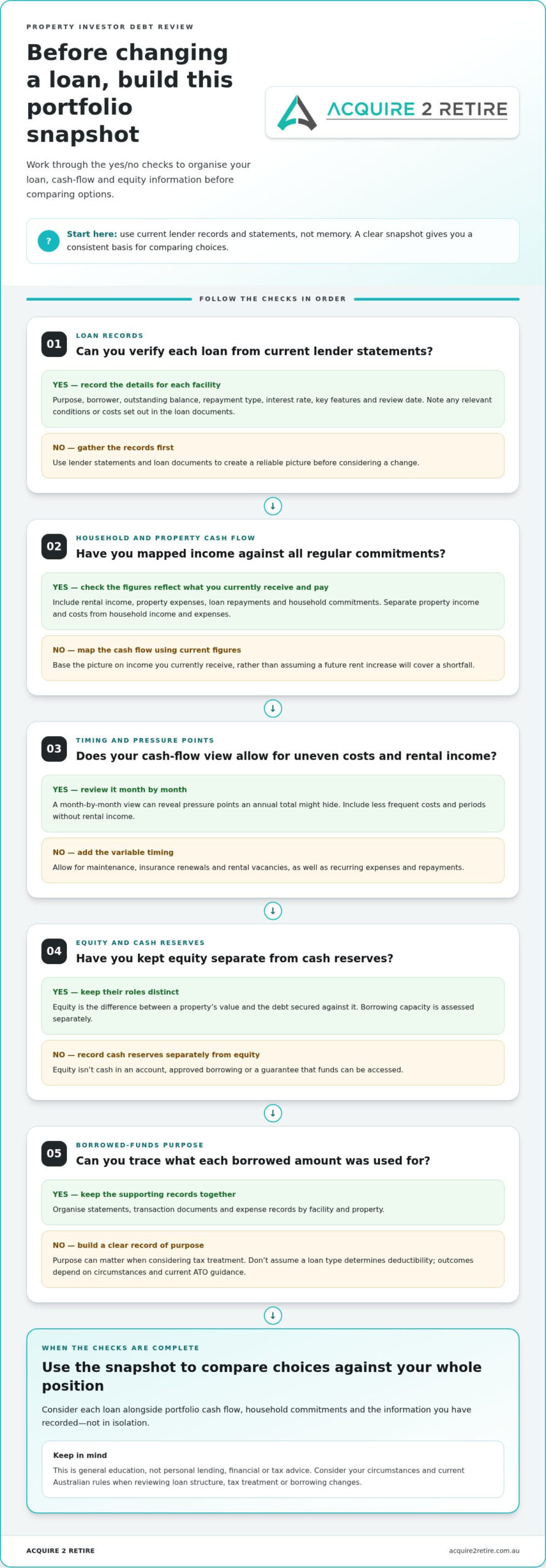
Before adjusting a loan, create a reliable snapshot of your position across your portfolio and household. This gives you a consistent basis for comparing options, rather than prompting a change because one rate or repayment looks concerning on its own. Use current lender records and statements, not memory, and note when each loan is next due for review.
Create a clear snapshot of loans and cash flow
For each facility, record its purpose, borrower, outstanding balance, repayment type, interest rate, key features and review date. Note details that may affect a future change, such as whether repayments are principal and interest or interest-only, and any conditions or costs set out in your loan documents. An investment property loan structure guide can help explain how different structures fit into a broader review.
Next, map regular rental income against property expenses, loan repayments and household commitments. Include recurring costs and less frequent items such as maintenance, insurance renewals and periods without rental income. Base your calculations on income you currently receive, rather than assuming a future rent increase will cover a shortfall. A month-by-month view can reveal pressure points that an annual total might hide.
- Check loan balances and repayments against lender statements.
- Separate property income and costs from household income and expenses.
- Allow for variable timing, such as irregular repairs or rental vacancies.
- Record cash reserves separately from any equity figures.
Review equity, borrowing capacity and loan purpose
Equity and cash reserves serve different roles. Equity is the difference between a property’s value and the debt secured against it. It isn’t cash in an account, approved borrowing or a guarantee that funds can be accessed. Borrowing capacity is assessed separately and depends on relevant lending considerations. For more context, compare the borrowing capacity guide with the equity use guide.
Keep a clear record of what borrowed funds were used for, including relevant statements and transaction documents. Purpose can matter when considering tax treatment, so don’t assume that a particular loan type determines deductibility. Australian tax outcomes depend on the circumstances and current ATO guidance. Seek appropriately qualified tax advice for your situation.
Organise records so each loan and property is easy to follow. For example, group statements, transaction documents and expense records by facility, then note any changes to the loan or use of funds. This can make future reviews more straightforward and help you explain how a proposed change fits your broader portfolio plan.
Once your figures are organised, consider them alongside your plans and risk profile. Acquire2Retire’s property investment planning and finance support can bring loan structure, cash-flow needs and longer-term portfolio goals into the same discussion.
Comparing debt management strategies for property investors
There’s no single debt strategy that suits every investor. Compare options using the same questions: What are you trying to achieve? How could regular cash flow change? What work or complexity is involved, and what risks need attention? The table is a starting point, not a ranking. Loan terms, household needs and portfolio plans all affect the trade-offs.
| Strategy | Objective and cash-flow effect | Complexity, risks and professional input |
|---|---|---|
| Extra repayments | Reduce the loan balance; regular surplus cash may be less available for other needs. | Check loan features and access to repaid funds. Consider liquidity and the effect on other commitments. |
| Cash reserves | Keep funds accessible for vacancies, repairs or other costs; this doesn’t directly reduce the loan balance. | Decide how much liquidity fits your circumstances and how reserves sit alongside repayments and goals. |
| Consolidation | Restructure multiple debts into a different arrangement; repayments may change according to the new terms. | Assess fees, terms, security and total debt. Consolidation changes arrangements but doesn’t automatically reduce what you owe. |
| Debt recycling | Potentially redirect available funds through borrowing for investment purposes; cash flow and debt composition can change. | Requires careful structuring, records and tax consideration. Suitability and treatment depend on individual circumstances. |
Repayment, reserves and consolidation
Extra repayments can reduce outstanding debt, while retaining surplus funds as a reserve keeps money accessible for costs that don’t arrive on schedule. A lump-sum payment involves both considerations: it reduces the balance but may leave less accessible cash. Weigh the value of a buffer against the loan terms and your expected commitments before acting.
Consolidation may simplify how borrowing is arranged, but a lower repayment alone doesn’t show that the change is beneficial. Compare the full terms, costs, repayment period and risks, including any changes to security over assets. For portfolio context, the multiple investment property finance guide discusses borrowing across more than one property.
Debt recycling and repayment structures
Debt recycling generally involves paying down private, non-deductible debt and borrowing separately for investment use. It can add complexity: the purpose and movement of funds need to be clearly documented, and tax treatment depends on the use of borrowed money and individual circumstances. It isn’t a shortcut to a tax outcome. Consider current ATO guidance and obtain qualified tax advice for personal decisions.
Interest-only repayments may mean lower required repayments during the interest-only period, while the principal doesn’t reduce through those payments. Principal-and-interest repayments include principal reduction but require cash flow for both components. Compare them by repayment demands, debt reduction and fit with your plan, not as assumed tax strategies. The interest-only versus principal-and-interest guide explores those structural differences.
Choosing between these approaches is part of a wider portfolio decision. Structured property investment planning can help connect finance choices with cash-flow needs, risk and longer-term acquisition plans.
A practical debt management process for changing circumstances
A repeatable review can help you respond to changing circumstances with a considered decision rather than a rushed reaction. For debt management for property investors, the aim is to identify what has changed, understand the effect on the whole portfolio and compare possible responses before altering a loan.
- Update your records. Bring loan statements, balances, repayment details, rates, relevant features and review dates up to date. Add current rental income, property expenses, household commitments and cash reserves, using actual records rather than remembered figures.
- Test your cash flow. Consider how the figures may look if a property is vacant, a repair needs attention or loan repayments change. These are scenarios to examine, not predictions. Identify which commitments would still need to be met and what accessible funds could help cover them.
- Compare possible responses. Set out the options that fit the situation, such as retaining cash, making extra repayments or reviewing loan arrangements. Compare their effect on repayments, liquidity, debt levels and longer-term plans, rather than focusing on one feature in isolation.
- Assess risks and seek relevant input. Consider whether a change affects other loans, household finances or planned acquisitions. Confirm tax treatment with a registered tax professional, and discuss lending terms with an appropriate finance professional. Don’t treat projected rent, accessible equity or a potential tax outcome as certain.
- Document the decision. Record what prompted the review, the options considered, the reasons for your choice and any trade-offs you accepted. Keep supporting statements and records, including documents showing how borrowed funds were used, so you can understand and revisit the decision later.
Set decision criteria before choosing a strategy
Before acting, decide what the change needs to achieve. Consider repayment capacity, how much accessible cash you want to retain, your tolerance for risk and the timeframe you intend to hold the investment. Write down the purpose of a proposed loan change and what you might give up in return, such as liquidity or flexibility. Clear criteria make comparisons more grounded, especially when a strategy looks appealing on one measure but less suitable on another.
Choose review triggers and keep reliable records
Set a regular review point, then revisit your position sooner if income, expenses, loan terms or portfolio plans materially change. A vacancy, an unexpected repair, a rate change or a decision to delay an acquisition can all be reasons to refresh your assessment.
Regular debt reviews help investors make informed decisions as circumstances change, rather than relying on assumptions that may no longer fit.
A structured review can connect financing choices with your cash-flow needs, risk profile and longer-term property plans. To explore how those factors fit together, discuss a tailored property strategy with Acquire2Retire.
How strategic advice can bring debt management together
A loan decision can affect more than your next repayment. It may shape your flexibility for household needs, whether a future acquisition fits your plan and how comfortably you can hold existing properties through changing circumstances. Strategic advice brings these considerations into one view, so you can weigh debt decisions against your goals and risk profile rather than treating them as isolated finance choices.
Connect borrowing decisions to the wider portfolio
A tailored property roadmap can set out your intended timeframe, cash-flow needs and portfolio priorities, then provide a framework for considering how borrowing fits. Finance structuring can align with broader portfolio and debt-management goals, while ongoing portfolio support can help keep those goals in view as circumstances evolve.
Equity reviews can inform a strategic discussion about your position, but available equity isn’t a promise of further borrowing or, on its own, a reason to acquire another property. Consider how any potential change fits your plans, capacity and tolerance for risk. This joined-up approach to debt management for property investors helps keep acquisition ambitions connected to commitments already in place.
Make the next step considered and manageable
A useful conversation starts with your goals, current commitments and intended timeframe. It can also consider what matters most to you, whether that’s preserving flexibility, reducing debt over time or preparing for a possible future purchase. The right approach depends on your circumstances. A formula that suits one investor may not suit another.
Acquire2Retire’s property investment planning, finance structuring and portfolio support can bring these moving parts together through tailored wealth strategies, property roadmaps and ongoing portfolio monitoring. The aim is to organise decisions around your broader plan, not to promise a particular return, loan approval or debt outcome.
Some decisions also call for specialist input beyond investment planning. Discuss tax treatment with a registered tax professional and legal questions with an appropriately qualified legal professional. Lending terms can be considered with a suitable finance professional, so each part of the decision is informed by relevant expertise.
If you’re ready to consider how your borrowing fits your broader property goals, take a measured next step and explore property investment advisory with Acquire2Retire.
Take your next property decision with greater clarity
Your next step doesn’t need to be a major change to your loans. Start with one decision you want to feel clearer about, such as whether your current commitments still fit your plans or what you need to understand before considering another purchase. A focused question can turn a broad concern into a practical conversation.
Good debt management for property investors is personal. It should reflect your financial objectives, risk profile and intended timeframe, rather than follow a formula designed for someone else. A considered property roadmap can bring those priorities together with finance structuring and ongoing portfolio reviews, including equity as one part of the discussion. This creates space to revisit decisions as your circumstances evolve without assuming a particular borrowing or investment outcome.
If you’d like to explore how your next property decision fits your wider plans, explore a considered property investment strategy with Acquire2Retire. A thoughtful starting point can make the path ahead feel more manageable.
Frequently Asked Questions
How much debt should a property investor have?
There’s no universal debt level that suits every investor. A more useful measure is whether your total commitments remain manageable against dependable income, household expenses, reserves and your tolerance for risk. For example, consider whether you could meet repayments if rent stopped temporarily or another property needed urgent work. Debt management for property investors is personal, so assess the whole portfolio and your financial capacity rather than relying on a single borrowing or equity ratio.
Is debt recycling the same as refinancing?
No. Refinancing replaces or changes an existing loan arrangement, often to alter its terms or structure. Debt recycling is a strategy that generally involves paying down private debt and borrowing separately for investment use. It may involve refinancing, but the terms aren’t interchangeable. The purpose and movement of borrowed funds need careful records, and tax treatment depends on individual circumstances. Consider the structure with suitable finance and tax professionals before making changes.
Can a property investor change from interest-only to principal-and-interest repayments?
Possibly, but the change depends on your loan terms and lender assessment. Moving to principal-and-interest repayments means repayments include an amount towards reducing the loan balance, which can increase the required payment compared with an interest-only period. Before requesting a change, compare the proposed repayment with your regular budget and other loan commitments. Ask an appropriate finance professional to explain the applicable terms, timing and any costs involved.
What happens if rental income does not cover an investment property’s costs?
You’ll need to fund the shortfall from another source, such as household income or accessible reserves, while reviewing the cause and likely duration. Separate a temporary gap, such as a vacancy, from a recurring shortfall after expenses and repayments. Check which costs can be managed and update your cash-flow plan. If repayments may become difficult, speak with your lender early about your circumstances and available options rather than waiting for arrears to build.
How can investors prepare for higher interest rates?
Test your budget against higher repayments using the balance, current loan terms and repayment information for each facility. Include household spending and property costs, then identify what could be adjusted if the budget became tighter. You might also review whether your cash buffer remains suitable and when loan terms are due for review. Treat this as a stress test, not a forecast, and discuss lending implications with an appropriate finance professional.
What records should I keep when managing investment property debt?
Keep loan contracts and variations, lender statements, repayment records, interest summaries and documents showing how borrowed funds were used. Retain relevant transaction records and invoices for property expenses, and organise them by property and loan so the purpose of each amount is easier to trace. Clear documentation can help when reviewing your position or preparing tax records. Ask a registered tax professional which records are relevant to your circumstances and how long to retain them.
Does consolidating investment loans reduce the amount of debt?
No, consolidation usually changes how debts are arranged; it doesn’t by itself reduce the total principal owed. For instance, combining two balances may leave you with one facility but a similar overall debt, before any fees or other costs. Compare the new repayment, interest terms, loan duration and security arrangements with your existing loans. A smaller regular repayment may reflect a longer repayment period, so assess the total arrangement, not just its monthly cash-flow effect.