
There’s no fixed timetable for when to buy a second investment property in Australia. Equity in your first property can be a useful signal, but it is not enough on its own. Your borrowing capacity, loan-to-value ratio, cash flow and the property’s performance all matter.
It’s natural to look for a clear milestone, such as reaching a certain level of equity or owning your first property for a set period. Building equity for two to three years or more may be a reason to review your options, but the better test is whether your finances and wider investment plan can support another purchase.
This article explains how equity may help fund a deposit, what to review in your first property’s income and costs, and how lenders assess borrowing capacity and loan-to-value ratios. Use the framework to weigh the opportunity against added debt and responsibilities, so you can make a considered decision rather than rush into a purchase.
Key Takeaways
- There’s no universal timetable for buying again; weigh your long-term goals, risk tolerance and financial position together.
- Home equity may help fund a deposit, but usable equity and lender approval depend on more than your property’s value.
- Review your first investment’s rental income alongside repayments, maintenance, insurance, rates and vacancy periods.
- Understand how negative gearing, tax deductions and possible capital gains tax could affect your overall investment position.
- Compare your borrowing capacity and loan-to-value ratio with the cash-flow buffer you’d need to manage another property comfortably.
1. How does using equity to invest in property work?
Using equity can help fund another deposit without selling your first property. A lender assesses the property’s value, your existing loan, income and debts before deciding whether to release funds. This usually involves refinancing your home loan or topping it up, then putting the additional borrowing towards an investment property. Equity is security for borrowing, not spare cash, so the extra debt brings interest and repayments.
Tax treatment is also part of the decision. Negative gearing takes some ownership costs, including home-loan interest, into account when calculating taxable income. An investment property may qualify for deductions or negative gearing, but any benefit depends on your income and circumstances. Keep clear records of rental income and eligible expenses, and assess after-tax cash flow rather than treating a possible tax benefit as income.
Some investors choose interest-only loans because principal repayments aren’t tax-deductible. But interest-only borrowing is not automatically suitable: the loan balance may stay unchanged, while interest rates and other costs affect cash flow. If rent falls short of interest and expenses, your income must cover the gap. Negative gearing can also reduce serviceability and limit how much a lender may allow you to borrow next.
Build a buffer before taking on another loan. Allow for an interest-rate rise of 1 to 2% when testing repayments, and consider whether your income could cover a rental shortfall during a vacancy. The Federal Budget 2026/27 made recommendations to change the landscape around negative gearing, so investors should account for tax policy changes when reviewing a long-term plan.
When comparing a second property with paying down debt or investing in shares, weigh each option against your goals, risk tolerance, cash flow and time horizon. Property can provide rental income and exposure to real estate. Paying down debt reduces interest costs, while shares offer a different kind of investment exposure.
Stamp duty and other purchase costs vary between Australian states and territories. The property’s location and your circumstances affect the amount. Check the applicable duties and concessions for the relevant jurisdiction, then include them with loan fees and ongoing holding costs when deciding what you can afford.
Selling an investment property that isn’t your main home may trigger capital gains tax. Any potential tax bill, the remaining loan balance and the cash-flow effect of another property all matter when deciding whether to buy again. A second purchase is more sustainable when the investment still stacks up after interest, tax and purchase costs are considered together.
2. Using home equity as a deposit
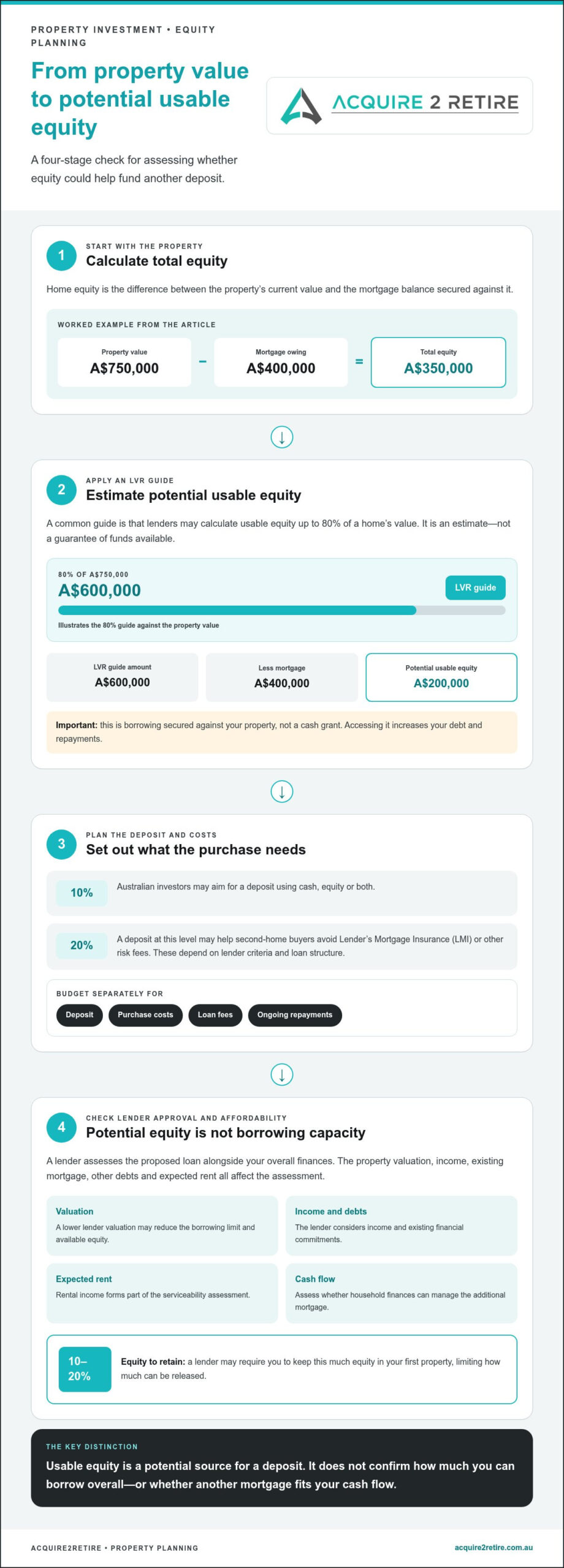
Home equity is the difference between a property’s current value and the mortgage balance secured against it. For example, a home valued at A$750,000 with A$400,000 owing has A$350,000 in equity. That full amount usually isn’t available to borrow, because a lender considers its loan-to-value ratio (LVR), your income, debts and the property’s valuation.
A common guide is that lenders may calculate usable equity up to 80% of a home’s value. In the A$750,000 example, 80% is A$600,000; subtract the A$400,000 mortgage, and potential usable equity is A$200,000. This is borrowing secured against your property, not a cash grant, and accessing it increases your debt and repayments.
To use equity, you may refinance your existing mortgage or apply to increase it. The lender assesses the proposed loan alongside your overall finances, then decides whether equity can be released. The valuation matters: if the lender assesses the property at a lower value, your borrowing limit and available equity may also be lower.
Equity can contribute to a deposit, while savings can cover some or all of the remaining amount and purchase costs. Australian investors may aim for a 10% deposit using cash, equity or both. A 20% deposit may help second-home buyers avoid Lender’s Mortgage Insurance (LMI) or other risk fees. LMI and risk fees depend on the lender’s criteria and loan structure, so factor them into the purchase calculation.
Consider the figures before treating equity as an available deposit. That limit applies to the new property’s loan calculation; it doesn’t tell you how much you can borrow overall. Your existing mortgage, other debts, income and expected rent all affect the lender’s serviceability assessment.
- Estimate the property’s current value and subtract its mortgage balance.
- Apply the lender’s LVR limit to estimate potential usable equity.
- Budget separately for the deposit, purchase costs and ongoing repayments.
- Assess whether household cash flow can manage the additional mortgage.
Retaining equity matters too. A lender may require you to keep 10 to 20% equity in your first property, limiting how much can be released. Equity and deposit planning can help you compare loan structure, borrowing capacity and purchase costs before committing to another property.
3. Assessing the performance of the first investment
Your first property’s performance can show whether your portfolio has a dependable foundation. Start with rent actually received, not the advertised weekly amount, then compare it with mortgage repayments and annual holding costs. Include maintenance, landlord’s insurance, property management and rates. If rent consistently covers these costs, the property may support future growth. If you regularly cover a shortfall, another loan could put pressure on your household budget.
For example, Sheree’s investment duplex rents for A$750 per week. That figure doesn’t show the full performance without vacancy periods, loan costs and expenses. Track rent received against costs over time, and separate routine bills from irregular repairs. This gives you a clearer view of the income the property contributes and whether you can afford another investment.
Before buying again, review the performance of your current property and complete due diligence on the one you’re considering. Check rental records, loan repayments, maintenance, insurance, rates and vacancy history. Research the target area’s supply and demand, rental yields, employment rates and economic indicators. Consider whether your portfolio would remain stable if rent stopped temporarily or repairs were needed.
To assess rental yield, compare a property’s annual rental income with its purchase price. To assess cash flow, subtract mortgage repayments and holding costs from rent received, allowing for vacancies and repairs. For capital-growth prospects, research local and broader market conditions rather than relying on past price movements alone.
A holiday home booked consistently for 10 weeks a year can still cost more to hold than it earns in rent. Occupancy alone doesn’t show performance. Add mortgage interest, maintenance, insurance, rates and property management before judging the result. Even strong bookings may leave the owner needing to contribute income from elsewhere.
Consider how much your wealth would depend on one property type or market. Diversifying across locations and property types can help manage risk. Research can also show whether properties depend on the same employers, tenants or economic conditions. Property markets can remain negative or stagnant for a decade or more, so short-term growth expectations shouldn’t drive the whole decision.
Set a practical review point before expanding. Compare your first property’s income and costs across its rental history, then stress-test your household budget against vacancies, maintenance and repayments. If performance depends on uninterrupted rent or rising values, strengthening cash reserves or reviewing your investment strategy may be wiser than taking on another commitment.
4. Borrowing capacity and loan-to-value ratio
Borrowing capacity is the amount a lender assesses you can repay, based on income, expenses, existing debts and rental income. A second property may add to your assets, but its mortgage also brings repayments and costs. Signs you may be able to afford another investment include manageable existing debt, reliable income and enough cash flow to cover repayments, vacancies and maintenance.
Your loan-to-value ratio (LVR) compares the loan with the property’s value. For example, 80% of a A$750,000 home value is A$600,000. This calculation shows a possible equity amount, not approval to borrow it.
A separate example shows how existing debt can reduce room to borrow. At an 80% LVR, a property with a A$520,000 borrowing limit and A$450,000 of existing debt has A$70,000 of potential usable equity. The lender still assesses income, other liabilities and repayment capacity before deciding whether additional lending is supportable.
Rental income can contribute to a lender’s assessment, but it is considered alongside your other financial commitments. The lender looks at the proposed mortgage, existing loans, household expenses and income together. If rental income doesn’t cover relevant costs, negative gearing may affect serviceability because your available income must fund the shortfall.
Test your budget against changing conditions before relying on a borrowing estimate. Allow for an interest-rate rise of 1 to 2% and consider whether your income can manage repayments if rent falls short. Interest-only lending can also be less favourable for servicing than other repayment structures, so compare how each loan affects your capacity.
A broker or lender can discuss loans, rates and pre-approval, helping you understand how a proposed purchase fits your finances. Borrow only what you can manage. Australian home loan applications are subject to credit approval, and loan offers include full terms and conditions; fees and charges are payable.
- List your income, household expenses and existing debts.
- Estimate the new loan against the property value to understand its LVR.
- Include realistic rental income, then allow for vacancies and holding costs.
- Stress-test repayments against a 1 to 2% interest-rate rise.
These figures help show whether another purchase is financially workable, but borrowing capacity and available equity are different measures. A property may have equity while your income and commitments limit further borrowing. Review both before treating a pre-approval or equity estimate as your purchase budget.
5. Building equity in the first investment property
Equity in your first investment property can grow as its value rises, the loan balance falls, or both. A higher valuation increases the property’s assessed value, while repayments directly reduce the debt. Neither automatically means a lender will release funds. Treat these changes as reasons to review your position, not as a purchase signal by themselves.
Building equity for two to three years or more may be a reason to consider buying again, but treat that timeframe as a prompt to review your progress, not a rule. Your position depends on the property’s current value, remaining mortgage, rental performance, income and plans. When deciding when to buy a second investment property, consider how these factors work together rather than relying on a single milestone.
Compare the property’s current valuation with its loan balance, then consider the lender’s loan-to-value ratio limit and your capacity to service additional debt. Australian investors may need to own 30 to 40 per cent of their first property to use its equity towards another purchase. This is a broad guide, not a measure of accessible funds. The lender’s assessment and your financial commitments influence what equity may be available.
Equity growth and cash-flow strength are separate measures. A property can rise in value while still requiring regular contributions for repayments, vacancies or repairs. Before using equity, review rent received, holding costs and the remaining loan balance. Then assess whether your household income could support another mortgage. This helps distinguish a paper gain from funds you can actually borrow and manage.
Consider your longer-term direction, too. Paul Clitheroe suggests asking how continuing your current approach for another 20 years could build a solid asset base. This hypothetical timeframe can help test whether your strategy fits your wealth goals, risk tolerance and intended holding period. It isn’t a forecast. Revisit the question of when to buy a second investment property if your goals or financial circumstances change.
A reported Australian example shows why a revaluation alone shouldn’t determine your next purchase. A higher assessed value changes the equity calculation, but debt, borrowing capacity and ongoing performance still affect whether the owner can use that equity towards another property.
- Track the property value and loan balance separately.
- Review rental income, expenses and repayments alongside equity.
- Assess whether accessible equity fits your deposit and loan plan.
- Consider whether holding the existing property supports your long-term strategy.
Use the full financial picture, rather than a valuation alone, to guide your next decision. Plan your next investment step with a clear view of your existing property’s equity, performance and long-term role.
Acquire2Retire: Planning & Strategy
Acquire2Retire helps investors turn their property goals into a considered plan through Planning & Strategy, Acquisition, Finance and Tenancy. If you’re weighing existing equity against borrowing capacity, or deciding whether another purchase fits your long-term direction, this support can help bring those considerations together. The focus is on building a resilient Australian property portfolio, with a strategy shaped around your investment goals and financial position. Acquisition support can guide the property selection process, while finance and tenancy coordination address important parts of putting an investment plan into practice. A second purchase may not suit every situation, so a structured review can help clarify the next step. To discuss your property investment plans, visit acquire2retire.com.au.
Set a clear direction for your next move
Deciding when to buy a second investment property is easier when you define what a successful next step means for you. Before committing, write down the outcome you want, the financial conditions that need to hold and the circumstances that would make you pause. This turns a broad ambition into a framework you can revisit as your income, priorities and portfolio change.
A plan can also help keep a promising property from distracting you from the bigger picture. Acquire2Retire’s Planning & Strategy can help shape your investment direction, while Acquisition and Finance support the steps involved in putting that plan into action. The aim is to make your next decision with a clear view of how it fits your longer-term goals, rather than responding to pressure or momentum.
If you’re ready to explore your options, contact Acquire2Retire to discuss your plans. A considered next step can help you move forward with greater clarity and confidence.
Frequently Asked Questions
How does using equity to invest in property work?
Home equity lets you borrow against the value built up in a property rather than selling it to raise funds. Refinancing replaces or restructures the existing mortgage; a top-up adds borrowing to it. The lender assesses the property’s value, your income and liabilities before releasing funds. You can use the money towards another property’s deposit, but repayments on the additional debt remain part of your household budget.
Is now a good time to consider buying a second home?
There’s no single best date to buy a second property. The right time is when the purchase fits your financial plan and risk tolerance. Consider whether your first property is performing as expected, your income can support added debt and your investment horizon suits holding another asset. A favourable market alone doesn’t mean you’re ready. Revisit the decision if your goals, household costs or employment situation change.
How much deposit and upfront costs are needed for a second investment property in Australia?
Australian investors can aim for a 10% deposit funded by savings, equity or both. A 20% deposit may help avoid Lender’s Mortgage Insurance or other risk fees. Set aside separate funds for stamp duty and purchase costs, which vary by state or territory and buyer circumstances. Work out the full amount based on the property’s location, price, loan structure and applicable charges, rather than treating the deposit as the total upfront cost.
How do Australian lenders assess borrowing capacity for a second investment property?
Lenders assess the proposed loan against your income, regular expenses, existing debts and expected rental income, then test whether repayments meet their serviceability criteria. They also consider the security property’s value and loan-to-value ratio. Pre-approval can indicate your borrowing parameters, but the final application remains subject to credit approval and loan terms. Provide complete income, debt and expense records so the assessment reflects your financial position.
How do rental income, existing property debt and living expenses affect serviceability?
Lenders can include rental income in an application, but weigh it alongside your existing mortgage, personal debts and household living expenses. If rent doesn’t cover the property’s loan and holding costs, your income needs to fund the shortfall. For example, a vacancy can reduce rent while mortgage payments and rates continue. Serviceability therefore depends on cash flow after essential household spending, not gross salary alone.
What are the tax implications of buying a second investment property, including negative gearing and capital gains tax?
Home-loan interest and some other ownership costs can be considered for tax deductions or negative gearing, but any benefit depends on your income and circumstances. Selling a property that isn’t your main home may result in capital gains tax. According to the Australian Taxation Office, the six-year rule relates to moving into and out of a property and its capital gains tax treatment. Keep records of rental income and expenses.
What risks come with owning multiple investment properties, including vacancies, repairs and interest rate rises?
Owning multiple properties adds tenancy, maintenance and compliance responsibilities, while increasing your exposure to vacancies and borrowing costs. A vacancy reduces rental income, but mortgage payments and rates continue; unexpected repairs can add pressure. Rising interest rates can lift repayments across several loans at once. Test your budget against lower rent and higher costs, and keep accessible savings for repairs or income gaps rather than relying solely on continued capital growth.