
What if a property that looks promising in a listing carries risks its photos and rental estimate can’t reveal? A sound investment property due diligence checklist looks beyond the asking price to test the evidence, legal and physical condition, and fit with your investment plan.
It’s reasonable to want clear answers before committing. Contract details, ownership issues and state or territory processes can be difficult to assess at a glance. Rental estimates and market claims also need to be weighed against reliable evidence, not treated as guarantees.
This practical Australian checklist helps you assess key legal, physical and financial risks, build a more realistic picture of income and expenses, and decide whether to proceed, seek clarification or reconsider. Work through the property, its paperwork, likely tenancy and investment assumptions in a considered order, viewing each finding alongside your cash-flow needs, risk tolerance and longer-term goals.
Key Takeaways
- Use an investment property due diligence checklist to organise checks of ownership, restrictions, planning, condition and environmental risks before committing.
- Compare advertised rent with relevant market evidence, and separate estimates from confirmed income when assessing the investment case.
- Build a fuller cash-flow picture by accounting for recurring and irregular expenses, finance assumptions, vacancy and maintenance.
- Follow a clear sequence from setting investment criteria to reviewing documents, inspections and your final decision. Record the evidence each step provides.
- Weigh findings against your risk tolerance, cash-flow needs and portfolio goals to decide whether to proceed, renegotiate or reconsider.
What an investment property due diligence checklist should uncover
Due diligence means checking a property’s evidence, obligations, condition and investment assumptions before you commit. An investment property due diligence checklist turns those checks into a decision process. It helps you identify what’s established, what’s estimated and what still needs an answer, rather than relying on a confident listing or a single inspection.
A general homebuyer checklist may focus on whether a home suits its occupants. An investor also needs to test whether the property supports the intended strategy. Consider likely rent and tenant demand alongside operating expenses, finance assumptions, potential vacancy and the property’s fit with your cash-flow needs, risk tolerance and wider portfolio goals. A property can appear suitable on its own yet be a poor match for your overall plan.
Use the checklist to reduce uncertainty, not to expect certainty. Inspections and documents can reveal present issues, but they can’t guarantee rental income, future growth or freedom from later problems. For a broader overview of real estate investing and due diligence, consider how risk assessment and valuation inform an investment decision.
Which risks should an investment property checklist cover?
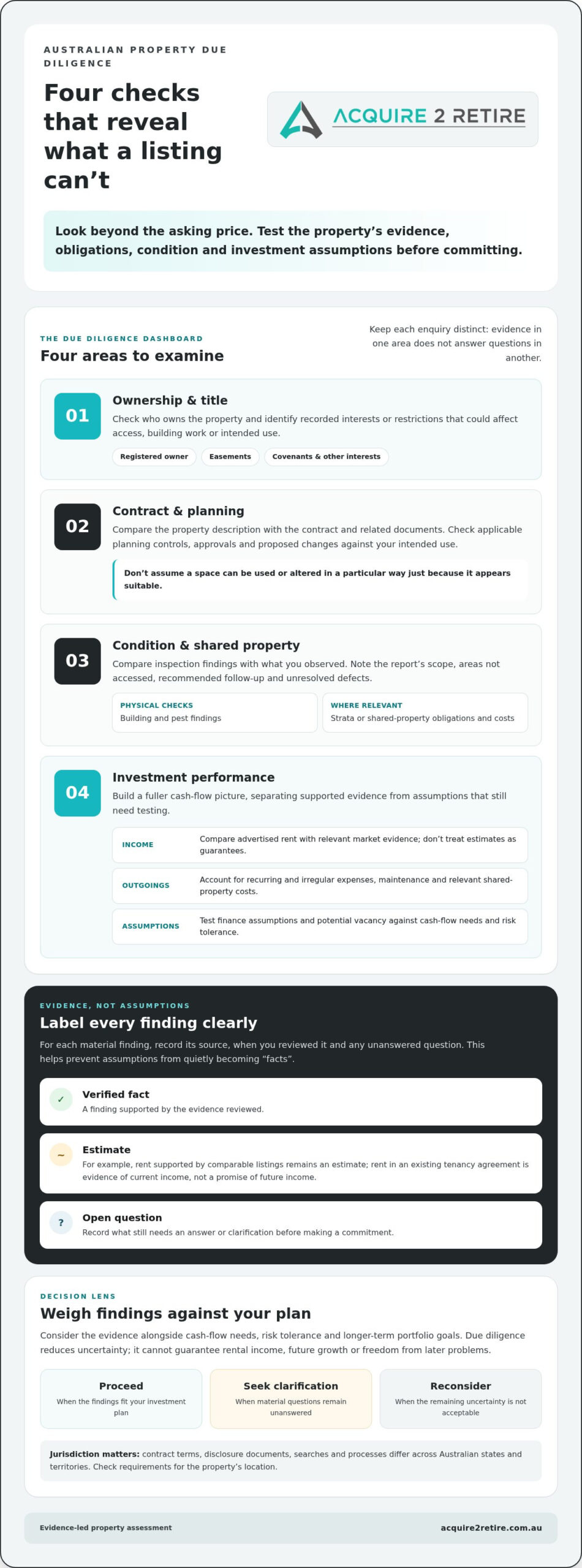
Keep separate areas of enquiry visible, because evidence for one doesn’t answer questions in another. Ownership and title records relate to who owns the property and what interests or restrictions may be recorded. Contract documents set out proposed transaction terms, inspections address physical condition, and planning information concerns permitted use. Requirements and records vary across Australian states and territories, so identify the relevant jurisdiction before relying on a document or process.
Then assess the investment case. For a unit or another shared-property asset, include relevant strata or shared-property records, obligations and potential costs. Treat rental estimates, finance assumptions and vacancy allowances as assumptions to test, not settled facts.
- Ownership and title: identify recorded interests or restrictions that could affect the intended use.
- Contract and planning: note obligations, permitted use and any jurisdiction-specific questions that need clarification.
- Condition and shared property: record inspection findings and, where relevant, shared-area responsibilities and obligations.
- Investment performance: distinguish evidenced rent and expenses from estimates, then test the cash-flow effect of vacancy and finance assumptions.
How to use the checklist without treating it as a guarantee
For each material finding, record the source, the date you reviewed it and any question that remains unanswered. Label each item as a verified fact, an estimate or an open question. For example, rent supported by comparable listings is still an estimate. Rent recorded in an existing tenancy agreement is evidence of current income, not a promise of future income.
This simple record makes uncertainty easier to judge and helps direct further enquiries. It also prevents an assumption from quietly becoming a “fact” as the purchase progresses. Rules, disclosure documents and transaction processes differ between states and territories, so make sure your checks reflect the property’s location and applicable requirements.
Due diligence is an evidence-led assessment of a property’s obligations, condition and investment assumptions before making a commitment. The aim isn’t to remove every unknown. It’s to understand which findings matter to your decision, which need clarification and whether the remaining uncertainty is acceptable within your investment strategy.
Check the property’s title, condition, planning and environmental risks
Once you’ve set your investment criteria, examine whether the property can be owned and used as intended, and what its physical condition could mean for future costs. An investment property due diligence checklist is most useful when each document or inspection is tied to a practical question: could a restriction affect the intended use, could a defect need follow-up, or could a shared obligation change the investment assumptions?
Title, contract and planning checks before proceeding
Review title information to identify the registered owner and any recorded easements, covenants or other interests that may affect access, building work or use. A title record is one part of the picture, not a substitute for checking how the property is described in the contract and related documents.
Look into applicable zoning, planning controls, approvals and any proposed changes that could be relevant to your plans. Don’t assume a space can be used or altered in a particular way simply because it appears suitable. The responsible authority and available records depend on the property’s location.
Contract terms, disclosure documents and required searches differ across Australian states and territories. Treat them as jurisdiction-specific checks rather than applying one state’s process nationally. Record any term or search result that needs clarification before you make a commitment.
Building, pest, strata and environmental checks
Compare building and pest inspection findings with what you observed at the property. Note the inspection’s scope, areas that couldn’t be accessed, recommended follow-up and unresolved defects. A report describes what was assessed at a particular time; it doesn’t establish that every part of the property is free from issues.
- Condition and services: note concerns with visible structures, drainage or essential services, and identify where further assessment may be needed.
- Boundaries and access: check available boundary information and whether access arrangements align with the intended use.
- Environmental risks: review relevant flood, fire or contamination information for the specific property. A location alone doesn’t confirm a hazard, so consider what the available evidence actually shows.
- Strata or shared property: review available records, financial information, maintenance plans, meeting decisions and potential levies. These may reveal upcoming works or shared obligations that affect costs and use.
Keep the distinction clear between a confirmed finding and a concern that needs more investigation. If an inspection identifies a defect, note what it says, what it leaves unresolved and how the answer could affect your purchase decision or financial assumptions.
Acquisition research is stronger when property findings are considered alongside your investment objectives and finance strategy. Acquisition research and strategy can help connect those considerations as you assess whether to proceed, negotiate or pause for clarification.
Test the investment case: rent, expenses, cash flow and market evidence
A property’s condition and paperwork tell only part of the story. Next, test whether its likely income and costs make sense for your finances and investment strategy. Keep evidence, estimates and assumptions distinct, so a promising headline yield doesn’t obscure a cash-flow gap or reliance on uncertain future growth.
How to test rent, yield and cash-flow assumptions
Compare advertised rent with evidence for similar properties, taking account of location, property type, size, condition and included features. Check whether the comparison reflects current listings, achieved rents or an existing tenancy, because each provides a different level of evidence. Advertised rent is an estimate until relevant evidence supports what a tenant is likely to pay.
Gross rental yield is annual rent divided by the purchase price, expressed as a percentage. It’s a useful comparison measure, but it excludes ownership expenses and finance costs, so it doesn’t show how much cash is left over. For a more practical view, account for expected rent alongside recurring costs, irregular maintenance, potential vacancy and your finance assumptions. Keep capital-growth potential separate: identify the evidence behind that rationale without treating future growth as a promised return.
Use a simple scenario comparison to see which assumptions matter most. The entries below are prompts, not forecasts or guaranteed outcomes.
| Scenario | Assumptions to test | Decision question |
|---|---|---|
| Base case | Evidence-based rent and expected costs | Does the property fit your planned cash flow? |
| Lower income | Reduced rent or a longer vacancy period | Can your finances absorb less rental income? |
| Higher costs | Increased finance costs or an unexpected repair | Would the investment remain manageable? |
How market indicators inform, but do not decide, the purchase
Assess rental demand using comparable evidence, vacancy conditions, competing rental supply and the property’s own attributes, such as layout and condition. Broad market indicators can help frame questions, but they can’t establish demand for an individual property. Look at how the evidence relates to the specific property, rather than treating one vacancy figure as a universal threshold or pass-or-fail rule.
Consider what the evidence means for your time horizon, risk profile and capacity to manage weaker income or higher costs. Tight rental conditions may still come with risks, while softer conditions aren’t automatically a reason to reject a property if its price, attributes and investment role suit your plan. The investment property due diligence checklist should help you see how sensitive your decision is to each assumption, rather than reduce it to one market statistic.
For context on how rental, finance and portfolio assumptions can connect with your objectives, read about property investment planning.
Use this due diligence checklist in a clear order before committing
A staged process helps you gather evidence before making a decision, rather than letting a promising feature or unanswered question dominate the assessment. Use this investment property due diligence checklist as a working record: note what you reviewed, what it shows, what remains uncertain and how the finding affects your decision.
A staged checklist from shortlist to contract decision
Move through each stage in sequence, updating your records as new information becomes available. This creates a clear trail from your investment criteria to your final decision and helps you spot when an assumption has changed.
- Set your criteria. Record the property type and investment role you’re seeking, your finance capacity, cash-flow needs and intended holding period. Ask whether the asset fits your objectives and risk profile. If it doesn’t meet essential criteria, decide whether there’s a sound reason to keep assessing it.
- Gather property and transaction information. Collect available title, planning, contract, disclosure, strata and property records relevant to the asset. Ask what the documents establish, which obligations or restrictions could affect your plans, and what information is missing. Check that your review reflects the property’s state or territory, rather than assuming the process is identical across Australia.
- Review condition evidence. Arrange relevant inspections and compare their findings with your observations. Record the inspection scope, limitations, defects and recommended follow-up. Ask whether an unresolved issue could affect use, costs or your ability to proceed on the current terms.
- Revisit the investment case. Update rent, expenses, vacancy, maintenance and finance assumptions using the evidence gathered. Ask whether the property still fits your cash-flow capacity and portfolio plan if an assumption changes. Decide whether to proceed, seek clarification, renegotiate or reconsider.
When a finding should pause or change the decision
Don’t treat every open question as a reason to walk away, but don’t let it disappear from view either. Label each item resolved, outstanding or material, then record the evidence or answer needed to move it forward. A concern is material when resolving it could change your willingness to buy, the terms you’d accept or the investment’s financial viability.
Pause for a clearer picture if ownership is unclear, contract terms appear restrictive, permitted use is uncertain, records are incomplete or an inspection identifies a potentially material defect. If updated information changes expected rent, costs, finance assumptions or repair needs, recalculate the scenarios rather than relying on an earlier assessment.
A deadline or competitive bidding pressure doesn’t make an unresolved risk acceptable. If the decision depends on an unanswered question, consider whether you have enough reliable information to proceed on the proposed terms. A step-by-step view of the Australian investment property buying process can help put these checks in context.
Acquire2Retire connects property assessment with investment objectives and finance strategy through its property acquisition strategy services.
Bring due diligence findings into a confident acquisition strategy
Due diligence is most valuable when the findings inform a real decision. Bring together evidence on condition, ownership obligations, permitted use, market support and cash flow, then compare it with the investment objectives you set at the outset. The result doesn’t need to be a simple yes or no: you may have grounds to proceed, negotiate on price or terms, or reconsider the property.
Turn property findings into an investment decision
Separate confirmed facts from estimates and unresolved questions, then assess how much each matters to your goals and risk profile. A repair that changes expected costs, weaker rental evidence or a restriction affecting intended use could alter the acquisition rationale. Rework the financial assumptions when material findings change, rather than relying on the original numbers.
Some questions are commercial, such as whether an asset fits your portfolio and cash-flow needs. Others concern the meaning of contract terms or legal obligations. Keep investment strategy and acquisition advice distinct from legal interpretation and conveyancing, so each decision is considered in the appropriate context.
What an integrated acquisition strategy can add
Property research is more useful when considered alongside your broader portfolio direction, borrowing structure and capacity to manage cash-flow variability. Acquisition analysis can connect evidence about an asset with your objectives, while finance structuring considers how a purchase fits wider debt and portfolio considerations.
Initial tenancy arrangements also belong in the acquisition-stage assessment. Likely tenant demand, readiness for letting and the steps needed to prepare for a tenancy can inform the plan. These are part of considering the purchase and its transition, not a substitute for a strategy that reflects your overall circumstances.
Acquire2Retire brings acquisition research, market assessment and negotiation support together with investment planning and finance considerations. The company also coordinates initial tenancy arrangements and provides ongoing portfolio support. This helps keep the property decision connected to your longer-term targets rather than treating due diligence as a standalone document review.
- Proceed when the evidence supports the property’s intended use and the assumptions remain acceptable within your strategy.
- Renegotiate when a finding changes the property’s value or costs, but the asset may still fit if terms can be adjusted.
- Reconsider when a material risk conflicts with your objectives, risk tolerance or ability to manage the likely cash-flow demands.
A well-used investment property due diligence checklist won’t promise a particular result, but it can help you understand why you’re proceeding and what uncertainties you’re accepting. Acquire2Retire’s investment property acquisition strategy connects property findings with your objectives and finance considerations.
Let the evidence guide your next move
A considered decision isn’t about finding a property with no risks. It’s about knowing which uncertainties you can accept and whether the investment still makes sense for you. Keep your investment property due diligence checklist as a record of the reasoning behind your choice, so you can revisit the assumptions as your plans and circumstances evolve.
Acquire2Retire brings acquisition research and due diligence into a broader strategy shaped around your investment objectives, risk profile and cash-flow requirements. This can help you assess a property not just as a standalone opportunity, but as one part of your longer-term direction.
Ready to assess how a potential purchase fits your plans? Talk with Acquire2Retire about your next property investment step and connect your due diligence findings with your investment strategy.
Frequently Asked Questions
How long should investment property due diligence take in Australia?
There’s no fixed timeframe. It depends on the property, how quickly records are available and whether inspections raise further questions. A straightforward property may need fewer follow-ups than one with complex shared-property records or unclear planning information. Before making an offer, allow time to review documents and arrange relevant checks. If there’s a deadline, find out what must be completed by then and avoid assuming every issue can be resolved afterwards.
Can I make an offer before completing investment property due diligence?
You may be able to make an offer while some checks are still underway, but the protections available depend on the contract and the rules in the relevant state or territory. Don’t assume you can withdraw without consequences if new information emerges. Before signing, understand the terms, any conditions and key dates with advice suited to the transaction. If a material check is incomplete, weigh that uncertainty against the risk of proceeding.
What happens if an inspection finds a problem after I have signed a contract?
Act promptly. Give the inspection findings to your conveyancer or solicitor and ask what options, deadlines and obligations apply under your contract and local rules. A defect doesn’t automatically give you a right to cancel or change the terms. Keep the report and any follow-up findings, and avoid agreeing to a variation or taking action based on assumptions about your rights. The appropriate next step depends on the contract and the issue.
Do I need a separate due diligence checklist for a strata investment property?
Use the core property checks, then add a strata-focused review because some costs and decisions are shared with other owners. For example, examine available meeting records for planned works, disputes or decisions that could affect future contributions. Compare the records with the property’s immediate condition: a well-presented unit doesn’t necessarily show the state of shared areas or the financial position of the scheme. The relevant documents and terminology vary across jurisdictions.
Does a building and pest inspection guarantee there are no property defects?
No. An inspection reports on the areas and conditions assessed at the time, within the inspection’s stated scope. Concealed spaces, inaccessible areas or issues that develop later may not be identified. Read the report’s limitations as well as its findings, and note any recommended specialist assessment or further inspection. If a concern could affect safety, intended use or repair assumptions, treat it as an open question until you understand its implications.
How much does investment property due diligence cost?
There’s no single total, because the checks required vary by property and location. As a guide, a standard building inspection may cost A$300 to A$600, while a combined building and pest inspection may cost A$350 to A$700. Some inspections may cost more depending on the property and scope. These figures cover inspections only, not every possible report, search or transaction expense.
Are rental estimates enough to confirm an investment property will be cash-flow positive?
No. A rent estimate is only one input, and it can’t establish the property’s cash position by itself. Model expected income against finance costs, recurring ownership expenses, vacancy and maintenance, then test what happens if rent is lower or costs rise. For example, a property with an attractive gross yield may still require extra cash from you once expenses and loan repayments are included. Treat projected cash flow as an assumption to test, not a guarantee.