
The loan with the sharpest rate may not be the right fit for your property portfolio. Comparing rates, loan features and borrowing capacity can feel complicated, especially when a finance choice for one purchase could affect your options later. A mortgage broker for property investors can help with lending decisions, but that role is different from broader investment advice.
This article explains how mortgage broking differs from property investment advisory, so you can identify which support addresses each part of your plan. You’ll learn how to consider finance alongside cash flow, risk and future purchases, and what to understand about broker remuneration and lender relationships.
Planning, acquisition and finance can work together. At Acquire2Retire, finance support sits within a broader property investment service, connecting lending decisions with investment objectives and acquisition plans. Ongoing portfolio reviews can help you revisit finance and future purchases as your circumstances and goals develop.
Key Takeaways
- Look beyond the headline rate. Compare repayment flexibility, fees and loan features against your cash flow needs.
- A mortgage broker for property investors focuses on lending options and arranging finance, while an investment adviser helps shape broader property decisions.
- Existing loans, income, expenses and investment goals can help frame a practical finance discussion.
- Assess finance choices alongside acquisition plans, risk and the borrowing capacity you may need for future purchases.
- A joined-up process can connect investment objectives with strategy, acquisition research and suitable lending options.
Why a mortgage broker for property investors needs to look beyond one loan
Choosing finance for an investment property involves more than securing approval. The loan also needs to sit comfortably alongside your cash flow, risk tolerance and plans for what comes next. A structure that works for one purchase may feel restrictive if you later want to build a portfolio, manage changing expenses or retain flexibility for another opportunity.
A mortgage broker can help compare lending options and arrange finance. A broader investment strategy considers how a purchase fits your goals. Understanding the broker’s role as an intermediary, as outlined in What is a Mortgage Broker?, is a useful starting point. Approval answers whether a lender will provide a loan under its assessment criteria. It does not, by itself, show how that debt supports your longer-term plans.
Assess investor finance against both current and planned needs. Consider the purchase in front of you and how its repayments and features may affect your choices later.
What makes an investment property loan different from a home loan?
The intended use of the property shapes the lending discussion. For an investment purchase, a lender may consider expected rental income alongside your broader financial position. Repayments and other property costs also affect the cash flow you have available. The way each lender assesses income, expenses, existing debts and the proposed property can influence the options available to you.
Your circumstances matter too. An investor with existing loans and plans to buy again may weigh flexibility differently from someone making a single purchase. There is no loan structure that suits every investor or property, so consider finance choices in context rather than treating them as a standard formula.
Why a single-purchase view can leave important questions unanswered
Focusing only on the loan for the immediate purchase can leave broader cash flow questions unexplored. How would repayments fit alongside your other commitments? Do the loan features support your preferred approach to managing repayments? If your plans change, would the structure offer useful flexibility, subject to the lender’s terms and your eligibility?
These questions do not predict that you will buy another property. They help you make a deliberate decision. Future plans can affect how you think about debt structure, accessible funds and borrowing capacity, while lender criteria and your financial position may change over time. A considered plan can help you recognise trade-offs before committing, rather than assuming today’s approval settles every later decision.
For a closer look at how loan structure connects with investment plans, explore this investment property loan structure guide. Use it to frame questions about the property, your cash flow and the next steps you have in mind.
Mortgage broker vs property investment adviser: what does each do?
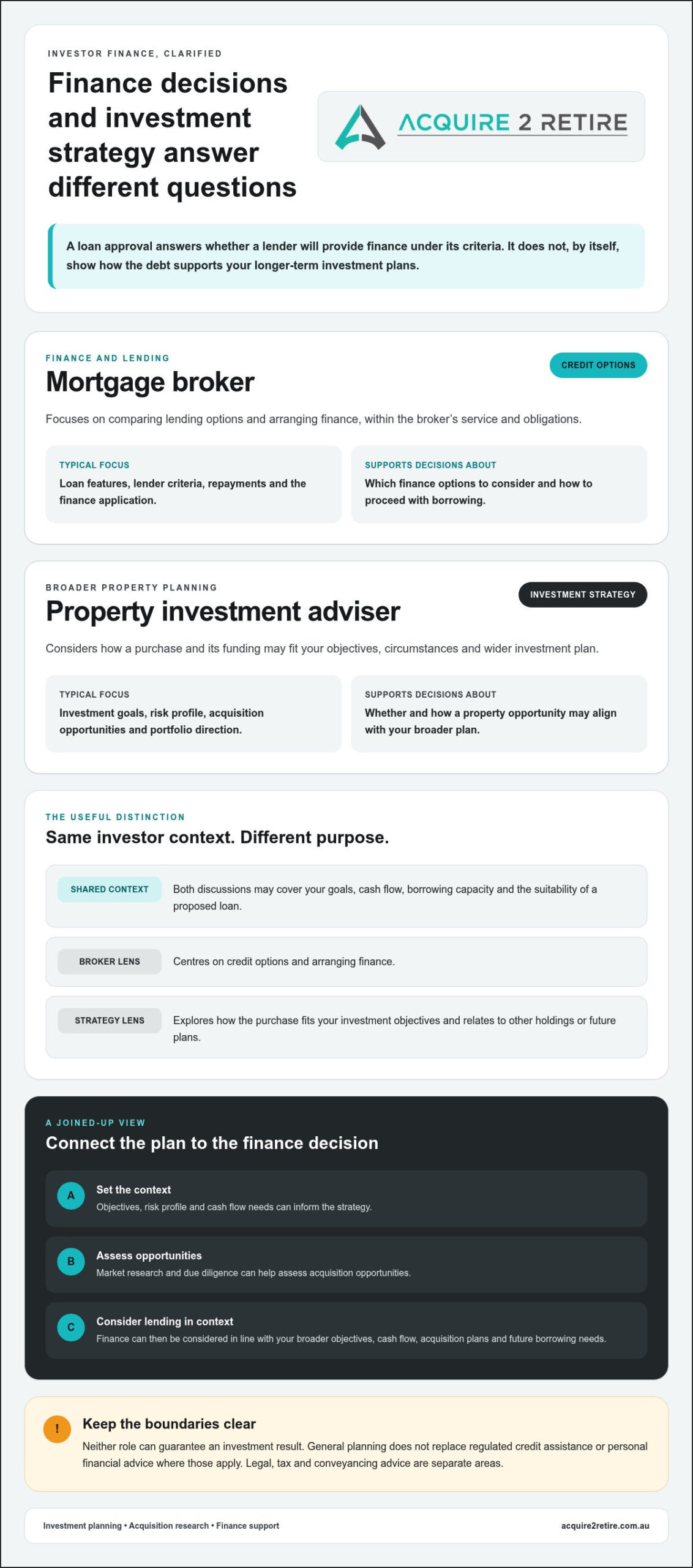
Both roles can contribute to an investor’s decisions, but they answer different questions. A mortgage broker focuses on finance options and arranging lending. A property investment adviser considers how a purchase and its funding may fit within a wider investment plan. Knowing the focus of each role helps you understand what support you’re receiving and which decisions may need separate advice.
| Area | Mortgage broker | Property investment adviser |
|---|---|---|
| Core purpose | Explore lending options and arrange suitable finance. | Develop investment strategy in light of your objectives and circumstances. |
| Typical focus | Loan features, lender criteria, repayments and the finance application. | Investment goals, risk profile, acquisition opportunities and portfolio direction. |
| Decisions supported | Which finance options to consider and how to proceed with borrowing. | Whether and how a property opportunity may align with your broader plan. |
| Scope | Credit assistance, within the broker’s service and obligations. | Planning and acquisition guidance, with finance considered as part of the strategy. |
A mortgage broker for property investors can help assess lending choices against your financial details and the lender’s criteria. An investment adviser looks more broadly at the reasons for acquiring a property, its fit with your goals and how the decision relates to other holdings or future plans. Neither role can guarantee an investment result. Loan approval alone does not determine whether a property suits your strategy.
Where mortgage broking and investment advisory overlap
Both conversations may cover your goals, cash flow, borrowing capacity and the suitability of a proposed loan. The purpose differs: a broker’s discussion centres on credit options and arranging finance, while broader strategy explores how the purchase fits your investment objectives. General planning does not replace regulated credit assistance or personal financial advice where those apply. Legal, tax and conveyancing advice are separate areas.
What an integrated investment and finance process can add
Acquire2Retire brings planning, acquisition and finance support together in one investment journey. Your objectives, risk profile and cash flow needs can inform the strategy. Market research and due diligence can then help assess acquisition opportunities, with lending arranged in line with your broader objectives. This joined-up view can make trade-offs clearer without promising a particular outcome. For wider context, explore this property investment planning strategy.
Professional standards and qualifications vary across countries and roles, so international material should not be treated as a guide to Australian requirements. The Investment Advisor Certifications and Standards resource offers context about investment and wealth professionals. To see how strategy, acquisition and finance support can connect, explore Acquire2Retire’s property investment support.
How to compare investor finance support beyond the interest rate
A loan comparison is more useful when it shows how each option may work in your circumstances, not just which rate is lower today. For an investor, repayments, access to funds and eligibility can all affect cash flow and the ability to pursue later plans. A mortgage broker for property investors can help assess lending options. Make sure your comparison also reflects your objectives and the property’s intended use.
Use consistent questions to compare options. Product features, eligibility and conditions vary between lenders, so treat the table as a framework rather than a universal recommendation.
| Comparison point | What to consider |
|---|---|
| Rate type | How might a variable rate or a fixed-rate period fit your budget and tolerance for repayment changes? |
| Repayment flexibility | What repayment arrangements are available, and do they align with your cash flow? |
| Fees | What fees apply, when are they charged, and how do they affect the overall cost of the loan? |
| Offset or redraw | Does the loan offer either feature, and what access rules, conditions or limits apply? |
| Loan purpose | Is the proposed borrowing assessed and structured for the property’s intended investment use? |
Which loan features matter for an investment property?
A fixed rate can provide more certainty about repayments during its fixed period, while a variable rate can change over time. Neither suits every investor. An offset account may reduce the balance on which interest is calculated when eligible funds are held in it. Redraw generally involves accessing eligible additional repayments already made. Availability, access and conditions depend on the product. Weigh the repayment structure against your income, expenses and capacity to manage changes too.
The rate alone does not determine whether an investment loan is suitable. Its features, conditions and fit with your plans all matter. For example, an investor who prioritises repayment certainty may compare options differently from one who places greater value on access to funds. Both still need to consider costs and eligibility.
How borrowing capacity and portfolio plans fit the comparison
Lenders can assess income, expenses, existing debts and rental income differently, and their criteria may change. Existing liabilities and plans for another purchase can affect which options are practical and how today’s repayments fit your broader cash flow. Consider the property opportunity alongside due diligence and your intended acquisition timeline, rather than treating finance as a separate decision.
For a clearer picture of how lenders may assess your position, use this investment property borrowing capacity guide. If you’re considering more than one purchase, a guide to financing multiple investment properties can help you frame questions about liabilities, flexibility and future lending needs.
A practical process for assessing finance support as an investor
A useful finance discussion starts with your plans, not an assumed loan amount. Preparing an accurate picture of your finances and the property you’re considering can make the conversation more productive. Keep expectations grounded: borrowing capacity and approval depend on lender assessment and your individual circumstances.
- Clarify your goals and timing. Note whether you’re considering a first investment property or adding to an existing portfolio, your likely purchase timeframe and what you want the investment to contribute. Be realistic about repayment comfort, including how much room your household cash flow needs for changing costs or unexpected expenses.
- Gather a snapshot of your finances. Income, regular expenses, savings and other assets help describe your current position. Include existing liabilities and loan details such as balances, repayments and relevant features. If you already receive rent, that information may also form part of the discussion. Accurate details inform an assessment, but do not guarantee an outcome.
- Set out your risk preferences. Consider how comfortable you are with repayments changing, how much flexibility matters and whether you may want to purchase again. These preferences help frame the trade-offs to explore. They do not mean one rate type or loan feature is right for everyone.
- Compare finance against the intended purchase. As you assess a property, consider its expected income and costs alongside the proposed lending structure. Acquisition research and due diligence can help you understand the opportunity, while finance discussions clarify how loan options and conditions relate to your plans.
- Review options and next steps. Compare repayments, relevant features, fees, conditions and lender criteria, then identify what needs further investigation. Treat any borrowing estimate as subject to the lender’s assessment, not as a promise of approval, a particular rate or an investment result.
Start with goals, cash flow and the current position
Before speaking with a mortgage broker for property investors, organise your figures and write down the questions you want answered. These might include how a proposed repayment fits your budget, how existing loans affect the assessment, or whether your intended timing leaves room for another purchase. Clear goals help keep the discussion focused on your priorities.
Review options in the context of the intended property purchase
A loan comparison is more meaningful when considered alongside the specific property, its due diligence and your acquisition plan. A feature that appears useful may have conditions that affect how you can use it, while repayment settings need to suit your cash flow. If you’re considering equity as part of a future purchase, this guide to using equity for another property can help frame the questions to explore.
For support that brings investment objectives, acquisition considerations and finance into one process, explore Acquire2Retire’s investment planning and finance support.
How Acquire2Retire connects investment strategy with finance support
Finance is one part of an investment decision, alongside the reasons for buying, the property itself and its potential fit with your wider portfolio. Acquire2Retire brings planning, acquisition support, finance structuring and ongoing portfolio advice together, so lending can be considered in the context of your investment objectives rather than in isolation.
The process begins by understanding what you want to achieve and the practical boundaries around your plan. Your risk profile and cash flow requirements help shape the strategy, while acquisition research helps assess whether an opportunity fits that direction. Finance support then structures and arranges suitable lending solutions in line with your broader objectives. This joined-up approach can help make trade-offs visible, but it cannot guarantee a lender’s decision or an investment outcome.
From investment plan to finance and acquisition
Planning considers your objectives, risk profile and cash flow needs before moving to potential acquisitions. Market research, due diligence, asset identification and negotiation inform the property decision, while finance is considered alongside the opportunity. The proposed lending needs to relate to the actual purchase and your wider plans, not just an abstract borrowing estimate. Lending outcomes remain subject to your individual circumstances and lender assessment.
This is where a mortgage broker for property investors can contribute to the finance side of the journey, while broader investment planning connects lending with the acquisition rationale. The aim is to keep decisions coherent: what you hope to achieve, which opportunity you’re assessing, and how the finance may fit your cash flow and risk considerations.
Ongoing reviews can keep the plan responsive
A portfolio plan need not be fixed once a purchase is complete. As your circumstances, objectives or existing lending change, portfolio reviews can revisit finance arrangements, available equity and the timing of possible future acquisitions. For example, an investor considering another purchase can reassess how current liabilities and cash flow affect the next step, rather than assuming earlier borrowing capacity still applies.
These reviews provide an opportunity to consider the portfolio as a whole and identify questions for further assessment. They do not promise that equity will be available, that a lender will approve further borrowing, or that a particular purchase will be suitable. Instead, they help keep finance decisions connected to current circumstances and evolving goals.
What to do next if you’re comparing finance options
Before discussing your options, outline your current financial position, the purchase you’re considering and your longer-term portfolio intentions. Include the questions that matter most to you, such as repayment comfort, flexibility or how a potential future acquisition fits the plan. This gives the discussion a practical starting point and connects lending considerations with your broader investment strategy.
If you’d like to consider your investment objectives and finance needs together, discuss your property investment plans with Acquire2Retire. Start with your goals and circumstances, then work through the planning, acquisition and finance considerations relevant to your next step.
Make your next finance decision part of a considered plan
Your next step does not need to be a commitment to buy. It can be a chance to clarify your priorities: what you want your portfolio to achieve, what level of financial risk feels manageable, and how a potential purchase fits your cash flow. With those points clear, lending discussions can focus on choices that support your direction rather than simply the next transaction.
A mortgage broker for property investors can contribute to the finance discussion, while investment planning connects borrowing decisions with acquisition goals and the wider portfolio. At Acquire2Retire, planning, acquisition and finance support are considered together, with strategy shaped around your objectives, risk profile and cash flow requirements.
If you’re weighing up a purchase or reviewing what might come next, discuss your property investment and finance plans with Acquire2Retire. A clear conversation can help you organise the questions that matter and approach your next decision with greater confidence.
Frequently Asked Questions
How do mortgage brokers get paid in Australia?
In Australia, mortgage brokers are typically paid commission by the lender when a loan settles, rather than directly by the borrower. Commission can include an upfront amount and an ongoing trail commission, calculated in relation to the loan. Rates and arrangements vary, so the exact amount depends on the lender and loan. Ask for clear information about any commission or fees relevant to your application and how they’re disclosed.
Can a mortgage broker guarantee approval for an investment property loan?
No. A broker can help prepare and submit an application, but only the lender decides whether to approve it. Approval depends on the lender’s assessment of your financial position, the property and its lending criteria, and those factors can change. For example, a change in income or a valuation that differs from expectations may affect an application. Treat any discussion before the lender’s decision as an indication, not a guarantee.
Is a pre-approval the same as final loan approval?
No. A pre-approval is an early indication of potential borrowing, subject to the lender’s conditions and further checks. It is not a final commitment to lend for a specific property. Before settlement, the lender may still need to assess the property, verify financial information and complete other requirements. If your circumstances change or the property does not meet the lender’s criteria, the final decision may differ from the initial indication.
Should property investors choose a fixed or variable interest rate?
There is no single right choice for every investor. A fixed rate can make repayments more predictable during the fixed period, while a variable rate may change as the lender’s rate changes. Consider how each option fits your budget, tolerance for repayment changes and plans to sell, refinance or borrow again. Check the product’s conditions too, as repayment flexibility and costs for changing a loan can differ.
Does refinancing an investment property always increase borrowing capacity?
No. Refinancing may change your loan terms, but it does not automatically increase how much you can borrow. A lender will reassess your income, expenses, debts and the property using its current criteria. For instance, a higher property valuation alone may not overcome changes in income or existing commitments. Compare any potential benefit with refinancing costs and conditions, and consider whether the revised repayments remain manageable for your overall portfolio.
What happens if a lender values an investment property below the purchase price?
A lower valuation can mean the lender calculates its maximum loan using a value below the agreed purchase price, leaving you to cover a larger difference from your own funds or reconsider the purchase. The effect depends on the lender’s policy and your circumstances. You can review the valuation and available finance options before proceeding, but do not assume the lender will increase its offer to match the contract price.
Can I use equity in one property to help buy another investment property?
Potentially, yes. A lender may allow you to borrow against available equity, subject to its valuation, lending criteria and assessment of your finances. Equity is not the same as cash already available: using it increases debt and may affect repayments, risk and your capacity for later borrowing. A mortgage broker for property investors can help explore lending options, while the decision should also fit your wider investment plan.