
Could a loan that suits your first investment property make your next purchase, refinance or sale harder? It’s a reasonable concern: an investment property loan structure needs to support more than one transaction. It should help keep investment and personal borrowing clear while allowing for plans to change.
Before applying or refinancing, understand how the main choices work together. This guide explains loan splits, how lenders may secure borrowing against one or more properties, and how ownership arrangements fit into the picture. It also compares offset accounts with redraw facilities, including how access to funds can affect record-keeping and discussions with your tax professional. Use these points to weigh cash flow, future purchases and portfolio goals, then consider a lending approach that supports clarity and flexibility.
Key Takeaways
- Map the purpose of each borrowing before setting up accounts, so your records are easier to review with a registered tax agent.
- Understand what loan splits can organise, and why splitting a loan doesn’t change how the borrowed funds were used.
- Compare standalone and cross-collateralised security against your plans to sell, refinance or expand your portfolio.
- Weigh offset and redraw access against your cash flow needs and the importance of keeping investment and personal transactions distinct.
- Assess an investment property loan structure as part of your acquisition and portfolio strategy, not as a standalone product choice.
Why investment property loan structure matters before you borrow
An investment loan needs to fund the purchase in front of you while fitting your household finances and longer-term plans. A setup that seems straightforward today may be harder to manage if you later want to refinance, access funds or buy another property. Reviewing the structure before you borrow helps you understand those trade-offs before they become part of the lending arrangements.
An investment property loan structure describes how borrowing is organised across accounts and purposes, who borrows and owns the asset, and which property or properties secure the debt. It is different from choosing an interest rate or deciding between principal-and-interest and interest-only repayments. Those are loan features; the structure describes how the borrowing and security fit together.
Loan purpose and loan security are not the same thing: purpose is what the borrowed money is used for; security is the asset a lender can rely on under the loan agreement. A property might secure a loan without being the reason the funds were borrowed. Keeping that distinction clear helps when reviewing records with a registered tax agent. For broader context, real estate investing commonly involves financing and leverage, but the details of an individual loan still matter.
Which decisions make up an investment property loan structure?
Consider the loan accounts and any splits, the purpose of each borrowing, the borrower or borrowers, the ownership arrangement, and the property security offered to the lender. These are related but separate decisions. Lenders assess applications under their own criteria, so a particular arrangement does not guarantee approval or a specific borrowing capacity.
A simple hypothetical example
Suppose Alex buys a rental property in their own name and applies for a loan secured against that property. Alex could consider whether to keep the borrowing in one account or divide it into portions. The split organises the debt; it does not change the purpose for which the funds were originally used. This example makes no assumptions about tax treatment or lending approval.
Why one structure may not suit every investor
An investor focused on accessible cash flow may weigh account features differently from someone planning another purchase or arranging ownership with a partner. Extra accounts or security arrangements can also add administration, so each feature should serve a clear purpose. Connecting these choices to your acquisition timeline and wider property investment planning strategy helps align finance decisions with the portfolio you’re building.
Loan splits, offset accounts and redraw: understand the moving parts
Loan splits, offsets and redraws serve different purposes. A split organises borrowing into separate portions; an offset or redraw facility affects how you hold or access funds. Compare them against your cash flow preferences, record-keeping needs and the specific loan contract before deciding how they might fit your investment property loan structure.
| Feature | Function | Trade-off to consider |
|---|---|---|
| Loan split | Divides borrowing into separate loan accounts or portions, which may help track distinct purposes. | More accounts can mean more administration. A split doesn’t change the original purpose of the funds. |
| Offset account | Holds your cash in an account linked to a loan; under the loan terms, the balance may reduce the amount on which interest is calculated. | Account access, fees and conditions depend on the lender and contract. |
| Redraw facility | May let you access eligible extra repayments already made on a loan. | Access rules and conditions vary. A withdrawal can make the borrowing purpose and records more complex. |
For example, an investor might keep borrowing for an investment purchase separate from borrowing for another purpose by using distinct accounts. That separation can make transactions easier to follow, but it does not establish the tax treatment of interest. The Moneysmart guide to property investment provides broader Australian context on investment risks and costs. Your own borrowing still needs to be considered on its facts.
Acquire2Retire’s finance support connects borrowing decisions with property acquisition and wider portfolio goals. The company’s finance support for your property strategy forms part of that broader approach.
When can splitting a loan improve clarity?
Separate accounts can make it easier to identify transactions linked to different borrowing purposes, particularly when statements and supporting records are organised. But an account label or split does not determine whether interest is deductible. The use of the borrowed funds is central to assessing purpose, so keep records and discuss your circumstances with a registered tax agent. If redraw funds are used personally, the loan may involve mixed purposes that require careful tracking and tax advice.
Offset account or redraw facility: what is the difference?
An offset balance is money held in a separate account linked to a loan. It is not a repayment of the loan itself. Redraw generally involves accessing extra repayments made into the loan, subject to the contract. Both may provide access to funds, but they work differently and can have different account rules, fees or restrictions. Compare the specific terms and consider how you’ll use and record the money rather than assuming one option is always more tax-effective or flexible.
Standalone or cross-collateralised loans: compare control and flexibility
Security arrangements determine which property or properties support a loan. With standalone security, a loan is generally linked to a specified property. With cross-collateralisation, multiple properties may support lending through linked arrangements. Neither approach guarantees a better lending outcome; the details depend on the loan documents and lender assessment.
In brief: security structure affects which assets support lending, not investment performance. It can, however, shape the steps involved if you later sell a property, refinance or change your portfolio. Compare the arrangements against those possible decisions to make the trade-offs clearer.
| Consideration | Standalone security | Cross-collateralised security |
|---|---|---|
| How it is arranged | Each loan is secured against a specified property, subject to lender terms. | Two or more properties may support lending under linked security arrangements. |
| Separation | Can make it clearer which property supports a particular loan. | Assets and lending are more connected, which may require a broader view of the linked facilities. |
| Administration | Separate facilities may mean more accounts or arrangements to keep track of. | Linked arrangements may consolidate some administration while creating more connections to monitor. |
| Future transactions | A sale or refinance may focus more on one property, though lender assessment and security release still apply. | A sale or refinance may involve considering the other properties supporting the lending and the lender’s requirements. |
How does standalone security work for an investment property?
Under a standalone arrangement, a specified investment property secures its loan, subject to the lender’s terms. Some investors value this clearer separation because it helps show which asset supports each facility. If they later sell or refinance, the relevant property and loan may be considered individually, but the lender still assesses the request and any release of security.
What changes when properties are cross-collateralised?
With cross-collateralisation, a lender may take security over multiple properties to support lending. This can bring related facilities together and may simplify some administration, but it also links the assets. A future sale or refinance may therefore involve reviewing the wider arrangement, not just the property being transacted. The lender’s terms and assessment determine what changes can be made.
For example, an investor with two properties might want to sell one while keeping the other. With standalone security, the discussion may centre on the loan secured by the property being sold. With linked securities, the lender may also consider how the remaining property supports the overall lending. Neither example predicts approval, valuation or the funds available after a transaction.
Consider security choices alongside your likely acquisition, sale and refinance plans. Map what each property secures, how much administration you’re comfortable managing, and what flexibility you may need later. A clear record of the arrangements helps you understand the implications before making a change, without assuming either structure suits every borrower.
How to assess a structure against tax records, cash flow and future plans
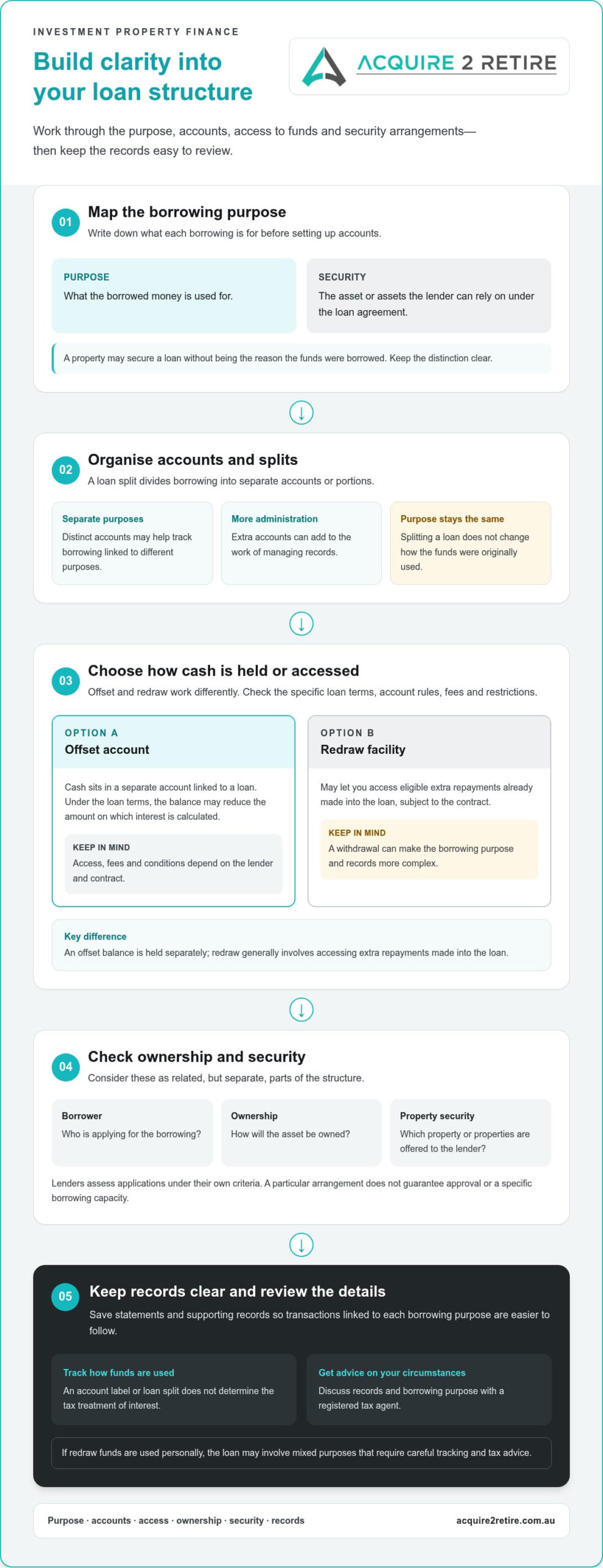
A useful review connects how funds are used with how the loan is organised, how repayments fit your budget and what you might do next. Work through these five points before applying or refinancing. The aim is to identify questions and trade-offs, not predict tax outcomes or lending approval.
- Purpose: Record what each amount borrowed is intended to fund. Keep that purpose distinct from the property offered as security.
- Accounts: Map each loan account and split to its borrowing purpose. Check that the transaction history is understandable and that personal and investment activity remain distinguishable.
- Security: Note which property or properties support each facility, then consider how that arrangement could affect a sale or refinance.
- Repayment capacity: Review repayments alongside household commitments. Consider whether your budget could absorb a vacancy, a change in rates or an unexpected expense without assuming a particular future result.
- Future transactions: Consider whether you may sell, refinance, acquire another asset or change ownership, and how the current structure could affect those steps.
These checks help you review an investment property loan structure against practical needs rather than judging it by a single feature. If you’re preparing to buy, the investment property acquisition guide can help connect the finance discussion with the purchase process.
What records help keep borrowing purposes clear?
Keep loan statements, drawdown records and evidence of how borrowed funds were used, such as relevant transaction records and invoices. Store them together so the sequence is easier to follow later. If borrowed funds are used for both personal and investment purposes, tracking each portion can become more involved. Tax treatment depends on individual circumstances, so use current Australian Taxation Office guidance and direct tax-specific questions to a registered tax agent rather than calculating deductions from the account structure alone.
How should future plans shape the review?
Consider the decisions you may face during the loan’s life: refinancing, selling one property, buying another asset or changing ownership arrangements. A structure that is manageable for one purchase may need a fresh review as your plans evolve. Test repayments against household commitments and possible changes, including vacancy periods or rate movements, without relying on a forecast. This keeps the discussion focused on resilience and options, not assumed borrowing capacity.
Acquire2Retire’s finance support relates borrowing decisions to acquisition plans and broader portfolio and debt-management goals. The company’s finance support for your property strategy can form part of that review.
Put your investment property loan structure into a considered finance plan
A considered finance plan connects the loan to the property you intend to acquire and the role that asset may play in your wider portfolio. Before settling on an investment property loan structure, work through the purpose of the borrowing, how you want it organised and what decisions you may face later. This gives you a clear basis for discussing options without assuming a particular lending or tax outcome.
A practical sequence is to:
- Clarify your goals: Set out what you want the purchase and borrowing to support, including your cash flow priorities and longer-term intentions.
- Map borrowing purposes: Identify what each amount borrowed will fund and how you’ll keep the related transactions understandable.
- Compare structures: Consider accounts, splits and security arrangements against how you expect to manage the investment.
- Review implications: Look at repayments, ownership arrangements and possible future transactions, then note where you need finance or tax advice.
What to prepare before reviewing a loan structure
Bring together current loan statements, ownership details and a short summary of what you intend to use borrowed funds for. Add your cash flow priorities and likely decisions, such as holding, refinancing or acquiring another property, without treating any outcome as certain. A concise question list helps focus discussions: direct lending and structure questions to your finance professional, and tax-treatment questions to a registered tax agent.
Keep supporting material organised, including records that show how funds were drawn and used. This helps you and your advisers understand the arrangement as it stands, rather than relying on memory when plans change. For tax questions, refer to current Australian Taxation Office guidance and seek advice that takes your individual circumstances into account.
How finance support fits into acquisition planning
Finance decisions are part of preparing for an acquisition, not a separate exercise to revisit only after choosing a property. Acquire2Retire considers and arranges lending in the context of property investment planning, acquisition requirements, and broader portfolio and debt-management goals. This brings the intended purchase and borrowing strategy into the same conversation while leaving room to assess your circumstances.
Lending suitability depends on your situation and the lender’s assessment; tax treatment also depends on individual circumstances and relevant advice. No structure can promise approval or a particular financial result. A careful review helps clarify the choices, the records to maintain and the questions that need a professional answer.
To connect your acquisition plans with a considered finance approach, discuss your property investment finance strategy.
Take your next finance decision forward with clarity
Your next step needn’t be choosing every loan feature at once. Bring your intended purchase, current debt position and likely portfolio direction into one conversation. This gives you a practical way to consider whether an investment property loan structure supports the acquisition you have in mind while keeping future decisions in view.
Before that discussion, note what matters most to you: manageable cash flow, clear records, flexibility for a possible sale or refinance, or room to consider another acquisition. You don’t need every answer in advance. A clear sense of your priorities helps focus the conversation on trade-offs that matter to your circumstances, rather than on features in isolation.
Acquire2Retire’s finance service structures and arranges lending to support strategic property purchases, considering finance decisions alongside broader portfolio and debt-management goals. Lending suitability and tax treatment depend on individual circumstances, so direct finance and tax questions to the appropriate professionals.
When you’re ready to take a considered next step, discuss your property investment finance strategy. A thoughtful plan can help you approach your next property decision with greater confidence.
Frequently Asked Questions
Is interest on an Australian investment property loan tax-deductible?
It may be deductible, but the outcome depends on how the borrowed funds were used and your circumstances, not just on which property secures the loan. For example, using part of a facility for a personal expense may affect how the interest is assessed. Keep drawdown and transaction records, check current Australian Taxation Office guidance and ask a registered tax agent to consider your situation. This is general information, not personal tax advice.
Can I use one loan for both my home and an investment property?
A loan can involve borrowing for different purposes, but combining personal and investment use may make it harder to trace what each part funded. For instance, if you redraw from a facility used for an investment purchase to pay a household bill, retain records of that transaction. The home or investment property offered as security does not establish how the money was used. Discuss the proposed arrangement with a finance professional and registered tax agent.
Does cross-collateralising investment properties always make borrowing harder?
No. It does not make a later transaction harder in every case. The practical effect depends on the lender’s policy, loan documents and your circumstances. If you plan to sell one property while retaining another, linked security may mean the lender reviews the broader arrangement, while separate securities can involve their own administration. Neither setup guarantees easier refinancing or future borrowing, so consider likely transactions before choosing.
Can I change my investment property loan structure after settlement?
Sometimes a lender-approved variation, refinance or another transaction can change the arrangement, but it is not automatic. The lender will consider the facility, security and borrower circumstances, and the proposed change may have costs or affect how borrowing purposes are recorded. Before acting, ask the lender about the process and review possible tax-record implications with a registered tax agent, particularly if funds have been used for more than one purpose.
Should an investment property loan be in one name or joint names?
There’s no single arrangement that suits every investor. The borrower named on a loan and the person or people who legally own the property are related but distinct matters, so don’t assume one automatically determines the other. For example, partners may need to consider how intended ownership, repayment responsibilities and lender requirements fit together. Obtain individual tax and legal advice before deciding, as the implications depend on your circumstances.
Is an offset account the same as a redraw facility on an investment loan?
No. An offset generally holds money in a separate account linked to a loan, while redraw involves accessing eligible extra repayments under the loan terms. Depositing savings into an offset is different from paying extra into the loan and later requesting a withdrawal. Lender conditions and access rules vary. Read the contract and seek tax advice before moving funds if the transaction could affect how borrowing purposes are recorded or assessed.