
Could a property rise in value and still put pressure on your finances? Building wealth through property Australia can involve long-term capital growth, rental income and borrowing to invest, but none guarantees a positive outcome. Debt, interest costs, vacancies and changing market conditions can all affect how an investment performs.
If you’re unsure how those pieces fit together, that’s a sensible place to start. Property decisions can have lasting financial consequences. Confident claims about quick or reliable gains don’t replace a strategy that reflects your circumstances and capacity to manage risk.
This 2026 guide explains how property may contribute to wealth over time, alongside the costs and trade-offs to weigh before committing. You’ll explore how growth, rent and leverage can work in practice, what can disrupt your plan, and which questions to raise with qualified finance, tax and property professionals. The aim is to help you assess your options with clearer expectations and take a considered next step, rather than assume property is right for everyone.
Key Takeaways
- Understand how rent, changes in property value and loan repayments can each affect your position over time. They don’t deliver the same result.
- Building wealth through property Australia requires a strategy suited to your goals, finances and ability to manage risk, not reliance on confident growth claims.
- Assess affordability using conservative assumptions. Account for vacancies, holding costs and unexpected expenses before deciding whether to invest.
- Test what could happen if rent falls, interest costs rise or market conditions change, rather than weighing benefits in isolation.
- Consider whether coordinated planning, property research, acquisition and finance support could help you examine your assumptions before taking the next step.
How building wealth through property in Australia can work
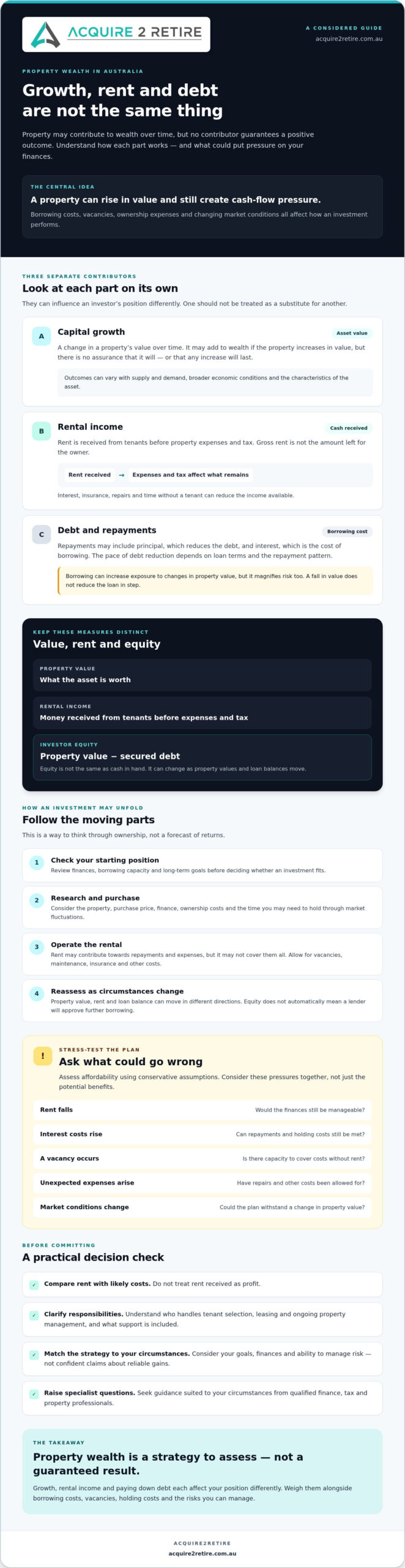
Property wealth building is a long-term investment approach that aims to grow an investor’s financial position through rental income, changes in an asset’s value and, where applicable, paying down debt. It isn’t a guaranteed outcome. Results depend on the property, purchase price, finance, ownership costs, time and market conditions.
These contributors are related, but they’re not interchangeable. Rent may help meet expenses, a property’s value may rise or fall, and loan repayments may reduce the outstanding debt. A property can gain value without producing positive cash flow, or earn rent while its value changes little.
Capital growth and rental income: two different contributors
Capital growth means a change in an asset’s value over time. It can add to an investor’s wealth if the property increases in value, but there’s no assurance that it will, or that any increase will last. Outcomes vary with supply and demand, broader economic conditions and the characteristics of the asset. The Australian property market offers background on the market’s context and historical price trends, but history doesn’t predict what a particular property will do.
Rental income is money received from tenants before property expenses and tax. Gross rent is the total collected, not the amount left for the owner. Loan interest, insurance, repairs and periods without a tenant can all reduce the income available. Compare expected rent with likely expenses rather than treating rent as profit.
How time and borrowing can affect the outcome
Borrowing to buy property is a form of leverage: it lets an investor control an asset using a loan as well as their own funds. This can increase exposure to changes in the property’s value, but it magnifies risk too. A fall in value doesn’t reduce the loan in step, and repayments and other holding costs still need to be met.
Loan repayments may include principal, which reduces the debt, and interest, which is the cost of borrowing. Over time, principal repayments can change the balance between the asset and the loan, but the pace depends on the loan terms and repayment pattern. Time alone doesn’t ensure a gain, and an investor may need to hold through market fluctuations while meeting costs.
Property value is what an asset is worth, rental income is money received from tenants before expenses and tax, and investor equity is the property’s value less the debt secured against it. Equity isn’t the same as cash in hand, and it can change as property values and loan balances move. If you’re researching building wealth through property Australia, keeping these distinctions clear is a practical first step towards assessing how an investment might fit your circumstances.
How an Australian property investment may build wealth over time
Consider a hypothetical investor who first checks their finances, borrowing capacity and long-term goals, then researches and buys a property they intend to rent out. This illustrates how ownership might unfold, not a forecast of returns. The investor arranges finance, prepares the property for tenants and receives rent, while also meeting loan repayments and ownership costs.
From purchase to rental operation
Rent can contribute towards loan repayments and other expenses, but it may not cover them all. Interest, maintenance, insurance, periods without a tenant and other costs affect cash flow, while tax treatment can influence the investor’s overall position. Compare the rent expected with the costs likely to fall due, allowing for time without a tenant. The rent received alone isn’t a reliable measure of profit.
Initial tenancy coordination, such as selecting a tenant and arranging a lease, is distinct from ongoing day-to-day property management. Before committing, understand who will handle each responsibility and what support is included. For tax questions, seek guidance suited to your circumstances from a qualified tax professional.
Equity, debt, and possible portfolio growth
As the hypothetical investment continues, the property’s value may change in either direction, rent may vary, and principal repayments may reduce the outstanding loan. These movements affect different parts of the investor’s position. Equity is the difference between an asset’s value and the debt associated with it. It isn’t the same as rental income or cash available to spend.
Even if an investor has equity, that doesn’t mean they can automatically borrow against it to buy another property. A lender assesses a new application on its own terms, including the borrower’s financial circumstances and ability to meet repayments. Property equity and usable borrowing capacity are not interchangeable: equity describes the gap between value and debt, while borrowing capacity depends on a lender’s assessment.
This distinction matters if the longer-term aim is to grow a portfolio. Relying on an assumed increase in value or future borrowing can leave an investor exposed if prices fall, expenses rise or income is interrupted. A considered plan should allow for those possibilities, not just the outcome the investor hopes for.
For readers exploring building wealth through property Australia, coordinated planning may help connect personal goals with property research, acquisition and finance considerations. Property investment planning and acquisition support can help investors test assumptions, though advice cannot guarantee lending approval or investment results.
Property wealth in Australia: potential benefits, risks, and misconceptions
It’s easy to assume Australian property values always rise, or that rental income will make an investment pay for itself. Neither is assured. Prices can fall or remain subdued, rent may not cover expenses, and even a property that gains value can put pressure on an investor’s cash flow if loan and holding costs are high.
For anyone considering building wealth through property Australia, a balanced assessment means weighing possible benefits against practical limits. Property may provide rental income and potential long-term value growth, but outcomes depend on the asset, its purchase price, financing, ongoing costs and changing market conditions. It can also concentrate a substantial share of wealth in one property or market, rather than spreading exposure across different assets.
What property investment can offer, and what it cannot promise
Rental income may help meet expenses, while an increase in value may contribute to wealth over time. Both are possibilities, not promises. Property is also relatively illiquid: unlike some investments that can be sold more readily, selling a property can take time and involve costs. Refinancing or changing strategy may also depend on market conditions, loan terms and the investor’s financial position.
| Potential benefit | What to weigh |
|---|---|
| Rent may contribute towards costs | Vacancies and expenses can reduce or exceed rental income. |
| Value may grow over the long term | Prices can fall, and growth isn’t guaranteed. |
| Borrowing can increase exposure to an asset | Debt magnifies financial exposure and repayments remain due if circumstances change. |
| Property may form part of a broader plan | A large investment in one asset can create concentration risk and limit flexibility. |
Risks investors should assess before committing
Model how the investment might affect your budget if interest costs rise, a tenant leaves, repairs are needed or insurance and other holding costs increase. Ask whether you could meet repayments during a vacancy or income disruption without relying on a quick sale or an assumed rise in value. Any buffer should reflect your finances and the property’s likely costs.
Tax treatment can affect an investment’s net position, and lending criteria and products can change. Check current information with appropriately qualified tax and finance professionals before making decisions. General claims or past market performance are not a substitute for advice suited to your circumstances.
A practical framework for assessing property wealth in Australia
Before comparing properties, work through the decision in an order that keeps your circumstances at the centre. A clear framework can help you test whether an investment is workable, not simply whether an asset looks appealing.
Personal capacity should come before property selection: the investment needs to fit your goals, finances and ability to manage risk before you assess a particular asset.
Start with goals, capacity, and a realistic holding horizon
- 1. Set your objectives. Consider whether you’re seeking potential long-term growth, rental income or another outcome, and how an investment would fit with your broader financial plans.
- 2. Check your time horizon and flexibility. Think about how long you could hold the property, whether you might need access to your funds, and how comfortable you are with uncertainty or periods of weaker income.
- 3. Test the household budget. Include expected loan repayments and property expenses. Then consider how you’d manage if interest costs rose, rent stopped temporarily or an unexpected repair arose. Use conservative assumptions and leave room for a contingency buffer.
- 4. Seek advice where your circumstances call for it. A qualified finance professional can help you understand lending considerations, while a tax professional can explain how current tax rules may apply to your situation. Don’t base a decision on general guidance alone.
Assess the asset and plan how it will be monitored
- 5. Research the specific property. Examine its condition, relevant demand, likely tenant appeal and the basis for any rental assumptions. Identify risks that could affect income, costs or your ability to hold the asset.
- 6. Use due diligence to test your assumptions. Check information independently and investigate concerns, rather than looking only for evidence that supports a preferred purchase. If an assumption can’t be verified, treat it cautiously.
- 7. Decide how you’ll review the investment. Set a regular point to reassess expenses, tenancy performance, debt and whether the property still fits your goals. Review sooner if your income, household needs or market conditions change.
This process won’t remove uncertainty, but it can help you make a more deliberate decision about building wealth through property Australia. If you’d like support connecting your goals with property research, acquisition and finance considerations, discuss your property investment strategy.
Building wealth through property: when advisory support may help
Property investing can involve decisions that connect personal goals, borrowing, asset selection and tenancy arrangements. Coordinated support may be useful if you’re unsure how to bring those pieces together, want help researching an asset, or would value having assumptions examined before making a commitment. Advice can help clarify a decision, but it can’t guarantee lending approval, rental income or investment performance.
What to look for in an Australian property investment adviser
Choose an adviser whose recommendations can be clearly linked to your objectives and capacity for risk. Ask what research informs their suggestions, which assumptions have been made and how those assumptions would be tested if circumstances changed. A useful discussion should explain the reasoning and uncertainties, rather than simply reinforce a preferred outcome.
Before proceeding, ask about the scope of the service, fees, any conflicts of interest, who is responsible for each task and what follow-up support involves. Check relevant qualifications and authorisations for the specific services being offered, and read the service terms carefully. Tax and lending questions may need input from appropriately qualified professionals whose roles and responsibilities are clear.
How Acquire2Retire can support an informed next step
Acquire2Retire’s support can span investment planning and strategy, property research and acquisition, finance support aligned with broader objectives, initial tenancy coordination and ongoing portfolio advice. This sequence can help an investor consider how a potential purchase fits their plan, assess relevant assumptions and review the strategy as their circumstances evolve. Finance support doesn’t guarantee borrowing approval, and portfolio reviews are an opportunity to reassess, not a promise of stronger performance.
Tenancy coordination covers initial tenant selection and leasing arrangements. It is separate from ongoing property management. Before engaging any provider, confirm which responsibilities they cover and who will handle day-to-day management after a tenancy begins.
If you’re considering building wealth through property Australia, a measured first conversation can focus on your goals, financial capacity and the support you may need, without assuming property or advice is right for everyone. Explore property investment planning with Acquire2Retire.
Take your next property decision with care
Building wealth through property Australia is a long-term strategy to assess against your own goals, finances and tolerance for risk, not a guaranteed path to wealth. Rental income, changes in property value and debt reduction can each affect your position differently, while costs, vacancies and market conditions may alter the outcome.
Before committing, test whether the investment remains manageable under conservative assumptions, investigate the property carefully and consider how you’ll review the strategy as your circumstances change. The right next step may be to proceed, seek further advice or decide that property doesn’t suit your plans at this time.
Acquire2Retire can support investors with customised property investment planning, research, due diligence and acquisition, alongside finance support, initial tenancy coordination and ongoing portfolio advice. This support can help you examine your assumptions, but it can’t promise investment performance or lending approval.
If you’d like to explore whether coordinated advice fits your circumstances, explore property investment planning with Acquire2Retire. Take the time you need to make a considered decision for your financial future.
Frequently Asked Questions
Can property investment build wealth in Australia?
Yes, property investment can contribute to wealth in Australia, but it doesn’t guarantee a gain. An investor may benefit if an asset increases in value, rent contributes towards costs or loan repayments reduce debt. Outcomes depend on the purchase, borrowing, expenses, time held and market conditions. Assess whether you could manage repayments and unexpected costs, even if rent falls short or property values decline.
How does property investment create wealth?
Property may contribute to wealth through several distinct mechanisms: rental income, a potential change in the asset’s value and reductions in loan principal through repayments. Rent is not the same as profit, because expenses and tax affect what remains. Equity is the difference between the property’s value and associated debt; it can change as either value or debt changes. None of these factors guarantees an overall gain.
Is property a safe way to build wealth in Australia?
No investment property is risk-free, and property shouldn’t be treated as a guaranteed or universally safe way to build wealth. Borrowing can increase exposure to losses as well as gains, while vacancies, repairs, higher interest costs or falling values can put pressure on finances. Property can also tie a large share of wealth to one asset. Consider your ability to manage adverse scenarios before committing.
How much money do I need to start investing in property in Australia?
There’s no single amount that applies to every Australian investor. The funds required depend on the property, your deposit, the finance available to you and purchase costs, which can vary by transaction and location. You’ll also need to consider ongoing expenses and a buffer for vacancies or unexpected repairs. Ask a finance professional to assess your circumstances rather than relying on a general figure.
Can rental income cover an investment property’s expenses?
It can contribute towards expenses, but it may not cover them all. Compare expected rent with loan repayments, interest, insurance, maintenance and other costs, while allowing for periods without a tenant. Gross rent is the amount collected before expenses and tax, not the owner’s net income. Test your budget with conservative rental assumptions so you can judge whether you could manage any shortfall.
What should I consider before buying an investment property in Australia?
Start with your goals, financial capacity, risk tolerance and intended holding period. Then research the specific asset, including its condition, tenant demand, realistic rent assumptions and potential costs. Consider whether your budget could withstand higher borrowing costs, vacancies or repairs, and seek qualified tax and finance advice if your circumstances call for it. Due diligence should test your assumptions, not simply confirm a preferred purchase.
Do I need an investment strategy before buying property?
You don’t need a formal strategy to make a purchase, but setting one out first can help you judge whether a property fits your goals and finances. Consider what you want the investment to contribute, how much risk you can manage and how you’ll review it over time. Property investment planning and advice can help you examine assumptions, but can’t guarantee returns or lending approval.