
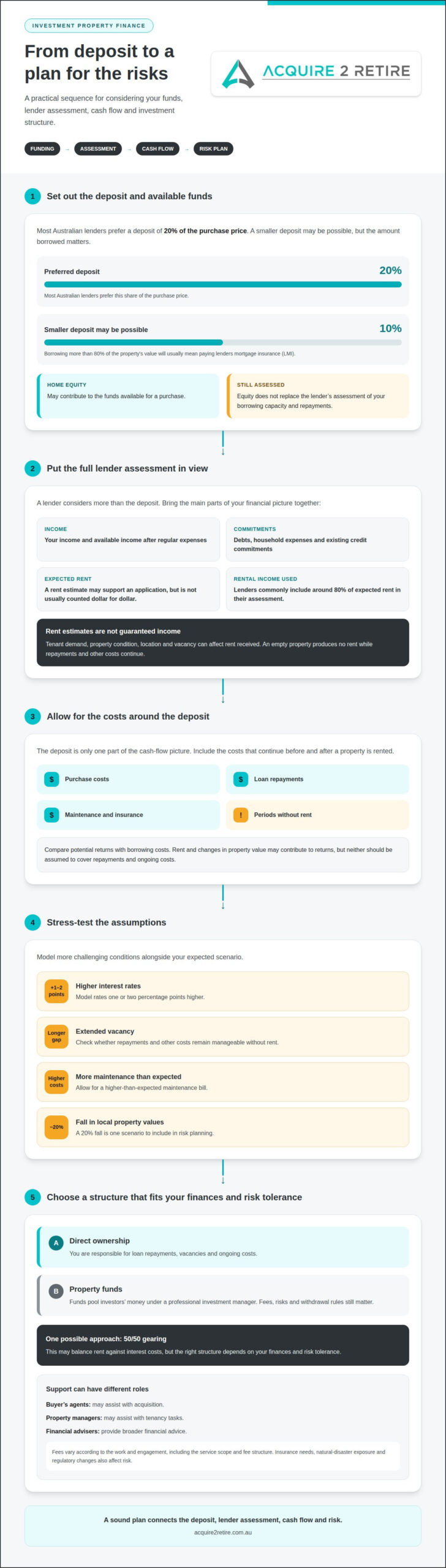
Your home equity can help fund an investment property, but it doesn’t replace the lender’s assessment of your income, debts, expenses and expected rental income. Most Australian lenders prefer a deposit of 20 per cent, while buying with a 10 per cent deposit may be possible and will usually mean paying lenders mortgage insurance if you borrow more than 80 per cent of the property’s value. Property investing without stress starts with understanding how those pieces fit together.
It’s understandable to want a clear picture before using equity or committing savings, especially if you’re renting and aiming to build wealth over the long term. Your contribution is only part of the decision: loan repayments and ongoing property costs also need to fit your finances.
This article explains how deposits and home equity may support a purchase, what lenders consider when assessing an investment loan, and how to weigh cash flow and long-term property wealth while renting. You’ll have a clearer framework for assessing both the opportunity and its financial commitments.
Key Takeaways
- Understand how a 20 per cent deposit compares with a smaller deposit, and how using home equity may affect the funds available for a purchase.
- See why lenders assess your income, debts and expenses alongside expected rental income when considering an investment loan.
- Explore how renting while investing can fit into a longer-term wealth plan, with cash flow and financial commitments considered together.
- Learn how rent and changes in property value may contribute to wealth over time, and why planning for vacancies and ongoing costs matters.
1. How much deposit do you need for an investment property?
Most Australian lenders prefer a deposit of 20 per cent of an investment property’s purchase price. A 10 per cent deposit may be possible, but borrowing above 80 per cent of the property’s value will usually mean lenders mortgage insurance. Home equity can contribute to the funds, though lenders still assess your borrowing capacity and repayments.
Allow for more than the deposit: purchase costs, loan repayments, maintenance, insurance and periods without rent all affect cash flow. Model interest rates one or two percentage points higher, alongside an extended vacancy and higher-than-expected maintenance. Gearing a property 50/50 is one possible way to balance rent against interest costs, but the right structure depends on your finances and risk tolerance.
Residential, commercial and REIT investments don’t have one universally less stressful option. Direct ownership brings responsibility for loan repayments, vacancies and ongoing costs; property funds pool investors’ money under a professional investment manager, but fees, risks and withdrawal rules still matter. A 20 per cent fall in local property values is one scenario to include in risk planning.
Buyer’s agents can assist with acquisition, property managers with tenancy tasks, and financial advisers with broader financial advice. Their fees vary according to the work and engagement; the relevant cost factors include the service scope and fee structure. Insurance needs, exposure to natural disasters and regulatory changes also affect risk. The May 2026 Australian Federal Budget announced changes to negative gearing and capital gains tax for residential property investors, with different treatment for new builds and properties bought before Budget night.
Compare potential returns with borrowing costs rather than assuming rent or growth will cover them. Australian shares delivered average annual total returns of 10.15% over the 10 years to the end of March. Timeshares grant holiday accommodation use for a set period each year, but resale difficulty can make recovering your money challenging.
2. Lender assessment of income, debts, expenses and rental income
An Australian lender assesses income alongside debts, household expenses and existing credit commitments. Expected rent may support your application, but it usually isn’t counted dollar for dollar. Lenders commonly include around 80 per cent of expected rental income when assessing an investment loan. They consider this income against repayments and other financial obligations, so strong rent estimates alone don’t determine borrowing capacity. Your available income after regular expenses is also central to the assessment.
Rental yield helps show how rent relates to a property’s value, but it doesn’t describe the whole investment. National rental yields are currently about 3.2%, and yields vary with property values and weekly rents. A lender’s rental estimate may also be affected by tenant demand, the property’s condition and its location. Vacancy rates matter to cash flow: an empty property produces no rent while loan repayments and other costs continue.
Direct property investment can generate returns through rent, increases in property value, or both. These potential returns aren’t the same as money available to meet repayments each month. Treat projected rent as an estimate, not guaranteed income: vacancies or gaps between tenancies can reduce cash received. A rental or vacancy guarantee should not be assumed to remove investment risk. Its value depends on what the agreement covers and the conditions attached.
For a clearer lending picture, organise your income, debts, regular expenses and expected rent into one assessment. A tenancy plan can also consider how tenant demand and leasing gaps may affect income over time. Tenancy coordination can help connect rental planning with the wider investment approach, while keeping projected rent distinct from dependable cash flow.
3. Building wealth while renting
Renting in Australia doesn’t prevent someone from building wealth through investments. About 27.1% of people rent their homes, and rent takes 29.4% of income nationally. These figures describe housing costs, not a person’s capacity to invest. The practical question is whether rent, living expenses and investment commitments can fit within income without relying on optimistic rental assumptions. A plan can consider where someone lives separately from where they choose to invest.
In a Sydney comparison, renters have A$346 more in disposable income each week than homeowners. That difference isn’t automatically available for investing, because household budgets and circumstances vary. A property portfolio strategy considers how rent, savings, existing debts and investment repayments interact. It also accounts for the possibility that interest costs rise or a property earns less rent than expected, so a portfolio doesn’t depend on every assumption working perfectly.
Building a portfolio is a sequence of decisions, not simply buying several properties. A strategy can define the purpose of each acquisition, assess how an asset fits with existing investments, and consider the effect of additional borrowing. Holding property alongside a home can concentrate wealth in real estate, so other asset classes may also warrant consideration. Sound long-term planning connects each purchase to cash flow, risk tolerance and your broader goals.
A fixed build-time guarantee, where offered, concerns construction timing; it doesn’t guarantee tenant demand, rental income or growth in property value. Delayed completion can affect when a property becomes available to rent, while repayments and other commitments still need planning. For a property investment portfolio, the distinction matters: construction timing is one project consideration, while returns depend on wider market and property factors. A measured plan considers these separately and avoids relying on a guaranteed outcome to make the numbers work.
4. Long-term wealth creation through real estate
Australian property can build wealth through rental income, increases in property value, or both. Across Australia’s eight state capitals, property values grew by about 6.4% annually over the past 10 years covered. That history shows how capital growth may contribute over time, but it isn’t a forecast for the next decade. Buying an investment property means weighing potential gains against borrowing costs, ongoing expenses and the possibility that local markets move differently.
A second comparison illustrates why timeframes matter: national property values rose by 18% in the 12 months to March 2022. That single period was much stronger than the longer-term annual figure, so it shouldn’t be treated as a typical yearly return. For a long-term plan, assess rental income and possible capital gains separately, then consider how each could contribute to the investment’s purpose. Growth on paper also isn’t cash available for repayments unless the asset is sold or refinanced.
Property ownership also concentrates capital in an asset that cannot be divided or sold in small portions. If funds are needed, an owner cannot simply sell part of a house to release money. A 20% fall in local property value is one useful risk scenario: it may reduce equity and make a planned sale less attractive. The impact depends on the purchase price, debt and investment timeframe, not just the market headline.
Land banking offers a different route: it involves buying undeveloped land in the hope its value rises or it gains development approval. It may offer fewer protections than other investments, so expected gains should never be treated as certain. Property funds instead pool investors’ money under a professional investment manager, though fees, risks and withdrawal rules affect suitability. The clearest takeaway is to build a plan around cash flow, diversification and time, rather than assuming capital growth will solve every shortfall. Plan a long-term property investment strategy around the role each asset is intended to play.
Acquire2Retire
Acquire2Retire helps Australian investors connect their property goals with a considered plan for deposits, borrowing and long-term wealth. Its Planning & Strategy, Finance and Acquisition support can bring the investment approach and purchase decisions into alignment, while Tenancy coordination and ongoing support help address practical considerations after acquisition.
Consider this support when you’re weighing home equity against savings, assessing whether repayments fit your income, or deciding how a property could sit within a broader portfolio. The process can account for your objectives and financial position, rather than treating a deposit or projected rent as the whole investment decision.
If you’d like professional guidance on your property investment plans, contact Acquire2Retire.
Take the next step with a considered plan
Before making a purchase decision, consider what you want your property investment to achieve and how it should fit your wider financial life. A thoughtful plan can turn a broad ambition into a sequence of decisions, with room to reassess as your circumstances and priorities change. That’s a steadier foundation for property investing without stress: progress guided by your goals, rather than pressure to act quickly.
The right next step is a conversation about your position, priorities and the kind of support that would help you move forward. Acquire2Retire can discuss how its Planning & Strategy, Acquisition and Finance support may relate to your property investment plans. Your circumstances shape which approach makes sense, so there’s value in considering the options carefully before committing.
Contact Acquire2Retire to discuss your options, and take the next step with a clear sense of direction.
Frequently Asked Questions
Can you use the equity in your home?
Yes, home equity may help fund an investment property deposit or purchase costs, subject to lending assessment. For example, a lender may consider your home’s value alongside its existing mortgage and your capacity to manage additional repayments. Using equity increases debt secured against property, so your investment plan should account for repayments alongside rent, living costs and possible periods without rental income.
How much deposit do you need for an investment property?
Most Australian lenders prefer a deposit of 20 per cent of the purchase price. A 10 per cent deposit may be possible, though borrowing above 80 per cent of the property’s value will usually incur lenders mortgage insurance. The deposit is only one part of the funds needed: purchase costs and a cash buffer for vacancies or repairs also affect how much you may need available.
Interest-only or principal and interest?
Interest-only repayments cover the loan interest during the agreed period, while principal and interest repayments also reduce the amount borrowed. Interest-only repayments can leave the principal unchanged during that period; principal and interest repayments gradually pay it down. Compare how each structure affects repayment amounts, debt reduction and future cash flow, including what repayments may look like when an interest-only period ends.
What about the tax changes?
The May 2026 Australian Federal Budget announced changes to negative gearing and capital gains tax for residential property investors. Treatment differs for new builds and properties bought before Budget night, so the purchase timing and property type matter when considering the effect on an investment plan. Keep projected rent, repayments and potential tax outcomes distinct, and include tax treatment in your overall financial assessment.
What do lenders look at?
Lenders assess your income, debts, regular expenses and expected rental income when considering an investment loan. They commonly count around 80 per cent of expected rent in their assessment, rather than treating every projected rental dollar as available income. Existing loan commitments and household spending also affect the picture, so an application depends on the balance between income and financial obligations.
What does low-stress property investing involve in Australia?
Property investing without stress means making decisions in a planned order, rather than relying on optimistic growth or rent assumptions. Set investment goals, assess how borrowing fits your finances, and consider vacancies, maintenance and market changes before buying. A considered approach also looks at diversification and access to funds, since direct property can’t be divided and sold in small portions when cash is needed.