
Property income can support early retirement, but a rental portfolio is not a shortcut to a reliable paycheque. Understanding how to achieve financial independence with property means seeing how rental income, ownership costs, loan commitments and lifestyle needs fit together. The aim is to build income-producing assets that help cover your expenses while accounting for the work and risks of owning rentals.
Rent can contribute to loan repayments and other costs, and may leave income after expenses. But rent collected is not the same as income available to spend, and property values can change. A clear plan helps you assess what your portfolio could contribute and where it might fall short.
This guide explains how property can support a FIRE plan, how to estimate the assets you may need and how to manage rentals with financial freedom in mind. You’ll learn to connect income goals with property performance, weigh risks such as debt and limited liquidity, and consider practical ways to improve rental cash flow, including dual-income properties.
Key Takeaways
- Set your financial independence target by comparing passive income with core living costs, and focus on rent left after property expenses.
- Weigh property’s potential role in a FIRE plan against market fluctuations, leverage, limited liquidity and the demands of rental ownership.
- Estimate the assets you need from your spending gap, rental performance, loan balances, interest rates and plans for using or selling properties.
- Look for ways to strengthen rental cash flow, including whether a dual-income property could suit your broader investment strategy.
Defining financial freedom through passive income
Set your target based on the income needed for your lifestyle, not a particular number of properties. Then compare your expected income after costs with your spending needs.
-
Assess How Passive Income Supplements Active Income
Calculate the gap between employment income and the passive income you’d need to meet your financial goals. Financial independence means income from other sources can fund your current lifestyle if you leave work. For example, an Australian might set a target of A$50K/year or A$100K/year. These are examples, not universal targets. Property rent can supplement wages before it replaces them, while you retain the ability to work.
-
Compare Property and Dividend Income
Compare rental property cash flow with dividend income before deciding how to balance your portfolio. Rent may cover mortgage payments and other expenses, but calculate all costs before treating any surplus as spendable income. Dividend shares can provide another income stream, and combining shares with real estate can diversify a FIRE strategy. Passive income comes from an enterprise where you aren’t materially involved, but rental properties can still require active decisions and coordination.
-
Account for Tax on Growth and Income
Separate potential capital growth from income yield in your projections. Capital growth is taxed when an asset is sold, while income yield is taxed each tax year. Rental income and dividends are examples of investment income. Don’t count a rise in a property’s value as current cash flow: it is not realised income until you sell. Account for both income and tax timing in your long-term plan.
-
Assess Property Costs and Location Prospects
Estimate the deposit and upfront costs using the purchase price, finance terms and property location, as the total depends on these factors. No Australian city or region is always strongest for both rental yield and long-term growth. Compare local rent potential with purchase costs, then assess growth prospects against your timeframe and cash-flow needs. Finance planning can clarify how borrowing commitments affect the income available for your goals.
FIRE Strategy and Property: Can Real Estate Fund Early Retirement?
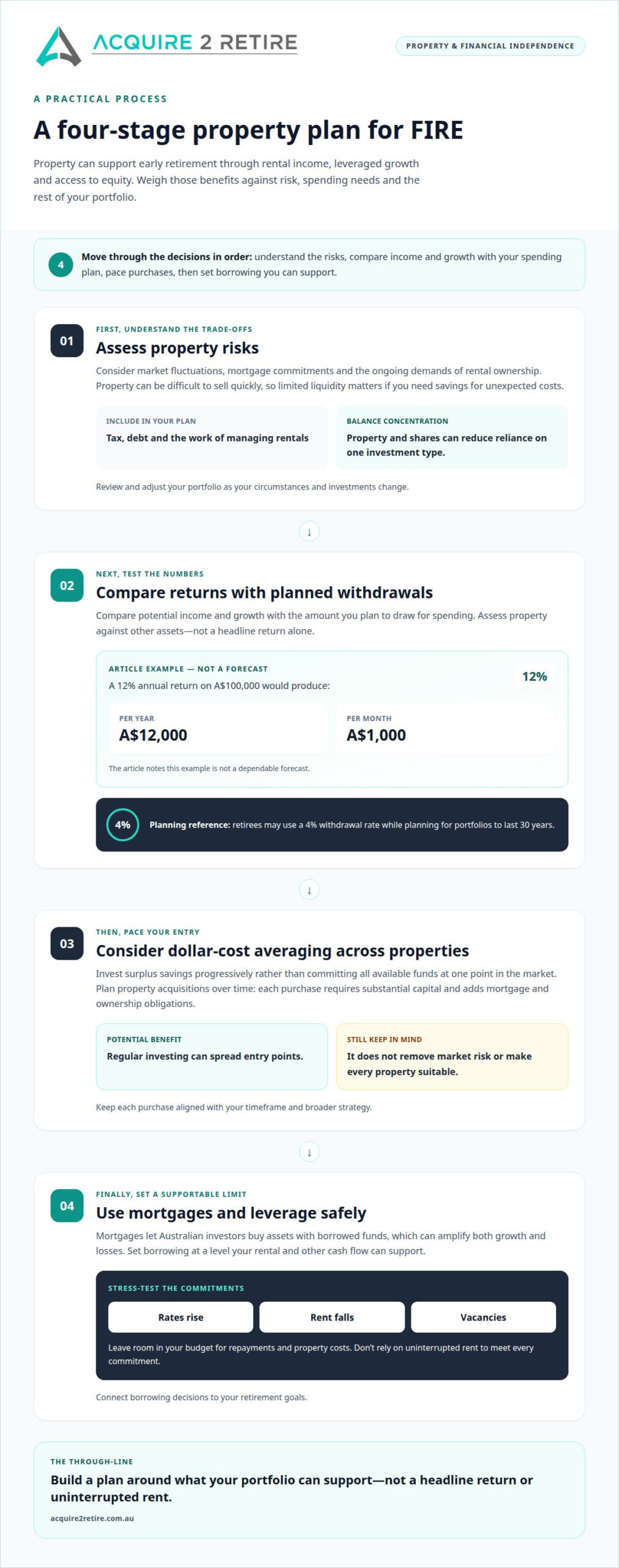
Property can contribute to a FIRE plan through rental income, leveraged growth and access to equity. A practical approach to how to achieve financial independence with property weighs these benefits against risk, retirement spending and the rest of your investment portfolio.
-
Assess Property Investment Risks
Before investing, consider market fluctuations, mortgage commitments and the ongoing demands of rental ownership. Property can be difficult to sell quickly, so limited liquidity matters if you need savings for unexpected costs. Diversifying across asset classes, such as property and shares, can reduce reliance on one investment type. Include tax in your projections, then review and adjust your portfolio as your circumstances and investments change.
-
Compare Investment Returns and Withdrawal Rates
Compare potential income and growth with the amount you plan to draw for spending. A 12% annual return on A$100,000 would produce A$12,000 per year, or A$1,000 per month, but this example isn’t a dependable forecast. Retirees may use a 4% withdrawal rate as a reference while planning for portfolios to last 30 years. Assess property against other assets, not a headline return alone.
-
Consider Dollar-Cost Averaging Across Properties
Invest surplus savings progressively rather than committing all available funds at one point in the market. With property, plan acquisitions over time: each purchase requires substantial capital and adds mortgage and ownership obligations. Regular investing can spread entry points, but it does not remove market risk or make every property suitable. Keep each purchase aligned with your timeframe and broader strategy.
-
Use Mortgages and Leverage Safely
Set borrowing at a level your rental and other cash flow can support, including if interest rates rise or rent falls. Mortgages allow Australian investors to buy assets with borrowed funds, which can amplify both growth and losses. Leave room in your budget for repayments, vacancies and property costs; don’t rely on uninterrupted rent to meet every commitment. A sound plan for how to achieve financial independence with property connects borrowing decisions to retirement goals.
Calculating the asset base needed for financial freedom
- Define the lifestyle your assets need to support. A useful way to think about how to achieve financial independence with property is to start with the life you want, not a target portfolio size. List essential commitments, flexible spending and income you expect to retain, such as part-time work. Financial independence means being able to fund your current lifestyle without relying on employment. Financial freedom can mean having passive income exceed expenses, though each household can set its own practical goal.
- Work out the income gap. Total your regular expenses and subtract income you expect to continue receiving. For example, if planned living costs are A$6,000 per month and income from work you enjoy is A$5,000 per month, the gap is A$1,000 monthly. This example shows how ongoing work can reduce the income your assets must provide. Recalculate the gap if your housing, family or spending plans change.
- Estimate income available from your assets. Assess rental income after operating costs and mortgage commitments, rather than using rent collected as your target. Include other income-producing assets in the calculation, and distinguish regular cash flow from wealth held as property equity. Equity may contribute through a future sale or borrowing, but it is not spendable rental income while tied up in an asset.
- Test the asset target against your circumstances. To decide how to achieve financial independence with property, model how changes in rental performance, loan balances and interest rates affect usable income. Consider whether you’ll keep properties for rent, sell assets to fund expenses or continue earning alongside investment income. Each choice changes the asset base you may need. Revisit your estimates as your goals and circumstances evolve, so your plan stays relevant to your household.
Managing and improving rental properties
Track each property’s income, costs and condition to see how it contributes to your lifestyle. A clear cash-flow and yield calculation can show where to protect profit or improve performance.
-
Calculate Rental Property Cash Flow
Subtract property expenses and loan repayments from rent received to estimate cash flow over a consistent period. Include interest, maintenance, insurance, council rates and periods without rent so the result reflects costs, not rent alone. If rent does not cover these outgoings, the property needs support from other income. Track actual figures regularly and separate one-off repairs from recurring costs.
-
Calculate Rental Property Net Yield
Calculate net yield by subtracting annual operating costs from annual rent, then dividing the result by the property’s purchase price and multiplying by 100. This percentage helps compare rental performance across properties, but it doesn’t show loan repayments or capital growth. Use the same cost categories for each property, and avoid treating gross rent as profit. Cash flow and net yield answer different questions.
- Improve income without overlooking tenant needs. Consider whether a property’s layout can support more than one income stream. A duplex or a home with a granny flat may increase cash flow through dual income, but can also add coordination and upkeep. Weigh any changes against privacy, maintenance and the property’s long-term appeal. Focus on improvements that suit the property and likely tenant demand, rather than adding features without a clear income purpose.
- Review performance against your financial goals. Compare rent, costs, property condition and loan interest over time, then decide whether to maintain, improve or reassess the asset. If a household member relies on rental income, include that need in cash-flow planning. A property that supports your plan today may need a different approach as expenses or lifestyle priorities change. Plan your property investment strategy around the income and responsibilities you want your portfolio to sustain.
Acquire2Retire
Acquire2Retire helps Australians turn property income goals into a considered investment plan, from defining a portfolio direction to coordinating practical next steps. Its Planning & Strategy, Acquisition and Finance offerings can support decisions about suitable assets, borrowing and how each purchase fits your longer-term objectives. Tenancy coordination and ongoing support help keep the portfolio aligned with those objectives as circumstances change.
Consider this support when you’re moving from estimates to investment decisions, or when your rental income, finance and future plans need to work together more clearly. The focus is on building a property strategy around your circumstances, rather than assuming one approach suits everyone.
Contact Acquire2Retire to discuss your property investment goals.
Make your next property decision count
A plan for how to achieve financial independence with property starts with a decision that fits your life, not an idealised retirement timeline. Before taking the next step, decide what you want your investments to make possible: more choice over work, more time for family or a gradual move towards relying less on employment income. That purpose can keep future property decisions connected to the life you want to build.
Then turn that goal into a practical direction. Identify the next decision, such as refining your investment approach or assessing whether an acquisition fits your financial position. A clear strategy can bring those choices into focus, while finance considerations help define what is manageable. The right path depends on your circumstances, priorities and tolerance for investment risk.
If you’re ready to discuss a considered next step, talk with Acquire2Retire. You can move forward thoughtfully, one decision at a time.
Frequently Asked Questions
📞 Want to Use Property to Reach FIRE Faster?
Property may support your FIRE plans, but buying more quickly does not automatically bring retirement closer. First, map how each potential purchase affects savings, borrowing capacity and the income you’ll need for living costs. Then consider whether rent could support repayments and future investing after expenses. A measured acquisition plan can help you build towards greater choice without relying on uninterrupted rent or rising property values.
How much property income is needed to achieve financial independence in Australia?
There is no single income target that suits every Australian household. Work out how much you need to meet planned lifestyle costs, then account for employment or other investment income you expect to retain. Compare that amount with rental income after property expenses, loan commitments and tax. Revisit the calculation when your spending plans, household income or portfolio changes.
What are the Australian tax rules for rental income, negative gearing and capital gains tax?
For investment planning, distinguish rental income from increases in a property’s value. Rental income is generally treated as investment income for the relevant tax year, while capital growth is taxed when the asset is sold. Negative gearing may have tax advantages when property costs exceed rental income, but its effect depends on the investor’s circumstances. Include tax in cash-flow estimates rather than treating it as extra profit.
How does property compare with shares and superannuation for building financial independence?
Property, shares and superannuation can each play different roles in a financial independence plan. Direct property investment can involve borrowing and ongoing tenancy responsibilities, while shares provide exposure to a broader mix of companies. Investments may also be held inside or outside superannuation, so consider access needs and timeframe alongside potential returns. Combining asset types can reduce dependence on one source of income or growth.
What are the risks of achieving financial independence through property in Australia?
Relying heavily on property exposes your plan to changing market values, mortgage costs, limited access to invested capital and the work involved in rental ownership. A vacancy or unexpected repair can also strain household cash flow. Before buying, consider how you would cover repayments and essential expenses if rent stopped temporarily, and whether other assets could balance your overall investment exposure.
What steps can Australians take to build a property portfolio towards financial independence?
Start by setting a lifestyle income goal and reviewing your savings, liabilities and borrowing capacity. Build an investment strategy around your timeframe, risk tolerance and cash-flow needs, then assess each property’s likely income, costs and growth prospects. After acquiring an asset, coordinate tenancy arrangements and track its performance. Review your portfolio as your goals change rather than assuming every purchase will bring you closer to independence.