
The property with the highest advertised rental yield may be the wrong investment for you. If you’re working out how to choose an investment property, headline rent or growth claims can be tempting, but the numbers also need to suit your finances and plans. A property can look promising on paper yet put too much pressure on your cash flow or borrowing capacity.
A sound choice starts with fit, not hype. Assess each option against your goals, financial position, tenant demand and tolerance for risk. Lending conditions and tax settings can also affect the picture, so careful, up-to-date due diligence matters before you commit.
This guide gives you a repeatable way to compare locations and property features, test rental assumptions, account for ownership costs and consider long-term risks. It also explains how finance structure and leasing readiness fit into the process, so you can identify practical next steps before making an offer.
Key Takeaways
- To understand how to choose an investment property, assess each option against your objectives, financial capacity and risk tolerance, rather than relying on a universal checklist.
- Research tenant demand by looking beyond advertised rent to access to employment, transport, services and amenities.
- Compare shortlisted properties using the same criteria, including condition, ownership costs and how well each option supports your plan.
- Record the evidence behind your assumptions, test the numbers and review your shortlist before committing.
- A considered investment strategy can connect property research, acquisition decisions and finance structuring into a coherent next step.
How to choose an investment property that fits your plans
Comparing investment properties can feel like choosing between competing promises: a strong advertised yield, a location tipped for growth or a property that appears easy to rent. Make the decision more manageable by starting with your objectives and financial capacity, then testing each option against consistent criteria and relevant evidence.
A suitable investment is one that aligns with what you want your portfolio to do, what you can afford to hold and the level of risk you’re comfortable accepting. No single property feature, market narrative or advertised return can prove an asset is right for you. Selection is the first stage, not a substitute for detailed due diligence, purchase negotiation or planning for the property after purchase.
Start with what the investment needs to do for you
Consider your intended holding period and the role this property would play in your wider portfolio. An investor who needs income during the holding period may weigh rental demand and cash flow differently from someone focused on long-term growth. Neither aim is automatically better. The right balance depends on your circumstances and what you need the investment to contribute.
Be realistic about your borrowing capacity, existing commitments and ability to cover periods when costs exceed rent. These factors shape the trade-offs you can reasonably accept between income, potential growth and risk. A property investment planning guide can help connect your priorities to a clear investment brief before you compare specific assets.
Treat advertised performance as a starting point
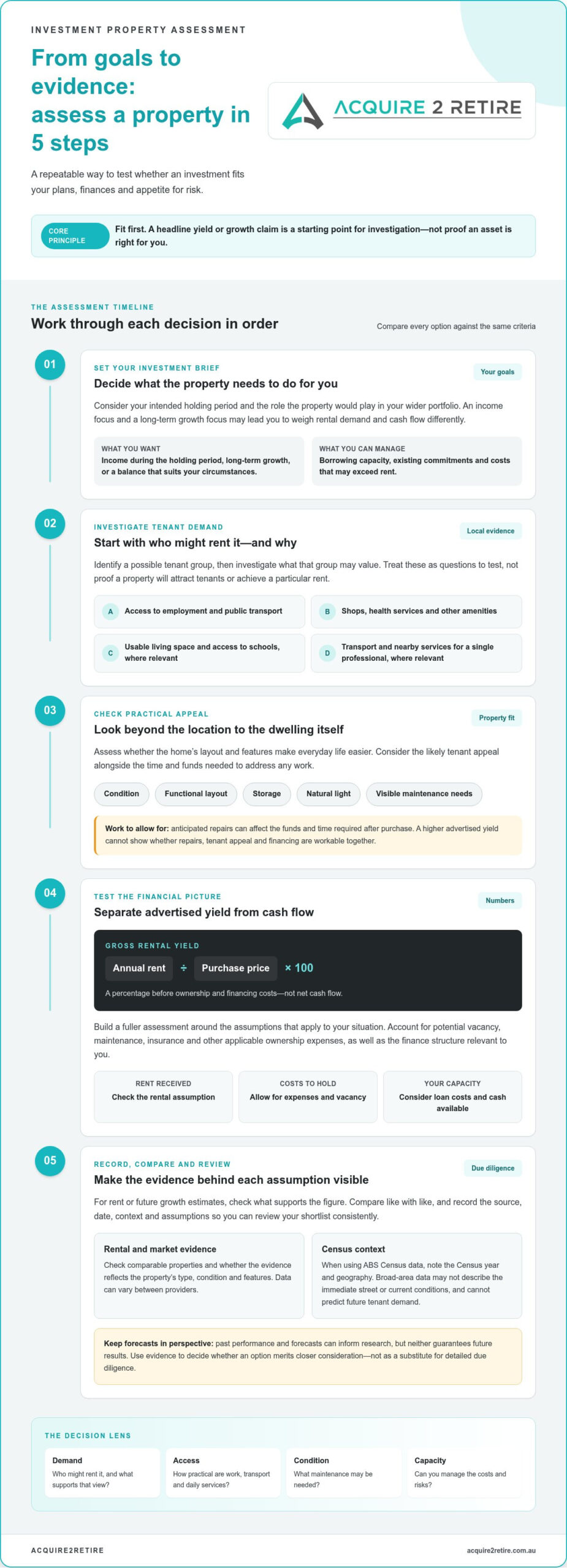
An advertised rental yield is a prompt for further investigation, not a complete picture of your return. Gross yield is calculated by dividing annual rent by the purchase price and expressing the result as a percentage. It does not account for ownership expenses, loan costs, vacancy periods or the cash you need available to hold the property. Build your assessment around assumptions that apply to your situation rather than treating a headline figure as income you’ll necessarily receive.
Ask what supports each rent or future growth estimate. Is it based on comparable properties, and does it reflect the type, condition and features of the property you’re considering? Past performance and forecasts can inform research, but neither guarantees future results. If you use market or return figures, record their source and date, along with the context and assumptions behind them. Data can vary between providers, so check that you’re comparing like with like.
This evidence-led approach reflects broader real estate investing principles, where valuation and the stages of an investment matter alongside the asset itself. At this point, your aim is to decide whether a property merits closer consideration. Acquisition research can then examine the opportunity in more detail, while negotiation and finance structuring address practical steps towards a purchase. Initial tenancy coordination is a separate step in preparing an acquired property for leasing.
Which investment property factors deserve the closest attention?
A useful assessment brings four questions together: is there evidence of tenant demand, does the property work in practical terms, can you manage the ownership costs, and does the asset suit your financial position? These factors are connected. Strong tenant appeal may support leasing prospects, for example, but it won’t make a property suitable if its likely costs or risks exceed your capacity.
Assess demand and the property’s practical appeal
Identify the tenant group a property may suit, then consider what those tenants are likely to value. A household with children may look for usable living space and access to schools, while a single professional may prioritise transport and nearby services. Treat these as questions to investigate, not proof that a property will attract tenants or achieve a particular rent.
Consider practical access to employment, public transport, shops, health services and other amenities. Then assess whether the dwelling’s layout and features make everyday life easier. Australian Bureau of Statistics (ABS) Census data can help you understand population and household characteristics, but record the Census year and the geography you’re examining. Broad-area data may not describe the immediate street or current conditions, and it can’t predict future tenant demand. Use it as context alongside more specific, current rental evidence.
Compare income, costs and property fundamentals
Gross rental yield is the annual rent expressed as a percentage of the purchase price, before ownership and financing costs. It isn’t net cash flow. A yield calculation doesn’t show what remains after expenses, loan repayments or periods without a tenant. To assess the financial position more fully, account for potential vacancy, maintenance, insurance and other applicable ownership expenses, as well as the finance structure relevant to your circumstances.
Look closely at the dwelling itself. Consider its condition, functional layout, storage, natural light and visible maintenance needs. A property that needs work may still suit an investor, but anticipated repairs can affect the funds and time required after purchase. A higher headline yield alone can’t tell you whether those demands, tenant appeal and financing are workable together.
- Demand: Who might rent the property, and what evidence supports that view?
- Access: How practical are connections to work, transport and daily services?
- Condition: What maintenance may be needed, and how could it affect ownership?
- Investor fit: Do the likely income, costs and risks align with your plan?
For a broader overview of property investment risks, costs and returns, ASIC’s Australian property investment guide provides useful context. Apply these checks consistently to make how to choose an investment property a more grounded exercise: weigh evidence and trade-offs rather than relying on one appealing feature. Acquire2Retire’s planning and strategy service can help connect property research with your wider investment plan. Explore tailored property investment support.
How do you compare property options without chasing one metric?
Once you’ve shortlisted properties, compare them using the same criteria rather than letting the most attractive feature set the agenda. A simple scorecard makes differences visible: one property may have stronger rental evidence, while another may need less work or fit your cash flow needs more comfortably. The goal isn’t to find a universal winner, but to see each option’s benefits, compromises and unanswered questions side by side.
Choose criteria that matter to your plan, then use a consistent scale, such as 1 to 5, for every property. Decide the importance of each criterion before scoring, so a high rating in one area doesn’t automatically outweigh a concern that matters more to you. Record the evidence behind each rating and flag information that’s incomplete or estimated.
| Comparison area | What to assess | Evidence to record |
|---|---|---|
| Rental demand | Likely tenant appeal and relevant rental evidence | Comparable listings and local rental information |
| Ownership costs | Expected expenses, finance needs and capacity to hold | Your estimates, assumptions and financing position |
| Property condition | Practical layout, visible condition and potential maintenance | Inspection observations and identified issues |
| Location access | Connections to employment, transport and services | Travel routes, amenities and relevant local research |
| Plan alignment | Fit with your objectives, time horizon and risk tolerance | Your investment criteria and personal priorities |
Balance rental income and potential growth
Rental income and capital growth are different parts of an investment, and neither is guaranteed by a listing or market forecast. If you need stronger cash flow during ownership, give more weight to rental evidence and costs. If your plan allows for less income now, you may consider other attributes, while still checking that you can comfortably hold the asset. The right balance depends on your finances and objectives, not a blanket rule about property types or markets.
A strong advertised yield doesn’t automatically mean a low-risk investment. It may sit alongside uncertain rental evidence, substantial maintenance needs or costs that put pressure on your budget. Consider each factor together and note the trade-offs instead of letting one figure dominate your comparison.
Look beyond a compelling listing or market narrative
Separate verifiable features, such as layout, condition and access, from promotional claims about future demand or growth. Claims about planning changes or proposed infrastructure need current, location-specific research. An announcement alone doesn’t establish timing or impact. Industry context from the Real Estate Institute of Australia can inform your research, but broad commentary shouldn’t replace evidence about the individual property.
A property’s suitability depends on the investor’s objectives, financial capacity and tolerance for risk, not on a single score or feature. Use the scorecard to clarify trade-offs and guide further research. This is a more dependable way to approach how to choose an investment property than chasing one headline metric.
What steps help you assess a shortlist before deciding?
A shortlist becomes useful when every property is assessed on the same terms. Use the steps below to move from initial interest to a considered decision, recording what you know, what you assume and what still needs checking. This helps prevent an appealing listing or early estimate from quietly changing the standards you set for other options.
Build a shortlist using consistent evidence
Before comparing properties, write down your non-negotiables. These should reflect your objectives and financial capacity, such as an acceptable level of ongoing costs, practical property condition or access to amenities that matter to likely tenants. Apply the same measures and time period to each option, and label information as verified, estimated or unknown.
- 1. Set your criteria. Decide which features are essential, which are preferences and which risks would rule a property out. Keep the criteria tied to your investment plan rather than to what a listing happens to emphasise.
- 2. Gather evidence. Collect comparable information for each property, including rental evidence, likely ownership expenses, condition observations and relevant location details. Note the source and date so you can distinguish current information from older material.
- 3. Compare the options. Use one scorecard or worksheet, with the same categories and rating scale for every property. Add a short note explaining each score. A number without its reasoning can hide an important difference.
- 4. Test your assumptions. Rework your estimates using less favourable but plausible conditions. Consider how a vacancy, unexpected expense or change in lending costs could affect your ability to hold the property. This is a resilience check, not a prediction.
- 5. Pause before committing. Review the evidence and unresolved questions when you’re not caught up in the pressure of an offer. If a key assumption remains uncertain, treat it as an open item rather than filling the gap with optimism.
Separate selection from the next stage
Market information and planning controls can change, so check relevant state or territory planning sources and note when you accessed them. Confirm that the information relates to the property and area you’re assessing. A broad announcement may not explain how a change affects an individual site. Keep this early research distinct from detailed building inspections, formal due diligence, legal checks and transaction steps, which each require focused attention.
Once an option remains suitable after this assessment, examine the acquisition process in detail. The investment property acquisition guide can help you understand how research and negotiation fit into that progression. Acquire2Retire provides structured property assessment that connects selection with your objectives and finance position. Explore support with your investment property plan.
How can an investment property strategy guide your next move?
A considered property choice isn’t the one that ticks every item on a universal checklist. It’s the one whose likely demands and potential contribution make sense within your broader investment plan. Your objectives, risk profile, cash flow needs and capacity to hold an asset should guide the selection, so the decision reflects your circumstances rather than the appeal of a particular listing or market narrative.
Connect property selection with the wider investment plan
Clarify the role you want the property to play. Is your priority to support cash flow, build a portfolio over time or balance both aims? Your answer helps shape the criteria you use to assess rental evidence, property condition, location access and costs. It also helps you decide which compromises are acceptable and which could put too much pressure on your finances.
Once your criteria are clear, acquisition research can turn them into a focused search. Instead of looking broadly at properties that seem attractive, research can identify assets to assess against your requirements, examine relevant market evidence and support a considered negotiation. This doesn’t remove uncertainty or promise a particular return. It creates a clearer link between your reasons for investing and the property under consideration.
Finance structuring is another part of that connection. Consider a purchase alongside your borrowing position, cash flow requirements and wider portfolio plans, rather than as a standalone transaction. Thinking through financing early can help you understand whether the proposed asset and purchase approach fit within your overall strategy.
Choose a considered next step
Before deciding how to proceed, bring your findings together. Review the evidence you’ve gathered, the assumptions used in your comparisons and any unresolved questions. If an important part of the case depends on information you haven’t verified, investigate it rather than glossing over it. A measured decision can include choosing not to proceed if the property doesn’t fit.
After acquisition, initial tenancy coordination can help prepare the property for leasing and support the transition into ownership. This is distinct from selecting and acquiring the asset. Keeping the stages clear helps you plan what needs attention at each point without losing sight of the investment’s purpose.
Learning how to choose an investment property is ultimately about connecting your goals to sound research, a finance approach that fits and a realistic view of risk. No checklist can make the decision for you, but a structured process can make your reasoning clearer and your next steps more deliberate.
Acquire2Retire brings planning, acquisition research and finance structuring together as part of its investment property advisory service. Learn more about investment property advisory support.
Take your next step with a clearer investment plan
A property decision doesn’t need to be rushed to be productive. Turn what you’ve learned into a practical brief: what the investment needs to contribute, which risks you can carry and what evidence you still need before committing. That brief gives you a steady reference point as circumstances or market conditions change, and helps you recognise when an option no longer fits.
Knowing how to choose an investment property is about making a decision you can understand and stand behind, not trying to remove every uncertainty. A considered approach brings your financial objectives, risk profile and cash flow needs into the same conversation as property research, negotiation and finance structure, with tenancy preparation considered at the right stage.
Acquire2Retire provides property investment planning, acquisition consulting, finance support and ongoing portfolio advice to help connect your priorities with a considered next step. Explore a property investment strategy with Acquire2Retire.
Frequently Asked Questions
Is rental yield enough to choose an investment property?
No, rental yield alone can’t show whether an investment suits your circumstances. Gross yield is a starting ratio, while your net position depends on expenses, vacancy, finance costs and how much cash you can comfortably contribute. For example, two properties with similar advertised yields may leave different amounts available after regular costs. Compare them using consistent assumptions, then consider how each result fits your wider goals when deciding how to choose an investment property.
Can an investment property have negative cash flow and still suit an investor?
It can, depending on your financial capacity, objectives and tolerance for risk. Negative cash flow means the rent received doesn’t cover the relevant outgoings over a period, so you need other funds to meet the shortfall. Consider whether your income and available reserves could manage that gap alongside your existing commitments. A property’s potential fit depends on your personal circumstances, not on a general rule about whether negative cash flow is acceptable.
What happens if an investment property is vacant between tenants?
If there’s a gap between tenancies, rental income pauses, while some ownership costs may continue. You may still need to meet loan repayments, insurance and other bills, and the property may require cleaning or repairs before it’s leased again. Include a vacancy allowance in your cash-flow planning and consider how you’d manage a longer-than-expected gap. The effect depends on your reserves, expenses and other sources of income.
Should I choose a house or an apartment as an investment property?
Neither is automatically the better choice. A house may offer more private outdoor space, while an apartment may have shared facilities and shared ownership costs, such as owners corporation or strata levies. Compare the condition, layout, maintenance responsibilities and likely tenant appeal of the specific property, as well as its ongoing costs. The right option depends on what suits your objectives, budget and capacity to manage its particular requirements.
How much should I keep aside for investment property expenses?
There’s no single reserve amount that suits every investor, because costs depend on the property, its condition, financing and your circumstances. Allow for recurring expenses such as insurance, council and water rates, maintenance and loan costs, as well as possible vacancy or unexpected repairs. Review the property’s likely expenses and your own cash-flow position together, and avoid relying on rent alone to cover every outgoing from the start.
Do Australian property taxes and duties vary by state or territory?
Yes. Property-related duties, charges, concessions and land tax rules can differ between Australian states and territories, and settings may change over time. Before relying on an estimate, consult current information from the relevant state or territory revenue office and the Australian Taxation Office. How a rule applies can depend on your circumstances and the property, so treat general information as a starting point rather than individual tax advice.
Can I choose an investment property before arranging finance?
You can research properties first, but understanding your borrowing capacity early helps keep your shortlist realistic. Lenders assess your financial position and the property, and the amount you may be able to borrow can depend on their assessment and prevailing conditions. Consider how repayments and purchase-related expenses would fit your budget before becoming attached to a particular option. Early finance discussions can help you focus your search without guaranteeing loan approval.