
There’s no single formula for how to diversify an investment property portfolio. Consider spreading investments across Australian locations and property types, while weighing how each fits your goals. This can reduce reliance on one market, but it can’t eliminate property risk.
A diversified mix means more than buying in different places. Each investment should suit your goals, borrowing capacity and tolerance for risks such as vacancies, changing interest rates and ongoing costs.
This guide explains how to diversify an investment property portfolio by comparing locations and property types, from metropolitan and regional markets to houses, units and commercial property. It also covers how to align those choices with your goals and risk tolerance, so your portfolio has a clearer purpose.
Key Takeaways
- Balance property types and locations so your portfolio isn’t overly exposed to one market’s performance.
- Assess rental demand, yields and vacancy rates together to understand how a local market may support your investment goals.
- Compare metropolitan and regional opportunities by weighing their market conditions against your priorities, not by location alone.
- Set your strategy around your preferred balance of income and growth, while accounting for borrowing, vacancies and the time you can commit.
Diversifying across locations and property types
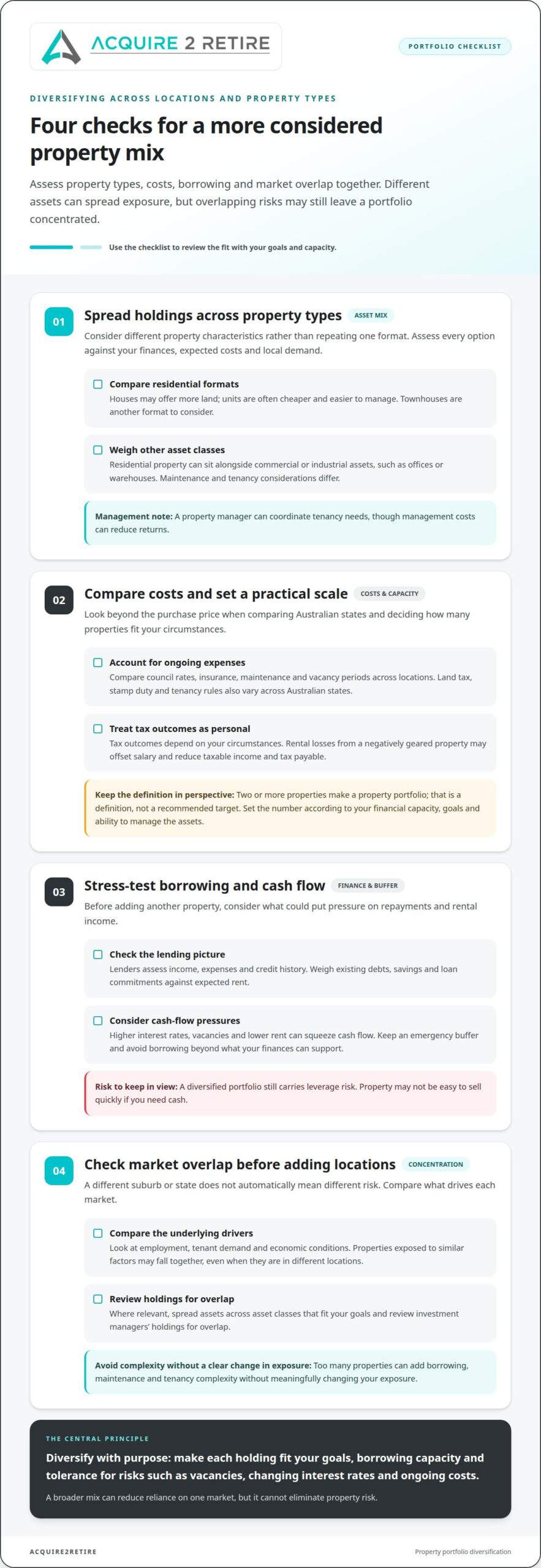
Diversifying an investment property portfolio starts with considering both property types and locations. Different assets can spread exposure, but overlapping risks may still leave a portfolio concentrated.
Use these steps to assess your property mix, borrowing capacity and the practical limits of diversification.
-
Spread holdings across property types
Consider property types with different characteristics, such as houses, apartments and townhouses, rather than repeating one format. Houses may offer more land, while units are often cheaper and easier to manage. Assess each against your finances, expected costs and local demand.
Residential property can sit alongside commercial or industrial assets, such as offices or warehouses, but each has different maintenance and tenancy considerations. A property manager can coordinate tenancy needs, though management costs can reduce returns.
- Compare purchase and ongoing costs across Australian states, including council rates, insurance, maintenance and vacancy periods. Tax outcomes depend on your circumstances. Rental losses from a negatively geared property may offset salary and reduce taxable income and tax payable.
Two or more properties make a property portfolio, but that’s a definition, not a recommended target. Set the number of properties according to your financial capacity, goals and ability to manage the assets.
- Stress-test your borrowing before adding another property. Lenders assess income, expenses and credit history. Higher interest rates, vacancies and lower rent can squeeze cash flow, so keep an emergency buffer and avoid borrowing beyond what your finances can support.
When planning finance, weigh existing debts, savings and loan commitments against expected rent. A diversified portfolio still carries leverage risk, and property may not be easy to sell quickly if you need cash.
-
Assess correlated markets and over-diversification
Compare the factors driving each market, not just the suburb or state name. Properties exposed to similar employment, tenant demand or economic conditions may fall together, so adding locations alone may not reduce concentration risk.
To diversify an investment property portfolio effectively, spread assets across relevant asset classes where they fit your goals, and review investment managers’ holdings for overlap. Too many properties can add borrowing, maintenance and tenancy complexity without meaningfully changing your exposure.
Why build a property portfolio?
A portfolio can aim to provide rental income, capital growth or a considered mix of both. Land tax, stamp duty and tenancy rules vary across Australian states, so assess each location’s costs and requirements before buying.
-
Weigh rental yield against capital growth
Choose a priority that matches your income needs and investment horizon. Rental yield reflects rental income alongside property management, maintenance and other costs. Capital growth is an increase in a property’s value over time.
Research local rental demand, rents and vacancy rates together. Strong rent may not offset frequent vacancies or high costs, while growth-focused markets may produce less income. Compare these trade-offs with your cash-flow needs.
-
Balance income and property appreciation
Assess how each property could contribute to regular income and longer-term appreciation. Rent can help cover ownership costs, while market changes may affect the property’s value over time.
Allow for vacancies and property damage, which can interrupt rental income and leave you covering costs. A positively geared property has gross rental income greater than its ongoing ownership costs. A negatively geared property earns less rent than its loan repayments and other costs.
- Research local conditions before choosing an investment strategy. Compare rental demand, vacancy rates, property values, rents, job growth and population trends to understand what may support a property’s income or growth prospects.
Direct rental ownership is one approach. House flipping and property-market exposure through REITs are others. REITs can provide exposure without direct property ownership, while flipping depends on buying, improving and selling property. Consider how each approach fits your goals and capacity.
- Review the portfolio as a whole instead of judging each purchase in isolation. A property chosen mainly for rental income may complement one selected for potential capital growth, but both still need to suit your finances and tolerance for vacancies.
Tenancy coordination can help keep rental arrangements organised as holdings grow. For support connecting tenancy considerations with your investment plans, explore property investment planning.
Comparing metropolitan and regional markets
Compare markets by their local drivers, costs and fit with your objectives, rather than assuming one location is always stronger. A metropolitan unit and a regional house, for example, may respond differently to local demand and employment.
- Assess metropolitan and regional options using consistent criteria. Metropolitan markets may have higher prices and stronger long-term growth than regional areas, while regional locations may offer a different entry point and tenant base.
Consider how each property supports your income, capital growth and borrowing goals. Combining a metropolitan unit with a regional house is one example of geographic diversification, but location alone doesn’t remove exposure to broader property-market movements.
- Research each local market before committing equity. Review property values, rental rates, vacancy rates, job growth and population trends, then assess whether those conditions support your investment objectives.
Look beyond headline growth: employment and tenant demand can influence rental continuity. Compare these factors across the specific suburbs or towns you’re considering, rather than treating an entire state as one uniform market.
- Assess how a downturn could affect your holdings and cash flow. Falling property values may reduce your equity, while a vacancy can leave you covering ownership costs without rental income.
Property values and rental income may rise alongside inflation, but property isn’t protected from losses or downturns. Keep borrowing within your capacity to manage periods when rent or values weaken, especially if several assets depend on similar economic conditions.
- Consider international exposure separately. Investing overseas can reduce reliance on one market, while exchange-rate movements can change the Australian-dollar value of unhedged overseas assets.
Emerging markets and developing economies account for 45% of global GDP, compared with 25% in 2000. That economic scale doesn’t establish that a particular property market suits your portfolio; assess its risks and relevance to your objectives independently.
Setting investment goals and risk tolerance
Set your financial objectives before choosing another asset. In Australia, a clear plan can help align your property exposure, borrowing and available time with your broader wealth goals.
- Define what you want from property, such as rental income, capital growth or a balance of both. Then consider your investment horizon and tolerance for volatility, since property values and rental income can change.
Growth investments are generally held for at least 5 years to allow time to grow and recover from losses. Align that timeframe with when you may need access to your capital.
- Test your risk tolerance against your mortgage commitments and household cash flow. Consider how rising interest rates or falling rent could affect repayments, and whether you could cover costs during a vacancy.
Keep borrowing within what your finances can support, and retain an emergency buffer for unexpected costs. A portfolio with several mortgaged properties can still face leverage risk if income falls across your holdings.
- Decide how much time you can devote to tenancy matters or overseeing a property manager. Direct ownership can involve maintenance, tenant issues and vacant periods, so your available time affects which investment approach is practical.
Include these responsibilities in your risk assessment. If you want less day-to-day involvement, weigh the support required against your expected returns and each asset’s complexity.
- Account for currency risk before adding overseas investments. Exchange-rate movements can change the Australian-dollar value of unhedged international assets, even when their value in local currency is unchanged.
Compare that exposure with your Australian property holdings and overall objectives. A diversified managed fund can hold shares, bonds and cash, while a property-heavy portfolio remains concentrated in real estate.
For help aligning borrowing with your investment objectives, consider tailored property finance.
Acquire2Retire
Acquire2Retire helps Australian investors connect portfolio diversification decisions with a practical investment plan. Its Planning & Strategy, Acquisition and Finance support can help align property choices with your goals, borrowing capacity and tolerance for risk, while Tenancy coordination supports the rental side of a portfolio.
Consider this support when you’re weighing another location or property type and want a clearer view of how the decision fits your broader strategy. The focus is on bringing those considerations together, from planning and finance through to acquisition and tenancy coordination.
If you’d like to discuss your property investment goals, contact Acquire2Retire.
Make your next property decision with purpose
Knowing how to diversify an investment property portfolio is a starting point, not a reason to add assets for their own sake. Before your next commitment, consider whether it strengthens your overall plan, remains manageable alongside your responsibilities and leaves room to respond if circumstances change.
A useful next step is to bring your priorities into one clear discussion: what you want your portfolio to achieve, how much borrowing feels sustainable and which decisions need careful planning. This can help turn broad intentions into a considered direction for future investment, without rushing into a purchase simply to expand your holdings.
Acquire2Retire can support that planning with strategy, acquisition and finance guidance shaped around your property investment goals. Discuss your property investment plans and take the next step with greater clarity.
Build at a pace that suits your circumstances, with each decision serving a purpose in your broader financial future.
Frequently Asked Questions
What is diversification?
Diversification means spreading investments across different assets to reduce reliance on any single investment and help limit overall portfolio volatility. For example, an investor holding property alongside shares and cash has exposure to more than one asset class. Diversification doesn’t remove investment risk, but it can help prevent one market or asset type from determining the performance of the entire portfolio.
What does diversification mean for an Australian investment property portfolio?
For an Australian property investor, diversification means considering how holdings differ by location, type and market drivers. A portfolio with a house and an apartment may still be exposed to similar local economic conditions if both depend on the same tenant demand. Assess how each asset contributes to your goals and whether its risks overlap with properties you already own.
How to diversify property across Australian states, cities and regional markets?
Compare prospective markets using consistent criteria, then consider whether their economic drivers differ. Review local rents, vacancy rates, property values, employment conditions and population trends. A metropolitan property and a regional holding can offer different market exposure, but distance alone doesn’t guarantee diversification. Check whether tenant demand and employment rely on similar industries, since shared pressures can affect both locations.
How to diversify between residential, commercial, industrial and other property types in Australia?
Consider each property type’s income profile, tenancy needs and operating demands before adding it. Residential investments can include houses, units and apartments; commercial property can include offices, retail properties and warehouses. Commercial holdings may involve more hands-on maintenance, alongside potentially longer leases and lower tenant turnover. Property funds or REITs can provide market exposure without direct ownership, but still carry investment risk.
How to balance property investments with shares, bonds, cash and superannuation in Australia?
Start by viewing property alongside your other investments and superannuation, rather than assessing each in isolation. For example, an ETF tracking the S&P/ASX 200 provides exposure to Australia’s largest 200 companies through one investment. A diversified managed fund can combine shares, bonds and cash. Government bonds are generally safer than company bonds, while cash has low loss risk but loses purchasing power as inflation rises.
How should investors compare rental yields, capital growth and vacancy rates across Australian markets?
Compare these measures together, since none shows an investment’s full contribution on its own. Assess rental income against management, maintenance and other ownership costs, then consider vacancy conditions and local rental demand. Evaluate capital growth potential separately using local market evidence, such as property values, employment and population trends. A market with strong rents may still need careful assessment if vacancies disrupt income.