
What if the equity in your first investment property isn’t the main thing holding back your next purchase? How to finance multiple investment properties involves more than finding another deposit: lenders also assess your income and existing debts, while repayments, vacancies and rate changes can affect the cash flow of your whole portfolio. It’s understandable to feel unsure about how these pieces fit together, especially when one financing decision can shape your options later.
A considered plan helps you weigh another purchase against your borrowing capacity, financial goals and tolerance for risk. This article explains the main ways investors fund another property, and how equity, savings and borrowing capacity may contribute, so you can assess your options with greater confidence.
You’ll also learn how loan structures can affect flexibility and exposure across your properties, why cash flow matters beyond a lender’s assessment, and how to stage portfolio growth rather than relying on equity alone. The aim is to help you treat finance as part of an integrated investment strategy, with room to review the plan as your circumstances change.
Key Takeaways
- Learn how to finance multiple investment properties by weighing equity, savings and borrowing capacity as separate parts of your funding plan.
- Understand why usable equity depends on more than the value of your existing property, including lender assessment and current commitments.
- Compare separate and cross-collateralised loan structures, and consider how one or multiple lenders may affect flexibility and complexity.
- Use a step-by-step approach to review your goals, existing debt and a proposed purchase before making your next move.
- Stress-test your cash flow for vacancies, repairs and changing repayments, then connect finance choices with your broader portfolio strategy.
How to finance multiple investment properties without stretching your finances
Funding another purchase while keeping your household budget and existing investments resilient is the central challenge of portfolio growth. How to finance multiple investment properties isn’t just a matter of securing a deposit or getting approval for a new loan. It means coordinating borrowing, the assets used as security, repayments and cash flow across several properties, while retaining enough flexibility to respond when circumstances change.
Approval for one property is a snapshot of an application, not a guarantee that adding another loan will remain comfortable over time. A lender may consider an application serviceable, while the combined repayments leave your household with little room for a vacancy, an unexpected repair or a change in income. Reviewing the portfolio as a whole helps bring those pressures into view before you commit.
Borrowing capacity is what a lender may be prepared to lend; a prudent portfolio borrowing plan is what you can manage while protecting your wider financial wellbeing. Keep that distinction in mind when assessing a proposed purchase, rather than focusing only on its immediate approval prospects.
What changes when you finance a second or later property?
When you already have an investment loan, lenders may assess your total debts alongside your income, living expenses and rental income. They may also consider the commitments attached to properties you already own, rather than assessing the next purchase in isolation. Assessment methods and lending policies vary, so don’t assume one lender’s approach will match another’s or remain unchanged.
The practical effect is cumulative: a new repayment sits alongside existing repayments, and rental income may not cover every property cost as it falls due. A portfolio review helps you see how these obligations interact, rather than relying on the apparent affordability of one property at a time.
Why cash-flow resilience matters as much as approval
Rent can pause between tenancies, maintenance can arise at an inconvenient time, and repayments may change. For example, if one property is vacant while another needs repairs, you may need to cover more costs from household income or savings than planned. This doesn’t mean every purchase is too risky. It means your plan should allow for ordinary disruptions.
Before using available funds for a deposit, consider what will remain for household expenses, property costs and a cash buffer. Test the proposed purchase under different conditions: expected rent arriving as planned, a temporary vacancy, an unplanned repair, or higher repayments. You don’t need to predict exactly when these events will occur. The aim is to see whether your finances could absorb them without forcing a rushed sale or an abrupt change to longer-term plans.
This measured view can make the next step clearer. Rather than asking only whether another property is financeable, consider whether its debt, security and likely cash-flow demands fit with your existing commitments and broader goals. That portfolio-wide perspective provides a steadier basis for deciding what to explore next.
How equity, savings and borrowing capacity can fund another investment property
Equity, cash savings and borrowing capacity can each contribute to a purchase, but they address different parts of the funding puzzle. Equity may provide access to additional funds, savings can cover a deposit and purchase costs without creating more debt, and borrowing capacity indicates whether a lender may consider further lending. A sound plan weighs these sources together rather than treating them as interchangeable.
Using equity as part of a deposit strategy
Total equity is the difference between a property’s estimated value and the debt secured against it. Usable equity is narrower: it’s the amount a lender may allow you to borrow against the property after considering its valuation, lending criteria and your existing commitments. A lender’s valuation can differ from your estimate, so the figure you have in mind may not match the amount the lender recognises.
Releasing equity can help fund a deposit or other purchase costs, but it increases debt and adds repayments. Consider how those repayments fit with your existing loans and cash flow before relying on equity as your main funding source. The borrowing capacity for investment property guide can help clarify how a lender’s assessment fits into your broader funding picture.
Balancing savings and borrowing capacity
Savings offer a different kind of flexibility: using them for a deposit doesn’t create a loan repayment, but committing too much cash can leave less available for vacancies, repairs or household needs. Instead of directing every accessible dollar towards the purchase, decide what reserve you want to retain and build your funding plan around that boundary.
Even if a property has substantial equity, lender serviceability assessments may limit how much you can borrow. Lenders can consider income, expenses, existing debt and rental income, and their assessment approaches vary. Access to equity can help fund a deposit, but it doesn’t guarantee borrowing approval. Security and repayment capacity are related, but distinct, parts of the decision.
A staged approach can bring these inputs together. First, establish how much cash you’re comfortable allocating while keeping a reserve. Then assess whether accessible equity could contribute without making repayments unmanageable. Finally, consider whether your borrowing capacity supports the proposed loan alongside your current commitments. This sequence can reveal a funding gap early, before you become committed to a purchase.
For a wider economic perspective, the Reserve Bank of Australia on housing finance discusses investor participation and housing finance in Australia. It offers context, rather than current guidance on individual lender criteria. If you’re weighing funding options against portfolio goals, tailored property finance support can help connect lending decisions with your broader investment strategy.
Comparing loan structures and lender approaches for a property portfolio
Once you’ve considered how a purchase could be funded, the next decision is how to arrange the borrowing. Loan structure affects which property secures each loan, how connected your debts are and what may be involved if you later refinance or sell. There isn’t one arrangement that suits every investor. Consider which structure best fits your priorities for flexibility, administration and risk management across the portfolio.
Separate securities or cross-collateralisation?
With separate securities, each loan is generally secured against a particular property. With cross-collateralisation, more than one property may secure a loan or lending arrangement. The comparison below sets out trade-offs to consider, not a universal rule.
| Structure | Potential flexibility | Complexity to consider |
|---|---|---|
| Separate securities | Property and loan arrangements may be easier to consider individually when reviewing a sale or refinance. | Separate facilities can mean more accounts and loan details to keep organised. |
| Cross-collateralised lending | Using multiple properties as security may support a combined lending arrangement. | A change involving one property may require consideration of the linked securities and lending arrangements. |
For example, if you plan to sell one investment property, separate securities may make it easier to identify which loan and security relate to it. With cross-collateralisation, the lender may need to review how the sale affects the wider arrangement. The actual process depends on the loan documents and lender requirements, so don’t assume a structure guarantees a particular refinancing or sale outcome. The investment property loan structure guide explores these considerations in more detail.
Choosing repayment features and lender arrangements
Interest-only repayments generally cover interest for an agreed period, while principal-and-interest repayments cover interest and reduce the loan principal over time. Interest-only repayments may mean lower required repayments during that period, but they don’t reduce the principal. Principal-and-interest repayments reduce debt over time, while requiring the borrower to repay both principal and interest. Compare each feature with your cash-flow needs and debt objectives across all properties, not just the latest loan.
Borrowing from one lender may make it simpler to keep facilities together, while using multiple lenders may provide access to different lending approaches. Either option can involve trade-offs in administration, policy and future flexibility. Lender pricing, assessment criteria and policies can differ and change, so compare the full arrangement instead of assuming one lender strategy is always preferable. Moneysmart’s guide to investment property loans also outlines general loan considerations and risks.
To make the comparison practical, map each property to its loan, security, repayment type and lender. Then consider how a proposed change to one loan could affect the rest of the portfolio. This keeps the focus on your overall plan, rather than on a feature in isolation. For tailored finance support aligned with broader portfolio goals, explore property investment finance support.
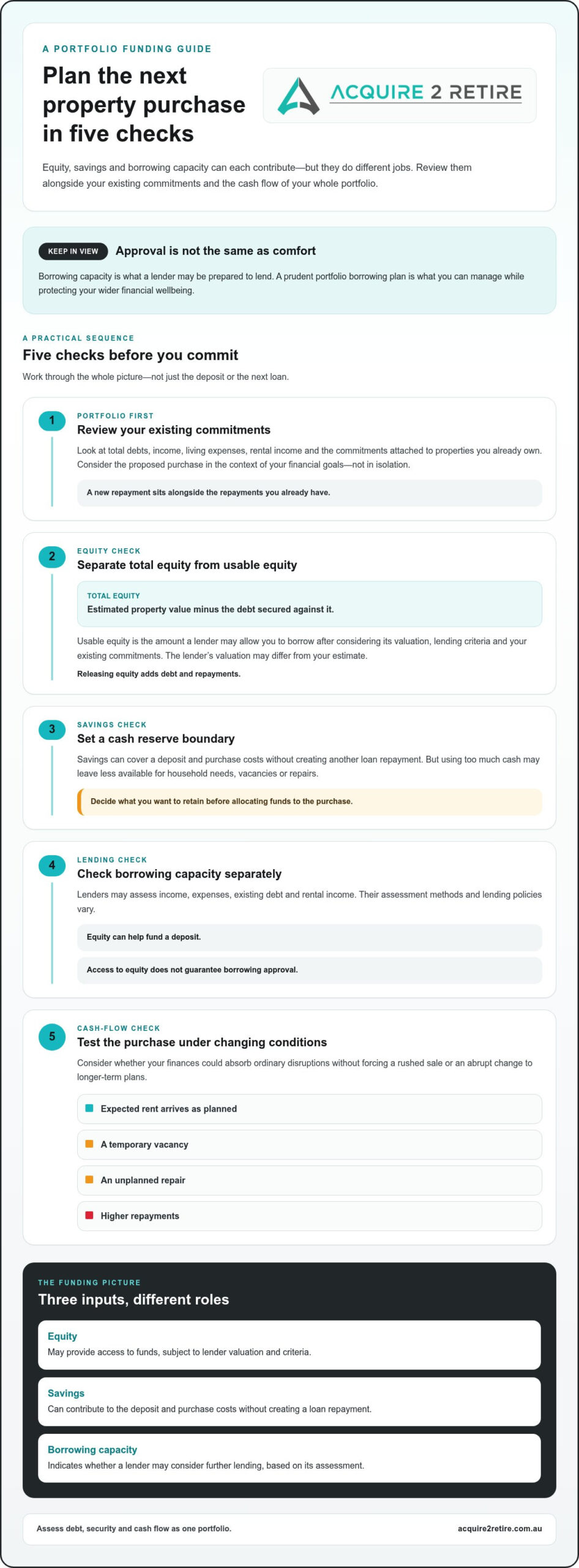
A practical sequence for planning finance before your next purchase
A staged review can help you move from a broad intention to a considered decision, without treating finance approval as proof that a property suits your goals. Use the steps below to review your current position, test a possible purchase and identify what needs further assessment before you commit.
- Revisit your goals and risk tolerance. Clarify what you want the portfolio to support, your preferred time horizon and how much variability in income or expenses you’re comfortable managing. Set a borrowing target only after considering these priorities, rather than letting a lender’s maximum determine the scale of your next move.
- Map your current portfolio and finances. Record each loan balance, repayment, interest and repayment structure, along with the property or properties used as security. Add household income and expenses, rental income, regular ownership costs and accessible cash reserves. This overview gives a finance specialist useful context for assessing how a new commitment may fit with your existing ones.
- Define the purchase parameters. Before focusing on a particular property, outline the funding range and ongoing costs you could manage while retaining an appropriate cash buffer. Property selection is a separate decision: being finance-ready doesn’t establish that a particular property is suitable, and an appealing property doesn’t guarantee its financing fits your plan.
- Test the proposed purchase under different conditions. Consider expected rent alongside loan repayments and ongoing ownership costs, then examine how the picture could change if the property is vacant, needs repairs or repayments increase. Also consider what happens if rent is lower than expected or a valuation differs from your assumptions. The purpose isn’t to forecast events precisely, but to see whether your plan has room to absorb them.
- Confirm the assessment and review your decision. Lending policies and assessment requirements can change, so base your finance planning on current information and your individual circumstances. If tax treatment affects your calculations, discuss the relevant questions with a qualified tax professional. Before proceeding, review the proposed loan, security and cash-flow impact together, and make sure the purchase still aligns with your broader objectives.
This sequence helps separate what you hope to buy from what your overall finances can support. For a wider framework connecting purchasing decisions with long-term goals, explore property investment planning in Australia. If you’re ready to assess your next move in the context of your portfolio, discuss your investment finance and strategy with Acquire2Retire.
How integrated property finance advice can support your next move
Finance works best as part of an investment plan, not as a standalone decision about how much you can borrow. For investors considering how to finance multiple investment properties, the next loan needs to make sense alongside portfolio goals, existing debt, cash-flow needs and the type of property being considered. Reviewing these factors together can help you assess your next move more clearly, without assuming that finance approval guarantees a suitable purchase or a particular outcome.
When coordinated strategy and finance support may help
Reviewing your objectives, risk profile and cash-flow requirements can help shape finance decisions across the portfolio. Acquisition research adds another perspective by assessing whether a potential property aligns with your strategy, rather than letting the available loan amount drive the choice. Neither finance planning nor research can guarantee how an asset will perform, but together they can support a more considered decision.
Acquire2Retire provides property investment strategy, acquisition and tailored finance support aligned with broader portfolio goals, including expansion and debt management. Ongoing portfolio support can include monitoring and equity reviews, helping investors revisit their plans as circumstances change. This is the difference between arranging finance for one purchase and considering how that purchase fits the longer-term direction of your investments.
It’s also helpful to understand where related responsibilities sit. Tenancy coordination is different from day-to-day property management, while legal conveyancing is a separate part of a property transaction. Keeping these roles clear helps focus finance and acquisition discussions on funding, strategy and the proposed investment, without confusing them with other parts of ownership or purchase.
Turn the next step into a considered plan
A productive strategy discussion starts with a clear picture of your current position and what you want your portfolio to achieve. Preparing relevant information makes it easier to examine options in context, rather than focusing only on a new property or a single loan feature.
- Current loan balances, repayment arrangements and security details
- Household and investment income, regular expenses and rental income
- Available savings and reserves you want to preserve
- Your investment objectives, preferred risk level and thoughts about a potential acquisition
From there, finance options can be considered alongside acquisition research and the effect a proposed purchase may have on your broader portfolio. The discussion can also identify questions that need further assessment before you commit, so your next step is guided by your circumstances rather than pressure to proceed. A measured review helps keep flexibility and long-term goals in view.
If you’re ready to explore a considered approach to your next purchase, discuss your property investment finance strategy with Acquire2Retire.
Plan your next move with care
Portfolio growth doesn’t need to follow a fixed timetable. Your next step may be to refine your goals, review your current position or assess whether a particular opportunity fits your plans. Returning to how to finance multiple investment properties with your wider financial priorities in view can help you make decisions deliberately, rather than feeling pulled forward by borrowing capacity alone.
Acquire2Retire brings finance, investment planning and acquisition research together, with ongoing portfolio support to help you revisit your approach as circumstances evolve. This provides a considered framework for weighing options while keeping your objectives and comfort with risk at the centre. Discuss your property investment finance strategy and take a thoughtful next step towards your portfolio goals.
Steady, well-considered progress is a worthwhile foundation for what comes next.
Frequently Asked Questions
How many investment properties can one person finance in Australia?
There’s no single number that applies to every Australian investor. The practical limit depends on factors such as income, existing debts, expenses, rental income and the lender’s current assessment criteria. One person might be able to finance several properties, while another may reach their borrowing limit sooner. For example, a change in employment or a new personal loan could affect an application, even if the properties themselves are performing as expected.
Do lenders count all rental income when assessing another investment loan?
No, a lender may not count every dollar of rent as available income. Rental income can be assessed conservatively to allow for factors such as vacancies and property expenses, and lenders use different methods. If you’re preparing for an application, keep current lease details and rental income records organised, and distinguish rent received from the amount available after costs. This helps clarify your position without assuming the lender will use the full rent.
Can a couple apply together to finance multiple investment properties?
Yes, a couple can apply together, although the lender will assess both applicants’ circumstances and the application as a whole. That may include each person’s income, debts, expenses and financial commitments, not just the rent and costs linked to an investment property. Before applying, discuss how you’ll share contributions and repayments, and make sure both applicants understand the obligations attached to the borrowing. The lender’s assessment will depend on its current criteria and your circumstances.
Is it better to use equity or savings for an investment property deposit?
Neither is automatically better; the right mix depends on your borrowing position and how much cash you want to retain. Using savings avoids increasing debt for the deposit, while borrowing against equity can preserve cash but adds repayments. For instance, you might use some savings while keeping a reserve for personal or property expenses, rather than committing all available funds. Compare the effect of each option on your overall debt and accessible cash before deciding.
Should I buy another investment property as soon as I can borrow more?
No, increased borrowing capacity alone doesn’t mean another purchase suits your financial plans. Consider whether the property meets your investment objectives, whether you can manage its costs under less favourable conditions, and what else you may need your savings for. For example, an upcoming change in household income could make waiting more appropriate, even if a lender indicates you can borrow. A pause to reassess can be a sound decision, not a setback.
Can I buy an investment property through a trust?
Yes, an investment property can be purchased through a trust, but the structure can affect lending, administration and tax considerations. The lender may assess the trust and the people connected with it according to its own policies, so don’t assume borrowing works the same way as an individual application. Before proceeding, discuss the proposed structure with qualified tax and legal professionals, and consider how it fits your longer-term ownership and investment plans.
To discuss finance, acquisition and investment planning for your portfolio, contact Acquire2Retire.