
Winning the property isn’t the same as winning the negotiation. A disciplined approach to negotiating investment property purchase terms starts with protecting the investment case, not simply offering more than the next buyer. Price, conditions and settlement timing can all affect whether a property fits your plan.
It’s understandable to feel pressure when another buyer may be close or when an experienced selling agent is guiding the conversation. But acting quickly without a defensible view of value and a clear limit can leave you paying more than the property makes sense for. The aim is to make a considered offer, not to win at any cost.
This guide sets out a research-led process to help you assess value, define your maximum purchase price and weigh terms alongside price. You’ll learn how to factor property risks and investment objectives into your decision, and how to document your rationale so you can negotiate with confidence or walk away knowing why.
Key Takeaways
- Start with your investment objectives so your purchase limit reflects the role the property needs to play in your portfolio.
- Use comparable sales and property-specific research to support your view of value, rather than treating the asking price as proof.
- When negotiating investment property purchase terms, remember that private treaty and auction change the decision context, not your investment limit.
- Make price and conditions deliberate trade-offs, and avoid concessions that weaken the investment case without a clear benefit.
- After an offer is accepted, keep the commercial decision distinct from formal contract review, conveyancing and finance processes.
Why negotiating an investment property purchase starts with your investment case
When a property attracts competing offers, it’s easy to focus on securing it before another buyer does. Start instead by deciding what the asset needs to contribute to your investment plan. Then use evidence and a clear limit to shape your offer. This gives you a practical basis for proceeding, adjusting your terms or walking away.
Negotiating a purchase means reaching agreement on price and conditions within your investment parameters. The asking price is the seller’s starting point, not proof of market value or a measure of what the property is worth to you. Your maximum should reflect your research, the property’s characteristics, your borrowing position and the returns and risks you’re prepared to accept.
A lower purchase price doesn’t automatically make a property a sound investment. A discount, for example, may not offset repair needs, weak rental prospects or a mismatch with your intended portfolio. The broader principles of valuation, financing and investment strategy are outlined in Real Estate Investing Principles. Assess the whole investment case rather than treating a price reduction as a win in itself.
What does negotiating an investment property purchase involve?
Negotiating investment property purchase terms can involve agreeing on the price, deposit arrangements, settlement timing and relevant contract conditions. Each term has a commercial effect. Settlement timing may need to fit your finance arrangements, while conditions can affect the flexibility or certainty of the offer. Terms and processes vary according to the sale method and Australian jurisdiction. Decide what works for your investment, and leave formal contract interpretation to the appropriate process.
Set the investor’s position before making contact
Before speaking with the selling agent, define the role this property is meant to play. Is it intended to provide rental income, support portfolio diversification or form part of a longer-term growth strategy? Consider how the purchase would affect cash flow, borrowing capacity and your ability to manage costs if circumstances change. Connect those objectives to a maximum price and the conditions you need to proceed.
Write down your walk-away limit before competition or attachment starts to influence your judgement. It should be a reasoned ceiling, not a figure you keep revising because another buyer may be interested. A brief record of your assumptions, evidence and non-negotiable requirements can help you stay consistent under pressure. For the wider steps involved in a goal-led purchase, see this investment property acquisition guide.
- Identify the property’s intended role in your portfolio.
- Set a maximum price that reflects your research and cash-flow needs.
- Decide which terms matter to your position, and what would make you walk away.
With that groundwork in place, negotiation becomes a considered investment decision rather than a race to secure a property. Next, build the evidence behind your limit and prepare alternatives so you can respond calmly if the seller’s expectations differ from yours.
Prepare your investment property negotiation with evidence, limits and alternatives
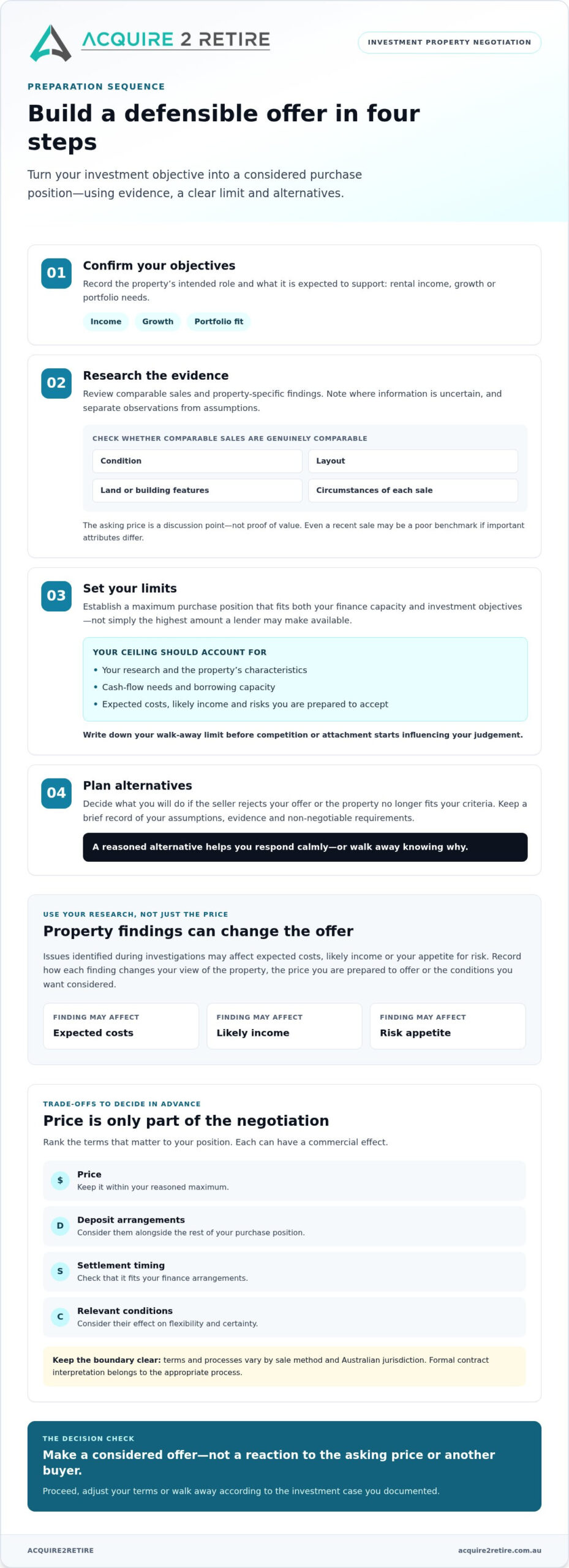
Once you’ve defined what the property needs to do for your portfolio, build a preparation file that turns that objective into a defensible offer. A clear sequence helps you keep research, finance and judgement in view, even if the seller expects a quick response.
- Confirm your objectives. Record the property’s intended role and the income, growth or portfolio needs it is expected to support.
- Research the evidence. Review comparable sales and property-specific findings, and note where your information is uncertain.
- Set your limits. Establish a maximum purchase position that fits your finance capacity and investment objectives.
- Plan alternatives. Decide what you’ll do if the seller rejects your offer or the property no longer fits your criteria.
This groundwork helps distinguish a reasoned offer from a reaction to the asking price. For a broader view of how to assess Australian markets and gather relevant evidence, use this investment property market research guide.
Build a defensible offer from property and market research
Comparable sales are useful only when the comparison is meaningful. Look at properties with similar attributes, then account for differences in condition, layout, land or building features, and the circumstances of each sale. A recent sale may still be a poor benchmark if the property differs in ways that matter to buyers or investors. The asking price can inform your discussion, but it doesn’t establish value.
Include property-specific findings in your assessment. Issues identified during your investigations may affect expected costs, likely income or your appetite for risk. They could influence the price you’re prepared to offer or the conditions you want considered. Separate observations from assumptions, and record how each finding changes your view. A separate assessment framework, such as an investment property due diligence checklist, can help organise those findings.
Decide your limit, alternatives and trade-offs
Your maximum purchase position should reflect both what you can finance and what makes sense for the investment, not simply the highest amount a lender may make available. Rank the terms that matter to you, such as price, deposit arrangements, settlement timing and relevant conditions. This makes it easier to consider a concession deliberately: be clear about what you’re receiving in return and whether the revised proposal still fits your plan.
An alternative doesn’t have to mean choosing a weaker asset. It may simply mean continuing to search for a property that better meets your criteria. Before making an offer, write a short rationale covering why the property fits, how the evidence supports your position and what would prompt you to revise or withdraw. That note gives you a steady reference if emotions or competition start to pull you beyond your limit.
For buyers who want structured guidance connecting research, investment objectives and negotiation decisions, explore acquisition support as part of a broader property investment plan.
Choose a negotiation approach for private treaty or auction conditions
The sale method shapes how you communicate, how quickly you may need to decide and which terms can be discussed. It doesn’t change the investment limit you set using your research and finance position. Keep that limit steady, then adapt how you present or respond to an offer. The right approach depends on the property, the seller’s process and relevant state or territory requirements, not on a universal opening offer or tactic.
Consider price, timing and conditions together. A seller may value a straightforward offer or a preferred settlement timeframe, while you may need arrangements that suit your finance or investment plan. Treat each term as part of the overall proposal and assess any change against the value you expect to receive. Don’t assume one sale method always gives the buyer more leverage.
Private treaty: make a considered offer and manage counteroffers
For a private treaty sale, present your offer clearly, with the proposed price, relevant terms and a reasonable response timeframe. A concise offer helps the seller understand your proposal without relying on unsupported claims about value. If a counteroffer arrives, compare it with your evidence and pre-set limit before replying. Consider whether a change to timing or another term makes the proposal workable, but don’t let a counteroffer reset your ceiling.
Practices and contract requirements differ between Australian states and territories. Before acting, verify current details that may affect the offer process, contract arrangements or applicable timeframes through authoritative government sources for the relevant jurisdiction. Keep commercial decisions about price and terms separate from formal contract review.
Auction: prepare for a different decision environment
An auction can create a more public and fast-moving decision environment than private treaty negotiations. Set a firm maximum before bidding begins, based on the same investment and finance considerations as any other offer. Decide in advance how you’ll respond as bidding progresses, including the point at which you’ll stop. A competitive atmosphere isn’t evidence that a property is worth more to your investment plan.
Don’t assume the options available after an auction, or the way contract conditions operate, are identical across Australia. Verify current auction and contract requirements with authoritative state or territory sources, and understand the relevant process before participating. If bidding reaches your limit, stepping back is a sound commercial decision, not a negotiation failure.
Whether the property is offered by private treaty or auction, the discipline is the same: adapt your communication, not your investment case. Before making a commitment, weigh the full proposal against your research, finance capacity and objectives. The sale format should inform how you proceed, not pressure you into accepting a price or terms that no longer make sense.
Negotiate price and terms without compromising the investment property decision
A clear offer gives the seller something practical to consider: a price supported by your research, the terms you’re proposing and a response timeframe. Keep your explanation calm and specific. Refer to relevant comparable sales or property findings rather than making broad claims that the property is overpriced. This keeps the discussion focused on your reasons for offering without presenting your view as the only possible valuation.
Negotiation isn’t a sequence of automatic concessions. If you adjust your position, do it purposefully: consider what concern the change addresses and whether the revised deal still works for you. A change to price, settlement timing or a condition can affect the investment decision in a different way. Record offers, counteroffers and agreed points in writing as the discussion progresses so you can track exactly what has changed.
Respond to counteroffers while protecting your maximum
When a counteroffer arrives, pause before replying. Compare it with your researched limit, your priorities and the alternatives available to you. Consider whether the seller’s stated concern could be addressed through a different term rather than a higher price. If the revised proposal exceeds your limit or no longer fits your investment case, declining it or allowing your offer to lapse may be the considered choice. You don’t need to keep negotiating simply because a conversation is under way.
A short written note can help: record what changed, why you’re considering it and what the revised offer means for the property’s suitability. This makes it easier to distinguish a deliberate adjustment from a decision driven by urgency. When negotiating investment property purchase terms, the best offer is one that stays within your researched limit.
Assess conditions and timing as part of the deal
Weigh settlement timing, finance-related considerations and other proposed conditions alongside price. A timeframe that suits the seller may not align with your finance arrangements, while changing a condition could shift risk onto you. No term is automatically good or bad; understand its practical impact before treating it as a concession. Keep the commercial question clear: does the whole proposal still suit your objectives?
Before committing, have the contract terms reviewed through the appropriate professional process. Negotiating the commercial points and understanding the formal documents are related but distinct steps. Keep copies of written offers and responses, and make sure agreed changes are accurately reflected through the relevant process before proceeding.
- Keep a written record of each offer, counteroffer and agreed point.
- Assess any concession by what it changes in the overall deal.
- Pause or decline if the proposal moves beyond your researched limit.
For structured support connecting property research, investment objectives and acquisition negotiations, explore investment acquisition support.
Move from negotiated offer to a confident investment property acquisition
An accepted offer is an important milestone, but it doesn’t confirm by itself that the property is right for your portfolio or that every step is complete. Treat acceptance as the point to coordinate what comes next: record what has been agreed, progress the relevant contract and finance processes, and revisit due diligence matters that could affect your decision.
Keep the commercial decision separate from formal contract review, conveyancing and finance approval. Each has its own purpose, and an agreement in principle isn’t a substitute for reviewing the contract or progressing finance through the appropriate channels. The discipline behind negotiating investment property purchase is carrying your investment rationale through these steps, rather than letting the momentum of an accepted offer make the decision for you.
Check that the agreed terms still fit the investment plan
Before progressing, compare the agreed price and terms with your original purchase limit, property rationale and key due diligence findings. Ask whether the asset still fits your objectives and whether new information has changed your view of its risks, expected costs or suitability. If an important matter remains unresolved, make sure it is clearly recorded for the relevant professionals to address through their part of the process.
Keep a concise written summary of the agreed commercial terms, outstanding questions and supporting research. This helps maintain a consistent record as contract review and finance steps progress. The Australian investment property buying process provides broader context for how acquisition decisions fit into the purchase sequence.
A useful post-acceptance checklist might include:
- Confirm the agreed price, timing and commercial terms are recorded accurately.
- Share relevant research and unresolved matters with the appropriate professionals.
- Continue assessing the property against your investment objectives as due diligence and finance processes progress.
- Keep track of decisions and information that could change your assessment.
When structured acquisition support can help
Some investors prefer support that connects market research, asset assessment and negotiation, particularly when they want each purchase to fit within a wider portfolio strategy. Acquisition guidance can bring those threads together, while finance solutions can be aligned with broader portfolio objectives. Initial tenancy coordination may also form part of the transition after a property is acquired, where relevant to the investor’s plans.
This support doesn’t replace formal contract review, conveyancing or lender processes. It helps keep the investment case and acquisition decisions connected as those steps proceed. If you want a more structured approach to researching and negotiating an investment purchase, explore investment property acquisition support.
Make your next acquisition decision with a clear plan
A considered negotiation can inform more than the property you’re assessing today. A clear investment framework helps you judge future opportunities consistently, so each purchase decision supports your portfolio direction. That perspective is useful when market conditions, financing needs and property characteristics differ from one opportunity to the next.
For investors who want support connecting acquisition research and asset identification across Australian markets with negotiation decisions, a structured process can keep the focus on individual objectives. Finance solutions can also be considered alongside broader portfolio strategy, rather than treated as a separate decision. This gives you a steadier basis for approaching the next opportunity, whether you proceed or decide it isn’t the right fit.
Explore Acquire2Retire’s investment property acquisition support to connect research and negotiation with your goals. With a clear rationale behind negotiating investment property purchase decisions, you can move forward with care and confidence.
Frequently Asked Questions
How do you negotiate the price of an investment property?
Build your proposed price around evidence and the investment’s financial fit. Review comparable sales, then adjust your assessment for differences such as condition, features and likely costs. If a property needs work, for example, consider how that affects the amount you’re prepared to pay rather than relying on a general discount. State your offer clearly and keep a record of your reasoning so you can assess any response without losing sight of your investment objectives.
Should you make the first offer on an investment property?
You can make the first offer if you’ve completed enough research to support it and are comfortable with the terms you’re proposing. There’s no single opening figure that suits every property or seller. A considered first offer may help establish a clear position, but an unsupported figure can distract from the substance of your proposal. If you need more information to assess value or finance implications, take time to gather it before making a commitment.
Can you negotiate an investment property purchase at auction?
You generally can’t negotiate with the seller in the same way while bids are being called, so prepare your bidding decision beforehand and stop at your firm limit. The auction process and any options after it can vary with the sale circumstances and jurisdiction. If a property doesn’t sell, further discussions may be possible, but don’t assume the same terms or process apply everywhere. Check current state or territory guidance before relying on a particular auction procedure.
What should you negotiate when buying an investment property?
Consider the whole proposal, not just the purchase price. Depending on the sale process, relevant points may include deposit arrangements, settlement timing and proposed conditions. A timing change, for instance, could affect how you coordinate finance or other commitments, so weigh it against the benefit it offers. Keep track of which terms are essential and which may be flexible, and have formal contract terms reviewed through the appropriate professional process before committing.
How do you know when to walk away from an investment property negotiation?
Walk away when the deal no longer fits your investment plan or requires you to exceed your researched limit. A seller’s deadline, another buyer’s interest or the time already spent on research doesn’t make an unsuitable purchase more viable. Revisit your original rationale and check whether new information has changed the expected costs or risks. If the property no longer meets your requirements, record the reason and redirect your attention to opportunities that may fit better.
Is an investment property purchase negotiable in Australia?
Often, yes, but the scope for negotiation depends on the sale method, seller’s position, demand for the property and applicable state or territory processes. A private treaty sale may allow discussion of price and terms, while an auction creates a different bidding environment. There’s no universal amount a seller must accept or a buyer can expect to save. Check jurisdiction-specific requirements and assess each property on its own evidence and investment merits.
When should you get professional help negotiating an investment property purchase?
Consider professional acquisition support if you’re unsure how to assess market evidence, compare a property with your portfolio objectives or manage negotiations while keeping your limit in view. Acquire2Retire provides property research, asset identification and negotiation support, with finance solutions considered alongside wider portfolio strategy. This can help connect the property search to the purchase decision. Formal contract review, conveyancing and finance processes remain distinct steps and should be handled through the appropriate channels.