
The building and the fixtures inside it follow different depreciation rules. An investment property depreciation schedule explained in plain English sets out eligible deductions for capital works under Division 43 and plant and equipment under Division 40; eligible capital works may generally be claimed at 2.5% of construction costs per year over 40 years. What you can claim depends on the property’s history, the assets it contains and any changes made to it.
Depreciation can be difficult to pin down, especially when a property has been renovated or includes second-hand assets. This guide explains what an investment property depreciation schedule covers, how the prime cost and diminishing value methods work, and how Australian rules affect claims for established properties and later improvements. It also shows how a schedule organises relevant figures and why a deduction is only one part of an investment property’s performance.
Key Takeaways
- Separate capital works from plant and equipment to understand which property components may qualify for deductions.
- Compare prime cost and diminishing value to see how the calculation method can affect an asset’s yearly decline-in-value claim.
- Renovations and newly installed assets may create depreciation opportunities, including in older properties; keep records of changes to the property.
- For established properties, the purchase date and the history of existing assets can affect what plant and equipment you may claim.
- A depreciation schedule organises eligible claims over time, giving you structured figures to discuss with your tax professional.
What is investment property depreciation?
Investment property depreciation is the decline in value of eligible building works and assets used to earn rental income. An investment property depreciation schedule explained in plain English separates capital works from plant and equipment, then estimates deductions under the relevant rules. Eligible residential capital works generally qualify when construction commenced after 15 September 1987, with deductions typically calculated at 2.5% of construction costs per year over 40 years.
Capital works and plant deductions
Capital works deductions under Division 43 apply to eligible building construction costs, while Division 40 covers depreciating plant and equipment. This distinction matters because the building and its fixtures are assessed differently. For example, construction costs of A$250,000 produce an annual capital works deduction of A$6,250 at the 2.5% rate. The building deduction is spread over time, while plant claims reflect each asset’s decline in value and eligibility.
For established homes bought at or after 7:30pm (AEST) on 9 May 2017, existing plant and equipment generally cannot be claimed. Eligible capital works may still be deductible, so the property’s construction history remains important.
Immediate deductions for low-cost assets
Eligible assets costing A$300 or less can generally be claimed as immediate deductions rather than deducted over their effective life. That can bring a qualifying expense into the income year it is incurred. Keep the purchase record and identify the item clearly; an asset in a set costing more than A$300 cannot be treated separately for an immediate deduction.
An asset’s purpose and use matter too. A deduction must relate to earning rental income, and private use can reduce the amount claimed. Separate asset entries in an investment property depreciation schedule help owners keep track of these distinctions.
How schedules estimate deductions
A depreciation schedule estimates eligible deductions by recording construction details, asset values, relevant dates and changes to the property. The estimate depends on the building’s age, renovation history, fixtures and use. Common errors include claiming restricted second-hand assets, overlooking private use and missing improvements. Review the records after renovations, asset changes or a change in use to keep the schedule aligned with the property.
Australian taxpayers generally have up to 2 years from the date of an ATO notice of assessment to amend the relevant tax return, according to the Australian Taxation Office.
Schedule costs and tax effects
A schedule’s price depends on the property’s size, complexity, inspection requirements and reporting scope, and is given after a quote request. Quantity surveyor fees for an investment property depreciation schedule are generally tax deductible in Australia.
Eligible deductions reduce taxable rental income for the relevant year. Capital works deductions can also affect a property’s cost base for capital gains tax calculations, so keep schedules and claim records together. Common compliance risks include unsupported figures, duplicate claims and failing to account for private use or asset eligibility. An accountant can use documented property details to prepare a return that reflects the deductions claimed.
Can I claim depreciation on structural renovations or additional assets?
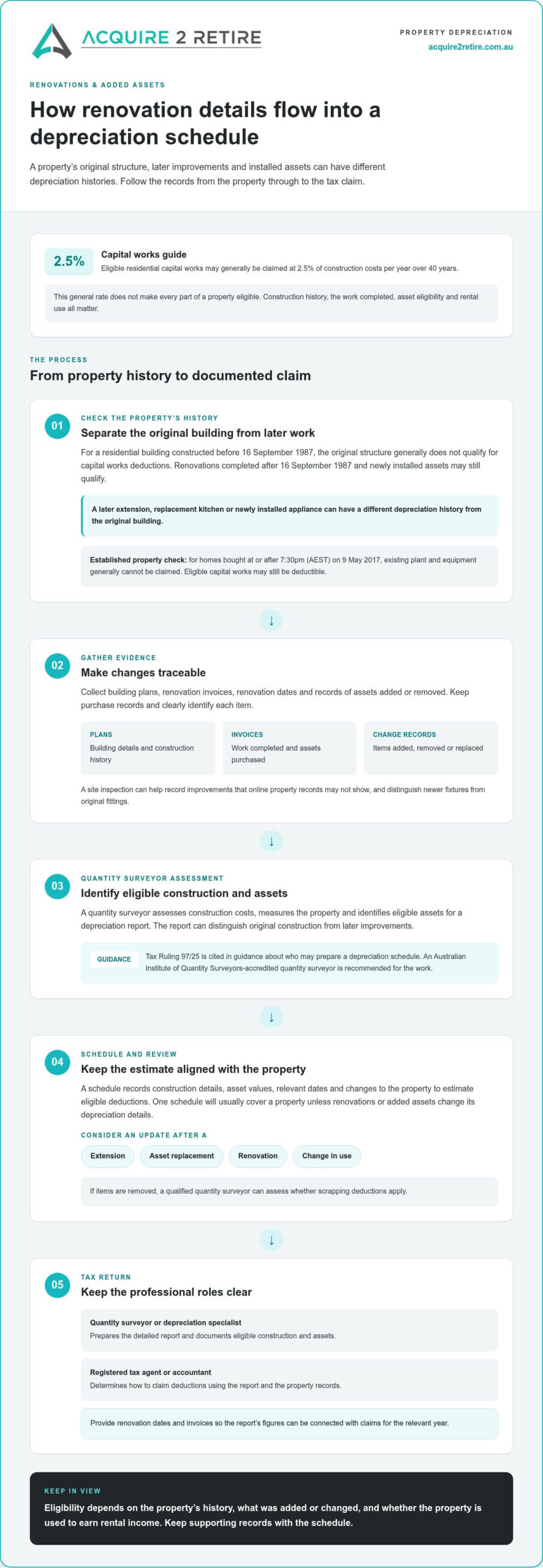
Renovations and newly installed assets may create depreciation deductions, including in older Australian residential properties. Eligibility depends on when the work was completed, what was added and whether the property earns rental income.
For a residential building constructed before 16 September 1987, the original structure generally doesn’t qualify for capital works deductions. However, renovations completed after 16 September 1987 and new assets installed may still qualify. An extension, replacement kitchen, or newly installed appliance can therefore have a different depreciation history from the original building.
A quantity surveyor assesses construction costs, measures the property and identifies eligible assets for a depreciation report. A site inspection can also record improvements that online property records may not show. For example, an inspection may distinguish newer fixtures from original fittings, helping the report reflect the property’s condition and renovation history.
To arrange a schedule, gather building plans, renovation invoices and records of assets added or removed, then have a quantity surveyor prepare the report. The Australian Taxation Office Tax Ruling 97/25 is cited in guidance about who may prepare a depreciation schedule; an Australian Institute of Quantity Surveyors-accredited quantity surveyor is recommended for the work.
The surveyor’s report and the tax return serve different purposes. A quantity surveyor or depreciation specialist prepares the detailed report, while a registered tax agent or accountant determines how to claim deductions. Keep invoices and renovation dates, then provide these records so the report can distinguish original construction from later improvements.
One schedule will usually cover a property unless renovations or added assets change its depreciation details. Consider an update after an extension, asset replacement, renovation or change in use. When items are removed, a qualified quantity surveyor can assess whether scrapping deductions apply. Accurate records help the tax agent connect the report’s figures with claims for the relevant year.
Keeping the surveyor, investor and tax agent roles clear can make renovation decisions easier to assess. Investors supply property records and report changes; surveyors document eligible construction and assets; tax agents apply the deductions in the return. For wider investment decisions, property investment planning can help place renovation choices alongside portfolio priorities.
Prime cost and diminishing value methods
Australian depreciation schedules may use two methods to calculate an eligible asset’s decline in value. The method affects how deductions are distributed over the asset’s effective life.
Comparing depreciation methods
Prime cost generally spreads an asset’s decline in value evenly, while diminishing value claims a larger share earlier. Both methods use the asset’s effective life, but the annual figures differ.
For an asset with a five-year effective life, the prime cost formula uses a 100% factor, while diminishing value uses 200%. The choice shapes the timing of rental deductions, so compare the yearly claims rather than treating either method as universally preferable.
Using the diminishing value method
Diminishing value calculates decline using the asset’s base value, days held, a 200% factor and effective life. As the adjustable value falls, later deductions generally reduce too.
In an Australian Taxation Office example, a new outdoor table costing A$1,500 has a five-year effective life. Its diminishing value deduction is A$600 for the 2025-26 income year, leaving an adjustable value of A$900 at 30 June 2026.
Prime cost produces a different pattern for the same table: the ATO example gives a A$300 deduction for 2025-26. Its adjustable value is A$1,200 at 30 June 2026. These figures show how method selection changes the amount claimed in a particular income year, even when the asset and effective life remain the same.
A separate prime cost example uses a dishwasher valued at A$1,400, with an effective life of ten years. The resulting depreciation claim is A$140 per year. The calculation spreads the asset’s value across its effective life, providing a more even deduction pattern than the diminishing value approach.
Low-value pooling can simplify records for eligible depreciating assets valued below A$1,000. Instead of calculating each item separately, qualifying assets may be grouped and depreciated together. The pool rate is 18.75% in the first year, regardless of how long the investor owned the assets during that year.
Ownership records matter alongside the method. For a property held through a company, trust or another structure, keep asset purchase documents and depreciation details with the relevant ownership records. This helps match each schedule entry to the rental property and taxpayer’s records, rather than mixing assets from different properties or ownership arrangements.
When reviewing a schedule, compare each asset’s effective life, method and adjustable value with its purchase and installation records. A qualified tax professional can use these details to prepare claims that reflect the chosen method and the property’s rental use.
Second-hand depreciating asset restrictions
Yes, but purchase and construction dates can limit which deductions apply. In Australia, eligible capital works and depreciating assets follow different rules, so the property’s history matters.
Renovations and newly installed assets
Renovations and new assets can create separate depreciation claims, even where existing fixtures are restricted. A second-hand residential property owner may generally claim eligible capital works deductions on the building, but not existing plant and equipment under the post-2017 restrictions.
Keep renovation invoices and note when new items are installed or ready for use. A property inspection can help identify eligible assets, measure the residence and record improvements that online records may miss. These details help distinguish newly installed assets from items left by a previous owner.
For assets in a newly built or substantially renovated property, an owner may qualify for deductions if they acquire it within six months of completion. This rule applies to certain depreciating assets, so completion and purchase records help establish the relevant timeline.
Purchase and construction dates
The purchase date affects existing plant and equipment claims, while the construction date helps determine capital works eligibility. For a second-hand residential property bought after 9 May 2017, existing plant and equipment generally cannot be claimed, although eligible assets purchased by the owner may qualify.
For a home bought at or after 7:30pm (AEST) on 9 May 2017, there is no scrapping deduction for assets already used in the property. A former homeowner who first rents out their home on or after 1 July 2017 generally cannot claim the plant and equipment already there.
Construction history is assessed separately. Residential buildings that began construction before 16 September 1987 generally don’t qualify for capital works deductions on the original building. Renovations completed after that date and newly installed assets may still qualify, even when the original structure does not.
A depreciating asset is an item that loses value over time through use, wear or obsolescence. In a rental property, this may include eligible appliances, fittings or other equipment used to earn rental income. The asset’s effective life determines how long its decline in value can be claimed. Owners can use the Commissioner’s effective life or their own reasonable estimate.
A property inspection helps connect each asset to its location, condition and history. Record purchase documents, renovation dates and details of removed or replaced items. The Australian Taxation Office advises rental owners to keep at least a spreadsheet for depreciating assets. These records support accurate claims and help distinguish the property structure from individual assets.
What an investment property depreciation schedule is
An investment property depreciation schedule is a report that organises estimated deductions for eligible building works and depreciating assets. For owners wanting an investment property depreciation schedule explained in practical terms, it helps to think of the report as a property-specific record for taxation planning. It can provide depreciation figures for up to 40 years, depending on the property and eligible items.
The report separates capital works from plant and equipment, as each category follows different deduction rules. For example, it may record construction details separately from an eligible appliance. This gives an accountant distinct figures to consider when preparing a tax return, rather than one combined estimate for the whole property.
A quantity surveyor or depreciation specialist prepares the detailed report using information about the property, its construction and its assets. An inspection can help identify items, measure the building and record improvements that may not appear in online property records. Building plans, renovation records and asset details help connect the report’s figures with the property’s history.
The schedule is an estimate and supporting record, not a tax return or an automatic claim. Keep purchase and renovation documents, note changes to assets, and give relevant details to your accountant or registered tax agent. That professional uses the schedule alongside your circumstances to determine which deductions to include.
For plant and equipment, the report can list eligible assets, their values, effective lives and applicable depreciation calculations. It may show how figures differ under the prime cost and diminishing value methods. For capital works, it records eligible construction information and the basis for deductions over time. This helps owners see how annual estimates relate to specific parts of the property.
Use the schedule as a working reference when a property changes. An extension, renovation, replacement asset or change in use can affect its underlying information, so owners should keep updated records and provide them for review. A clear paper trail also helps explain why an item appears in a claim and how its value was assessed.
For anyone who wants an investment property depreciation schedule explained alongside their property records, the practical value is organisation: construction information, eligible assets and annual estimates appear in one reference. Keep it with invoices, plans and tax returns, then discuss relevant figures with your accountant. To connect property decisions with a broader investment plan, plan your property investment strategy.
Acquire2Retire: Planning & Strategy
Acquire2Retire can help connect property decisions with your broader investment goals through Planning & Strategy. If you’re weighing renovation, acquisition or finance choices, a clear strategy can help you consider how each decision fits your portfolio and expected rental income.
Its Acquisition, Finance and Tenancy offerings support different stages of an investment journey, while ongoing support helps you keep your wider portfolio goals in view. Depreciation rules remain one part of the picture; your property’s suitability, funding approach and tenancy arrangements also shape investment decisions.
For guidance that considers your investment plans as a whole, contact Acquire2Retire.
Make your next property decision with clarity
Having an investment property depreciation schedule explained in plain terms can make tax information easier to place within your wider investment decisions. The next step is to consider how property choices fit your longer-term goals, rather than viewing a potential deduction in isolation.
Acquire2Retire’s Planning & Strategy can help you shape that broader perspective, with Acquisition and Finance supporting decisions about what to buy and how to fund it. This can be useful when you’re weighing a property opportunity, reviewing your portfolio direction or considering how a future purchase aligns with your plans.
Bring your property goals into focus and contact Acquire2Retire to discuss your property. A considered plan can help you move forward with greater confidence.
Frequently Asked Questions
What Is a Tax Depreciation Schedule?
A tax depreciation schedule is a report setting out estimated deductions for eligible property construction and depreciating assets. It gives an owner and tax agent a structured reference when preparing rental income records and tax returns. For example, the report can help distinguish an appliance from building work, so the relevant details are recorded under the appropriate category. It supports a claim, but does not itself lodge a tax return.
Can you claim missed depreciation deductions?
Often, a missed eligible deduction can be addressed by amending the relevant tax return. Australian taxpayers generally have up to 2 years from the date of an ATO notice of assessment to amend that return, according to the Australian Taxation Office. The amendment period runs from the assessment date, not simply from when you discover the missed item. Gather the schedule and supporting property records for the relevant year.
Can tax depreciation be claimed on renovations completed by the previous owner?
Some eligible capital works from a previous owner’s renovations may still be claimable, but existing plant and equipment can be restricted. For second-hand residential property purchased after 9 May 2017, existing plant and equipment generally cannot be claimed by the new owner. Renovation dates and the type of work matter: eligible renovations completed after 16 September 1987 may qualify for capital works deductions. Keep sale and renovation records to establish the property’s history.
What can be claimed?
Potential claims include eligible capital works and depreciating plant and equipment used to earn rental income. An eligible item costing A$300 or less can generally qualify for an immediate deduction; an item in a set costing more than A$300 cannot be separated from that set for this treatment. Private use reduces an asset’s decline-in-value deduction. A tax agent considers the asset, its use, purchase details and applicable restrictions before including a claim.
Can my accountant prepare the schedule instead?
A quantity surveyor or depreciation specialist prepares the detailed tax depreciation report, while a registered tax agent or accountant decides how deductions are claimed. The roles work together: the report records property and asset details, and the tax professional applies eligible figures to the owner’s return. For instance, an accountant can use renovation records alongside the schedule to assess how a property change affects claims for the year.
Do schedules account for ATO updates and rulings?
A schedule reflects the information and tax rules used when it is prepared; it does not automatically change when guidance or rulings change. If an update affects a property’s claims, the owner’s accountant or registered tax agent can consider its effect when preparing a return. Keep the schedule’s issue date and supporting records together so later reviews can identify which calculations relate to each tax period.
What is a depreciation schedule for an Australian investment property?
A depreciation schedule is a property-specific record of estimated deductions across income years, prepared for Australian taxation use. It brings together relevant construction details, eligible asset information and calculations, giving the owner a reference for tax discussions. For example, two properties with different construction histories or renovations may have different schedules, even if both earn rental income. The report helps organise records for each property.
What assets and building costs can be depreciated on an Australian rental property?
Eligible building construction costs may support capital works deductions, while qualifying plant and equipment may be depreciated as assets. Examples of plant and equipment include appliances and other rental property items, subject to eligibility and second-hand asset restrictions. Construction dates affect whether original building costs qualify, and renovation work may have a separate history. A property inspection and records of purchases, improvements and private use help identify relevant items accurately.