
What if the Australian market with the strongest past growth is the one that needs the closest scrutiny? Investment property market research can feel confusing when price histories, rental figures and supply data point in different directions. Strong results in the past don’t guarantee the same conditions in future.
If you’re wondering whether the evidence supports your investment strategy, focus on indicators that connect with your objectives, cash flow needs and tolerance for risk. A single impressive figure rarely tells the whole story.
This practical 2026 guide sets out a repeatable way to compare Australian markets, weigh demand and supply signals, and identify risks. You’ll learn how to read historic performance in context, make sense of conflicting data and build a focused shortlist for property-specific due diligence. The aim isn’t to predict exactly what a market will do, but to make your next research steps more considered and manageable.
Key Takeaways
- Use investment property market research to assess whether market conditions align with your objectives, risk profile and cash flow needs.
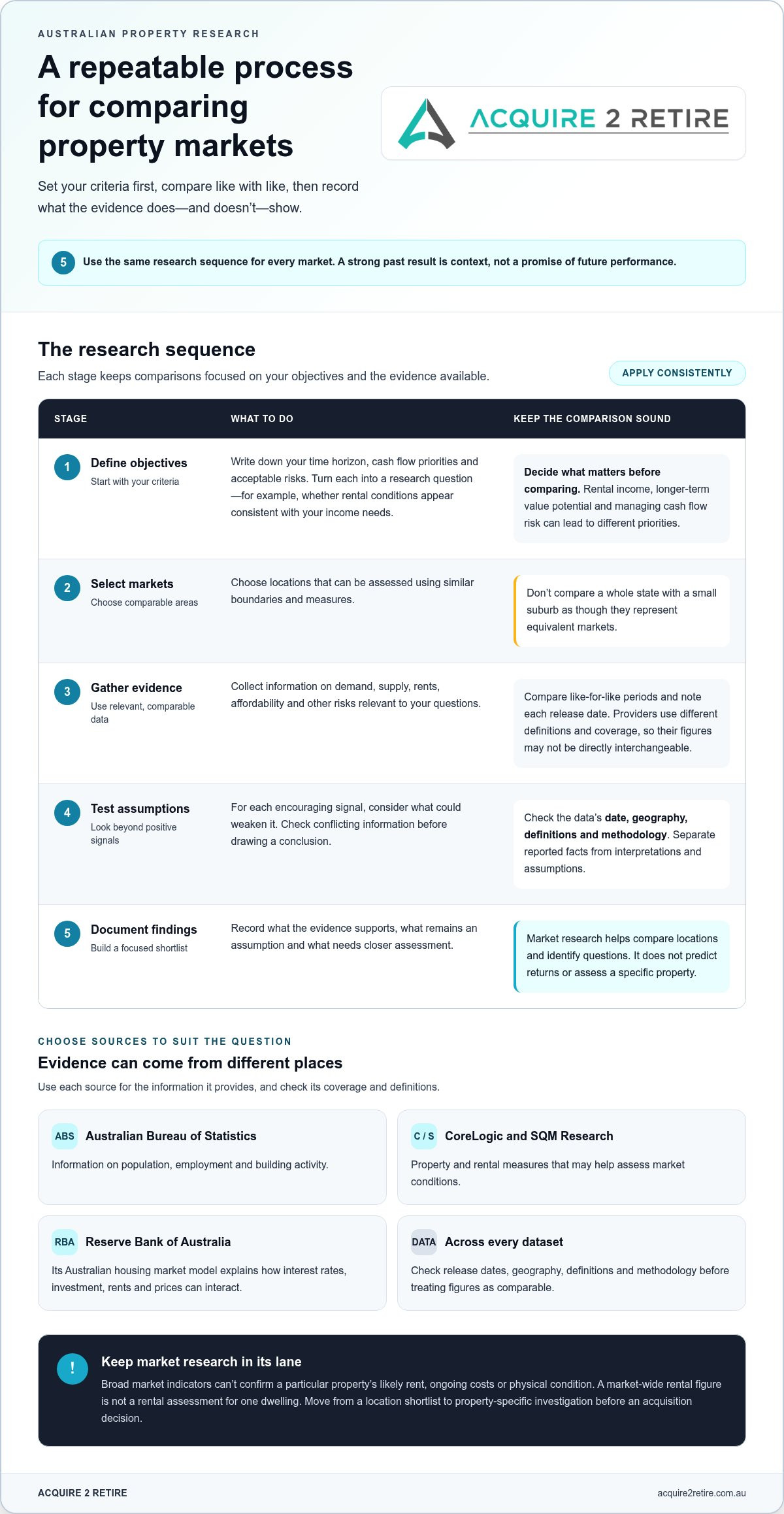
- Follow a repeatable process: define your goals, choose comparable markets, gather evidence, test assumptions and document your findings.
- Compare demand, supply and risk indicators alongside their limitations, rather than relying on a single headline figure.
- When data conflicts, check its date, geography, definitions and methodology, then separate facts from interpretations and assumptions.
- Use market research to build a focused shortlist, then move to property-specific due diligence before making an acquisition decision.
Investment property market research: what it can, and cannot, tell you
Investment property market research is a structured assessment of market conditions against an investor’s objectives. It helps compare opportunities and build a shortlist, but it doesn’t predict returns or assess a specific property. It organises evidence about demand, supply, rental conditions, affordability and risk so you can consider whether a market may suit your strategy.
What does investment property market research include?
Research considers how factors such as population and employment trends, available housing, rental demand and local affordability may interact. These themes reflect the fundamentals of real estate economics, where the needs of buyers, renters and owners meet the supply of property. Each indicator needs context. For example, low rental vacancy may suggest a tight market, but it doesn’t establish that a particular property will attract tenants.
Start with your objective. An investor prioritising potential rental income may weigh rental conditions and affordability differently from someone focused on longer-term value or managing cash flow risk. The same evidence can support different conclusions, so decide which measures matter to your strategy before comparing markets.
Market research also differs from a property valuation. It examines conditions across a defined area or market, while a valuation estimates the value of a specific asset using property-level evidence and an appropriate method. Neither replaces assessing an individual property’s condition, checking relevant legal matters or deciding whether the purchase fits your finances.
What market research cannot predict
Past price movements describe what happened over a particular period. They don’t promise that prices will rise or fall at the same pace in future. Conditions can change as affordability, borrowing capacity, employment, housing supply and buyer sentiment shift. Historical growth can help explain a market’s trajectory, but consider it alongside current evidence and the risks that could affect your strategy.
Broad indicators can’t confirm a property’s likely rent, ongoing costs or physical condition. A market-wide rental figure isn’t a rental assessment for one dwelling, and area-level supply data won’t reveal defects or maintenance needs at a particular address. Those questions require property-specific investigation before an acquisition decision.
Keep the boundaries clear. Market research compares locations and identifies questions to investigate. Acquisition advice connects evidence with your objectives and helps inform asset selection. Finance structuring considers borrowing and cash flow, while property-specific due diligence examines the individual asset and relevant checks. These are related parts of a considered decision, but one doesn’t replace another.
Good research doesn’t remove uncertainty. It makes uncertainty easier to see by separating what the evidence supports, what remains an assumption and what needs closer assessment. That distinction helps create a disciplined shortlist without treating any market signal as a guarantee.
How to research an Australian investment property market step by step
A useful research process begins with your investment criteria, then applies them consistently to comparable Australian markets. This stops a prominent headline or compelling growth chart from setting the direction before you’ve decided what you need the investment to do.
Start with the investor’s criteria, not a market headline
Before comparing locations, turn your time horizon, cash flow needs and risk tolerance into questions you can investigate. Are you prioritising rental income, considering longer-term value potential, or seeking a balance that fits your capacity to manage uncertainty? Define these criteria in advance and use them for every market to help limit confirmation bias.
Keep your personal borrowing capacity separate from a market’s apparent strengths. A market may look suitable on broad indicators but still fall outside your financial limits. For a fuller framework for aligning goals with an investment approach, see Property Investment Planning in Australia: A Clear Strategy for 2026 and Beyond.
Collect and record comparable Australian market evidence
Choose sources that suit the question. Australian Bureau of Statistics (ABS) releases can provide information on population, employment and building activity. CoreLogic and SQM Research publish property and rental measures that may help assess market conditions. Each dataset has its own definitions and coverage, so figures from different providers may not be directly interchangeable. The Reserve Bank of Australia’s model of the Australian housing market also explains how factors such as interest rates, investment, rents and prices can interact.
- Define your objectives. Write down your time horizon, cash flow priorities and acceptable risks. Turn each into a research question, such as whether rental conditions appear consistent with your income needs.
- Select comparison markets. Choose areas that can be assessed using similar boundaries and measures. Don’t compare a whole state with a small suburb as though they represent equivalent markets.
- Gather relevant evidence. Collect data on demand, supply, rents, affordability and other risks relevant to your questions. Compare like-for-like periods and note each release date so older figures aren’t mistaken for current conditions.
- Test your assumptions. For each positive signal, consider what might weaken it. If population growth suggests potential demand, check whether housing supply and employment evidence support the same interpretation. Treat the finding as an indication, not a forecast.
- Document your findings. Record the source, publication date, geography, definition and limitations beside every data point. Flag gaps, revisions and methodological differences, then separate observed facts from your interpretations and assumptions.
This record makes comparisons easier to revisit as evidence changes and gives your shortlist a clear rationale. Acquire2Retire’s property investment support connects research with investment objectives and acquisition decisions.
How to compare property markets using demand, supply and risk
Compare patterns across several indicators rather than choosing the location with the most impressive single figure. A low vacancy rate, rising rents or strong population growth may be relevant, but each needs context and a countercheck. Demand, supply, affordability and risk indicators are most informative when interpreted together, because no single measure can show whether a market’s conditions are durable or suitable for an investor’s strategy.
Read demand and rental indicators in context
Population and employment measures can help indicate whether an area is attracting residents and supporting local incomes. Rental vacancy, advertised rents and rent movements offer a different view. They may point to current pressure in the rental market, but don’t establish how long it will last or what one property will earn.
Check the reporting period, geographic boundaries and methodology before comparing figures. A monthly vacancy estimate and a quarterly rent series may capture different conditions. A broad regional figure may also conceal variation between local areas. Short-term rental pressure is one signal; consider sustained tenant demand alongside population, employment and available housing evidence.
Balance supply, affordability and downside signals
Supply indicators, such as dwelling approvals and construction activity, help frame whether housing stock may expand, though approvals don’t guarantee completed homes. Consider them alongside demand, rents and affordability. If prices or rents are becoming difficult for households to sustain, that may constrain future demand even where current rental conditions appear tight.
Interest rates and lending conditions belong in the risk assessment, too. Reserve Bank of Australia decisions influence broader financial conditions, but they aren’t forecasts of property prices in a particular market. Australian Prudential Regulation Authority (APRA) material can provide context on lending and financial stability. Use it to inform an investor’s borrowing-risk assessment, not as a location ranking.
| Indicator | What it may suggest | Limitation | Source |
|---|---|---|---|
| Population and employment | Potential depth of local housing demand | Growth figures don’t show where residents will live or whether jobs are secure | ABS population and labour statistics |
| Vacancy and rents | Current rental availability and pricing pressure | Measures vary by period, coverage and method; they don’t guarantee a property’s rent | SQM Research or other clearly documented rental series |
| Approvals and dwelling stock | Possible additions to housing supply | Approvals are not completed dwellings | ABS building approvals and Australian Bureau of Statistics dwelling data |
| Affordability and lending context | Potential pressure on household demand and investor borrowing | National settings don’t capture every borrower or local market condition | ABS, RBA and APRA publications |
Use the comparison to identify questions, not to declare a guaranteed winner. If one market shows tight rental conditions but limited employment diversity or affordability headwinds, record both sides. In investment property market research, transparent limitations make comparisons more useful: they show where evidence is strong, where it’s incomplete and which risks need closer attention before a market reaches the shortlist.
How to assess conflicting data before shortlisting an investment market
Conflicting figures don’t necessarily mean one source is wrong. They may measure different things, cover different areas or reflect different reporting periods. Before deciding what the evidence means, trace each figure back to its definition and source. Keep unresolved differences visible rather than smoothing them into a single conclusion.
Test the reliability and relevance of market data
Check whether the data describes the same geography, property type and time period. A rental measure for a broad region may not be comparable with one for a smaller suburb. A quarterly figure may also tell a different story from a monthly estimate. Check how each source defines its measure and whether the data is observed, modelled or estimated.
Give priority to primary sources or clearly attributed data with a published methodology. If figures differ, note the reason where you can identify it. Mark information as outdated, incomplete or difficult to compare when that’s the honest assessment. Record gaps in the evidence rather than filling them with assumptions presented as facts.
A simple research log can separate three kinds of statements:
- Observed fact: what the source reports, with its date, geographic coverage and definition.
- Interpretation: what that evidence may indicate when considered alongside other relevant information.
- Assumption: what you’re expecting to happen, but can’t establish from the available evidence.
For example, a reported increase in rental listings is a fact if accurately sourced. Interpreting it as easing rental pressure is a judgement that needs context. Assuming the increase will continue is a forecast, not an established finding.
Turn market comparisons into a disciplined shortlist
Use a decision matrix built around criteria you set before comparing markets. Score each market consistently against rental evidence, supply considerations, affordability and exposure to downside risks. Treat a score as a prompt for discussion, not a precise measure of investment quality, and record the source and reasoning beside it.
| Criterion | Market A | Market B | Reasoning or concern |
|---|---|---|---|
| Rental evidence | Score and source | Score and source | Note data limits or conflicting signals |
| Supply and affordability | Score and source | Score and source | Record evidence that may weaken the case |
| Downside exposure | Score and source | Score and source | Identify what could change the ranking |
Write down what new evidence would alter a score, such as a revised data release or a change in your assessment assumptions. This makes the shortlist easier to revisit and helps prevent a preferred market from receiving more favourable treatment than its comparators.
A market shortlist is a starting point, not a property-level decision. Use it to guide the next stage of research, including the property-specific checks covered in the 2026 Australian Investment Property Due Diligence Checklist. Acquire2Retire’s acquisition advisory connects market evidence with asset identification and acquisition decisions. Explore the property investment shortlist process.
From market research to an investment property decision with Acquire2Retire
Market evidence becomes more useful when considered alongside your objectives, risk profile and cash flow needs. A market that appears promising on one measure may not suit your time horizon or capacity to manage risk. Acquire2Retire provides tailored property investment strategy and acquisition advisory, helping turn research into a considered shortlist rather than a prediction of future performance.
Connect research findings to an investor’s broader strategy
The same market signals can matter differently to different investors. If maintaining cash flow is a priority, rental evidence and affordability may carry more weight in the comparison. If your circumstances allow a longer investment horizon, other market conditions may deserve closer consideration, alongside the risks that could affect your plans. There’s no universal scorecard: the research needs to reflect what you’re trying to achieve and the uncertainty you’re prepared to accept.
Acquire2Retire’s market research and asset identification help organise evidence around your criteria. Finance support can help you consider how a potential acquisition fits your wider plans and cash flow requirements. This connects market selection, acquisition planning and finance considerations, while keeping the decision grounded in your circumstances. It doesn’t remove market risk or guarantee rental income, capital growth or any other investment outcome.
Choose a considered next step
Once research has narrowed the field, a shortlist can guide acquisition planning and assessment of specific properties. Market-level evidence helps identify where to look; it can’t confirm a particular property’s condition, expected rent, legal position or financial suitability. Those questions require property-specific due diligence before proceeding. Acquire2Retire’s acquisition advisory includes market research, due diligence and asset identification, so each stage informs the next without treating broad market findings as a substitute for assessing the individual asset.
Investors who want to understand how research connects with the purchase process can also explore Investment Property Acquisition Service: A Practical Australian Buyer’s Guide and the buying process guide. These resources offer further context as you move from comparing markets to considering an acquisition, while keeping the distinction between market selection and property-level assessment clear.
Strategy can evolve, too. Changes to cash flow needs, risk tolerance or longer-term plans may affect how you assess your portfolio. Acquire2Retire provides ongoing portfolio support, including portfolio monitoring, equity reviews and strategic advice, to help you review your approach as your circumstances change. The aim is thoughtful decision-making, not pressure to act on a market signal.
For a tailored research and acquisition strategy, discuss your property investment strategy with Acquire2Retire.
Set a clear next step for your investment research
Good investment property market research gives you a basis for deciding what to investigate next, not a reason to rush. Choose a point at which you’ll review your findings, such as when new evidence becomes available or your financial priorities change. This keeps a shortlist relevant and gives you room to pause if the case no longer fits.
Your next step doesn’t need to be a purchase. It might be refining your criteria, revisiting a market comparison or considering how a potential acquisition fits your longer-term plans. A measured decision is still progress when it’s grounded in your circumstances rather than pressure to act.
Acquire2Retire can connect market research and acquisition planning with your objectives, risk profile and cash flow needs. Its due diligence and asset identification services can inform the next stage. You don’t need every answer in place before considering the right approach for you.
Discuss your property investment strategy with Acquire2Retire and take your next step with greater clarity.
Frequently Asked Questions
Can investment property market research guarantee capital growth?
No. Investment property market research can help you assess conditions and risks, but it can’t guarantee capital growth. A market’s direction may be affected by changing economic conditions, employment, housing supply and borrowing capacity, among other factors. Consider how your plans would hold up under different scenarios, including slower growth or weaker rental conditions. This supports a more measured decision without implying the future can be predicted with certainty.
Is a low vacancy rate always a good sign for an investment property market?
No. A low vacancy rate may indicate that rental homes are in short supply at the time measured, but it doesn’t automatically mean a market suits your investment. Check whether the rate covers the property type and area you’re considering, and whether affordability or household changes could affect tenant demand. A dwelling’s location, layout and condition also influence its appeal, so the broader vacancy figure is only one part of the assessment.
What should I do when property market indicators point in different directions?
Pause before choosing the most positive figure and check whether the measures use comparable dates, boundaries and definitions. For example, rising rents alongside increasing listings may warrant a closer look at the length of each trend and the types of properties counted. Note what each source actually reports, then record your interpretation and assumptions separately. If the conflict remains unresolved, treat it as a risk to investigate, not evidence to ignore.
How often should investors update their property market research?
Update it when you’re actively comparing markets and before moving from a shortlist towards a purchase. There’s no single schedule that suits every dataset: employment, population and property measures are released at different intervals. Keep the publication date beside each figure, then refresh the relevant evidence when a new release appears or a material change affects your assumptions. This helps prevent an old statistic from carrying more weight than current conditions justify.
Does investment property market research replace due diligence?
No. Market research helps you assess an area, but it can’t tell you whether a specific dwelling has defects, whether its tenancy arrangements suit your plans or whether the purchase fits your finances. Those issues need property-specific investigation before proceeding. For instance, a market may appear appropriate on broad evidence while an individual property has maintenance concerns or other features that alter its suitability. Treat market research as a way to guide further checks, not a substitute for them.
Can national property statistics tell me what one investment property will rent for?
No. A national rent statistic describes a broad market measure, not the likely rent for a particular home. It can provide context, but a property’s rent depends on factors such as its location, size, condition, features and competing rental options. For a more relevant estimate, examine evidence for comparable properties in the immediate area and consider whether their condition and features genuinely match. Keep the estimate distinct from confirmed rental income, which depends on the property and tenancy outcome.