
A property can earn a healthy rental return and still strain your cash flow. An investment property ROI calculator in Australia helps estimate how rental income and potential capital growth compare with the costs of buying and holding a residential property.
It’s easy to focus on rent and the property’s likely value, but neither tells the whole story. Upfront costs such as stamp duty and legal fees, plus ongoing expenses such as loan repayments, maintenance and insurance, all affect the result. Cash flow is positive when income exceeds expenses and negative when costs are higher.
This guide explains the difference between ROI and cash flow, the figures to include in an estimate, and how to assess residential property returns in Australia without relying on a single headline percentage. It also explains how assumptions about vacancy, finance and costs can change the picture, helping you assess a property’s potential more carefully.
Key Takeaways
- Calculate gross rental yield by annualising weekly rent and comparing it with the property’s purchase cost; subtract relevant expenses to understand net yield.
- Rental yield benchmarks vary by location, property type, tenant demand and market conditions, so a broad average may not reflect a specific investment.
- Model vacancy and finance costs alongside rent to see how different assumptions can shift an investment between positive and negative cash flow.
- Estimate total returns by considering rental income, upfront costs and potential capital growth together, then test how the result changes when assumptions move.
What is property investment ROI (Return on Investment)?
Property investment ROI compares an investment’s return with the cash invested, including income and any change in value. Calculate it by dividing the gain after relevant costs by the initial cash investment, then multiplying by 100. An investment property ROI calculator in Australia can help organise these estimates, but the result depends on the figures entered.
Net rental yield and holding costs
Net rental yield shows annual rental income after relevant property expenses, expressed as a percentage of the property’s cost. Subtract expenses from annual rent, divide by property cost, then multiply by 100. Net yield matters because gross rent alone doesn’t show what remains to support ownership.
Include recurring costs such as interest, insurance, strata fees, repairs and maintenance.
Upfront and ongoing property costs
Upfront costs are the amounts needed to acquire and prepare a rental property, including the deposit, stamp duty, legal fees and inspections. Include these in the initial cash invested when estimating ROI, as they affect the return on the money committed.
Ongoing costs arise during ownership and include loan repayments, insurance, maintenance and any applicable property management fees. Separating acquisition costs from annual expenses helps distinguish the initial investment from the costs that reduce income over time.
ROI assumptions and excluded costs
An ROI estimate is a projection based on assumptions about rent, vacancy, expenses, finance and potential capital growth. Change an assumption, such as expected rental income or interest costs, and the result changes too. Treat the calculation as a comparison tool, not a guaranteed outcome.
Some estimates exclude costs or use simplified inputs, so check what the calculation includes before relying on its percentage. A yield calculation, for example, may omit purchase expenses, while a total ROI estimate may include them. Tax outcomes and depreciation can also affect an investor’s position.
Estimating rental income and ownership costs
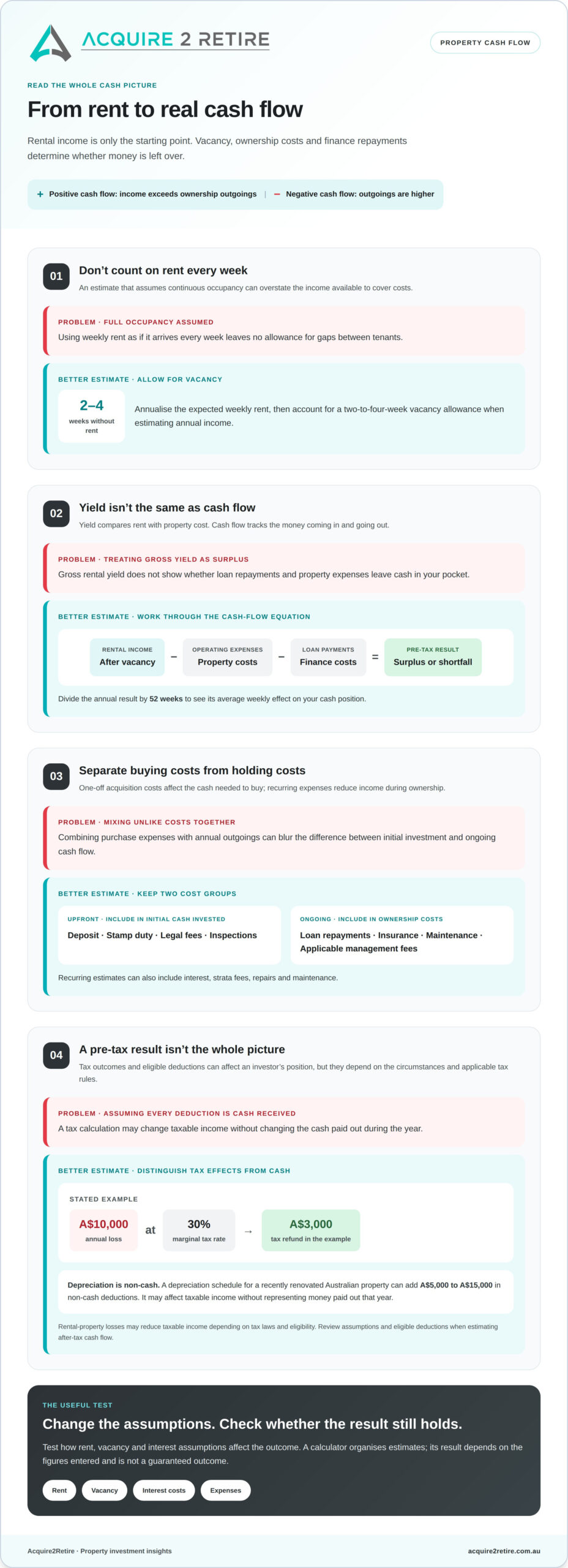
Estimate rental income using the expected weekly rent, then allow for vacancy rather than assuming the property is occupied every week. A two-to-four-week vacancy allowance gives a more cautious view of annual income. Tenancy coordination can help account for practical gaps between renters.
Include applicable management fees, maintenance and insurance in ownership costs, and review each assumption against the property. Insurance estimates should reflect the cost of rebuilding the dwelling and replacing covered features, rather than simply its purchase price. This gives a more useful view of holding costs and the income remaining after expenses.
What is property cash flow?
Property cash flow is the money left after rental income covers operating costs and finance repayments. The difference between rental yield and cash flow matters: yield measures rent against property cost, while cash flow tracks money moving in and out.
Gross rental yield compares annual rent with the property’s purchase cost. Divide annual rent by purchase cost, then multiply by 100; to annualise weekly rent, multiply it by 52. The Brisbane example’s gross yield is 4.77%. Australian gross yields range from 3% to 7%, with location, property type, rental demand and market conditions shaping the result.
Capital-city figures show why one benchmark doesn’t suit every property. Cotality’s October 2026 index recorded Sydney’s all-dwelling yield at 3.5% and Darwin’s at 6.4%; combined regional markets averaged 4.4%. Sydney houses recorded 3.1%, while units reached 4.5%. Brisbane houses recorded 3.5%, compared with 4.3% for units. These differences can inform a strategy focused on rental income, capital growth, or a balance of both, but don’t predict an individual property’s performance.
Cash-flow and tax calculators can model rent, expenses, finance and tax inputs, but their outputs depend on the information entered. Rental-property losses may reduce taxable income, depending on tax laws and eligibility. Compare property with shares or other investments by assessing total returns after costs and tax over the same period, while considering each investment’s liquidity and risks. Property investment planning and strategy can help weigh income and capital growth against your broader goals.
Positive and negative cash flow
Cash flow is positive when rental income exceeds ownership outgoings, and negative when outgoings are higher. Estimate both positions before and after tax to understand how much cash the property may require.
Estimating property cash flow
A pre-tax cash-flow estimate subtracts operating expenses and loan payments from rental income. Include vacancy in the income figure: allowing for two to four weeks without rent each year makes the estimate less reliant on continuous occupancy. Divide the annual result by 52 weeks to see its average weekly effect on your cash position.
Include stamp duty when assessing the capital needed to buy, but separate it from recurring holding costs. Gross rental yield compares rent with purchase cost; it doesn’t show whether repayments and expenses leave a cash surplus. Test how changes to rent, vacancy or interest assumptions affect the result.
After-tax cash flow
After-tax cash flow adjusts the pre-tax position for the investor’s tax outcome and eligible deductions. Australian property losses may reduce taxable income, depending on tax laws and eligibility. For example, a A$10,000 annual loss at a 30% marginal tax rate produces a A$3,000 tax refund in the stated example.
Depreciation is a non-cash deduction, so it may affect taxable income without representing money paid out that year. A quantity surveyor’s depreciation schedule for a recently renovated Australian property can add A$5,000 to A$15,000 in non-cash deductions. Keep that tax adjustment distinct from the property’s actual cash movement.
Capital gains tax and selling costs reduce the amount retained when an investment property is sold, affecting its overall return. Assess sale proceeds after those deductions alongside rental cash flow: a positive weekly position alone doesn’t capture the full investment result. Tax savings also depend on an investor’s circumstances, so don’t treat a deduction as an automatic cash refund.
Estimating returns for residential investment property in Australia
A useful estimate combines rental income, ownership costs, finance and possible capital growth. For a residential property, assess annual cash flow separately from total return over your planned holding period, as each view answers a different investment question.
Start with purchase costs and the deposit. It estimates net rental yield at 3.77%, then 3.29% when expenses and stamp duty are included. This shows why the calculation’s cost inputs matter.
Next, model rent and vacancy. The example uses a 2% national-average vacancy allowance, adjustable for local conditions, and 8% of rent for property management. Treat these as inputs, not universal settings. Local rental demand, property type, likely downtime and the services included in management can change the estimate.
Then test the finance and growth assumptions. Those figures depend on the example’s assumptions and don’t guarantee a future result.
For a more resilient estimate, increase the interest-rate assumption by 1 to 2 percentage points above the current rate, then observe how repayments affect cash flow. Assess any negative gearing benefit separately from the property’s underlying performance, since eligibility and tax outcomes depend on individual circumstances. Compare the resulting annual and weekly figures with your available capital and investment timeframe. An estimate is most useful when its inputs are clear and you can see which changes affect the outcome most.
To bring purchase, finance and rental assumptions into one considered plan, discuss your property investment strategy.
Acquire2Retire
Acquire2Retire helps bring property return estimates into a broader Australian investment plan. When you’re weighing rental income, holding costs, finance and potential capital growth, its Planning & Strategy can connect those factors with your investment goals.
If you’re moving towards a purchase, Acquisition and Finance support can help shape the approach, while Tenancy coordination and ongoing support help you consider the ownership stage. This can be useful when a calculator’s figures need to be considered alongside the decisions involved in building a property portfolio.
Contact Acquire2Retire to discuss your property investment plans.
Make your next property decision with clarity
Use an investment property ROI calculator in Australia as a starting point for deciding what role property might play in your broader financial plan. The next question is not simply whether a projected return looks appealing, but whether the investment fits your priorities, time horizon and capacity to hold through changing conditions.
Consider what balance you want between rental income, longer-term wealth building and borrowing. Acquire2Retire can help shape these decisions through Planning & Strategy, Acquisition and Finance, connecting the property choice with your wider investment objectives. Projections remain estimates, since property performance and personal circumstances can change.
Contact Acquire2Retire to discuss your next step and move forward with a plan that reflects your goals.
Frequently Asked Questions
What is a Good Rental Yield in 2026?
A gross rental yield above 5% is described as strong, while Australian gross yields typically range from 3% to 7%. Treat these as comparison points, not a pass-or-fail test: a higher yield can come with different growth prospects, vacancy patterns or ownership expenses. Compare similar property types and locations, then assess net yield and cash flow before judging whether a return suits your plans.
How does negative gearing affect my tax return?
Negative gearing may allow an eligible investor to use rental-property losses to reduce taxable income, subject to tax laws and eligibility criteria. The tax benefit depends on the investor’s circumstances and isn’t the same as recovering the full loss. For a useful estimate, distinguish deductible expenses from non-cash depreciation and consider how the resulting tax position affects available cash. Don’t treat a projected deduction as income.
What makes one property’s ROI beat another?
A stronger ROI can come from a better balance of purchase price, rental income, ownership costs and value growth over the same holding period. For example, compare two properties using the same finance assumptions and time horizon, then consider which relies less on optimistic rent or growth estimates. Tenant demand, vacancy exposure and the amount of capital tied up can also affect their relative appeal.
What is the formula for rental yield versus total property return?
Gross rental yield is annual rent divided by purchase cost, multiplied by 100. Net rental yield subtracts relevant rental expenses first. Total property return looks beyond rent: it compares income and any change in property value against the investment and associated costs over a chosen period. Keep the measures distinct, as yield describes rental performance while total return includes growth and other investment effects.
What costs should an Australian investment property ROI calculator include?
Include acquisition costs such as the deposit, stamp duty, legal fees and inspections, then model recurring expenses and vacancy. For a practical review, separate the costs of buying from the annual costs of holding the property. Consider loan repayments, insurance, maintenance, applicable strata fees and property management fees. Check whether the calculator includes these inputs, as omitted costs can make its projected return look higher.
How do Australian rental income tax and negative gearing affect property ROI?
Rental income and eligible expenses affect an Australian investor’s taxable position, while a rental loss may reduce taxable income if eligibility requirements are met. This can change an after-tax ROI estimate without changing the property’s underlying rent or value. Model pre-tax and after-tax results separately using assumptions that reflect your circumstances, and distinguish tax effects from the investment’s operating performance.