
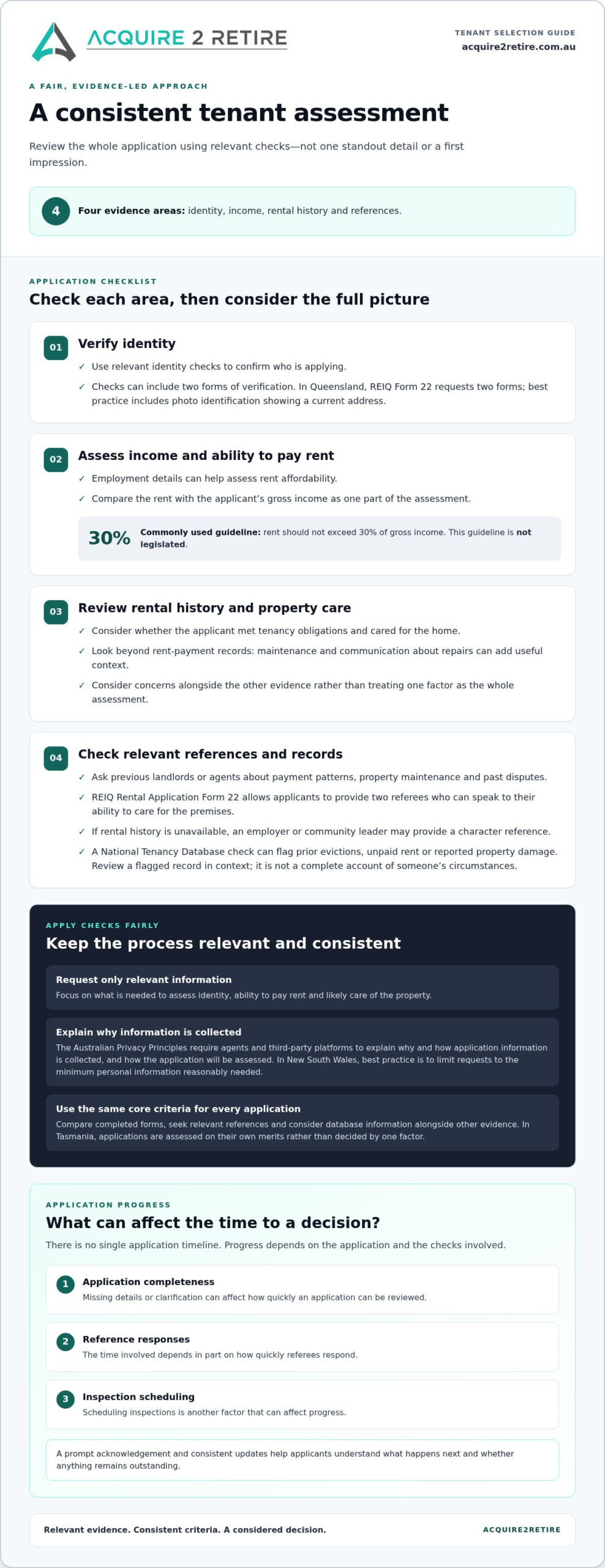
The strongest investment property tenant selection is based on consistent, relevant checks, not one standout detail. Property managers assess identity, income, rental history and references to understand whether an applicant can meet the rent and care for the property. A commonly used guideline is that rent should not exceed 30% of an applicant’s gross income, but this is not legislated.
Choosing a suitable tenant means assessing relevant evidence consistently, not relying on first impressions. This guide explains how identity and income checks, references and rental history can inform investment property tenant selection. It also covers practical ways to keep the process fair and understand what can affect the time between receiving an application and making a decision.
Key Takeaways
- Keep application checks focused on information needed to assess identity, ability to pay rent and care of the property, and explain how the information will be used.
- Use rental history and relevant references to understand an applicant’s payment record, property care and communication, rather than relying on one factor alone.
- Identity checks can include two forms of verification; in Queensland, REIQ Form 22 requests two forms, with best practice including photo identification that shows a current address.
- A commonly used affordability guideline is for rent to be no more than 30% of an applicant’s gross income, but this ratio is not legislated.
- Complete applications and timely reference responses help progress screening, while applying the same relevant criteria supports a fairer decision.
How Long Does the Tenant Application Process Take?
There is no single application timeline. Completeness, reference responses and inspection scheduling all affect progress. A clear process helps applicants understand each stage and gives property managers relevant information to assess applications fairly.
Collecting Necessary Applicant Information
Collecting necessary applicant information means requesting only details relevant to assessing identity, rent-paying ability and likely care of the property. In New South Wales, best practice is to limit requests to the minimum personal information reasonably needed for those assessments. The Australian Privacy Principles require agents and third-party platforms to explain why application information is collected, how it will be collected, and how the application will be assessed.
Explain why you need personal information before an applicant provides it. For example, employment details help assess rent affordability, while rental references can show payment and property-care history. In New South Wales, tell prospective tenants when their information will be used for a residential tenancy database search. Clear explanations help applicants provide relevant evidence without sharing unnecessary personal details.
Applicant Interviews at Inspections
A brief conversation at an inspection lets applicants and property managers discuss practical aspects of the rental. Managers can ask relevant questions about an applicant’s plans for the property and observe how they communicate. These conversations can complement the written application, but should not replace consistent checks of income, identity and references.
An applicant might ask about access, maintenance reporting or the proposed move-in process. These questions can clarify expectations, while the manager can explain the application steps and what information is needed next. Keeping the discussion focused on the rental helps applicants decide whether the home suits their needs.
Processing Applications and Communicating
Processing an application means reviewing the submitted details, following up on relevant references and explaining the next step to each applicant. The time involved depends on whether the application is complete, how quickly referees respond and whether clarification is needed. A prompt acknowledgement confirms receipt and helps applicants understand what happens next.
A tailored cover letter can make an application easier to assess. Applicants can briefly describe who will live at the property, their move-in timing and relevant rental history, then explain any unusual circumstances. Someone without a previous agent reference, for example, could outline their former living arrangement and provide another suitable referee. Specific context helps managers assess the application using the same criteria as others.
Applicants can follow up politely to ask whether anything remains outstanding. Repeated or demanding messages can complicate communication. Property managers can keep applicants informed with consistent updates as checks progress. If a referee is unavailable, explain which reference is pending and whether another relevant contact can help. These steps support an orderly decision without rushing checks or leaving applicants unsure about their application status.
How Do Property Managers Choose the Right Tenant?
Property managers compare relevant evidence, including rental history, references and information about property care. A fair approach to investment property tenant selection considers the whole application, rather than treating income or a first impression as decisive. Landlords may use a property manager or tenant-screening service; fees depend on the work and checks involved.
Rental History and Property Care
Rental history can show whether an applicant met tenancy obligations and cared for a home. Rent-payment records alone do not reveal how someone maintained the property or communicated about repairs, so references can add useful context.
With relevant details, a manager can ask previous landlords or agents about payment patterns, property maintenance and past disputes. A reference describing prompt repair reporting, for example, can add useful context. Consider any concern alongside the other evidence rather than treating one factor as the whole assessment.
Using Property Managers or Screening Services
A property manager can coordinate application checks, and tenant-screening information can help establish relevant tenancy history. These tools can support an organised assessment, but the decision should still follow relevant, consistent criteria.
A National Tenancy Database check can flag prior evictions, unpaid rent or reported property damage. In Queensland, REIQ Rental Application Form 22 includes Item 15, which advises applicants about tenancy database checks. A flagged record warrants context and review; it isn’t a complete account of an applicant’s circumstances.
References offer another perspective. REIQ Rental Application Form 22 allows applicants to provide two referees who can speak to their ability to care for the premises. A previous landlord may confirm whether rent was paid on time and whether the property was maintained. Without rental history, an applicant could provide a character reference from an employer or community leader.
Apply the same core checks to every application. Compare completed forms, seek relevant references and consider database information alongside other evidence. In Tasmania, applications are assessed on their own merits rather than decided by one factor. This helps distinguish an incomplete application from one that offers a different but useful account of the applicant’s circumstances.
A property’s presentation can influence who applies. Fresh paint, modern fixtures and fittings, and regular garden maintenance can make it more appealing at inspections. A clean, well-presented home also helps applicants understand its condition and features, making it easier to judge whether it suits their needs and the tenancy requirements.
Tenants who respect the property, follow lease requirements and report necessary repairs promptly can contribute to a harmonious living environment. Consistent investment property tenant selection also means weighing those relevant indicators against the same criteria for every applicant. For landlords considering how a tenancy decision fits wider portfolio goals, tenant decisions within portfolio planning can form part of that broader assessment.
Verifying a prospective tenant’s identity
Identity and income checks help establish who is applying and whether the rent appears affordable. In Australia, checks should relate to the tenancy, handle information carefully and assess applicants consistently.
Identity verification
The REIQ Form 22 requests two forms of identity verification, and best practice is for at least one to be photo identification with a current address. These checks help confirm that application details correspond with the person applying for the rental property.
Compare the application details with the identification provided, then clarify any discrepancies directly and respectfully. In New South Wales, rental agents should generally sight necessary identity documents and note relevant details rather than store copies. This supports verification while limiting the sensitive information retained.
In South Australia, a landlord or agent may clarify whether a prospective tenant is 18 years or over. This helps establish whether the applicant can legally sign a tenancy agreement. Ask only for information that relates to confirming identity or the applicant’s ability to enter the tenancy.
Verifying income and affordability
Income verification assesses whether a prospective tenant can meet the proposed rent alongside their other obligations. A commonly used industry guideline is that rent should not exceed 30% of an applicant’s gross income; this ratio is not legislated. Another recommended affordability measure suggests income of 2.5-3 times the monthly rent, so these are screening guides, not legal thresholds.
Consider income information in context rather than treating a single ratio as decisive. Employment details can help explain the source and regularity of income, while savings or guarantor information may help demonstrate affordability. A clear application form makes it easier to see how the evidence relates to the rent.
Verifying employment and income
Employment verification helps connect an applicant’s stated work situation with their capacity to pay rent. Assess information from the people who will be listed on the lease and legally responsible for the rent. In New South Wales, evidence of capacity to pay should be limited to those prospective tenants.
Keep the assessment focused. If income varies or an applicant has recently changed jobs, consider the available information together, including any relevant savings or guarantor details they choose to provide. The aim is to assess their ability to meet the rental obligation, not to collect unrelated financial information.
Credit information has separate privacy controls. Under Part IIIA of Australia’s Privacy Act 1988, credit reporting bodies may disclose consumer credit information to third parties only in specified limited circumstances. In New South Wales, charging a prospective tenant for a credit check or other background check breaches the Residential Tenancies Act 2010. Together, these points support a measured process: verify identity, assess relevant income information and keep each check tied to the application’s purpose.
Assessing a tenant’s income and ability to pay rent
Assessing income means weighing relevant evidence against the rent and the applicant’s ongoing obligations. Bond limits and rent-in-advance rules determine what can be requested at the start of a tenancy, while affordability concerns recurring rent payments.
Evidence of Ability to Pay Rent
Evidence of ability to pay rent can show whether an applicant is likely to meet the tenancy’s regular payment commitment. A single income figure may not explain how steady or accessible those funds are, so consider it alongside other relevant information.
Applicants may provide employment and income information, or details about savings or a guarantor. Consider these alongside the proposed rent rather than treating one document as conclusive. In New South Wales, evidence of capacity to pay should be limited to prospective tenants listed on the lease and legally responsible for rent.
Assessing Rent Affordability
Rent affordability compares the rent with the applicant’s income and available financial resources. A commonly used industry guideline is that rent should not exceed 30% of gross income, but this ratio is not legislated.
Another recommended measure is income of 2.5-3 times the monthly rent. Treat both measures as screening guides, not automatic pass-or-fail rules. An applicant whose income varies may present savings or a guarantor as additional context, while a steady income can help clarify how rent fits their regular finances.
Assess the people responsible for paying rent, not unrelated household members. In New South Wales, request capacity-to-pay evidence only from prospective tenants who will appear on the lease and carry legal responsibility for rent. This connects the assessment to the rental obligation and avoids collecting unnecessary financial details from other occupants.
Upfront funds and ongoing affordability answer different questions. Bond limits and rent-in-advance rules affect what an applicant may need to provide at the start; they do not establish whether the rent will remain manageable during the tenancy. Apply the requirements for the property’s location, then assess ongoing income against the agreed rent separately.
Rent bidding can also affect how rent is set. In South Australia, a landlord or agent cannot invite offers above the fixed rent in the residential tenancy agreement. Assess applicants against the stated rent, rather than comparing who offers the most.
A consistent assessment supports a reasoned decision and can give landlords greater peace of mind. Record which income evidence you considered, how it relates to the rent, and whether savings or a guarantor add relevant context. If an application raises questions, seek clarification about the specific evidence instead of making assumptions based on employment type or personal circumstances.
Fair and consistent tenant selection criteria
Fair decisions rely on relevant evidence and consistent criteria, within the requirements of tenancy and anti-discrimination laws. Choosing solely by income or first impressions can overlook important context and lead to unfair outcomes.
Applying Fair and Consistent Criteria
Fair criteria assess each application against the same tenancy-related factors, not personal impressions or assumptions. A recorded, consistent approach helps agents explain their decision and compare applicants using relevant evidence.
An assessment record could note whether each application includes relevant income details, rental references and information about property care. Previous landlords may help confirm payment and maintenance history, while other evidence provides context. In Tasmania, applications should be considered on their own merits using fair, consistent and relevant criteria. This makes the reasoning easier to follow if a decision is questioned.
Risks of Income-Only or First-Impression Decisions
An income-only decision can overlook rental history, communication and property care. First impressions may give too much weight to presentation or personal familiarity instead of the documented criteria applied to every applicant.
These shortcuts can also raise discrimination concerns for landlords and agents. In New South Wales, tenant selection must comply with the Residential Tenancies Act and anti-discrimination legislation. Protected grounds include race, sex, age, disability, sexual orientation, gender identity and marital or partner status. Fair investment property tenant selection therefore relies on relevant tenancy evidence, not assumptions about protected characteristics.
State rules can limit what information agents may request. In South Australia, prospective tenants cannot be asked for more than two documents in each of three categories: identity verification, ability to pay rent and suitability to enter the tenancy agreement. These limits help applicants understand what evidence is relevant and prevent excessive requests within those categories.
Queensland also sets a specific limit on questions about household composition. From 1 May 2025, property managers and lessors may ask prospective tenants only for the total number of occupants and the total number of occupants under 18 during the application process. Applying that rule helps agents keep questions relevant and consistent across applications.
Keep a written record of the criteria applied, the evidence considered and any follow-up that affected the assessment. For example, note how a previous landlord’s reference relates to property care rather than recording a broad personal impression. Consistency is central to investment property tenant selection: it grounds decisions in evidence and helps distinguish relevant concerns from bias.
For a tenancy decision that also needs to fit your wider investment plans, discuss your property investment strategy.
Acquire2Retire: Planning & Strategy
Acquire2Retire can help connect tenancy decisions with the wider plan for your Australian property portfolio. Its Planning & Strategy, Acquisition, Finance and Tenancy offerings support investors at different points, from shaping portfolio direction to coordinating tenancy considerations alongside an acquisition.
This broader perspective can help you assess how a property, its expected rental income and tenant suitability fit your investment objectives. Rather than viewing an application decision in isolation, consider how tenancy choices relate to the property’s role in your portfolio and your longer-term plans.
If you’d like to explore how these considerations fit your investment plans, contact Acquire2Retire.
Plan Your Next Property Decision With Confidence
Connect the tenancy decision with the direction of your wider portfolio. A considered approach to investment property tenant selection can support the property’s intended role and keep decisions aligned with your investment priorities. This perspective is especially useful when a tenancy decision coincides with a new acquisition or a change in portfolio strategy.
Acquire2Retire brings Planning & Strategy, Acquisition and Finance into the broader property investment conversation. These offerings can help you consider how a property fits your objectives and how tenancy decisions relate to the plans surrounding it. The aim is to give each decision its proper place in a coherent investment approach, rather than treating it as an isolated task.
When you’re ready to consider your next step, contact Acquire2Retire to discuss your property investment plans. A thoughtful plan can help you move forward with greater clarity and confidence.
Frequently Asked Questions
Can a Landlord Choose Any Tenant They Want?
No. Landlords can choose an applicant, but the decision must rely on relevant criteria and comply with anti-discrimination laws. In New South Wales, protected characteristics include race, sex, age, disability, sexual orientation, gender identity and marital or partner status. A practical safeguard is to record how each application meets the same tenancy-related criteria, rather than relying on personal preference or an informal impression.
What Checks Do Property Managers Complete?
Property managers commonly assess identity, income, employment details, rental history, references and relevant tenancy database information. These checks help establish whether application details are consistent and whether the applicant can meet tenancy obligations. A previous landlord, for example, may provide context about rent payment and property care, while an identity document helps verify the applicant’s details. Information collected should relate to the assessment and its stated purpose.
What Happens If an Applicant Has No Rental History?
No rental history doesn’t automatically prevent an applicant from being considered. In Queensland, REIQ Rental Application Form 22’s Item 9, “Applicants suitability”, may include evidence of the applicant’s previous living situation. An applicant could also provide a character reference from an employer or community leader. These details give the assessment other relevant context, such as reliability and responsibility, without treating a lack of landlord references as a complete picture.
What tenant screening checks can Australian landlords legally conduct?
Landlords and agents can assess relevant information about identity, ability to pay rent and tenancy suitability, while following privacy and tenancy requirements. The Australian Privacy Principles require agents and third-party platforms to explain why application information is collected, how it will be collected, and how the application will be assessed. In New South Wales, charging an applicant for a credit check or other background check breaches the Residential Tenancies Act 2010.
What documents should an Australian rental application include?
A rental application commonly collects personal details, rental history, employment information, income evidence and references. Identity verification can include two forms of identification; best practice is for at least one to be photo identification showing a current address. In South Australia, landlords and agents cannot request more than two documents in each of three categories: identity, ability to pay rent and suitability to enter the tenancy agreement.
How do landlords verify a tenant’s income, employment and rental history in Australia?
Landlords compare applicants’ stated income and employment details with relevant evidence, then use references to understand rental history. A previous landlord or agent may provide context about payment patterns, property maintenance or past disputes. For New South Wales rental applications, assess financial capacity only for prospective tenants who will be listed on the lease and legally responsible for rent. Savings or a guarantor may add context about affordability.
What are the rules for checking rental databases in each Australian state and territory?
Database requirements vary by jurisdiction, so the property’s state or territory matters. In New South Wales, best practice is to tell applicants when their information will be used for a residential tenancy database search. Queensland tenancy database rules are addressed in Chapter 9 of the Residential Tenancies and Rooming Accommodation Act 2008. Keep the search connected to assessing the tenancy application and explain the use of personal information.
How do Australian tenancy laws regulate discrimination in tenant selection?
Tenancy decisions must follow applicable anti-discrimination laws and use relevant, consistent criteria. In New South Wales, unlawful discrimination in accommodation includes grounds such as race, sex, age, disability, sexual orientation, gender identity, and marital or partner status. Queensland application rules also limit questions about household composition to the total occupants and total occupants under 18. Record decisions against tenancy-related evidence, not assumptions about applicants.