
A tax deduction doesn’t turn an investment loss into a profit. If you want negative gearing explained simply, it’s when an investment’s expenses exceed the income it earns, creating a loss that can be deducted from other income, such as salary and wages. The deduction may reduce taxable income, but you still need to fund the shortfall.
It’s understandable to focus on the tax effect, because a deduction can soften the impact of an investment loss. The key distinction is that it reduces the income tax calculated on your taxable income; it doesn’t reimburse the full loss.
This article explains how the deduction works in Australia and what it can mean for your cash flow. It also compares negative gearing with neutral gearing, where income and expenses broadly balance, and positive gearing, where income exceeds expenses, to help you understand the differences before weighing up an investment.
Key Takeaways
- Separate the tax effect from the investment’s actual cash flow when assessing whether a property is affordable to hold.
- Understand which investment expenses may contribute to a deductible loss, and how that loss can affect your taxable income.
- Compare negative, neutral and positive gearing by looking at the relationship between investment income and expenses.
- Consider how tax treatment, borrowing and potential changes in property value fit into your broader investment strategy.
What is negative gearing?
In Australia, negative gearing describes an investment where deductible expenses exceed the income it earns. The shortfall creates an investment loss, which may be deducted from other income, subject to applicable tax rules. Property is a familiar example, but negative gearing can also apply to investments beyond housing. The central calculation compares the asset’s income with its eligible expenses, rather than measuring whether its market value has risen. A property can therefore run at a loss while its value increases, or generate income without increasing in value.
That distinction matters because a yearly rental loss and a capital gain are different tax considerations. A rental shortfall concerns income and expenses during ownership; a capital gain concerns an increase in an asset’s value when it is sold. If an asset has been owned for more than 12 months, 50 per cent of its increase in value is subject to income tax when sold, according to the Australian Taxation Office. The tax treatment of a sale does not erase earlier holding costs or turn them into profit.
Capital gains tax treatment is also changing. From 1 July 2027, the 50 per cent CGT discount is replaced by cost base indexation, and a 30 per cent minimum tax generally applies to real gains accruing from that date. These changes concern how eligible gains are calculated or taxed on disposal; they are separate from the annual question of whether investment expenses exceed income. For an investor considering a property, the purchase date and the timing of any gain can therefore matter alongside rental income and expenses.
To understand negative gearing simply, keep three figures conceptually separate: investment income, eligible expenses and any later sale gain. Rent may help meet holding costs, while expenses exceeding rent create a loss. A later increase in value does not provide cash to cover that shortfall unless the asset is sold or otherwise accessed. Assessing an investment means considering both its ongoing cash requirements and its potential tax treatment at sale, including the 2027 change to capital gains tax rules.
Deducting investment losses against other income
In Australia, eligible investment losses may reduce taxable income from other sources. This can soften a cash shortfall, but it doesn’t remove the need to fund it.
Investment loss deductions
A deductible investment loss is the excess of eligible expenses over investment income. Individuals can generally deduct that loss against other income, such as salary and wages. For the 2026-27 financial year, a $17,600 rental shortfall could reduce income tax and the Medicare levy by $5,632, leaving $11,968 for the investor to fund. The tax effect is not the full loss.
Rental expenses and borrowing costs
Deductible rental expenses are eligible costs associated with earning rental income, including loan interest. In a worked example, Sandra receives A$28,000 rent, pays A$33,600 interest and has A$12,000 in other annual cash expenses. Her rental shortfall is A$17,600. Eligible borrowing expenses over A$100 are generally spread over five years or the loan term, whichever is shorter. Risks include ongoing shortfalls and costs that exceed rental income.
Deductions and investment income
First, eligible expenses are considered against investment income to establish whether the activity produced a net loss. That loss may then reduce taxable income from other sources; it isn’t returned dollar for dollar. For example, a rental loss can affect the taxable income used to calculate tax, while rent remains income earned from the property. Keeping income and eligible expenses distinct helps clarify both the tax calculation and the cash needed to hold the investment.
ATO rules for negative gearing
Current Australian rules allow individuals to deduct an eligible investment loss against other income, including salary and wages. From the 2027-28 income year, rental-loss limits generally apply to established dwellings acquired at or after 7:30 pm AEST on 12 May 2026; contracts entered before that time meet the stated grandfathering test. These changes may affect whether a rental loss can offset other income. A considered property investment strategy can help you assess the holding costs and tax implications together.
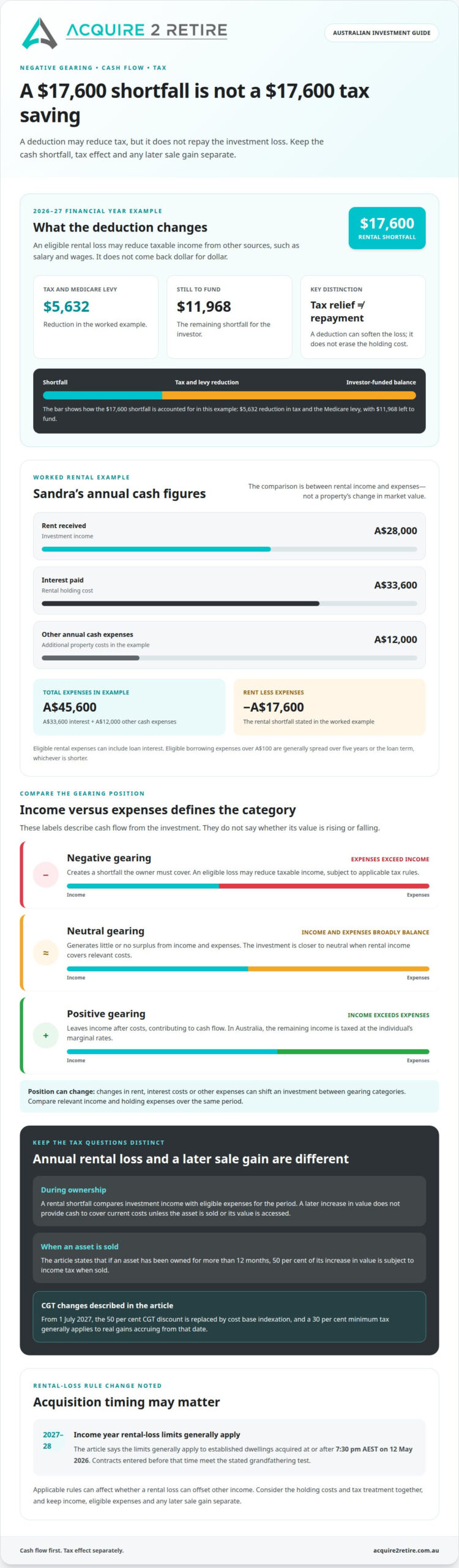
Negative, neutral and positive gearing
These three terms describe how an investment’s income compares with its expenses. Comparing them helps you understand cash flow and potential tax treatment.
Negative and neutral gearing
Negative gearing means an investment’s eligible expenses exceed its income, while neutral gearing means they broadly balance. The distinction matters: a negatively geared investment requires the owner to cover a shortfall, while a neutrally geared one generates little or no surplus from its income and expenses.
For example, if rent falls short of interest and other eligible costs, the property is negatively geared. If rental income covers those costs, it is closer to neutral. These labels describe the relationship between income and expenses, not whether the property’s value rises or falls. A rise in value doesn’t provide cash for current expenses unless the investment is sold or its value is accessed.
Assess the figures over the same period and include relevant holding expenses, rather than comparing rent with loan interest alone. Changes in rent, interest costs or other expenses can shift an investment between categories, so its gearing position may change over time.
Positive gearing
Positive gearing occurs when rental income exceeds interest and other expenses, leaving income after costs. This surplus contributes to cash flow, but it is also taxable: in Australia, the remaining income is taxed at the individual’s marginal rates.
For instance, a property may be positively geared when rent covers its eligible expenses and leaves money over. The size of the surplus depends on the relationship between income and costs; the property’s purchase price or loan balance alone doesn’t determine its gearing category. A property valued at A$700,000 with a A$560,000 loan, as in the Australian worked example, cannot be classified from those figures alone.
Compare all three positions by weighing rental income against interest and other expenses, then consider what the resulting cash flow means for your wider finances. Negative gearing can require you to fund a shortfall; neutral gearing broadly balances income and costs; positive gearing produces a taxable surplus. None of these labels, by itself, describes a property’s future value or guarantees an investment outcome.
Definition of negative gearing
Negative gearing describes an investment where eligible expenses, including interest, exceed the income it earns. The result is a net investment loss rather than a profit from ongoing income. In Australia, the term can apply beyond housing, so the definition depends on an asset’s income and costs, not simply on whether it is property. The key test is the relationship between those amounts over the relevant income period.
It doesn’t mean the asset has fallen in market value, or that the investor automatically receives the full loss back. A rental property’s market value could rise while its rent remains below eligible expenses. Equally, a lower sale value is a separate issue from a rental shortfall. Keeping income, expenses and asset value distinct makes the term easier to apply accurately.
The definition also helps separate an investment loss from a tax outcome. In 2012-13, around 1.3 million people who earned rental income in Australia reported a net rental loss. That historical figure describes rental results, not the amount each person could claim or the tax reduction each received. An individual’s deduction depends on eligible expenses and the applicable rules for that investment and income year.
Those rules can affect how the definition works in practice. From 1 July 2027, established dwellings acquired at or after 7:30 pm AEST on 12 May 2026 are generally subject to new rental-loss limits in Australia. Contracts entered before that cutoff meet the stated grandfathering test. This means a rental shortfall may not always be available to offset other income, even when expenses exceed rent.
The clearest takeaway is to assess both the investment’s income position and the rules applying to its acquisition. A loss describes the gap between income and eligible expenses; it does not, by itself, establish the investment’s overall performance. To connect that assessment with a broader property plan, explore property investment planning.
Acquire2Retire: Planning & Strategy
Acquire2Retire can help you connect an investment’s cash flow and tax considerations with a broader property strategy. Its Planning & Strategy offering helps you consider how a potential shortfall fits your goals, finances and approach to building a property portfolio.
Turn to this planning support when you’re weighing up an investment and want to assess more than its possible tax deduction. Acquisition and Finance support can inform the purchase and funding decisions, while Tenancy support helps coordinate the tenancy side. Together, these considerations can help you evaluate the practical commitments involved, rather than treating a tax deduction as the investment’s sole benefit.
To discuss how property investment planning could fit your circumstances, contact Acquire2Retire.
Make your next property decision with a clear plan
If you want negative gearing explained simply, the practical next step is to decide how an investment would fit your financial priorities, rather than letting a potential tax benefit make the decision for you. Consider the cash flow you can comfortably commit, how much flexibility you want to retain, and the property’s role in your longer-term plans. A clear view of these priorities can help you assess opportunities with greater purpose.
Before moving ahead, write down the questions that matter most to you, such as how you would manage changing expenses or what might lead you to reconsider your plans. Bringing these questions into a discussion can help keep your decision grounded in your circumstances and goals.
When you’re ready to explore your next step, start a planning conversation with Acquire2Retire. A thoughtful approach can help you move forward with greater clarity.
Frequently Asked Questions
What if the loan also has principal repayments?
Separate interest and principal when assessing an investment’s costs. Interest is a borrowing expense; principal repayment reduces the loan balance. Both affect cash flow, but the full loan repayment shouldn’t be treated as interest. For example, with an amortising loan, use the interest component to assess borrowing costs, while including the full repayment when planning the cash needed to hold the property.
What is positive gearing?
Positive gearing means an investment earns more income than it incurs in expenses. For a rental property, compare rent with interest and other eligible costs over the same period. Any remaining income is taxable at the individual’s marginal rates. A surplus can support cash flow, but it isn’t the same as a capital gain: it comes from rental income exceeding costs, not from a rise in the property’s value.
What is negative gearing in Australia, explained simply?
Negative gearing describes an investment whose eligible expenses exceed its income, leaving the investor with a shortfall. For a rental property, compare rent received with relevant expenses over the income period. The term describes this income-and-expense position; it doesn’t tell you whether the property’s market value has risen or fallen, or how much cash you must contribute each month.
How does negative gearing reduce taxable income in Australia?
An eligible investment loss may be deducted from other income, including salary and wages, reducing the income on which tax is calculated. It doesn’t reduce tax by the full amount of the loss. For example, an investor with employment income and a rental shortfall first works out the eligible loss, then applies the relevant rules to their taxable income for that year.
What expenses can Australian landlords claim as rental property deductions?
Landlords may claim eligible expenses associated with earning rental income, including loan interest. Borrowing expenses also have specific treatment: eligible borrowing expenses over A$100 are generally spread over five years or the loan term, whichever is shorter. Keep rental income and expense records organised by income year, and distinguish interest from principal repayments so the borrowing cost calculation reflects the interest component.
How is a rental property tax loss calculated in Australia?
Compare the property’s rental income with its eligible deductible expenses for the relevant income period. If eligible expenses exceed rental income, the difference is the net rental loss before tax rules are applied. For straightforward record-keeping, total the rent received, group eligible costs by type, and subtract those costs from rent. Keep borrowing costs separate, as their deduction may be spread across periods.