
The person who helps you buy a property may not be the person best placed to shape your investment plan. Choosing between a property investment consultant and a buyer’s agent depends on whether you need help finding and negotiating a specific property or broader guidance that connects property selection with your long-term investment strategy. The roles can overlap, but their core focus differs.
It’s easy to see the roles as similar: both may assess properties and support a purchase, and both can influence a major financial decision. The key difference is the scope of support, from focused purchase assistance to a strategy that considers how property fits your wider investment goals.
This guide explains how each role approaches market analysis, property evaluation, strategy and negotiation, then helps you weigh which support better matches your next step. You’ll also find a practical decision guide to help clarify what you need before you commit to a purchase.
Key Takeaways
- Choose a buyer’s agent when your priority is finding and negotiating a purchase; consider a property strategist when you need a broader investment plan.
- Compare how each professional assesses market conditions and property suitability against your goals, finances and intended holding approach.
- Clarify the scope of support, payment arrangements and relevant credentials before engaging a property professional.
- When you want strategy connected with acquisition, finance and tenancy coordination, Acquire2Retire’s Planning & Strategy offering may be a useful next step.
Buyer’s Agent vs Property Strategist: Who Should You Trust?
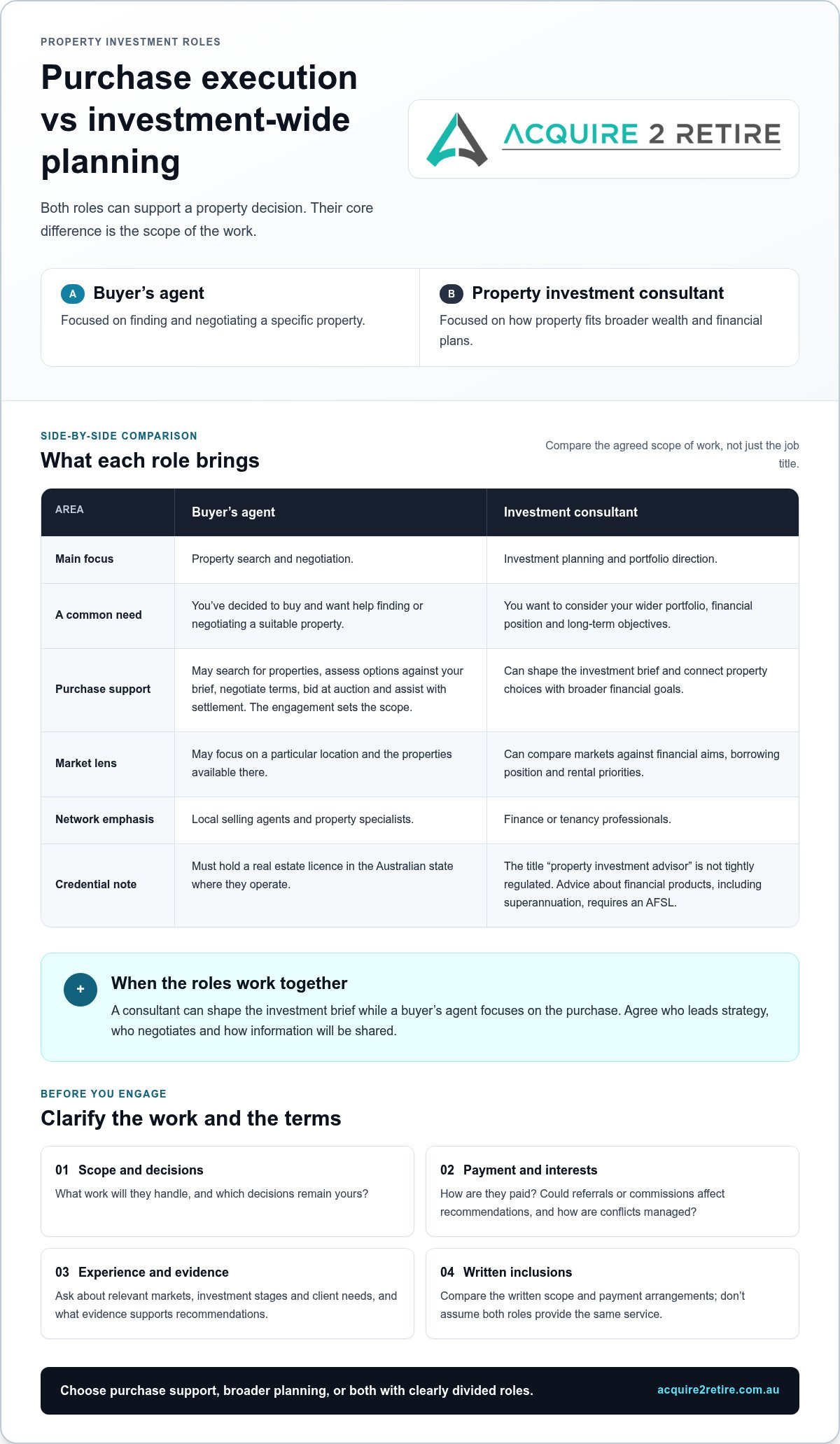
A buyer’s agent focuses on finding and negotiating a property, while a property investment consultant considers how it fits your broader wealth and financial plans. The roles can complement each other when acquisition decisions need to align with investment goals.
Professional Focus and Clientele
A buyer’s agent generally helps someone who has decided to buy and wants support finding or negotiating a suitable property. A property investment consultant considers the investor’s wider portfolio, financial position and long-term objectives. Their networks may also differ: buyer’s agents may work with local selling agents and property specialists, while consultants may coordinate with finance or tenancy professionals. You can use both, with the consultant shaping the investment brief and the buyer’s agent focusing on the purchase.
Scope, Experience and Qualifications
Compare the work each professional will do, not just their title or experience. Ask about relevant markets, investment stages and client needs they’ve supported. In Australia, a buyer’s agent must hold a real estate licence in the state where they operate. The title “property investment advisor” is not tightly regulated. Real property is not a financial product, so advice about which property to buy generally doesn’t require an AFSL. Advice about financial products, including superannuation, does require an AFSL.
Questions Before Engagement
Ask, “What work will you handle, and which decisions remain mine?” Clarify how the professional is paid, whether referrals or commissions affect recommendations, and how conflicts of interest are managed. Request a clear description of the scope, relevant experience and evidence behind recommendations. If you’re considering both roles, agree who leads strategy, who negotiates and how information will be shared. These answers help you judge whether the service suits your needs.
| Option | Main focus | Typical client need | Network emphasis |
|---|---|---|---|
| Buyer’s agent | Property search and negotiation | Purchase support | Local sales contacts |
| Property strategist | Investment planning | Portfolio direction | Finance and tenancy coordination |
Choose a buyer’s agent for purchase support, a consultant for broader planning, or both when their roles are clearly divided.
Market analysis and property evaluation
Market research helps distinguish a property that suits an investment portfolio from one that merely looks attractive. A buyer’s agent may focus on a particular location and available properties, while an investment consultant can compare markets with the client’s financial aims, borrowing position and rental priorities.
Across Australia, markets differ in employment drivers, housing supply, buyer demand and tenant demand. Compare these factors before choosing a suburb. A property near major employment may attract a different rental market from one in a location reliant on seasonal work. Interest rates and credit conditions also affect borrowing capacity and the price range a buyer can consider.
Market analysis should connect local evidence with the property itself. Review recent comparable sales, asking prices, vacancy conditions, rental estimates and planned local development. A two-bedroom unit and a family house in the same suburb may attract different tenants and have different ongoing costs. Assess the specific dwelling rather than relying on suburb-level averages.
Some buyer’s agents have access to properties that aren’t publicly advertised. Off-market access can broaden your options, but it doesn’t replace due diligence. Compare the asking price with similar sales, assess likely rental demand and consider why the seller is selling. Ask how the agent identifies opportunities and whether a commission or other interest could affect a recommendation.
For a fair comparison, use the same criteria for each property and market:
- Location: compare employment, transport, services and planned development.
- Rental case: assess likely tenant demand, achievable rent and vacancy risk.
- Property condition: factor in maintenance needs and suitability for the intended tenant.
- Portfolio fit: consider whether the purchase adds useful diversity or concentrates existing exposure.
A buyer’s agent can help identify and assess purchase options, while broader research connects market choice with investment strategy. Compare the evidence, the seller’s position and the property’s rental case before deciding whether an opportunity fits your plan.
Property buyer-agent services and negotiation
A buyer’s agent’s fee generally covers purchase-focused support, such as sourcing properties and negotiating terms, with the exact scope set by the engagement. A property investment consultant’s fee may cover strategy, research or broader support. Compare the written inclusions rather than assuming the roles provide the same service.
Buyer-Agent Responsibilities and Services
During a purchase, a buyer’s agent can search for properties, assess options against your brief, negotiate with the seller, bid at auction and assist with settlement. The agreed scope determines which tasks are included. This differs from investment strategy, which considers how a purchase supports wider financial goals. Ask whether the agent handles only the transaction or also provides advice beyond property selection and negotiation.
Negotiation support can include presenting an offer and discussing purchase terms with the seller. Before engaging an agent, clarify who will make offers, attend auctions and coordinate the next steps after an offer is accepted. This helps you understand where the agent’s work ends and where other professionals, such as a conveyancer, take over.
Comparing Service Fees
In Australia, a buyer’s agent may charge a flat fee or a percentage of the purchase price. A property investment adviser may charge a one-off fee, while a consultant may charge by the hour or project. Some services price strategy separately; others include it in broader support. The fee structure alone doesn’t show value, so compare the deliverables and the period covered.
Request a written breakdown separating advice, property search, negotiation and any ongoing work. Clarify whether payment changes with the purchase price and whether a commission or referral arrangement could influence property recommendations. This gives you a clearer basis for comparing an independent adviser with a purchase-focused service.
Ongoing property management is separate from buying support and investment strategy. It may involve coordinating the tenancy and routine matters after a property is acquired. Clarify which tenancy tasks are included, who handles tenant communication and maintenance requests, and whether management continues after settlement. Understanding these distinctions helps set expectations across the purchase and ownership stages.
Property investment strategist responsibilities
A property investment consultant connects real estate decisions with financial goals, lifestyle priorities and portfolio direction. Rather than focusing only on one purchase, the consultant helps the investor consider how capital, borrowing capacity and future plans shape each decision.
The process starts with a clear brief: define your goals, available capital and preferred level of involvement. A property can affect cash flow, time commitments and lifestyle, so consider these alongside its investment role. For example, an investor seeking a manageable portfolio may make different choices from someone focused on expanding across multiple markets.
Research then informs the plan. A consultant can compare potential locations and property types with the investor’s objectives, then explain how each option fits the wider portfolio. This creates a framework for acquisition decisions instead of treating each listing as a standalone opportunity. The investor can use the framework to assess new opportunities consistently.
Portfolio support can include reviewing performance regularly, with an annual review helping assess progress against the original goals. The discussion can consider whether the current property mix still suits the investor’s financial position, whether rental performance meets expectations, and whether changing circumstances call for a revised strategy. The review informs decisions; it doesn’t replace the investor’s judgement.
- Set priorities: record financial goals, lifestyle needs and investment timeframes.
- Assess capacity: consider available capital and borrowing position before setting acquisition criteria.
- Build the plan: compare property options against portfolio needs and intended outcomes.
- Review progress: use an annual portfolio review to revisit goals and strategy.
The key distinction is continuity: a strategist links research, acquisition choices and portfolio reviews to one coherent plan. If you want to align property decisions with your financial goals, map out your investment strategy.
Acquire2Retire: Planning & Strategy
Acquire2Retire can help investors connect property choices with a broader plan through its Planning & Strategy offering. This can suit you if you’re still shaping your investment direction, or if you want acquisition decisions considered alongside your financial goals rather than as a standalone purchase.
Support can also bring together Acquisition, Finance and Tenancy coordination, helping you consider key stages of an investment journey in context. This broader approach differs from engaging a buyer’s agent solely for property search and purchase negotiation. It can be useful when you want a structured strategy before choosing a property, or when you’re planning how a potential acquisition fits your portfolio.
To discuss your property investment plans, contact Acquire2Retire or visit acquire2retire.com.au.
Make your next property decision with a clear brief
Before taking your next step, write down what you want the investment to achieve, which decisions you need help with and where you want to remain in control. This makes the choice between a property investment consultant and a buyer’s agent more practical: compare the support with your priorities rather than choosing by title alone.
Consider whether you need help shaping a plan, progressing an acquisition, or understanding finance as part of your investment approach. Acquire2Retire offers Planning & Strategy, Acquisition and Finance, giving you a place to discuss how these areas relate to your property goals. A considered conversation can help you identify the support that best fits your next move.
Contact Acquire2Retire to discuss your property investment plans, and take your next step with greater clarity.
Frequently Asked Questions
What does a property investment adviser do?
A property investment consultant helps an investor turn financial objectives into a considered property plan. They can clarify how property fits the investor’s wealth goals, assess priorities such as cash flow and risk, and establish criteria for future decisions. For example, an investor balancing household commitments with long-term plans can first define a suitable investment approach before assessing potential purchases.
What about fees?
Fees depend on the professional’s agreed scope and charging method. Before engaging anyone, ask for a written breakdown of the work covered, how payments are calculated, and whether strategy, property search, negotiation or later reviews are separate. Compare the deliverables rather than the fee structure alone. This helps you understand what you’re paying for and avoid assuming different services include identical work.
Which one do you actually need?
Choose support based on the decision in front of you. If you’ve settled on an investment brief and need help pursuing a particular purchase, a buyer’s agent may suit the task. If you’re still deciding how property fits your finances and longer-term plans, a property investment consultant may be a better starting point. Write down your immediate decision and desired outcome before choosing.
What does a property investment consultant do in Australia?
In Australia, a property investment consultant helps clients consider how real estate could fit their broader financial objectives. The work may include shaping an investment plan, considering financing needs and assessing how a proposed purchase supports the investor’s position. For example, someone weighing a first investment against other priorities can use a structured plan to clarify decision criteria before proceeding.
What does a buyers agent do in Australia?
A buyer’s agent represents the buyer during a property purchase, rather than acting for the seller. In Australia, the agent must hold a real estate licence in the state where they operate. Their work can include searching for properties, assessing options against the buyer’s brief, negotiating with vendors or bidding at auction. The agreed engagement determines the specific tasks.
What is the difference between a property investment consultant and a buyers agent?
The difference between a property investment consultant and a buyer’s agent is the scope of support. A consultant focuses on the investor’s wider property decisions, while a buyer’s agent concentrates on the purchase process. You might use a consultant to establish your investment criteria, then engage a buyer’s agent to pursue a suitable property. If you use both, define who leads each task.