
Paying cash can feel safer, but it isn’t automatically the better choice. Neither an all-cash offer nor a mortgage suits every investor. Compare the purchase with your available cash, borrowing costs and the reserve you’ll need after settlement. One of the property investment mistakes to avoid is deciding before you understand how the choice affects your overall budget.
It’s sensible to focus on the purchase price, but the true cost of an investment also includes expenses and risks that continue after settlement. A budget that accounts for these commitments can help you assess a property calmly and avoid stretching your finances too far.
This article explains how to weigh market conditions, financing and offers, then account for ownership costs and possible vacancy periods. You’ll see which assumptions can leave your budget exposed and how a clear investment plan can keep each decision aligned with your long-term goals.
Key Takeaways
- Assess local demand, supply, tenant needs and policy settings before deciding whether a property fits your investment plan.
- Build your budget around the full cost of ownership, not just the deposit and mortgage repayments.
- Set clear investment criteria before making an offer so emotion doesn’t push you beyond your limit.
- Allow for vacancy periods and keep a cash buffer to help manage expenses when rental income pauses.
1. Considering market cycles, economic conditions and government policies
Property markets move with employment, inflation, borrowing conditions and government policy, so avoid treating past growth as a forecast. Sydney, Melbourne, Brisbane, Perth and Adelaide together account for 80 per cent of Australia’s population growth. That figure is national context, not proof that every suburb or property will perform well. Compare local supply with tenant demand, and consider how changing economic conditions could affect rents and resale interest.
Compared with shares, direct real estate ties more of your capital to an individual asset and location. Property can also involve borrowing, maintenance and vacancy costs, while shares may be easier to sell. Both carry risk: property values and rental demand can shift, while share prices fluctuate. Consider which risks fit your goals, time horizon and ability to manage changing income.
Research an Australian suburb by comparing rental yields, property condition, tenant demand and comparable sales. Check sales history and nearby transport, schools and amenities, then compare like-for-like properties by location and condition. Assess off-market opportunities by the same criteria; limited public advertising doesn’t make a price a bargain. Also consider zoning and local short-term rental rules, which may limit development or rental use.
Match the property to its likely tenants. Access to schools and safe surroundings, for example, may matter to families, while transport and shops may suit singles or seniors. Compare nearby rents, property condition and how readily similar homes find tenants. Before buying, estimate maintenance needs and test whether the expected rent still supports your target return.
Screen prospective tenants consistently, considering relevant rental history, references and their ability to meet rent commitments. Keep records of the property’s condition and maintenance needs, and address issues promptly to reduce avoidable disruption. A tenancy plan should account for tenant preferences, likely upkeep and local rental demand, rather than assuming the property will stay occupied without attention.
2. Budgeting for purchase, legal and ongoing ownership costs
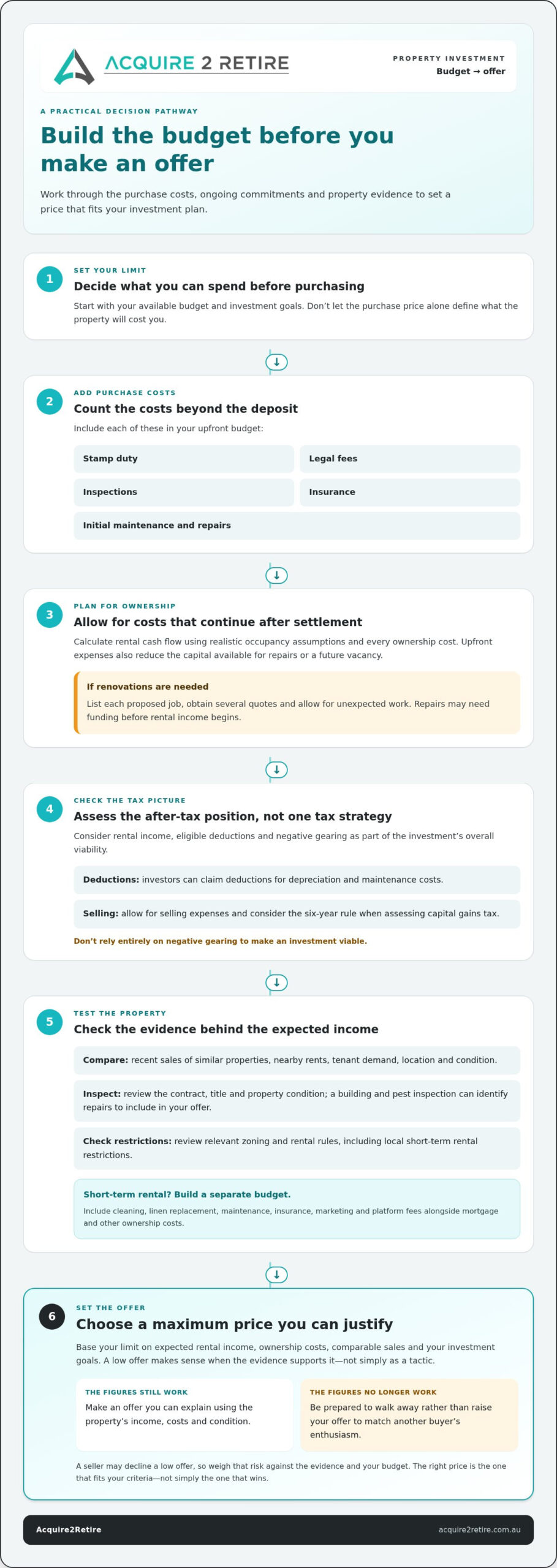
Set your spending limit before purchasing, then include stamp duty, legal fees, inspections, insurance and initial maintenance. These costs reduce the capital available for repairs or a future vacancy. For renovations, list each proposed job, obtain several quotes and allow for unexpected work. A property that needs repairs may require more cash before rental income begins.
Calculate rental cash flow using realistic occupancy assumptions and every ownership cost.
For Australian tax planning, rental income, eligible deductions and negative gearing all affect an investment’s after-tax position. Investors can claim deductions for depreciation and maintenance costs, but shouldn’t rely entirely on negative gearing to make an investment viable. Allow for selling expenses and consider the six-year rule when assessing capital gains tax on a sale.
Short-term rentals, including Airbnb stays, need a separate budget. Include cleaning, linen replacement, maintenance, insurance, marketing and platform fees alongside mortgage and other ownership costs. These expenses can reduce the income left after each booking, while local short-term rental rules may affect whether the intended use is permitted.
Before purchasing, review the contract, title, property condition and relevant zoning or rental restrictions. Check that insurance suits the building, intended tenancy and risks you need covered. A building and pest inspection can identify repairs to factor into your offer. For ongoing portfolio decisions, structured support can help keep cash-flow assumptions and ownership costs under review.
3. Is it worth making a lowball offer on a property?
A low offer can make sense when comparable sales, property condition or local demand support it. It’s less useful as a negotiation tactic without evidence: the seller may decline, and you could lose a suitable property. Set your maximum price using rental income, ownership costs and investment goals, then make an offer you can justify with those figures.
Common Australian property investment mistakes include overpaying through emotional attachment, underestimating ownership costs and relying on negative gearing instead of assessing long-term viability. A family home’s appeal, a polished renovation or pressure to secure an estate property can cloud judgement. Compare recent sales of similar properties, assess condition and expected maintenance, and separate personal preference from the investment case.
Use a consistent decision process. First, record the property’s likely rent and expenses. Next, compare its condition and location with similar homes, including sales history and tenant demand. Then decide the price at which expected income and potential returns still fit your strategy. If the figures no longer work, be prepared to walk away rather than raise your offer to match another buyer’s enthusiasm.
Buying off the plan or in a new development brings different uncertainties from purchasing an established home. The finished property may differ in detail from expectations, construction timing can affect when rental income begins, and market conditions may change before completion. Consider the proposed location, likely tenant demand and development details, and test whether the investment still works if rent or resale prospects disappoint.
A lowball offer isn’t automatically a mistake, and paying more isn’t proof of success. The key question is whether the price, property condition and expected income align with your investment criteria. Base your offer on comparable sales and your budget, not the desire to win. That discipline helps limit emotion-driven decisions and keeps each purchase connected to a clear financial purpose.
4. Budgeting for ancillary expenses and vacancies
A lender’s borrowing capacity is a ceiling, not a spending target. Set your mortgage budget below that limit so repayments leave room for changing interest costs, property expenses and household commitments. This can also preserve capital for future portfolio opportunities, rather than tying every available dollar to one purchase.
Map expenses by timing: costs due at settlement, regular ownership bills and irregular repairs. Include insurance, strata fees where applicable, rates, maintenance and preparation between tenancies. Keep separate estimates for essential repairs and optional improvements, then prioritise work that protects the property or supports tenant demand. This creates a more practical budget than relying on a single maintenance allowance.
Vacancy affects income as well as yield. In the example, a 4 per cent rental yield falls to 3.7 per cent if the property is vacant for one month each year. Budget for marketing, cleaning, minor repairs and the gap before a new tenant starts paying rent. A property’s location, condition, asking rent and tenant demand can all influence how quickly it becomes occupied.
Keep a financial buffer for interruptions and unexpected bills. One recommendation is to hold 2-4 months of rental income; another is to reserve 3-6 months of expenses. These use different measures, so consider both against your mortgage repayments, regular bills and likely maintenance needs. An illustrative property assumes 50 occupied weeks per year, but a vacancy can shorten that income period and increase the cash you must supply.
Review the budget before each purchase and after changes to rent, repayments or property condition. The biggest risk is treating rent as guaranteed income while fixed expenses continue. A clear cash-flow plan helps you decide what remains affordable during a vacancy, rather than relying on borrowing capacity alone. Plan your property investment budget with a structured view of costs, reserves and portfolio goals.
Acquire2Retire: Planning & Strategy
Acquire2Retire helps Australian investors connect property decisions with a broader wealth strategy. Its Planning & Strategy offering can help you shape an investment roadmap around your goals, budget and appetite for risk, before you commit to a purchase.
When you’re ready to act, Acquisition and Finance support can bring property selection and funding decisions into the same plan. Tenancy coordination and ongoing support can also help you consider how occupancy and portfolio needs fit your approach. This guidance is useful when you’re weighing a potential purchase or reviewing how a property fits your wider investment plans.
For a considered conversation about your property investment plans, contact Acquire2Retire or visit acquire2retire.com.au.
Make your next investment decision with purpose
A property budget is more than a limit on what you can spend; it’s a framework for deciding what fits your goals as circumstances change. Before pursuing another opportunity, clarify what you want your portfolio to achieve, how much flexibility you need and which trade-offs you’re comfortable making. That gives you a steadier basis for weighing the property investment mistakes to avoid against choices that genuinely suit your plans.
Acquire2Retire can help bring those decisions into one considered process through Planning & Strategy, Acquisition and Finance. Whether you’re shaping an investment direction or assessing a potential purchase, connect your next step to a clear view of your broader wealth strategy.
Discuss your property investment plans with Acquire2Retire, and take the next step with greater clarity and confidence.
Frequently Asked Questions
Is an all-cash offer better than getting a mortgage?
An all-cash offer avoids borrowing costs, but it isn’t automatically the stronger investment choice. Using cash can leave less available for repairs, vacancies or other investments, while a mortgage adds repayments and interest but preserves some capital. Compare both approaches against the property’s expected income, your ongoing commitments and the value of keeping funds accessible. The better fit depends on how each option supports your wider financial plan.
Is it worth making a lowball offer on a property?
A low offer can be worthwhile when comparable sales or the property’s condition support the price. Decide your maximum before negotiating, then explain your offer with evidence rather than emotion. For example, if a building inspection identifies repairs, estimate their effect on your budget and use that information to shape the offer. An unsupported low figure may simply be rejected, so keep your investment criteria clear and be prepared to move on.
What advice should property investors heed?
Make decisions from a written investment plan, not pressure to buy quickly or follow someone else’s strategy. Define your time horizon, cash-flow needs and acceptable risks, then assess each property against those criteria. Record assumptions, such as expected rent and maintenance needs, so you can revisit them when circumstances change. These are practical property investment mistakes to avoid: buying without a clear purpose or treating projected returns as certain.
What are some common mistakes that people make with real estate contracts?
Common contract oversights include missing special conditions, misunderstanding the settlement date and assuming fixtures or inclusions are covered without checking. Buyers can also overlook finance, inspection or other conditions that affect their decision to proceed. Read the contract and disclosures carefully, compare them with the agreed offer, and note every deadline. A conveyancer or solicitor can explain legal terms and how clauses apply to your transaction.
How do Australian stamp duty and land tax vary by state for investment properties?
Stamp duty and land tax rules differ across Australian states and territories, so the property’s location matters. Rates, thresholds, exemptions and surcharges may depend on factors such as property value and ownership circumstances. Before comparing properties in different jurisdictions, include the relevant purchase duty and likely ongoing land tax in each scenario. This lets you compare costs on a like-for-like basis rather than focusing only on the purchase price.
How should investors assess rental yield, vacancy rates and cash flow before buying?
Start with annual rent divided by the purchase price to calculate gross yield, then test how the result changes during vacancy. Next, subtract recurring ownership expenses and mortgage costs to estimate cash flow. For example, compare expected rent with a scenario where a tenant leaves and advertising or repairs delay the next tenancy. Use local rent comparisons and the property’s condition to assess whether your assumptions are realistic.