
What if a property that looks affordable on its own still puts pressure on your finances when combined with your other investments? A property portfolio cash flow strategy looks beyond individual rental figures to how income, expenses, debt commitments and reserves interact across your portfolio and household.
It’s understandable to focus on each property’s rent and repayments, but those figures won’t always show whether you have room to manage a vacancy, a change in interest rates or an unexpected repair. They may also leave you unsure whether another purchase fits comfortably alongside your existing commitments and long-term plans.
This article explains how to assess cash flow across your portfolio, identify pressure points and consider how changing conditions could affect your position. You’ll learn practical ways to review your assumptions and compare options, so acquisition and finance decisions fit within a considered investment roadmap instead of relying on isolated property figures.
Key Takeaways
- A property portfolio cash flow strategy brings income, outgoings, debt commitments and reserves into one view, helping you see beyond each property’s individual figures.
- Map regular rental receipts against ongoing and irregular costs to understand where cash-flow pressure could emerge.
- Weigh income resilience and growth objectives against your time horizon, circumstances and capacity to manage shortfalls.
- Use a structured review to test changing assumptions, identify pressure points and plan practical responses before making your next investment decision.
- Align property research, finance and acquisition choices with existing commitments and your longer-term investment roadmap.
What does a property portfolio cash flow strategy actually manage?
A property portfolio cash flow strategy is a plan for understanding how money moves across your investments and how those movements fit your wider financial commitments. It brings rental income, operating expenses, finance commitments, planned costs and available reserves into one view, rather than treating each property as a separate decision.
This matters because a property showing an apparent surplus may not tell you how much cash is available across the portfolio. Its income may need to support shared costs, upcoming work or another property’s shortfall. Household commitments can also affect how comfortably you can take on further debt. A useful cash flow view tracks money received and paid over a period, not simply the income an asset appears to generate.
Property-level cash flow versus portfolio-level cash flow
Each property has its own rental receipts, running expenses and finance commitments, as well as possible cash demands such as a repair or a period without rent. Looking across the portfolio shows how those individual positions interact. Include personal commitments separately, since they also affect your capacity to absorb a shortfall.
Illustrative example: One investment property appears to have money left after its regular expenses and repayments. Another has a planned expense approaching, while the household also has ongoing commitments. Viewed separately, the first property may look comfortably affordable. Considered together, the portfolio may have less flexible cash available than that single-property figure suggests.
Why cash flow is not the same as investment performance
Portfolio cash flow is the money moving into and out of your investments over a chosen period, considered alongside the reserves available to meet upcoming obligations. It is distinct from equity, which reflects an ownership position, and capital growth, which concerns changes in an asset’s value. Neither equity nor an increase in value automatically means cash is available to meet a bill.
A cash-flow snapshot describes a particular period and relies on the assumptions used to prepare it. It isn’t a promise that the same position will continue: rental income, expenses and finance commitments can change. Cash flow is one input into assessing investment performance and future choices, not a complete measure on its own.
This article focuses on portfolio cash-flow decisions and how to understand the moving parts. It isn’t tax, legal or day-to-day property management advice. Keeping those boundaries clear helps you use the cash-flow picture to support more considered planning and investment decisions.
How do income, expenses, debt and reserves shape portfolio cash flow?
Once you’ve looked beyond individual properties, map what money is expected to come in, what must go out and what needs to stay accessible. A useful property portfolio cash flow strategy separates predictable commitments from costs or timing changes that could put pressure on available funds.
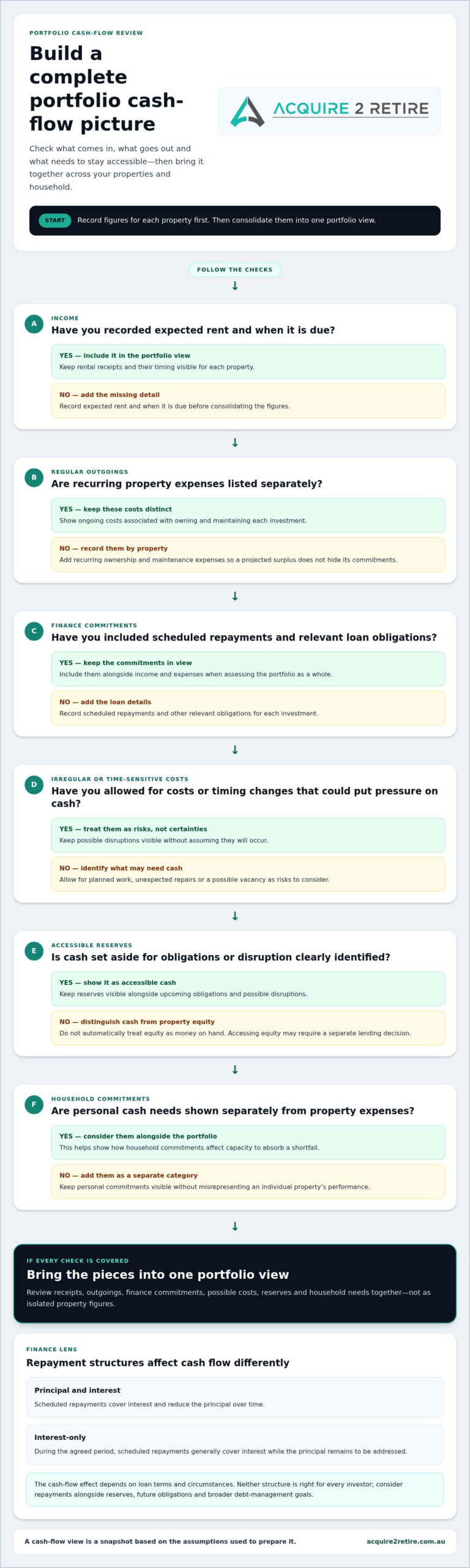
Build a complete portfolio cash-flow picture
Start by recording figures for each property, then consolidate them into a portfolio view. Keep categories distinct so a projected surplus doesn’t obscure the commitments behind it:
- Rental receipts: expected rent and when it is due.
- Regular property expenses: recurring costs associated with owning and maintaining each investment.
- Finance commitments: scheduled repayments and other relevant loan obligations.
- Irregular or time-sensitive costs: planned work, unexpected repairs or a possible vacancy. These are risks to allow for, not events that are certain to occur.
- Reserves: accessible cash set aside to meet obligations or respond to disruption.
Keep household commitments visible alongside the portfolio, but separate from property expenses. This shows how personal cash needs affect investment capacity without misrepresenting an individual asset’s performance. A reserve held as cash is also different from equity in a property: accessing equity may require a separate lending decision, so don’t automatically treat it as money on hand.
Understand how lending decisions affect flexibility
With a principal and interest loan, scheduled repayments cover interest and reduce the principal over time. An interest-only structure generally means scheduled repayments cover interest during the agreed period, while the principal remains to be addressed. The cash-flow effect depends on the loan terms and circumstances; neither structure is right for every investor. Consider how repayments fit with the portfolio’s reserves, future obligations and broader debt-management goals.
Lenders consider serviceability when assessing borrowing applications, but an assessment isn’t a promise of future borrowing capacity. Your circumstances, commitments and lending conditions can change. A cash-on-cash rate of return ratio can help describe cash generated in relation to cash invested, but it doesn’t replace a portfolio-wide view of receipts, outgoings and available reserves.
Acquire2Retire’s finance structuring service considers lending commitments alongside your existing assets and goals. Explore tailored property investment planning to consider those moving parts together.
Positive cash flow or growth: how should a portfolio strategy weigh both?
Income and growth can serve different purposes in an investment plan. A property portfolio cash flow strategy considers how reliably the portfolio can meet its commitments while keeping longer-term objectives in view. Positive cash flow alone doesn’t guarantee resilience: the result may still leave limited accessible reserves or rely on assumptions that change.
Use the comparison below to clarify what you’re prioritising, rather than treating either approach as a promised outcome.
| Consideration | Income resilience | Growth objectives |
|---|---|---|
| Focus | Rental income relative to costs and commitments. | Potential for longer-term value growth and reinvestment. |
| Cash-flow implications | Can place greater emphasis on ongoing income and accessible funds. | May involve accepting tighter cash flow in pursuit of a longer-term objective. |
| Trade-offs | A positive position may not account for every future cost or change. | Growth isn’t assured, and equity isn’t automatically available cash. |
| Useful questions | Could the portfolio meet commitments if income changed or costs arose? | Does the time horizon leave room to manage short-term pressure? |
When portfolio liquidity deserves more attention
Accessible cash may matter more if your income varies, significant costs are approaching or reserves are limited. There’s no single reserve target that suits every investor; needs depend on commitments, risk tolerance and the capacity to absorb a shortfall. A planned purchase can add finance commitments and ownership costs, so assess its effect on the whole portfolio before proceeding.
When growth and reinvestment remain part of the plan
Investors with a longer time horizon may weigh current cash flow alongside equity and future objectives, while recognising that neither future growth nor the ability to borrow against equity is certain. A strategic priority guides decisions; it doesn’t guarantee an investment result. For Australian investors, consider tax implications separately using current Australian guidance, as tax treatment can depend on individual circumstances.
The balance is personal. Reviewing cash-flow needs, risk profile and time horizon together can help shape an investment roadmap that reflects your circumstances, rather than favouring income or growth by default.
How to stress-test and review a property portfolio cash-flow strategy
A stress test helps you see how a change could affect the portfolio before it happens. It isn’t a prediction; it’s a way to explore your exposure and consider practical responses. Test each scenario across all properties and household commitments, rather than looking only at the asset where the change occurs.
Choose useful measures and scenario assumptions
Track rental receipts, regular outgoings, finance commitments and accessible reserves using consistent categories. Label confirmed figures separately from estimates, and note when assumptions need updating. Sensitivity checks can show which changes have the greatest effect on available cash, without relying on unsupported probabilities or forecasts about future interest rates.
Use a repeatable process:
- Establish a baseline: consolidate current income, expenses, finance commitments and accessible reserves across the portfolio.
- Vary assumptions: consider a vacancy, an unplanned repair or a change in finance commitments, one scenario at a time.
- Assess pressure points: identify which assets and household commitments contribute to any shortfall, and how much accessible cash remains.
- Set responses: consider what adjustments or choices could help manage the pressure, and what decisions might need to wait.
- Review: record the assumptions and revisit the assessment when circumstances change.
For example, consider a vacancy at one property while another has an upcoming expense. The portfolio view can show how the two demands overlap, whether reserves remain accessible and which commitments still need to be met. Treat the scenario as a planning exercise, not a claim that either event will occur.
Set review points before making the next move
Review your figures after a material change to income, expenses, finance arrangements or investment plans. Before an acquisition, consider its expected commitments alongside the existing portfolio and assess whether it remains consistent with your cash-flow needs, risk profile and longer-term objectives. A review can reveal when assumptions have shifted, helping you make a considered decision rather than relying on an old snapshot.
For a broader framework, explore strategic property investment planning in Australia, where cash-flow considerations can form part of a tailored investment roadmap.
How coordinated investment advice can support your cash-flow strategy
A cash-flow framework is most useful when it informs decisions across the life of an investment, from setting a direction to assessing a potential purchase and reviewing how the portfolio is tracking. A property portfolio cash flow strategy can sit within a tailored roadmap that brings your cash-flow requirements, risk profile and longer-term goals together, so each decision is considered in the context of your existing commitments.
Connect strategy, acquisition and finance decisions
An investment roadmap can guide property research and help define what a suitable acquisition needs to contribute to your plan. Due diligence and negotiation can be considered alongside the property’s expected costs and how its finance commitments may sit with the rest of your portfolio. This keeps affordability and cash-flow needs visible, rather than treating an attractive opportunity as a decision in isolation.
Acquire2Retire’s finance structuring service considers borrowing in relation to portfolio expansion and debt-management goals, without assuming that any particular borrowing outcome is assured. Initial tenancy coordination can support the leasing process for an acquired property. It is distinct from ongoing property management.
Keep the strategy responsive as the portfolio changes
Plans need room to adapt as your circumstances evolve. Portfolio monitoring, equity reviews and strategic advice can help you revisit how assets and commitments fit together when your goals, financial position or investment plans change. An equity review can inform a discussion about options, but equity isn’t the same as accessible cash and doesn’t guarantee borrowing capacity.
Useful review questions include: Does the portfolio still reflect your priorities? Have commitments or cash-flow needs shifted? Would a proposed acquisition fit the strategy as it stands now? Working through these questions periodically helps keep the roadmap grounded in your current position, rather than relying on assumptions made at an earlier stage.
Coordinated planning can connect these steps: establish the direction, assess and research opportunities against it, consider due diligence and finance, then monitor the portfolio as it develops. That approach makes cash flow part of the investment decision-making process, not just a figure to revisit after a purchase.
If you’re considering your next step, discuss your property investment strategy and how it can align with your portfolio commitments and longer-term goals.
Make your next portfolio decision with greater clarity
A resilient property portfolio cash flow strategy brings income, expenses, finance commitments and reserves into one considered view. It helps you understand how the properties work together, weigh income needs against longer-term goals, and test how changes could affect your position before making the next investment decision.
Tailored planning can bring your cash-flow requirements, risk profile and long-term targets into a practical roadmap. Property research, acquisition and finance decisions can then be considered alongside existing commitments, with portfolio monitoring and strategic advice helping you reassess as your circumstances change.
To consider how your investments fit together, discuss your property investment strategy with Acquire2Retire. A measured plan can help you move forward with greater confidence, one informed decision at a time.
Frequently Asked Questions
What is a property portfolio cash flow strategy?
A property portfolio cash flow strategy is a plan for tracking money coming into and going out of your investments, alongside reserves and financial commitments. It brings rental receipts, property expenses and finance repayments into a consolidated view, rather than relying on one property’s figures alone. Use it to assess affordability, identify potential pressure points and consider how investment decisions fit your household commitments and longer-term goals.
How do you calculate cash flow across multiple investment properties?
For each property, total rental receipts over a chosen period, then subtract its operating expenses and finance commitments for that same period. Include irregular or planned costs separately, and label estimates clearly. Add the property figures to see the portfolio position, while keeping household commitments visible as a separate part of your overall affordability assessment. Use consistent time periods and categories so comparisons remain meaningful as circumstances change.
Is positive cash flow more important than capital growth?
Neither is universally more important; the balance depends on your circumstances, time horizon, risk profile and capacity to manage shortfalls. Income can support ongoing commitments, while growth may align with longer-term objectives, but neither is guaranteed. Consider whether you need more accessible cash now, or whether your plan can accommodate tighter cash flow while pursuing longer-term aims. A strategy can account for both priorities without assuming a particular result.
Can a property portfolio have positive cash flow overall when one property runs at a shortfall?
Yes. The other properties may generate enough cash after their costs and finance commitments to offset one property’s shortfall over the period you’re assessing. However, a positive portfolio total doesn’t automatically mean funds are available at the right time or in the right place. Check when receipts and payments fall due, and consider whether accessible reserves can cover the shortfall without disrupting other commitments.
What happens to portfolio cash flow when a rental property is vacant?
Rental receipts from that property may pause or decrease, while finance commitments and other ownership costs can continue. The effect on the portfolio depends on the vacancy’s timing and duration, the property’s obligations and the cash available elsewhere. Treat a vacancy as a scenario to test, not a certainty: assess how it could affect the consolidated position and whether reserves could meet commitments during the gap.
How much cash should a property investor keep in reserve?
There isn’t one reserve amount that suits every investor. Consider your regular commitments, upcoming costs, finance obligations, income reliability and ability to manage a shortfall. Test how much accessible cash would remain under scenarios such as a vacancy or an unplanned repair, then decide what level feels appropriate for your circumstances. Property equity isn’t the same as cash on hand, as accessing it may require a separate finance decision.
How often should I review my property portfolio cash flow strategy?
Review it periodically and whenever a material change affects income, expenses, finance arrangements or your investment plans. Reconcile assumptions with actual receipts and costs, update estimates and consider whether your reserves and commitments still fit your goals. Review the portfolio before making another acquisition, too. Regular, thoughtful checks help your property portfolio cash flow strategy stay relevant as your assets, circumstances and long-term priorities evolve.