
An SMSF can buy residential property only when the investment meets the fund’s rules, including the requirement that members and related parties cannot live in or rent it. From 10 August 2026, an SMSF can no longer enter a new limited recourse borrowing arrangement to purchase residential property, although existing arrangements established before that date are grandfathered. These SMSF property investment rules make the property’s use and the way it is acquired central to whether it qualifies.
It’s understandable to assume that any property with investment potential could suit an SMSF, but the fund must hold it for members’ retirement benefits, not personal use. This guide explains which residential properties may qualify, the restrictions on buying, leasing and borrowing, and how the sole purpose test applies.
You’ll also learn how business real property differs, when related-party rules matter, and why a property’s intended use can affect its eligibility. These distinctions help you assess whether a property fits the fund’s purpose before considering an acquisition.
Key Takeaways
- Assess a property’s intended use and who will occupy it before deciding whether it can be held by an SMSF.
- Keep the fund’s retirement purpose at the centre of the decision, including how the property is acquired, leased and managed.
- Business real property follows different eligibility rules; a dwelling may qualify when it is on no more than 2 hectares and the property’s main use is not private or domestic.
- Consider the fund’s investment strategy, liquidity and member circumstances alongside the property’s potential returns.
Can I Buy Residential Property In My SMSF?
An Australian SMSF can buy residential property if the investment supports members’ retirement benefits and complies with the fund’s rules. Borrowing and related-party restrictions affect which properties qualify and how trustees can acquire them.
Borrowing arrangements and the new arrangement ban
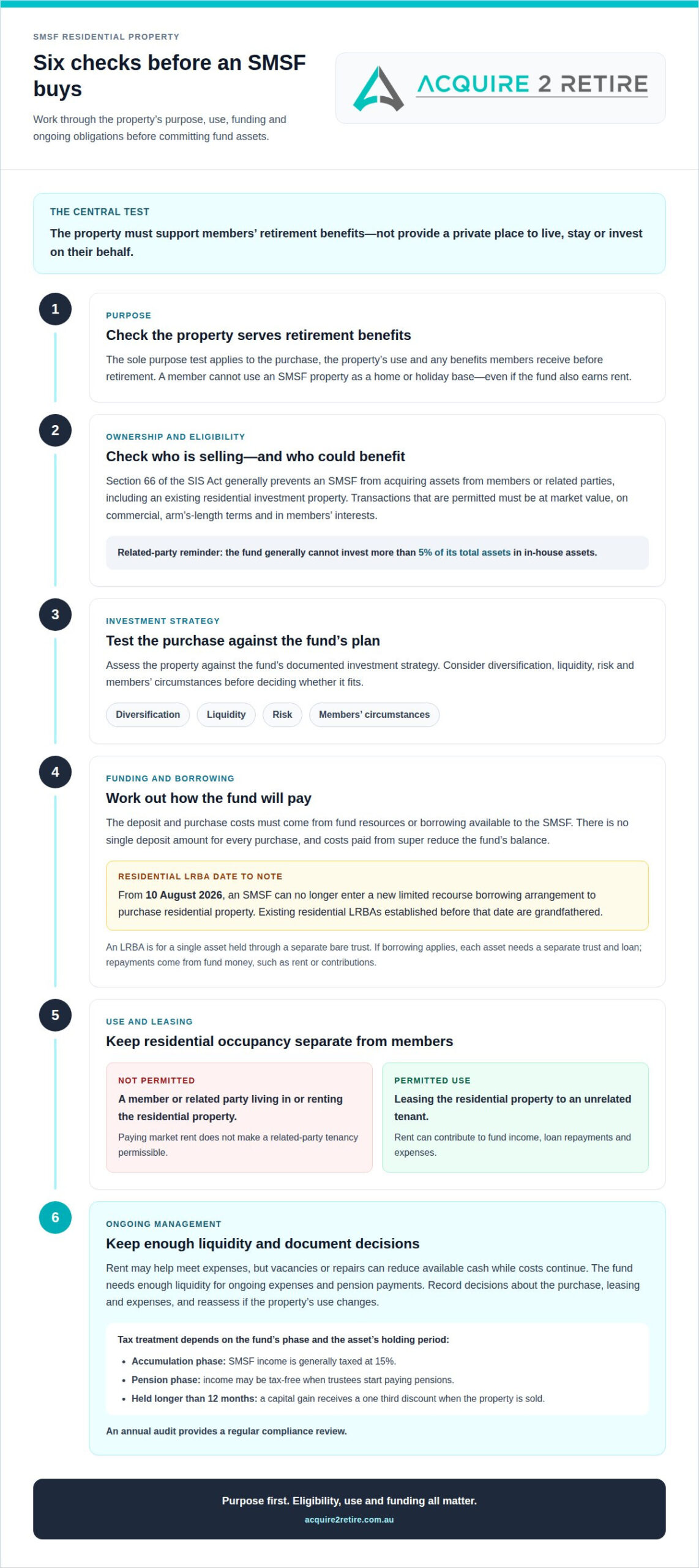
A limited recourse borrowing arrangement (LRBA) lets an SMSF borrow to acquire a single asset, held through a separate bare trust. The lender’s recourse is limited to that asset, so other fund assets are protected if the loan defaults. From 10 August 2026, an SMSF can’t enter a new LRBA to purchase residential property. Existing residential LRBAs established before that date are grandfathered.
Sole purpose and in-house asset rules
The sole purpose test requires SMSF property to provide retirement benefits, while in-house asset rules restrict certain fund investments and arrangements. An SMSF generally cannot invest more than 5% of its total assets in in-house assets. This matters where property involves a member or related party, as the fund’s ownership and use must remain compliant. Use and leasing of residential property held in an SMSF are subject to restrictions.
Rental income, capital gains and tax phases
Rental income and capital gains are taxed within the SMSF, with treatment depending on its phase and the asset’s holding period. In accumulation phase, SMSF income is generally taxed at 15%; in pension phase, income may be tax-free when trustees start paying pensions. According to the Australian Taxation Office, property held for longer than 12 months receives a one third discount on a capital gain when sold.
Property purchase steps and approvals
Before buying, trustees need to assess the property against the fund’s documented investment strategy, including diversification, liquidity, risk and members’ circumstances. If borrowing applies, the property must be held in a bare-trustee’s name, with a separate trust and loan for each asset. Repayments come from fund money, such as rent or contributions. The fund must also have enough liquidity to meet expenses and pension payments.
What are the SMSF investment restrictions?
Residential property held by a super fund is subject to strict rules on use, ownership and dealings with related parties. Before committing fund assets, trustees also need to consider purchase funding, ongoing expenses and liquidity.
Personal use and related-party restrictions
SMSF property rules can restrict personal use of fund property by members and related parties. This applies even if the occupant pays market rent, so leasing to a member’s relative is still prohibited. The fund may lease residential property to an unrelated tenant. This separation helps ensure the property serves the fund’s investment purpose rather than providing a private benefit to members or their associates.
Purchases from members and related parties
Section 66 of the SIS Act generally prevents an SMSF from acquiring assets from members or related parties, including an existing residential investment property. Exceptions include listed securities and business real property acquired at market value. A residential property doesn’t become business real property simply because its owner holds several investment properties. Related-party loans or other financial assistance to members or their relatives are also generally prohibited. Any permitted transaction must be conducted on commercial, arm’s-length terms and serve members’ interests, rather than sidestepping acquisition rules.
Property costs and ongoing expenses
The deposit and purchase costs must come from fund resources or borrowing available to the SMSF; there is no single deposit amount for every purchase. Costs paid from super reduce the fund’s balance. After settlement, rent can contribute to loan repayments and expenses, but the fund needs enough liquidity for ongoing costs and pension payments. A vacancy or repair can reduce available cash while expenses continue, so trustees should weigh this risk against the property’s expected income.
Regular portfolio support can help trustees keep investment decisions aligned with the fund’s needs. Explore ongoing investment support as part of that consideration.
Sole purpose test
An SMSF property must be held solely to provide retirement benefits to fund members. The sole purpose test applies to the purchase, the property’s use and any benefits members receive before retirement.
Personal benefits and the sole purpose test
Under the sole purpose test, residential or commercial property must serve the fund’s retirement purpose, not provide private advantages. A member cannot use an SMSF property as a home or holiday base, even if the fund also earns rental income. The key question is whether a decision supports the fund’s retirement objectives or gives a member an immediate personal benefit.
For example, leasing residential property to a member’s relative can create a private benefit, even when rent is paid. By contrast, rent from an unrelated tenant can contribute to fund income and retirement savings. Trustees should consider the whole arrangement, including who occupies the property and how it is used.
Compliance with the sole purpose test
Compliance depends on trustees’ actions, not simply on whether a property looks like an investment. The fund’s documented investment strategy should address risk, liquidity, diversification and members’ circumstances. Trustees should record decisions about the purchase, leasing and property expenses, then ensure the asset continues to support retirement benefits.
An annual audit provides a regular compliance review, while clear records help explain the fund’s decisions. If a property’s use changes, trustees need to assess whether it remains consistent with the fund’s purpose. Pension arrangements must also remain focused on providing retirement benefits to members.
Penalties depend on the breach: administrative penalties imposed on individual SMSF trustees are payable personally. A trustee caught by the section 66(3) anti-avoidance provision may face up to 2,000 penalty units, with a stated maximum of A$626,000 per trustee, and up to one year’s jail.
That section 66(3) penalty concerns schemes to avoid related-party acquisition rules, not every sole purpose breach. Keeping decisions, leases and property use aligned with retirement benefits helps trustees demonstrate the fund’s purpose and explain their actions during an audit.
SMSF property eligibility rules
A property’s eligibility depends on its use, ownership and fit with the SMSF’s documented investment strategy. Trustees must be able to show how the asset supports members’ retirement benefits.
Property eligibility criteria
Assess the property as an SMSF asset, not simply as a purchase with investment potential. The trustee’s documented strategy must consider the fund’s risk, diversification, liquidity and members’ circumstances. For example, a property with limited rental prospects may not suit a fund that needs cash for expenses or pension payments.
Ownership arrangements matter too. A property acquired through an SMSF must be held in the correct fund structure, and its use must remain consistent with the fund’s purpose. Trustees should consider its current and intended use, who will occupy it, and whether the fund can meet its ongoing obligations. These factors determine whether the asset fits the investment plan.
Residential and commercial property distinctions
Residential and commercial property differ chiefly in their use and the rules for related-party transactions. Residential property can be leased to an unrelated tenant, but a member or related party cannot occupy or rent it. The treatment of commercial property can depend on how it is used and the circumstances of the transaction.
A dwelling used for private or domestic purposes can still form part of business real property if it sits on no more than 2 hectares and the property’s main use is not private or domestic. For example, a residence on business land does not qualify solely because it is attached to business premises; the property’s main use remains central. A member’s business leasing commercial premises from the fund must pay market rent promptly and in full when due.
Use property investment planning to assess how an asset’s use and structure fit the SMSF’s strategy before acquisition.
Acquire2Retire: Planning & Strategy
Acquire2Retire can help you assess whether a property fits your SMSF strategy before you commit to an acquisition. Its Planning & Strategy work considers the fund’s investment goals and the property’s role, while Acquisition and Finance support can help shape the purchase approach. Tenancy coordination can also be considered as part of the investment plan.
This support can be useful when comparing residential and commercial options, weighing borrowing against liquidity needs, or assessing how a property aligns with members’ retirement objectives. A sound plan considers eligibility, funding and intended tenancy together, rather than treating each decision in isolation.
For support with planning an SMSF property investment, contact Acquire2Retire to discuss your next steps.
Make your next property decision with care
Before proceeding with a property, consider its role in the fund’s broader retirement plan. Assess how the asset could affect the fund over time, including the balance between long-term growth and the flexibility to respond to changing circumstances. A property can shape the fund’s options well beyond the purchase, so its place in the plan deserves careful thought.
The SMSF property investment rules are most useful as a framework for testing a decision, not as a checklist to consult at the last moment. When the intended use, ownership structure and investment rationale are clear, trustees can approach the next stage with a stronger understanding of what they are committing the fund to.
If you’re ready to explore a property decision for your SMSF, contact Acquire2Retire about your next steps. A considered plan can help you move forward with greater clarity and confidence.
Frequently Asked Questions
Can I buy an Investment Property in my Self-Managed Super Fund?
Yes, an SMSF can buy an investment property if it supports members’ retirement benefits and complies with superannuation law. For example, residential property rented to an unrelated tenant may generate income for the fund. Trustees should consider how the asset fits the investment strategy, its effect on cash flow and whether the fund can meet expenses while holding it.
Rules and Regulations: Can I Lease or Live in the property investment?
You can’t live in or rent residential property owned by your SMSF, and neither can a related party. Paying market rent doesn’t make a residential lease to a member or relative permissible. The fund can lease the property to an unrelated tenant instead. For commercial premises, a member’s business may be able to lease the property under the separate business real property rules.
Who are related parties?
Related parties generally include SMSF members, their relatives and their associates. The Australian Taxation Office explains these relationships in its guidance on SMSF related-party rules. For instance, a member’s relative isn’t an unrelated tenant simply because they aren’t a fund member. Identifying the parties before a sale or lease helps trustees understand which restrictions apply.
What are the Australian SMSF rules for buying investment property?
The SMSF property investment rules require trustees to consider the fund’s investment strategy, retirement purpose, property use and transaction structure. The fund must keep its assets separate from trustees’ personal assets, and trustees must arrange an annual audit. For example, assess a proposed purchase against the fund’s liquidity needs to ensure property expenses don’t prevent it from meeting other obligations.
Can an SMSF buy residential property from a member or related party?
Generally, no. An SMSF cannot acquire a member’s existing residential investment property by purchase or contribution, and related-party asset acquisitions are restricted. The exception for business real property doesn’t make an ordinary residential rental eligible. Trustees should distinguish a property’s actual use from its owner’s description; owning several rentals doesn’t, by itself, make them business real property.
What are the SMSF rules for buying commercial property from a related party?
An SMSF may acquire business real property from a related party if the property qualifies and the transaction reflects market value. For example, commercial premises used mainly for a member’s business may qualify, with the business paying market rent in full and on time. A commercial label alone isn’t enough: eligibility depends on the property’s use and the transaction’s terms.