
What if the amount a lender is willing to offer is higher than the amount you can comfortably manage? Working out your borrowing capacity for investment property can help define your options, but a lender’s maximum is not automatically a sensible investment budget.
You may be wondering how rental income affects an assessment, or whether existing loans and everyday expenses will narrow your choices. Lenders consider your income, regular commitments and financial position, and may assess expected rent differently from the full amount you anticipate receiving. Their result is an important guide, but it does not replace a review of cash flow, risk and your wider plans.
This guide explains the main factors that shape borrowing capacity, the information to organise before a finance assessment and how rental income may be treated. It also shows how to compare a lender’s estimate with your own budget, so you can set a realistic property search range without relying on the maximum alone.
Key Takeaways
- Borrowing capacity for investment property is a lender’s estimate of debt you may be able to service, not a property recommendation or spending limit.
- Compare a lender’s estimate with your available deposit or equity and the repayments you’d feel comfortable managing.
- Prepare accurate records of your income, household expenses, existing debts, assets and available contribution before an assessment.
- Rental income may be assessed differently from the rent you expect to receive, so base your plans on the lender’s assessment rather than assuming the full amount will count.
- Use the assessment to set a considered property search range, then weigh potential purchases against your investment strategy, cash flow needs and longer term plans.
What borrowing capacity for an investment property actually tells you
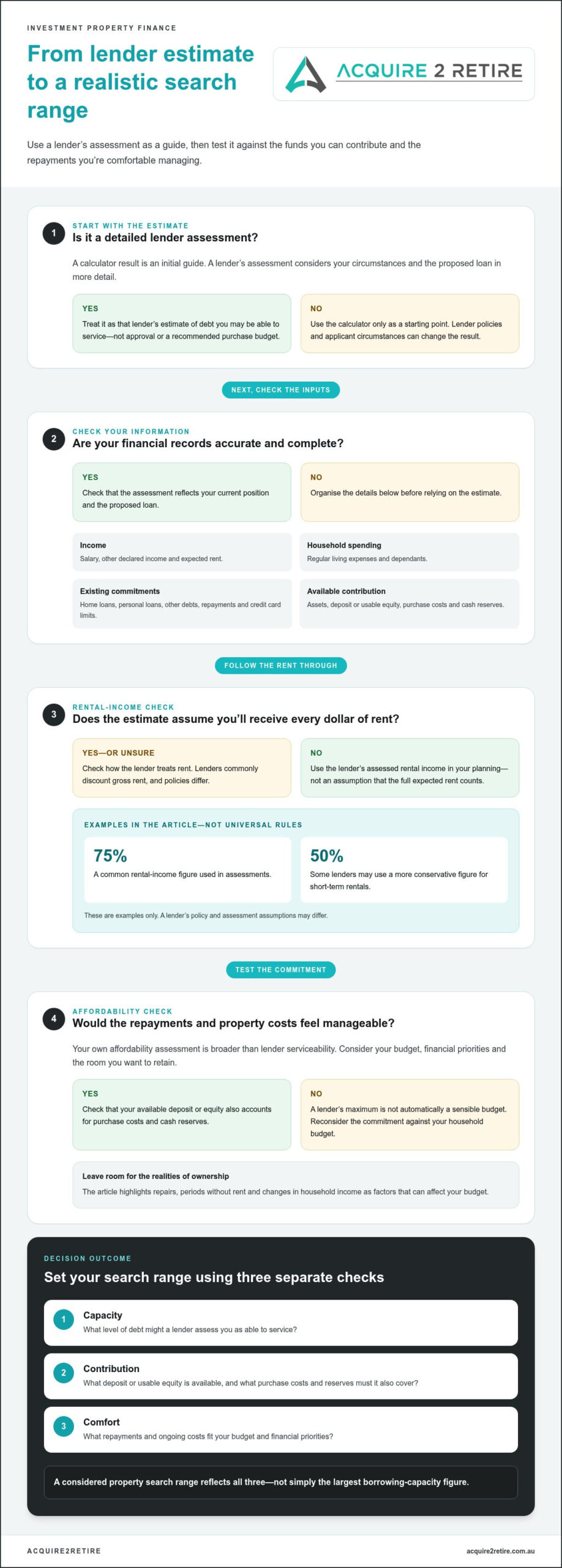
Borrowing capacity is a lender’s estimate of how much debt you may be able to service under its assessment assumptions. It helps indicate the scale of finance that might be available, but it is not a loan approval, a recommendation to buy a particular property or a personal spending limit. A calculator result is an initial guide. A lender’s assessment considers your circumstances and the proposed loan in more detail.
It is also only one part of the purchase picture. Your deposit or usable equity, funds for purchase costs and cash reserves are separate from borrowing capacity. Even if a lender’s assessment suggests you could service a certain loan, repayments and other property expenses still need to fit your household budget and leave room for unexpected changes.
Estimating your borrowing capacity for investment property before setting a search range can keep your research grounded. It gives you a starting point for considering suitable price ranges and can help you avoid becoming attached to a property before you understand how finance, available funds and ongoing costs fit together.
Borrowing capacity versus investment affordability
Lender serviceability is an assessment of your ability to meet repayments using the lender’s assumptions about your income, commitments and loan. Your own affordability assessment is broader: it includes the repayments you are comfortable with, the buffer you want to retain and your other financial priorities. Borrowing capacity is an estimate, not a recommended purchase budget.
For example, a lender’s estimate may allow for a higher loan than you would choose to carry while keeping room in your budget for repairs, periods without rent or changes in household income. The lender’s result describes its assessment; your budget helps define a commitment that feels manageable.
Why an investment loan assessment can differ
Expected rental income can form part of an assessment, alongside existing home loans, credit commitments, living expenses and the details of the proposed loan. Lenders may use different policies and assumptions, so similar applicants can receive different estimates. A calculator result from one lender is neither universal nor a promise of approval.
International discussions of buy-to-let lending can offer background on how rent and interest rate changes may be considered. However, the Buy-to-let mortgages and lender assessment overview relates to a different market and should not be treated as a guide to Australian lender policy.
Keep three questions distinct as you consider your next steps:
- Capacity: What level of debt might a lender assess you as able to service?
- Contribution: What deposit or usable equity do you have, and what purchase costs and reserves must it also cover?
- Comfort: What repayments and ongoing costs fit your budget and financial priorities?
Considering all three before narrowing your property search gives you a more balanced starting point. The aim is not to stretch towards the largest possible figure, but to understand how finance could support an investment plan you can sustain.
How lenders assess borrowing capacity for an investment property
Lenders assess whether your finances could support the proposed repayments, considering income alongside household spending, existing commitments and the new loan. There is no single universal formula: lender policies, loan details and applicant circumstances can all affect the result. Treat an online estimate as a guide, not a prediction of what every lender will offer.
Income, living expenses, existing debts and the proposed loan are the main inputs lenders may consider, subject to their own policies and assessment assumptions. Understanding how these factors interact can help you prepare for an informed assessment and identify details that need careful checking.
Income, rent and household expenses
Applicants may be assessed on salary and other declared income, together with rent expected from an investment property. Lenders commonly discount gross rent rather than counting every dollar. A 75% rental income figure is a common approach, while some may use a more conservative 50% for short term rentals. These are examples, not universal rules, and policies can differ.
Household expenses and dependants also matter because they affect the income available for repayments. Prepare a realistic picture of regular spending, including costs that are easy to overlook. An assessment based on incomplete or understated expenses may not reflect your actual position.
Existing loans, credit limits and assessment settings
Repayments on current home loans, personal loans and other debts can reduce the capacity available for another commitment. A credit card limit may also be considered under a lender’s policy, even if you do not usually use the full limit. Accurate details of balances, limits and repayments help present a clearer view of your obligations.
The proposed loan’s structure and assessed repayment settings matter too. As of October 2026, APRA requires lenders to apply a serviceability buffer of at least three percentage points when assessing loans. In practice, assessment repayments can be higher than those based on the advertised rate, helping test whether the application could withstand a rise in interest costs. Lenders may also apply their own assessment rates and methods.
When estimating borrowing capacity for investment property, consider how each input fits together rather than focusing on one figure, such as rent or salary. A change in household expenses, a new debt or a lender’s treatment of rental income may alter the outcome, even if the property and applicant appear similar to another scenario.
- Income: Salary and other declared income, plus rent assessed under lender policy.
- Outgoings: Household spending, dependants and existing loan repayments.
- Commitments: Debts, credit limits and the proposed loan’s assessed repayments.
- Assessment settings: Lender specific assumptions and applicable serviceability buffers.
Because policies and assessment methods vary, compare scenarios using consistent, accurate information rather than treating one calculator result as definitive. Acquire2Retire’s property investment finance and strategy brings lending considerations into the context of your cash flow needs and longer term goals.
Compare a lender estimate with your real investment position
A lender’s estimate is one part of the decision, not the whole picture. Your available contribution and the level of commitment that suits your finances can each set a different boundary. Looking at all three together helps translate borrowing capacity for investment property into a considered search approach, rather than treating the maximum as a target.
- Lender estimate: An indicative view of the debt a lender may assess you as able to service. Consider the assumptions behind the figure and how the assessment could change.
- Available contribution: The deposit or usable equity you could contribute, while allowing for purchase costs and funds you need to retain. Consider what will remain available after the purchase, not just at settlement.
- Comfortable commitment: The level of repayments and ownership costs that fits your cash flow, buffers and priorities. Consider whether the investment would remain manageable if rent stopped temporarily or costs rose.
These figures do not automatically line up. You might have enough borrowing capacity but not enough accessible funds for the deposit and purchase costs. Or you may have a substantial contribution but decide that a smaller loan better protects your cash flow. Equity can support a contribution, but its availability and the lender’s assessment of your capacity are separate considerations.
What an online borrowing calculator can and cannot show
A calculator provides an indicative result based on the details entered and the assumptions built into the tool. If you leave out a debt, underestimate household spending or enter rental income differently from a lender’s policy, the estimate may not reflect a fuller assessment. Treat it as a way to explore a scenario, not as an offer, approval or substitute for a lender’s assessment.
How your strategy and risk tolerance change the picture
Your comfortable commitment depends on more than the assessed repayment. Allow for ownership costs such as insurance, council rates, maintenance and periods without a tenant, as well as the possibility that interest rates or other expenses may change. Consider how those costs would interact with your existing commitments and other financial priorities, rather than assuming rent will always cover them.
Some investors may choose not to use all the capacity a lender indicates, preserving a buffer for unexpected costs or future plans. That choice can also leave more room to respond if household income changes or the property needs repairs. The right balance depends on your cash flow needs, risk tolerance and longer term portfolio goals, not a universal purchase range.
Loan structure can shape how finance fits within an investment plan. Reviewing investment property loan structure alongside your available contribution and comfort level can help you consider those choices in context.
How to prepare for an investment property borrowing-capacity assessment
A useful assessment starts with a clear picture of your finances and what you want the investment to achieve. Before discussing figures, organise current records and think through more than one realistic scenario. This makes the conversation more specific to your circumstances without treating an estimate as a promise of approval.
- Clarify your investment goals. Consider the role you want the property to play, your preferred timeframe and how a new commitment could fit with existing financial priorities. Note any plans that could affect future borrowing, such as holding the property long term or building a portfolio.
- Gather income information. Bring recent evidence of salary and other declared income, along with details of any rent you already receive. If your income varies or has changed, record the context so the figures can be understood accurately rather than relying on a single snapshot.
- Map expenses and liabilities. Write down regular household spending, dependants, current loan balances and repayments, other debts and credit limits. Use actual records where practical, and include recurring costs that are easy to overlook. Clear, complete information supports a more useful assessment.
- Separate assets from available contribution. Record savings and any equity you may be able to use, but distinguish these from borrowing capacity. Consider what funds need to remain available for purchase costs, ongoing expenses and a financial buffer after acquisition.
- Review more than one scenario. Compare a conservative borrowing scenario with a maximum estimate, treating both as discussion points rather than approvals. Consider how a change in rent, household spending or the lender’s interest rate assumptions could affect repayments and your cash flow. Use current lender guidance for the assumptions being tested.
Before a finance discussion, note unusual or changing circumstances, such as a recent income change or a debt that you expect to repay. Prepare questions about repayment structure, how rent is assessed and how a new loan could affect future borrowing plans. Reviewing investment property loan structure can also help you consider how lending choices relate to your longer term plans.
With accurate records and clear questions, a borrowing capacity assessment can become a grounded planning step. It can help you compare financing scenarios with your goals and cash flow needs, while leaving room to make a considered decision as property research progresses.
Explore tailored investment finance support to connect lending considerations with your broader property investment strategy.
Turn your borrowing capacity into a considered investment next step
A borrowing assessment becomes useful when it helps you make a decision, rather than setting the size of one for you. First understand what the lender’s estimate represents. Then set a range that works with your cash flow needs and financial buffers, and assess potential properties against your investment strategy. This order keeps finance, acquisition research and long term planning connected without allowing a maximum figure to drive the search.
The estimate is one input among several. A property may sit within a lender’s assessment but still be a poor fit for your timeframe, risk profile or plans for managing debt. Equally, a lower commitment may better suit your circumstances, even if a higher amount appears possible. Borrowing more does not automatically improve an investment’s suitability or outcome.
Connect finance decisions with your investment roadmap
Consider how a proposed loan fits your personal goals, tolerance for financial risk, available cash flow and investment time horizon. For instance, an investor who values flexibility may prioritise retaining a buffer, while someone with different goals may weigh the trade offs another way. A tailored finance strategy can connect lending choices with considered acquisition research, rather than treating finance as a standalone target.
That wider view matters as your plans evolve. Property investment planning in Australia can provide broader context for aligning a purchase with your objectives and longer term portfolio intentions.
What ongoing strategic support can contribute
Planning, finance and acquisition decisions inform one another: the property you pursue affects the lending approach, while the lending structure influences cash flow and future options. Ongoing portfolio reviews can help you revisit those choices as your financial circumstances, priorities or portfolio change. The purpose is to keep decisions connected to your strategy, not to assume that an earlier borrowing assessment remains suitable indefinitely.
Use the assessment as a point of orientation, then test each potential purchase against both the numbers and your reasons for investing. A measured process leaves room for research, thoughtful comparison and a financing approach that reflects your circumstances, rather than simply stretching towards the largest available commitment.
If you’re ready to connect a lending assessment with your broader investment plans, discuss an investment finance strategy with Acquire2Retire.
Build your next decision around the bigger picture
Treat finance as part of a living investment plan that can adapt as your goals, cash flow needs and circumstances develop. A clear roadmap can help you assess opportunities with purpose while keeping risk and portfolio priorities in view. The aim is not to borrow as much as possible, but to make choices that remain aligned with the future you are working towards.
Acquire2Retire connects tailored property investment roadmaps with finance solutions shaped around broader portfolio goals. Ongoing portfolio reviews and strategic support can help you revisit decisions as your position changes, keeping your approach considered over time.
To explore how your borrowing capacity for investment property could fit your plans, discuss a considered investment finance strategy with Acquire2Retire.
Frequently Asked Questions
How do I calculate borrowing capacity for an investment property?
To estimate borrowing capacity for an investment property, gather accurate details of your income, household expenses, existing debts, credit limits and expected rental income. Enter them into a lender’s calculator for an initial indication, but remember that each calculator uses its own assumptions and policies. A fuller assessment considers your circumstances and supporting information. The result is an estimate, not a loan approval or a recommended spending limit for your property search.
Does rental income increase borrowing capacity?
Rental income may contribute to a lender’s assessment, but how much weight it receives depends on the lender’s policy and the details of your application. Its effect is considered alongside expenses, existing commitments and other income, so rent alone will not determine the outcome. Use a realistic estimate based on the property you are considering, and factor in the lender’s approach to rental income rather than assuming the full rent will count.
Can I borrow for an investment property if I already have a home loan?
Yes, having a home loan does not automatically rule out applying for investment finance, though its repayments and related commitments may affect the assessment. A lender will consider your broader position, including income, household costs and other debts, as well as the proposed loan. The outcome depends on your circumstances and lender policy. Review all commitments together, rather than assuming available equity alone determines whether another loan is manageable.
Does using equity increase my borrowing capacity?
Equity may help fund a deposit or other purchase costs, but it is not the same as serviceability. A lender still needs to assess whether your income and finances can support additional repayments, including any new lending secured against your property. Accessible equity can depend on the lender’s policy and its valuation of the property. Treat equity as one possible source of contribution, not as a guarantee of approval or a higher borrowing limit.
Why do different lenders give me different borrowing-capacity estimates?
Estimates can vary because lenders may assess household expenses, rental income, credit commitments and repayment settings differently. Online calculators can also request different details or simplify parts of the assessment, producing different results from the same applicant information. Compare the assumptions behind each figure, including how rent and expenses were entered. A varied estimate does not guarantee approval; a full assessment needs to reflect your circumstances and the lender’s requirements.
Is a borrowing-capacity estimate the same as pre-approval?
No. An estimate is an indication based on information entered or supplied, while pre-approval is a lender’s preliminary assessment subject to its terms and conditions. Neither should be treated as an unconditional guarantee that a particular loan will be available. Verification of your information, the property and the lender’s requirements can affect the final decision. Before relying on a pre-approval, clarify its status, conditions, timeframe and what it covers.
What can reduce my borrowing capacity for an investment property?
Existing mortgage repayments, other debts, credit limits, household spending and changes to income can all affect an assessment. So can the lender’s assumptions about rental income and assessed repayments. The impact depends on your complete application and the lender’s policy, so a generic rule may not apply to your situation. Keep your records current and understand which factors are driving an estimate before making financial changes.