
What if the equity in your home could help you buy another property, but not in the way you expect? If you’re researching how to use equity to buy another property, remember that equity isn’t a cash deposit or free money. Accessing it means borrowing against your property and taking on additional debt.
A rising property value may look like an opportunity, while leaving you unsure how much you could access or whether repayments would fit your budget. Total equity and usable equity aren’t the same, and a lender’s approval depends on more than your home’s value. Income, expenses, existing debts and your ability to manage repayments under higher-rate assumptions can all form part of the assessment.
This guide explains how usable equity is estimated, the common ways to access it and what lenders may consider when assessing an application. It also shows how to weigh repayments and cash flow, prepare useful information and include an equity decision in a broader investment plan before moving towards a purchase.
Key Takeaways
- Learn how to use equity to buy another property by distinguishing total equity from the amount a lender may allow you to borrow.
- Follow a clear sequence from estimating equity and reviewing your finances to lender assessment and purchase planning.
- Compare a loan top-up, separate loan split and refinance to understand how each structure can affect the way borrowing is separated and managed.
- Test household and portfolio cash flow against changes in rent, expenses and interest rates before taking on additional repayments.
- Use a practical checklist to prepare your goals and financial details, while keeping early planning separate from lender approval and purchase milestones.
Using Equity to Buy Property: What Usable Equity Means
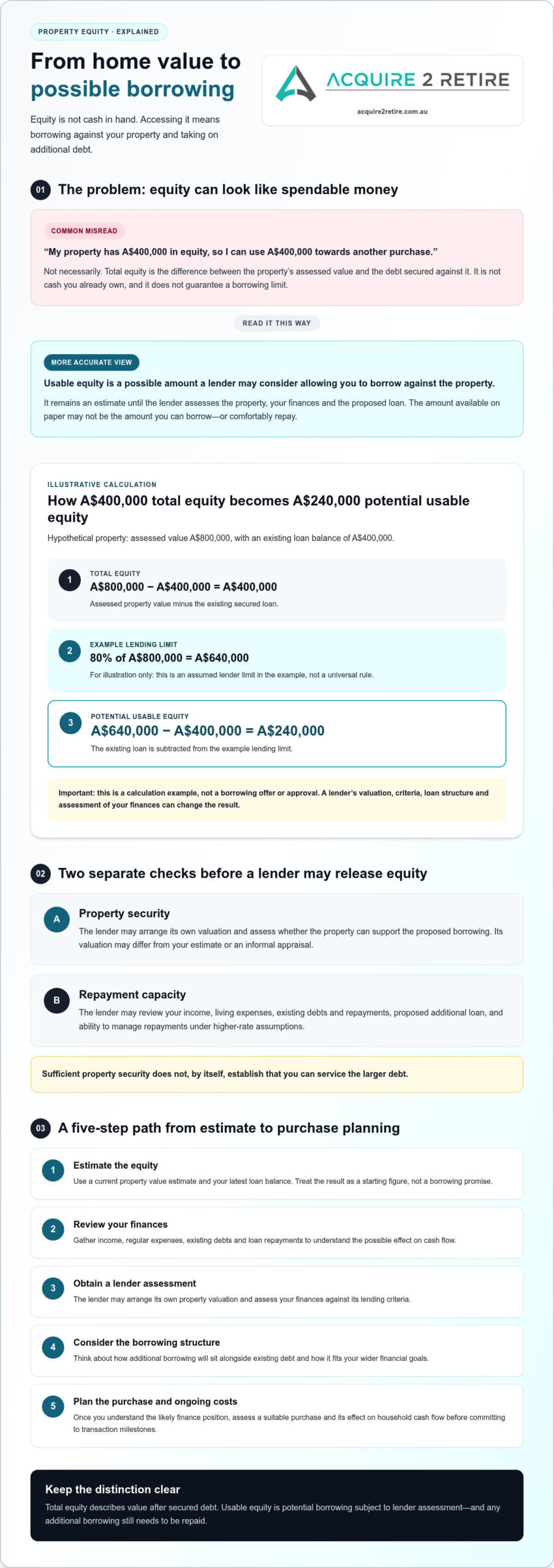
Equity can sound like a ready-made deposit, but accessing it involves borrowing against your property. Your equity is the difference between the property’s assessed value and the debt secured against it. For a foundational explanation, see Understanding Home Equity.
Usable equity is the portion a lender may consider available to borrow against. It remains an estimate until a lender assesses the property, your finances and the proposed loan. The amount that appears available on paper may not be the amount you can borrow, or the amount you could comfortably repay.
What is the difference between equity and usable equity?
Consider a hypothetical property with an assessed value of A$800,000 and an existing loan balance of A$400,000. The estimated total equity is A$400,000. That figure is the gap between value and debt. It doesn’t mean the owner has A$400,000 in cash to spend.
For illustration, if a lender considered borrowing up to 80% of the assessed value, that would equal A$640,000. Subtract the existing A$400,000 loan and the potential usable equity would be A$240,000. This is a calculation example, not a borrowing offer or approval. Lenders set their own criteria, and their valuation may differ from your estimate or an informal appraisal. The existing debt, loan structure and assessment of your finances also matter.
In short, total equity estimates the value you hold in the property after secured debt. Usable equity is a possible borrowing amount under a lender’s assessment. It isn’t money you already own or a guaranteed borrowing limit. Even if a valuation suggests room to borrow, a lender will also consider whether you can meet repayments on the larger debt.
Can equity help fund an investment property deposit?
Potentially. A lender may allow you to borrow further against an existing property, and you could use those funds towards a deposit or other purchase-related requirements. This may let you consider a purchase without first selling your current home, but it doesn’t remove the need to repay the loan or manage its costs.
The amount available, loan terms and approval depend on the lender’s assessment and your circumstances. Income, expenses, existing debts and your capacity to service the additional borrowing all matter. Consider how the new property fits your wider investment plan, including the effect of repayments and ownership costs on household cash flow.
That distinction is central to how to use equity to buy another property responsibly: treat equity as potential borrowing capacity, not as a deposit that is already yours. A sound plan weighs the lender’s assessment alongside your financial goals, risk profile and ability to manage the debt over time.
Accessing Equity for Property: Lender Assessment Steps
Estimating your home equity is only an early checkpoint. To understand how to use equity to buy another property, consider the property’s suitability as security and your ability to manage the proposed repayments as two related but separate questions. Work through the steps below to turn an initial estimate into a more grounded purchase plan.
- Estimate the equity. Use a current estimate of your property’s value and your latest loan balance to calculate a starting figure, not a borrowing promise.
- Review your finances. Gather income, regular expenses, existing debts and loan repayments so you can assess how further borrowing could affect cash flow.
- Obtain a lender assessment. The lender may arrange its own property valuation and assess your finances against its lending criteria.
- Structure the borrowing. Consider how the additional loan will sit alongside existing debt and be managed, taking your wider financial goals into account.
- Plan the purchase. Once you understand the likely finance position, assess a suitable purchase and its ongoing costs before committing to transaction milestones.
How is usable equity estimated?
A basic estimate starts with the lender’s assessed property value, applies its lending limit, then subtracts the debt already secured against the property. For example, assume a lender values a property at A$900,000 and, purely for illustration, applies an 80% lending limit. That gives A$720,000 before existing debt. With a A$500,000 loan balance, the indicative difference is A$220,000.
This is not an approval or a universal limit. Lender policies and individual assessments vary. A lender’s valuation may differ from your estimate or an informal appraisal, and an up-to-date loan balance is essential because repayments, redraws or other changes can alter the calculation. The lender’s valuation and criteria determine the figures used in its assessment.
What does a lender assess before releasing equity?
Property security helps the lender assess whether the property may support the proposed borrowing. Serviceability is about whether you can manage the repayments. A lender may consider there is sufficient security and still assess the application differently after reviewing your income, living expenses, existing commitments, current repayments and proposed additional loan.
A headline equity estimate can’t establish your borrowing capacity on its own. Prepare accurate information about your finances and consider how the repayments would fit alongside your other obligations. The borrowing capacity for investment property guide explains the broader assessment, while Australian Home Equity Release Options outlines general considerations for accessing home equity.
Use the assessment to inform your next decision, rather than rushing into a purchase. Connecting the finance structure with your objectives, cash flow and acquisition research can help keep the purchase within a considered investment plan. Explore property investment planning and finance guidance as you shape that plan.
Equity release options compared: understand the borrowing trade-offs
Once you’ve considered whether further borrowing could fit your finances, decide how to organise it. A loan top-up, separate loan split and refinance can all provide ways to access funds. They may differ in how the borrowing sits alongside your current loan, how clearly you can track it and how repayments are managed. Features and terms vary between lenders, so treat these as broad structures rather than identical products.
The suitable structure depends on your existing loan, investment plans and financial circumstances. Comparing the purpose, potential benefit and key consideration of each option can help you prepare informed questions and include finance in a wider property strategy.
| Structure | Purpose | Potential benefit | Key consideration |
|---|---|---|---|
| Loan top-up | Increase an existing loan to access additional funds. | May keep borrowing within an existing loan arrangement. | Check whether the additional borrowing is distinguishable from the original loan and understand the revised repayments and terms. |
| Separate loan split | Create a distinct loan portion for the additional borrowing. | Can make it easier to track borrowing for a separate purpose. | Account setup, repayment arrangements and available features depend on the lender and loan terms. |
| Refinancing | Replace or change the current loan arrangement, potentially borrowing more. | May allow the overall loan structure to be reconsidered. | Compare rates, fees, features and approval requirements against your current arrangement. |
A loan top-up versus a separate loan split
A top-up adds borrowing to an existing loan, while a split puts some borrowing in a separate portion. The exact account structure and features depend on the lender. Keeping borrowing for different purposes distinguishable may support clearer record-keeping, but it doesn’t determine the tax treatment. Before proceeding, understand how each portion will be recorded, what repayments apply and whether the arrangement suits your plans.
For a closer look at how loan arrangements can fit an investment plan, explore this investment property loan structure guide. It can help you consider the structure alongside broader finance and portfolio goals, rather than treating access to funds as a standalone decision.
When refinancing may be considered
Refinancing means replacing or changing an existing loan arrangement, subject to lender approval. It may be worth comparing if you want to review the overall structure while considering additional borrowing, but it isn’t automatically more suitable than a top-up or split. Fees, interest rates, loan features and your circumstances all affect the comparison. If the proposed borrowing raises tax questions, discuss them with a registered tax professional.
Using equity to buy another property involves more than choosing a way to release funds. Compare repayment obligations and record-keeping implications, then weigh them against your cash flow, investment objectives and intended purchase. Lender terms can change, so base the decision on the specific assessment and loan details relevant to your situation.
Before using home equity, weigh repayments, cash flow, and investment risk
Equity isn’t spare cash. Accessing it means taking on more debt, with repayments that remain due whether or not the investment performs as hoped. Before deciding how to use equity to buy another property, test the effect on your household budget and wider portfolio instead of focusing only on the amount you may be able to borrow.
Compare your current budget with several possible scenarios. Include existing loan repayments and household expenses, then add the proposed borrowing and the costs of owning another property. Consider what the figures might look like if:
- the property is vacant for a period and rental income pauses;
- interest rates or other property expenses increase; or
- your household income temporarily falls while repayments continue.
These are planning tests, not predictions. They can show whether you’d have room to manage ordinary costs and unexpected changes without relying on uninterrupted rent or income.
Could repayments remain manageable if circumstances change?
Review your full household and portfolio position, including all current debts, regular expenses, expected property costs and repayments on the proposed borrowing. Then test how the budget responds to vacancy, an unexpected repair or a temporary income disruption. The aim isn’t to predict exactly what will happen. It’s to understand which pressures your finances could absorb and where you may need more of a buffer.
How can tax and investment risks be considered?
Tax treatment can depend on how borrowed funds are used and how that use is documented, so discuss your circumstances with a registered tax professional. Treat a possible tax outcome as something to clarify, not as a guaranteed benefit. An investment objective is also not a promise of rental income, capital growth or a particular return.
Look beyond the next repayment. Consider whether a further property would concentrate too much of your wealth in property, how readily you could access funds if circumstances changed, and whether the commitment fits your longer-term goals. Money tied up in property may not be readily available for other needs. A change in income, an extended vacancy or unplanned costs could put pressure on your household budget and your capacity to hold the investment.
Bring the assessment together by comparing the potential purchase with your financial objectives, risk profile and cash-flow capacity. If the investment only appears manageable under the most favourable assumptions, pause and reconsider the borrowing structure or purchase plan. A considered strategy accounts for both the opportunity and the obligations without relying on a guaranteed outcome.
For support weighing equity, finance and acquisition decisions within a broader plan, explore a tailored property investment strategy.
A practical next-step plan for using equity towards another property
A clear plan turns an equity question into a sequence of considered decisions. Start by clarifying what you want another property to do within your broader financial plan, then gather the information needed to explore finance. Early planning is not lender approval, a property selection or a commitment to proceed. Each is a separate milestone, and you can reassess your position as new information becomes available.
What information should you gather before planning a purchase?
Bring together a practical snapshot of your finances and intentions before exploring specific properties. Current, accurate details make discussions about borrowing, cash flow and the role of another property in your portfolio more useful.
- Loan details: current balances, repayments and relevant loan information for each property you own.
- Property information: available valuation details and other information that helps describe your existing properties.
- Income and commitments: household income, regular expenses, existing debts and financial obligations.
- Cash-flow assumptions: realistic estimates for potential rent, vacancy periods, ongoing ownership costs and repayment changes.
- Investment objectives: the purpose of another property, how it fits your broader goals and the time horizon you have in mind.
Keep assumptions separate from confirmed figures, and note questions about lending terms or tax treatment for the relevant qualified professionals. If you’re considering how to finance more than one investment property, the guide to financing multiple investment properties can help you think about borrowing within a wider portfolio.
How can advice connect equity planning with property acquisition?
Equity decisions are more useful when considered alongside your financial objectives, risk profile, cash flow and longer-term targets. Tailored planning can frame the borrowing question within that broader picture, while finance structuring considers how potential borrowing may align with your portfolio goals. Acquire2Retire provides property investment planning, acquisition consulting and finance support to connect these decisions. This gives you a basis for deciding what to investigate next without treating an early estimate as a commitment to buy.
If you move towards a purchase, acquisition support can connect the finance plan with market research, due diligence and negotiation. Initial tenancy coordination can also form part of the transition towards an investment, while keeping the purchase decision distinct from lender approval and transaction steps. Progress in a measured way, with each stage informed by the details gathered and the priorities you’ve set.
With strategy, finance and acquisition considered together, the next step can be a more informed discussion about your plans. Discuss your property investment strategy and explore how equity planning may fit your broader investment direction.
Make your next move with a clear investment plan
The next step isn’t necessarily to borrow or buy. Decide whether another property supports the future you’re working towards and what level of commitment feels sustainable. That perspective turns the question of how to use equity to buy another property into a broader decision about your financial direction, rather than a search for the largest possible loan.
A considered plan weighs your objectives, risk profile, cash flow and long-term targets together. It can also connect finance structuring and acquisition research with your wider portfolio goals, helping you assess the opportunity without assuming approval, returns or a particular outcome.
If you’re ready to explore how a potential purchase could fit your circumstances, shape the strategy before moving forward. Discuss a considered property investment strategy and approach your next step with greater clarity.
Frequently Asked Questions
What does usable equity mean when buying another property?
Usable equity is the portion of your property equity that a lender may consider for further borrowing under its assessment criteria. It isn’t the same as your total equity or money already available in your bank account. A lender might recognise potential borrowing against your property but offer less than you estimated after reviewing your financial position and proposed loan.
How do you calculate equity in your home?
Estimate your total equity by subtracting the debt secured against your home from its estimated value. This gives you a starting figure, not an amount you can necessarily borrow. If more than one loan is secured against the property, account for all relevant balances. Online estimates can help with preliminary planning, but a lender’s valuation may differ. Only its full assessment can establish what it may consider lending.
Can you use equity as a deposit for an investment property?
A lender may approve additional borrowing against an existing property, and you could use those funds towards an investment property deposit. The extra borrowing still adds debt and must be repaid. When considering how to use equity to buy another property, account for the timing of fund access, purchase costs and ongoing repayments, not only the deposit amount. Approval depends on the lender’s assessment and your circumstances.
Do you need to refinance to access equity?
No, refinancing isn’t the only possible approach. Depending on your current loan and lender, you may be able to consider a top-up or a separate loan split instead. Compare the proposed repayment terms, account structure, features and applicable fees with your existing arrangement, including how long you expect to hold the loan. Acquire2Retire can help structure finance in line with your borrowing needs and broader property investment plan.
Does having equity guarantee approval for another property loan?
No. Equity may support a loan application, but it doesn’t guarantee approval or determine your borrowing capacity on its own. A lender also considers your income, expenses, existing commitments and ability to meet the proposed repayments, using its own lending criteria and property valuation. Before making purchase commitments, clarify what stage any lender decision has reached and what conditions, if any, still need to be met.
What are the risks of using equity to buy another property?
Borrowing against your existing property increases your debt and can make your budget more sensitive to changes in income, vacancies or unexpected costs. If the loan arrangement uses an existing property as security, that asset is part of the lending risk. Before proceeding, consider whether you can maintain repayments during a difficult period, retain a cash buffer and manage the commitment without relying on uninterrupted rental income.
Can interest on equity used for an investment property be tax-deductible in Australia?
Possibly, but tax treatment depends on how the borrowed funds are used and your circumstances, not simply which property secures the loan. Keep clear records tracing the funds from borrowing to their use, as mixed or unclear transactions can make the purpose harder to establish. Don’t assume interest is deductible based on a general example. A registered tax professional can advise on your situation and the records to maintain.