
The lower repayment can create a bigger commitment later. If you’re weighing an interest only vs principal and interest investment loan, interest-only repayments may ease cash flow at first, but they don’t reduce the loan balance during that period. Principal-and-interest repayments cover interest and repay part of the debt, steadily reducing what you owe.
It’s understandable to focus on the repayment amount today, especially when balancing investment costs with other commitments. But the right structure isn’t simply the one with the lowest initial repayment or the one that appears most attractive for tax. It depends on how comfortably your finances can meet repayments over time, how quickly you want to reduce debt and what happens when an interest-only period ends.
This guide explains how each structure affects repayments, cash flow and debt reduction, and what to consider if repayments rise later. You’ll find practical questions to weigh against your investment horizon, portfolio plans and capacity to manage change. With a clearer view of the trade-offs, you can include the finance decision in a broader property strategy instead of treating loan structure as an isolated choice.
Key Takeaways
- Compare how much of each repayment goes towards interest and principal to understand how the loan balance may change over time.
- When weighing an interest only vs principal and interest investment loan, look beyond the initial repayment and consider the longer-term cash-flow trade-offs.
- Check how repayments could change when an interest-only period ends. The outcome depends on the loan terms.
- Assess your objectives, income reliability, other commitments, financial buffers and investment horizon before choosing a structure.
- Consider loan structure as part of your wider property strategy, including how current finance decisions may affect future plans.
Interest-only vs principal-and-interest investment loans: what changes?
Lower repayments now and reducing debt sooner can both matter when planning an investment property. The choice affects how much of each scheduled payment goes towards interest and whether the amount borrowed begins to fall. Understanding that distinction helps make the interest only vs principal and interest investment loan decision part of your cash-flow and portfolio planning, rather than a choice based on the initial repayment alone.
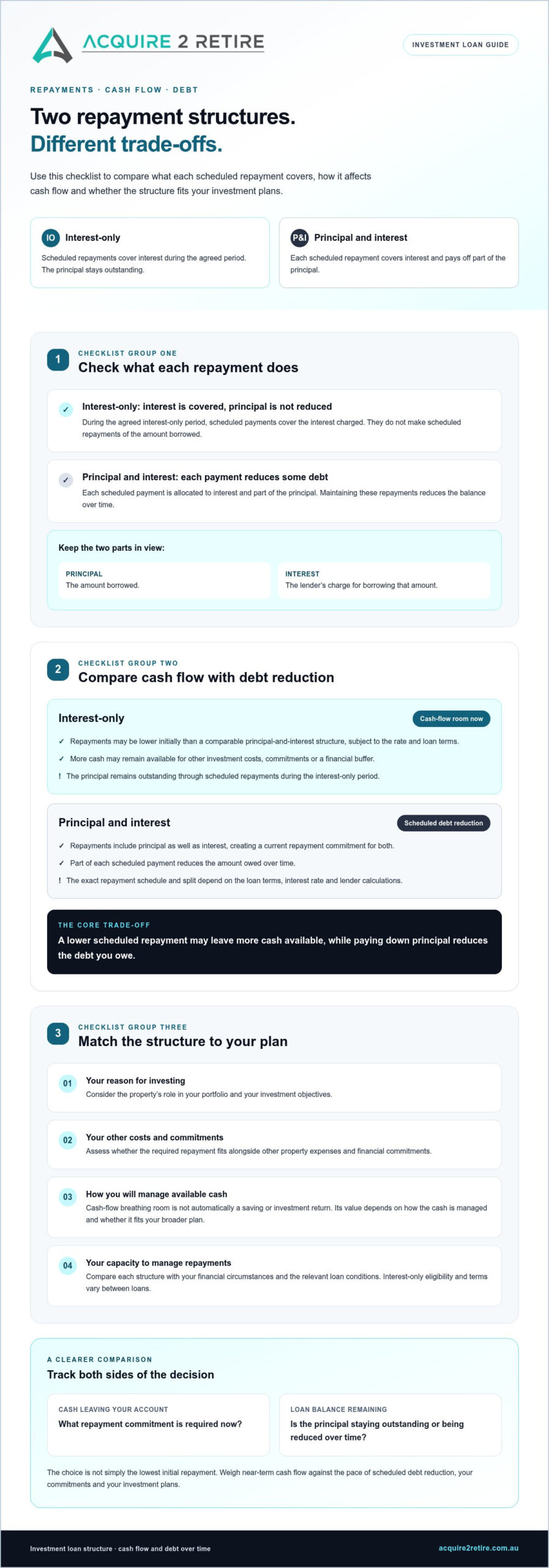
Principal is the amount borrowed, while interest is the lender’s charge for borrowing that amount. With interest-only repayments, scheduled payments cover interest for an agreed period, so they don’t reduce the principal. With principal-and-interest repayments, each scheduled payment covers interest and repays some principal. In plain terms: interest-only repayments cover interest without scheduled principal reduction; principal-and-interest repayments cover interest and gradually pay down the loan.
The two structures can shape your finances differently over the life of an investment loan. A lower scheduled repayment may leave more cash available for other investment costs or commitments, while paying down principal reduces the amount you owe over time. Neither feature alone determines which option is suitable. The Interest-only loan overview provides context on how this type of borrowing works. Your loan conditions and investment plans matter too.
What does an interest-only investment loan repayment cover?
During the agreed interest-only period, scheduled repayments cover the interest charged on the loan. The principal remains outstanding because those payments aren’t scheduled to repay the amount borrowed. That can mean a lower repayment than a comparable principal-and-interest structure, but the balance doesn’t fall through those scheduled payments. Interest-only periods, eligibility and conditions depend on lender assessment and the loan terms, so they vary between loans.
How do principal-and-interest investment loan repayments work?
With principal-and-interest repayments, each scheduled payment is allocated to interest and part of the principal. Maintaining those repayments reduces the balance over time, although the precise schedule and changing split depend on the loan terms. As the principal falls, the amount of debt remaining also falls. This structure may suit investors who want regular debt reduction built into their repayment plan, while still needing to account for the required cash flow.
Consider how each approach fits the property’s role in your portfolio. For example, an investor balancing loan commitments with other property expenses may value the cash-flow room an interest-only period can provide, but needs a plan for the unchanged principal balance. An investor focused on paying down debt may prefer repayments that include principal from the outset. These are planning considerations, not guarantees of investment performance. Compare each structure against your objectives, financial commitments and capacity to manage repayments under the relevant loan conditions.
How repayment structure changes cash flow and debt over time
The difference is easiest to see by tracking two things together: the cash leaving your account and the loan balance that remains. Interest-only repayments may be lower initially because scheduled principal repayment is paused. Principal-and-interest repayments generally include principal reduction, which can mean a higher current repayment commitment. The interest only vs principal and interest investment loan comparison is therefore about both near-term cash flow and the pace of scheduled debt reduction.
| Consideration | Interest-only | Principal-and-interest |
|---|---|---|
| Repayment focus | Interest during the agreed period. | Interest and scheduled principal repayment. |
| Principal reduction | Scheduled repayments don’t reduce the principal. | Scheduled repayments reduce principal over time. |
| Cash-flow demands | May be lower initially, subject to the rate and loan terms. | Include principal repayment as well as interest. |
| Key trade-off | More cash may remain available during the period, while the principal stays outstanding. | More of the debt is repaid over time, with higher scheduled commitments than an interest-only arrangement may have. |
Why can interest-only repayments affect cash flow?
Pausing scheduled principal repayment can leave more cash available during the interest-only period. An investor might use that breathing room to meet other property expenses or maintain a financial buffer, but the money isn’t automatically a saving or an investment return. Interest costs continue, and scheduled repayments leave the principal outstanding. The practical value depends on how the cash is managed and whether the arrangement fits the investor’s broader plan.
How does principal repayment change the loan balance?
With principal-and-interest repayments, part of each scheduled payment reduces the amount owed. Maintaining those repayments lowers the outstanding balance over time, although the exact amounts depend on the loan terms, interest rate and lender calculations. This scheduled reduction is different from making additional repayments or using an offset arrangement, which may be subject to separate loan conditions. Check the terms rather than assuming every loan treats these options in the same way.
Cash-flow planning should also account for what happens when an interest-only period ends. The Reserve Bank of Australia’s insights on expiring interest-only loan terms discuss the possibility of repayments increasing at that point. The amount and timing depend on the individual loan’s conditions, so build the transition into the repayment plan from the outset.
To connect repayment choices with wider investment objectives, consider how your investment property loan structure fits your cash-flow needs and portfolio plans. Acquire2Retire’s finance and planning support considers lending structures alongside those objectives, helping investors assess the trade-offs without treating one repayment approach as right for everyone.
Interest-only loan risks, tax questions and the end of the IO period
A lower initial repayment can make an interest-only loan appear more comfortable, but it doesn’t automatically make it the better investment choice. The repayment needs to fit today’s cash flow, the loan’s later stages and your wider property plans. Comparing the interest only vs principal and interest investment loan options means looking beyond the first repayment figure to understand what debt remains and how your budget may need to adapt.
Interest-only repayments do not themselves reduce the loan principal because scheduled payments cover interest, not the amount borrowed. While current repayments may be lower than under a principal-and-interest arrangement, the outstanding balance remains to be repaid. Consider any cash-flow difference alongside ongoing interest costs, property expenses and the possibility of repayment changes.
What should investors understand about the interest-only period ending?
At the end of an agreed interest-only period, a loan may move to principal-and-interest repayments under its terms. Repayments can rise because they then need to cover principal as well as interest, but the size and timing of any change vary between borrowers. The remaining loan term, applicable rate, repayment frequency and lender conditions can all affect the calculation. An extension may be subject to assessment and isn’t guaranteed.
Before relying on the cash flow available during an interest-only period, model what repayments could look like afterwards. Review the loan’s stated transition arrangements, then test your household or investment budget against different repayment scenarios. Consider whether income changes, vacancies, repairs or other commitments could coincide with the transition. This is not a prediction; it’s a way to identify whether your plan has room to adjust.
Does interest-only automatically create a tax advantage?
No. Repayment structure and tax treatment are separate questions. The tax treatment of interest on investment borrowing depends on factors including how the borrowed funds are used and the tax rules that apply to your circumstances. A loan being interest-only doesn’t, by itself, establish that the interest is deductible, and principal repayments shouldn’t be assumed to receive the same tax treatment as interest.
For an Australian property investor, review current Australian Taxation Office guidance and discuss your circumstances with a qualified tax professional. Keep clear records of how borrowed funds are applied, particularly if a loan is used for more than one purpose, and seek advice before relying on a tax outcome in your investment calculations. Tax treatment can depend on individual circumstances, so don’t treat it as a guaranteed benefit of choosing interest-only repayments.
The decision is less about avoiding an interest-only loan and more about understanding its conditions, the remaining debt and the transition plan. Including these considerations in your finance and property strategy helps you compare options with a clearer view of present cash flow and future commitments.
How to compare investment loan repayments against your circumstances
A useful comparison starts with your plans, not a repayment type in isolation. The interest only vs principal and interest investment loan decision involves balancing cash-flow flexibility against scheduled debt reduction, while allowing for changes in income, expenses and investment priorities. Work through these steps, then use the questions to identify where you may need tailored financial advice.
- Clarify your objectives. Decide what you need the loan structure to support. Is preserving cash flow for planned commitments a priority, or do you want regular principal reduction built into repayments? Consider the decision alongside your property and portfolio objectives, rather than as a standalone preference.
- Test your cash flow. Map income against loan repayments, other commitments and expected property expenses. Consider how reliable that income is and what buffer would remain if costs rose, rental income paused or an unexpected expense arose. If your borrowing assessment is part of the picture, review the relevant borrowing capacity for investment property guide.
- Assess your time horizon. Consider how long you expect to hold the property and how the loan fits your plans during that period. Your horizon doesn’t determine the right repayment structure by itself, but it can help you weigh current flexibility, gradual debt reduction and future repayment changes.
- Review the loan terms. Read the repayment conditions, including any interest-only period and what the loan says happens when it ends. Compare the scheduled repayments and test whether they remain manageable in less favourable circumstances. Lender conditions and assessments vary, so base your plan on the loan terms rather than assumptions.
When might cash-flow flexibility carry greater weight?
Cash-flow flexibility may matter if you have planned commitments or want room to manage variable property expenses. Test scenarios such as a vacancy period, less reliable income or an unexpected repair, and check what happens to your buffer if they overlap. A lower scheduled repayment can leave more cash available during an agreed interest-only period, but it doesn’t reduce the principal through scheduled payments or remove the need to meet the loan’s conditions.
When might scheduled debt reduction matter more?
If you value reducing the outstanding principal through regular scheduled repayments, compare whether principal-and-interest commitments are affordable across your investment horizon. Don’t test the budget only against a steady, favourable scenario. Consider how repayments would fit if income fell or expenses rose, and weigh that pressure against the value you place on scheduled debt reduction. The aim is to understand the trade-off, not assume one structure suits every investor.
This framework can make a finance discussion more focused, but it isn’t a substitute for advice tailored to your financial circumstances. Acquire2Retire’s property investment planning and finance support considers lending structures alongside your objectives, risk and cash-flow needs. Explore how finance fits your investment strategy.
Build the repayment choice into a broader Australian property investment strategy
A repayment structure is one part of managing an investment, not a decision that stands alone. It needs to sit alongside your objectives, risk tolerance, cash-flow requirements and portfolio plans. The interest only vs principal and interest investment loan comparison is more useful when you consider how today’s repayments fit with the property’s role, the debt you’re comfortable carrying and the choices you may want to make later.
How does repayment structure fit a wider portfolio plan?
Start by considering what you want your investment strategy to support. If cash-flow flexibility matters for planned commitments, that may influence how you assess repayments. If scheduled debt reduction is a priority, consider how principal repayments fit your budget and longer-term objectives. Neither preference determines the right structure on its own; your risk tolerance and ability to manage changing expenses matter too.
Financing decisions can also shape the options you consider for later acquisitions. Existing loan commitments, the amount of debt still outstanding and your cash-flow position may be relevant to a future lending assessment, but no repayment structure guarantees borrowing capacity or makes another purchase easier. If portfolio expansion is part of your plan, the guide to financing multiple investment properties can help frame the questions to consider across more than one loan.
Review your plan as a whole rather than assessing each property in isolation. Consider how repayments on one investment could sit alongside other commitments if expenses change, income varies or you decide to pursue another acquisition. This gives you a clearer basis for weighing the trade-offs without assuming one structure will deliver growth, tax savings or a particular future finance outcome.
What can strategic finance support help investors consider?
Tailored finance planning can connect lending decisions with your wider property objectives, cash-flow needs and risk profile. Acquire2Retire supports strategy, acquisition and finance as connected stages, so repayment choices can be considered in context: how they relate to the investment plan, the purchase and your broader portfolio priorities. This approach also gives you a basis for revisiting decisions as your circumstances or plans evolve.
If you’re an early-stage investor, the next step doesn’t need to be choosing a repayment type immediately. Start by clarifying what your finances need to accommodate, identifying the risks you’re comfortable with and preparing questions for a broader property planning discussion. A considered strategy lets you compare loan structures against your objectives without treating a lower current repayment or faster scheduled debt reduction as the only measure of suitability.
Acquire2Retire’s property investment planning connects your goals and cash-flow requirements with acquisition and lending decisions as part of your wider property plans.
Make your next finance decision part of the plan
The next step isn’t necessarily to settle on a repayment structure straight away. Start by asking what you want your investment finances to support over time, and which trade-offs feel manageable as your plans evolve. That perspective makes the interest only vs principal and interest investment loan decision more relevant to your overall strategy, rather than a choice driven by one feature alone.
A considered discussion can bring lending options into line with your investment objectives. Acquire2Retire’s planning considers your risk profile, cash-flow needs and long-term targets, while its finance support considers suitable lending solutions alongside those objectives. This can help you assess how a loan structure fits your wider property plans without assuming it will guarantee a particular outcome.
Talk with Acquire2Retire about your property investment and finance strategy.
Frequently Asked Questions
Can I switch an investment loan from interest-only to principal and interest?
Possibly, but a change depends on your loan contract and lender approval. You may be able to request principal-and-interest repayments before the interest-only period expires, though the lender may assess your circumstances and apply conditions. Before proceeding, compare the revised repayment schedule with your budget and review how the change affects the remaining loan term. The interest only vs principal and interest investment loan choice can be revisited as your plans evolve.
What happens if an interest-only investment loan period ends?
Your loan may move to principal-and-interest repayments, depending on its terms. The lender calculates repayments based on the principal still owing, the applicable rate and the time left on the loan, so your new repayment can differ from your current one. Review the transition arrangements in your loan documents and set a reminder well before the end date, giving yourself time to assess your budget and plan for the change.
Does an interest-only investment loan affect borrowing capacity?
It can affect how a lender assesses a future application, because existing debts and repayment obligations form part of the overall picture. Lenders also consider factors such as income, living expenses and their own serviceability criteria. A lower current interest-only repayment doesn’t guarantee greater borrowing capacity, as an assessment may use assumptions beyond the amount you’re paying now. Treat any future purchase as subject to a fresh lending assessment.
Is interest on an investment property loan tax deductible in Australia?
Interest may be deductible when the borrowed funds are used to produce assessable income, subject to current Australian tax rules and your circumstances. The property being an investment doesn’t automatically make every interest expense deductible. If loan funds are used partly for private purposes, the tax treatment may require apportionment. Keep records showing how funds were used, review the Australian Taxation Office’s current guidance and seek advice from a qualified tax professional.
Can I make extra repayments on an interest-only investment loan?
That depends on the specific loan conditions. Some contracts may allow extra repayments during an interest-only period, while others may set limits or different rules for handling additional funds. Before making a payment, check whether it reduces the loan balance, affects redraw access or is treated through an offset facility. These arrangements aren’t interchangeable, and access to extra-repayment options depends on the terms attached to your loan.
Which repayment structure is better if I plan to buy another investment property?
Neither structure automatically makes a future purchase more achievable. Consider how each option affects your cash flow, outstanding debt and ability to manage repayments if income or expenses change. A lender will assess your circumstances and existing commitments when you apply, so don’t rely on an interest-only repayment to improve borrowing capacity. Compare both structures against your portfolio plans and budget, then include the results in a broader finance discussion.